

Last updated: 19 October 2026 · By Naijatipsland Editorial Team · Editorial policy
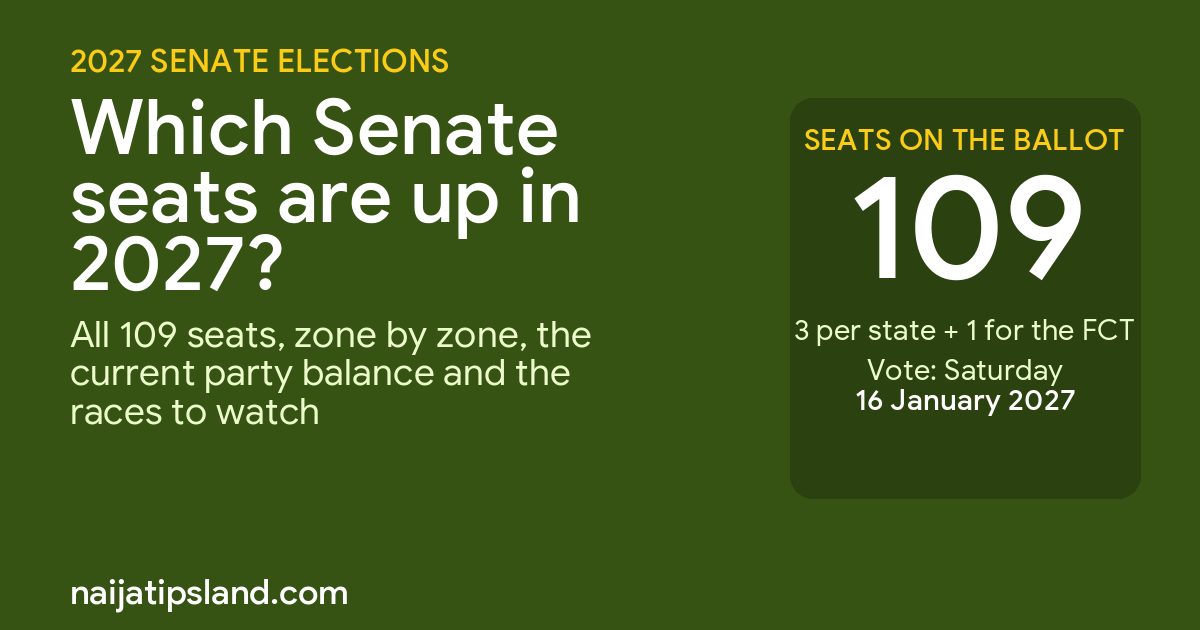
Every seat in Nigeria’s Senate is up for election in 2027. On Saturday, 16 January 2027, the same day as the presidential election, voters in all 36 states and the Federal Capital Territory will choose all 109 senators for the 11th National Assembly. There is no staggered system as in some countries: the whole Senate is elected at once, every four years.
This guide explains how Senate seats are allocated, lists every senatorial district by geopolitical zone, shows the current party balance, and picks out the races most likely to make headlines. For how the National Assembly works, see our guide to Nigeria’s National Assembly.
The short answer
- All 109 Senate seats are up in 2027: three for each of the 36 states and one for the FCT.
- Polling day is 16 January 2027, together with the presidential and House of Representatives elections.
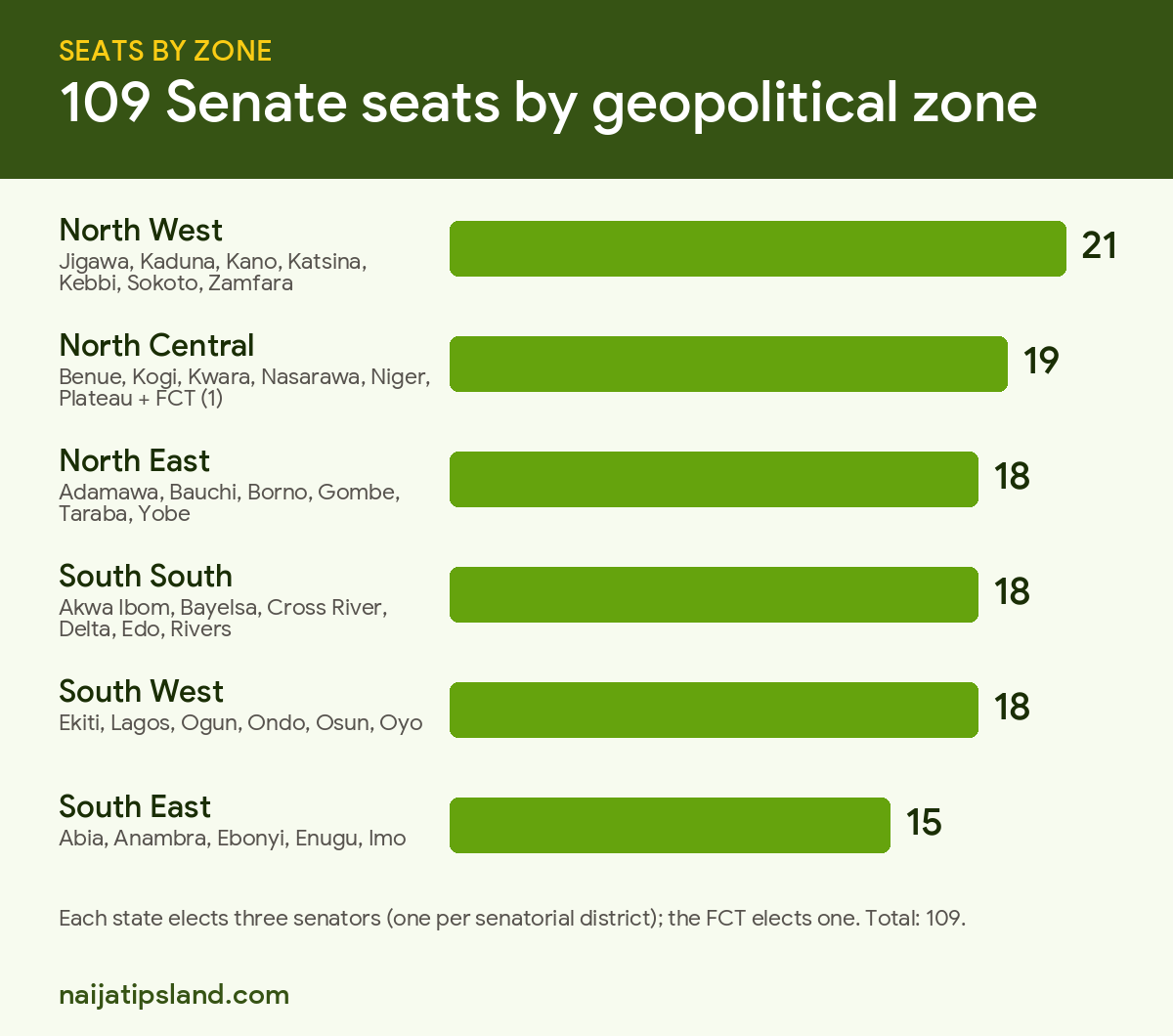
- By zone: North West 21 seats, North Central 19 (including the FCT), North East 18, South South 18, South West 18 and South East 15.
- The APC dominates the current Senate after a wave of defections: 84 of the 106 serving senators in March 2026.
- More than 1,000 candidates are on INEC’s final list, an average of about 11 to 12 per seat.
How Senate seats are allocated
Under the 1999 Constitution, each state elects three senators and the FCT elects one. Every state is divided into three senatorial districts, usually named after their position in the state, such as Kano North or Lagos West. Because every state gets the same number of senators regardless of population, Lagos and Bayelsa have equal weight in the Senate, unlike the House of Representatives, where seats roughly follow population.
Each senatorial district elects one senator. The candidate with the most votes in the district wins, after results from every polling unit are collated at ward, local government and district level, and a returning officer declares the result. Senators serve four-year terms and there is no limit on how many terms they can serve.
Every senatorial district, by zone
All of these seats will be contested on 16 January 2027.
North Central: 19 seats
| State | Senatorial districts |
|---|---|
| Benue | Benue North-East, Benue North-West, Benue South |
| Kogi | Kogi Central, Kogi East, Kogi West |
| Kwara | Kwara Central, Kwara North, Kwara South |
| Nasarawa | Nasarawa North, Nasarawa South, Nasarawa West |
| Niger | Niger East, Niger North, Niger South |
| Plateau | Plateau Central, Plateau North, Plateau South |
| FCT | Federal Capital Territory (one seat) |
North East: 18 seats
| State | Senatorial districts |
|---|---|
| Adamawa | Adamawa Central, Adamawa North, Adamawa South |
| Bauchi | Bauchi Central, Bauchi North, Bauchi South |
| Borno | Borno Central, Borno North, Borno South |
| Gombe | Gombe Central, Gombe North, Gombe South |
| Taraba | Taraba Central, Taraba North, Taraba South |
| Yobe | Yobe East, Yobe North, Yobe South |
North West: 21 seats
| State | Senatorial districts |
|---|---|
| Jigawa | Jigawa North-East, Jigawa North-West, Jigawa South-West |
| Kaduna | Kaduna Central, Kaduna North, Kaduna South |
| Kano | Kano Central, Kano North, Kano South |
| Katsina | Katsina Central, Katsina North, Katsina South |
| Kebbi | Kebbi Central, Kebbi North, Kebbi South |
| Sokoto | Sokoto East, Sokoto North, Sokoto South |
| Zamfara | Zamfara Central, Zamfara North, Zamfara West |
South East: 15 seats
| State | Senatorial districts |
|---|---|
| Abia | Abia Central, Abia North, Abia South |
| Anambra | Anambra Central, Anambra North, Anambra South |
| Ebonyi | Ebonyi Central, Ebonyi North, Ebonyi South |
| Enugu | Enugu East, Enugu North, Enugu West |
| Imo | Imo East, Imo North, Imo West |
South South: 18 seats
| State | Senatorial districts |
|---|---|
| Akwa Ibom | Akwa Ibom North-East, Akwa Ibom North-West, Akwa Ibom South |
| Bayelsa | Bayelsa Central, Bayelsa East, Bayelsa West |
| Cross River | Cross River Central, Cross River North, Cross River South |
| Delta | Delta Central, Delta North, Delta South |
| Edo | Edo Central, Edo North, Edo South |
| Rivers | Rivers East, Rivers South-East, Rivers West |
South West: 18 seats
| State | Senatorial districts |
|---|---|
| Ekiti | Ekiti Central, Ekiti North, Ekiti South |
| Lagos | Lagos Central, Lagos East, Lagos West |
| Ogun | Ogun Central, Ogun East, Ogun West |
| Ondo | Ondo Central, Ondo North, Ondo South |
| Osun | Osun Central, Osun East, Osun West |
| Oyo | Oyo Central, Oyo North, Oyo South |
Not sure which district you are in? Your polling unit is in one ward, one local government area, one federal constituency and one senatorial district. Our guide to finding your INEC polling unit explains how to check.
Who holds the Senate now
The 10th Senate was inaugurated on 13 June 2023 with Godswill Akpabio as Senate President. Since then, defections have reshaped it. By 12 March 2026, after four more PDP senators joined the APC within two days, ThisDay counted 84 APC senators among 106 serving members, giving the ruling party more than two-thirds of the chamber. The PDP had 14, the ADC 5, and the NNPP, NDC and APGA one each. The Labour Party, which won eight Senate seats in 2023, and the SDP, which won two, had none left.
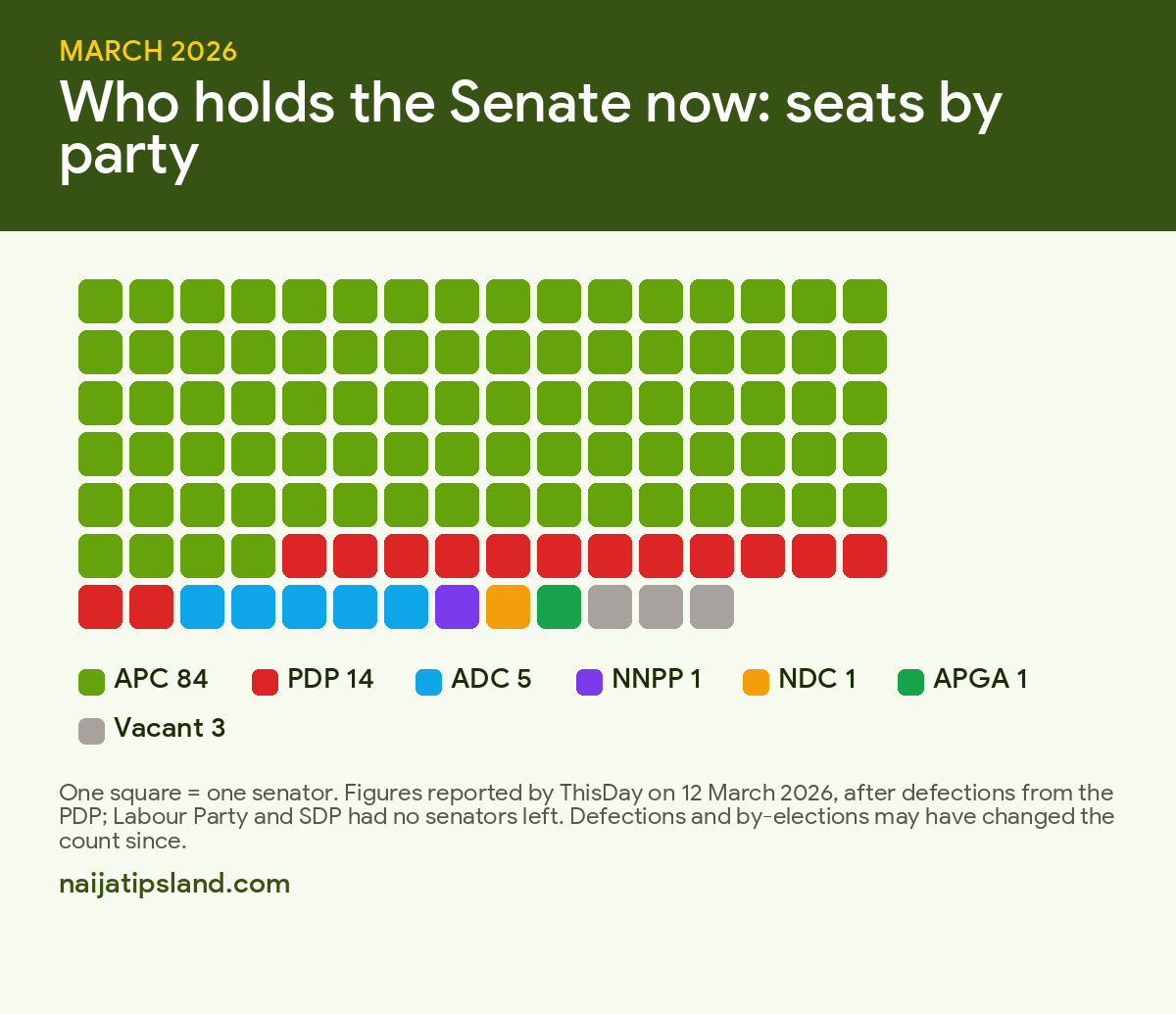
Defections and by-elections may have shifted these numbers again since March. What matters for 2027 is that every one of these seats goes back to voters, and many sitting senators have switched party since they were last elected, which will test whether voters follow the person or the party.
How many candidates are running?
INEC published its final list of National Assembly candidates on 12 September 2026. Media counts of that list differ: The Sun counted 1,195 Senate candidates, including 115 women, while ThisDay reported 1,303, including 123 women. Either way, that is an average of 11 to 12 candidates per seat, and women make up fewer than one in ten. Some districts are far more crowded than others: ThisDay counted 18 candidates in Kano Central and 15 in Kano North.
The list can still change. Under the Supreme Court’s 24 September 2026 ruling on party membership registers, parties that did not submit registers on time cannot sponsor candidates, and nominations of candidates who joined parties late are being challenged. INEC says the National Assembly list, published before the ruling, was not affected, but courts can still decide individual cases. Our guide to the 2027 party primaries results explains the ruling.
Senate races to watch
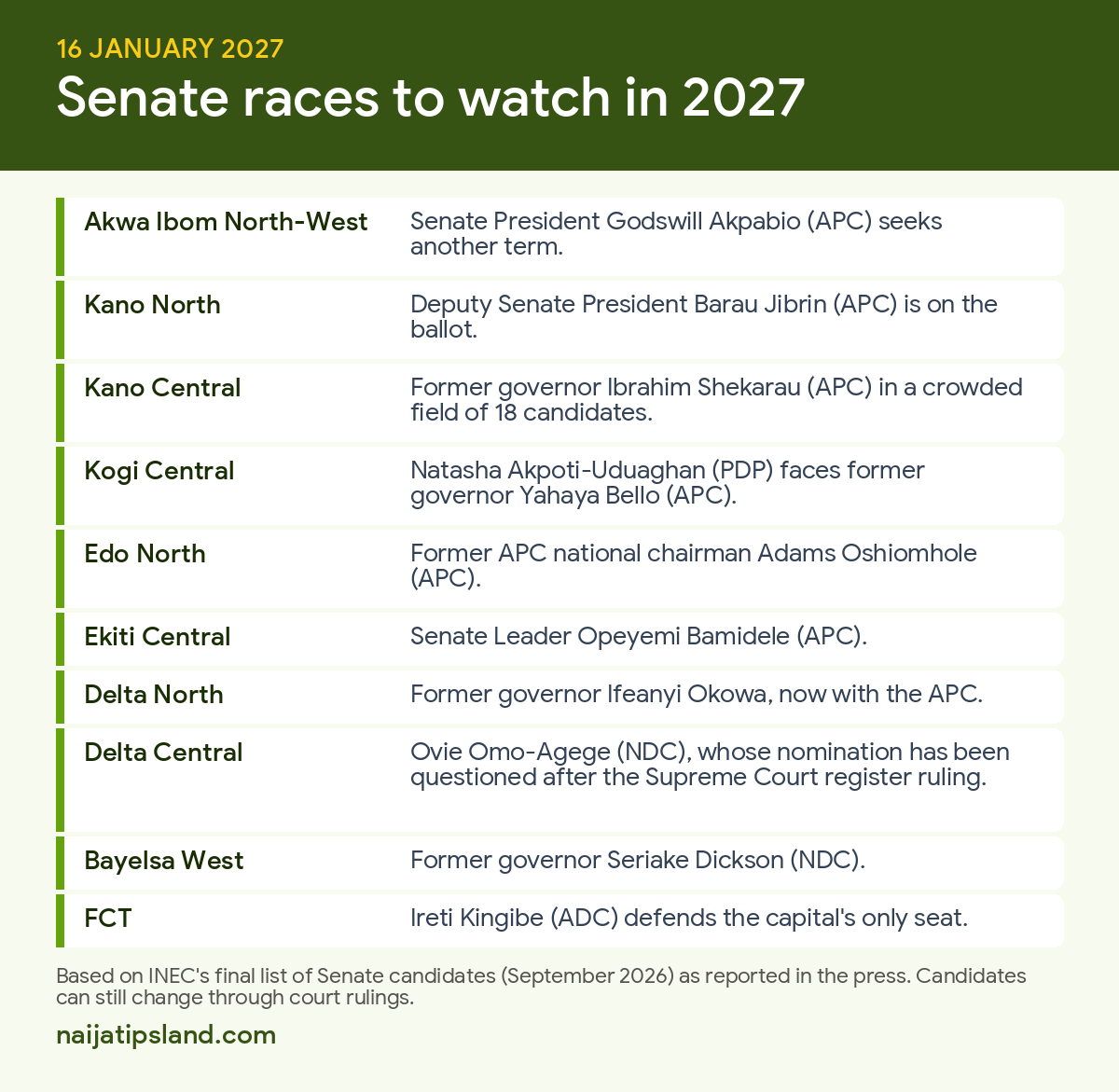
- Akwa Ibom North-West: Senate President Godswill Akpabio (APC) is on the ballot again. Whether he returns, and whether the APC keeps a majority, will shape the race for the next Senate presidency.
- Kano North and Kano Central: Deputy Senate President Barau Jibrin (APC) is running in Kano North, and former governor Ibrahim Shekarau (APC) in Kano Central, the most crowded district reported, with 18 candidates. Kano is also the home state of Obi’s running mate, Rabiu Kwankwaso, which makes it a key battleground.
- Kogi Central: Natasha Akpoti-Uduaghan (PDP), whose 2025 suspension from the Senate after a dispute with the Senate President drew national attention, faces former Kogi governor Yahaya Bello (APC).
- Edo North: former APC national chairman and former governor Adams Oshiomhole (APC).
- Ekiti Central: Senate Leader Opeyemi Bamidele (APC).
- Delta North and Delta Central: former governor Ifeanyi Okowa, Atiku’s 2023 running mate, is now the APC candidate in Delta North. In Delta Central, former Deputy Senate President Ovie Omo-Agege is running for the NDC, though his nomination has been questioned after the Supreme Court’s register ruling.
- Bayelsa West: former governor Seriake Dickson (NDC).
- FCT: Ireti Kingibe (ADC), who won the capital’s only Senate seat in 2023 for the Labour Party.
Why the Senate matters
The Senate confirms ministers, ambassadors, service chiefs, the INEC chairman and other key appointees; approves the federal budget with the House; and must pass any constitutional amendment by a two-thirds majority. A president whose party controls two-thirds of the Senate can get appointments and many bills through with little resistance, while a divided Senate can act as a check. That is why the Senate result can matter almost as much as the presidential one.
Senators also bring constituency projects and federal attention to their districts, so the quality of your senator affects roads, schools and health centres where you live.
How to find and judge your Senate candidates
- Find your district from your polling unit details.
- Check INEC’s final list on inecnigeria.org for the candidates in your district.
- Look at records, not just parties. For sitting senators, check bills they sponsored, motions they moved and how often they spoke for your district. Civic groups publish scorecards before elections.
- Attend or watch debates where they are held, and question candidates on what they will do for your district.
Frequently asked questions
How many Senate seats are up in 2027?
All 109: three for each of the 36 states and one for the Federal Capital Territory.
When is the Senate election?
Saturday, 16 January 2027, on the same day as the presidential and House of Representatives elections.
How many senators does each zone have?
North West 21, North Central 19 (including the FCT’s one seat), North East 18, South South 18, South West 18 and South East 15.
How long is a senator’s term?
Four years. There is no limit on the number of terms a senator can serve.
Which party has the most senators now?
The APC, with 84 of 106 serving senators in March 2026, according to ThisDay.
Do off-cycle states vote for senators in 2027?
Yes. States with off-cycle governorship elections, such as Edo, Ondo, Kogi, Bayelsa, Imo, Anambra, Ekiti and Osun, still elect their senators on 16 January 2027 with everyone else.
Bottom line
On 16 January 2027 you will get three ballots: one for president, one for your senator and one for your House of Representatives member. The Senate ballot decides who represents your district in the chamber that confirms appointments, passes budgets and amends the Constitution. Find your district, look at the candidates and vote. For the rest of the election calendar, see our 2027 election deadlines and the 2027 Nigeria Election Hub.
Sources
- ThisDay: As three more PDP senators join APC, party almost has two-thirds majority (12 March 2026)
- ThisDay: 1,303 candidates jostle for 109 Senate seats (September 2026)
- The Sun: Women only 10% of 4,408 National Assembly candidates (September 2026)
- Politics Nigeria: INEC releases final list of 2027 senatorial candidates (September 2026)
- WithinNigeria: Electoral Act ruling and nomination questions (October 2026)
- Independent National Electoral Commission (INEC)
Join the discussion
Have you tried this, or do you have a question we did not answer? 4 readers have already shared their views. Naijatipsland members help each other with real, first-hand experience.









Many sitting senators have switched parties since they were last elected, so 2027 will test whether voters follow the person or the party. Has your senator changed party, and will it affect your vote?
With an average of 11 to 12 candidates per seat, and women making up fewer than one in ten, many ballots will be crowded. How do you plan to learn about the candidates in your district?
All 109 Senate seats are up on 16 January 2027, and the guide notes the APC holds 84 of the 106 serving senators as of March 2026 after a wave of defections. Which Senate race are you watching most closely?
More than 1,000 candidates are on INEC’s final list, roughly 11 to 12 per seat. Does your senatorial district have a crowded field, and do you know who is running?