How to Verify Nigerian Trends in 24–48 Hours: A Practical Fact-Checking Workflow


Last updated: 14 October 2026. This workflow suits bloggers, small newsrooms and curious readers, and it is not a substitute for professional fact-checking. We replaced a long promotional page with a practical guide.
Trends in Nigeria move fast: a hashtag, a screenshot or a voice note can reach millions within hours, and many turn out to be wrong. Fact-checkers say AI tools have made false content cheaper and faster to produce, and that rumours on WhatsApp and Telegram travel faster than corrections. The solution is a routine. Here is a 48-hour workflow you can use before you publish or share.
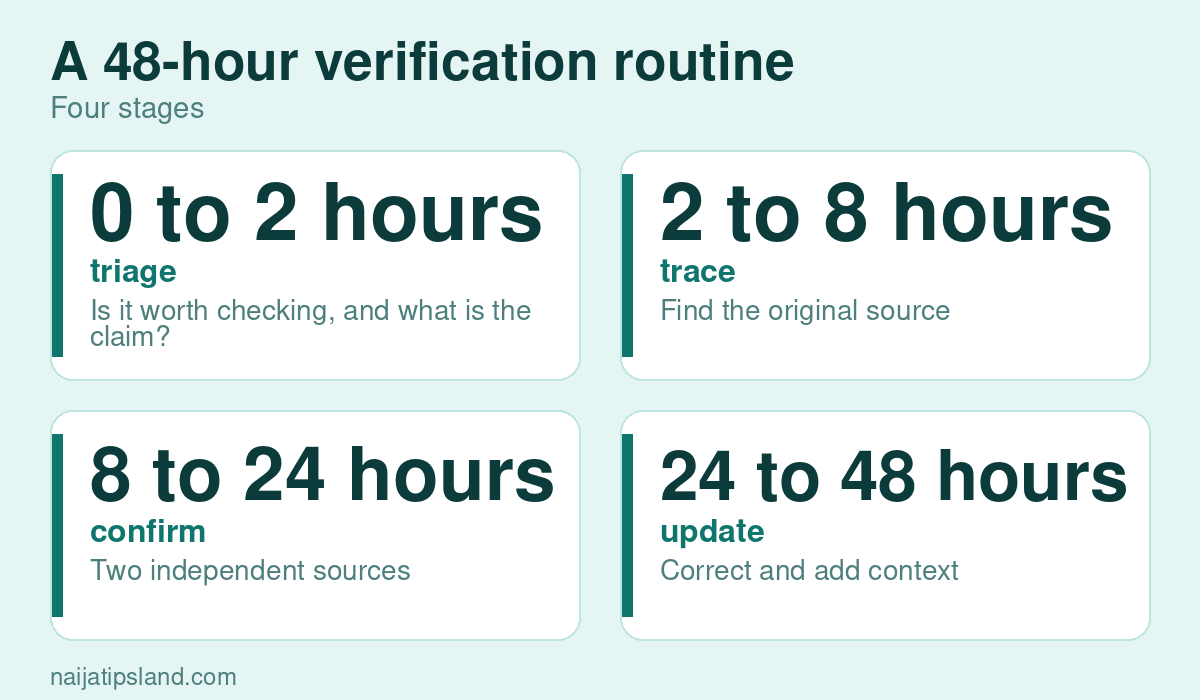
Hours 0 to 2: triage
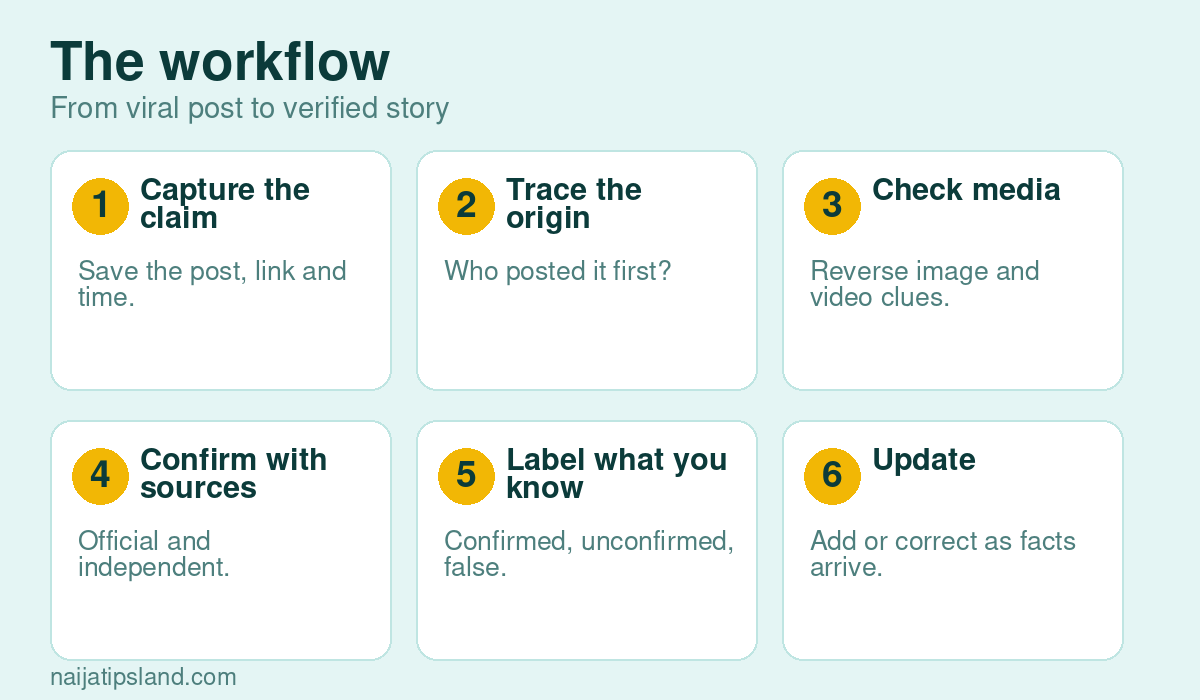
- Capture the claim exactly. Save the post, link, account name, time and a screenshot, and write the claim in one sentence.
- Decide whether it is worth your time. Is it likely to cause harm, panic or financial loss? Is it about an election, health, security, money or a death? Prioritise those.
- Check whether it has already been checked. Search the claim with “fact check”, and look at Dubawa, Africa Check, FactCheckHub and CableCheck, the members of the Nigerian Fact-checkers’ Coalition.
- Do not share yet. If you must say something, say it is unverified.
Hours 2 to 8: trace the source
- Find the original post, document or recording, not a copy. Look at the account’s history, followers, and whether it is real.
- Check dates and places. Old photos and clips often return as new.
- Test images and video: reverse image search, look for odd details, and note when the audio seems cloned.
- Look for official statements from the agency, company or person involved, on their verified channels.
Hours 8 to 24: confirm independently
- Look for two independent, reliable sources. Several outlets copying one weak source do not count.
- Ask the people involved for comment, and record their answer.
- Check numbers against primary data from the NBS, CBN, NCC, INEC or the relevant agency.
- Ask an expert if the claim is technical.
Hours 24 to 48: write carefully and update
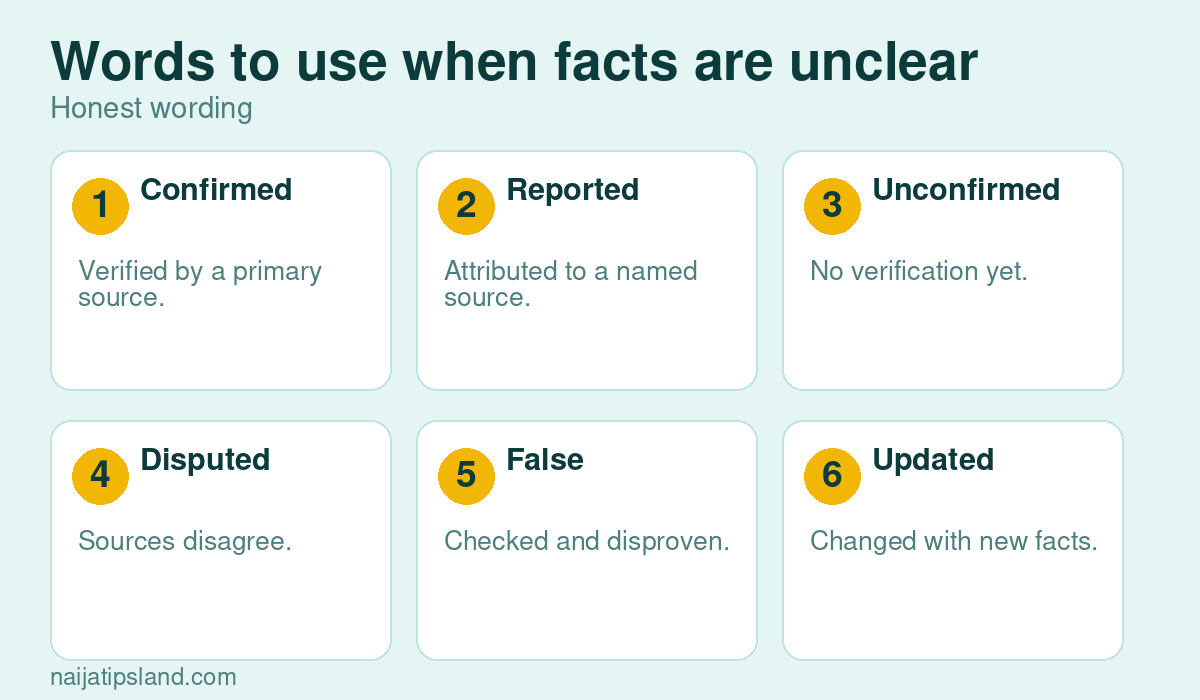
- Use honest labels: confirmed, reported, unconfirmed, disputed or false, and say what you do and do not know.
- Link to your sources and credit others’ work. Do not copy it. See how to write a news story.
- Update openly when new facts arrive, and correct mistakes with a note.
- Avoid amplifying falsehoods: do not repeat a false claim in the headline.
Tools and habits
- Reverse image search and video frame search.
- Archive services to save pages that may be deleted.
- A spreadsheet to log claims, sources, dates and outcomes.
- Caution with AI detectors and chatbots: Nigerian fact-checkers say tools exist but struggle with local languages, so treat them as clues, not proof. See our guides on fake news and AI deepfakes and verifying news step by step.
If you only have five minutes
- Search the claim plus “fact check”.
- Find the original source.
- Check two other reliable outlets.
- If unsure, do not share. See how to follow the news.
For finding and writing about trending topics, see our guide on how to find and write about trends in Nigeria, and for entertainment topics see reliable entertainment updates.
A Hypothetical Example
Imagine a voice note claims that a major bank will freeze accounts that are not updated by Friday. You capture the claim, search for the bank’s official statement, find nothing on its verified pages, notice that the voice is not attributed to any staff member and see that the same audio was posted months earlier. Your label is “unconfirmed, likely false”, and you say so plainly while asking readers to check with the bank directly.
A Simple Verification Log
- Claim: one sentence.
- First seen: account, platform, date and time.
- Checks done: reverse image search, official statements, independent sources.
- Result: confirmed, reported, unconfirmed, disputed or false.
- Next review: when you will check again.
When You Get It Wrong
Correct the post openly, say what changed and why, and avoid deleting the original without a note. Quick, honest corrections build more trust than silent edits. See our guides on verifying news step by step, fake news and deepfakes and writing a news story.
Frequently Asked Questions
Why 24 to 48 hours?
It gives enough time to trace sources and seek comment, while staying relevant. Urgent safety claims may need faster, clearly labelled updates.
What if I cannot verify a claim?
Say it is unverified, or do not publish it.
Who can I ask to check a claim?
Nigerian fact-checking organisations such as Dubawa, Africa Check, FactCheckHub and CableCheck.