
Submit Post
Date: August 20, 2026 11:35 am. Number of posts: 5,145. Number of users: 3,660.

Nigeria Political Parties: The Full Official List for 2026

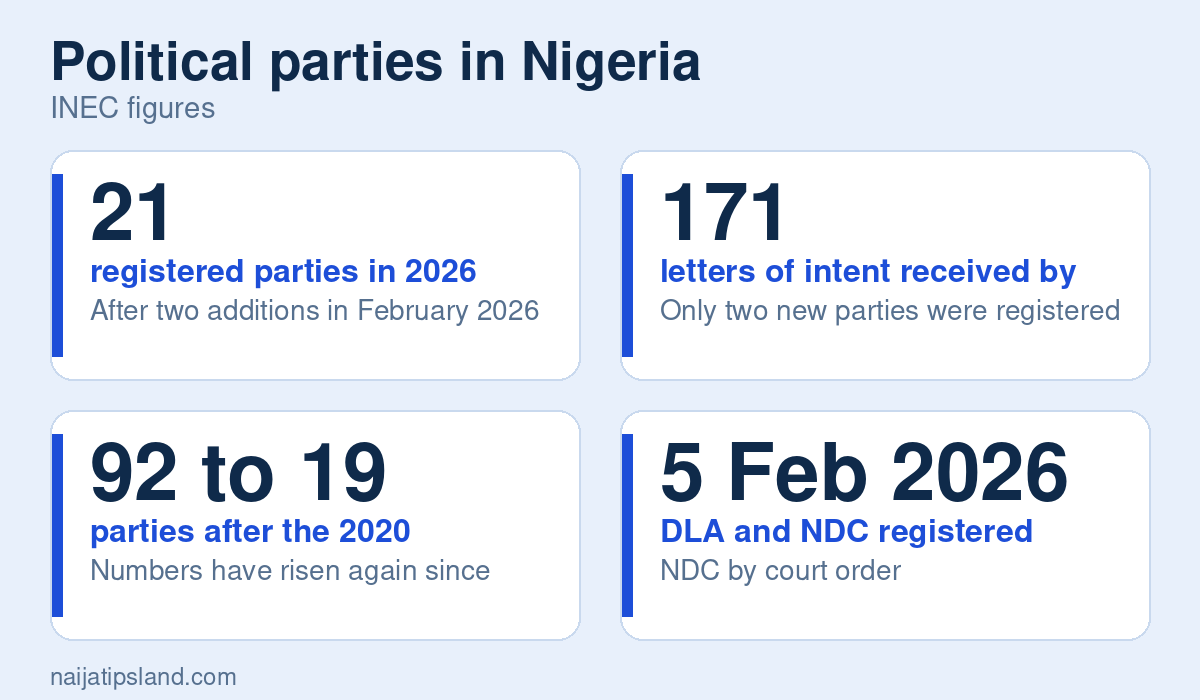
The Independent National Electoral Commission is the only body with the legal authority to say which parties exist in Nigeria, and its official party list is the source you check before any other. As of the most recent update reported by news outlets citing INEC, 18 political parties have been validated following a commission appraisal, though the exact count shifts as INEC deregisters non-performing parties or courts order reinstatements. If you need a number to cite today, check INEC’s page directly. This list is your starting point, not your final word.

Key Takeaways

Nigeria’s political party roster is not fixed. It changes as INEC deregisters non-performing parties or courts order reinstatements, so INEC’s own list is always the final word.

PointDetails
INEC is the sole authorityAlways verify party status directly on INEC’s official list before relying on any third-party source.
Roster count fluctuatesReports cite 18 validated parties as of the latest update, but courts and deregistrations can shift this figure.
Two parties dominateAPC and PDP hold the largest National Assembly blocs, shaping most legislative outcomes.
Registration has real stakesDeregistered parties lose the right to field candidates until a court reverses the decision.
Check state lists tooLagos residents should cross-reference LASIEC’s list for state-level participation, since it differs from national registration.

Table of Contents

What Is the Official List of Nigeria Political Parties?

Here is the roster of parties currently recognized by INEC, arranged alphabetically by name. Party status can shift between publication cycles, so treat this as a snapshot you should still verify against INEC’s own page before relying on it for anything formal, like a court filing or an academic citation.

  • Accord (A)
  • Action Alliance (AA)
  • Action Democratic Party (ADP)
  • Action Peoples Party (APP)
  • African Action Congress (AAC)
  • African Democratic Congress (ADC)
  • All Progressives Congress (APC)
  • All Progressives Grand Alliance (APGA)
  • Allied Peoples Movement (APM)
  • Boot Party (BP)
  • Labour Party (LP)
  • National Rescue Movement (NRM)
  • New Nigeria Peoples Party (NNPP)
  • Peoples Democratic Party (PDP)
  • Peoples Redemption Party (PRP)
  • Social Democratic Party (SDP)
  • Young Progressives Party (YPP)
  • Youth Party (YP)
  • Zenith Labour Party (ZLP)

A few of these names generate more questions than others. The ADC has drawn attention as a vehicle for opposition coalition talk ahead of 2027, with figures like Peter Obi remaining tied to the ADC coalition even as speculation about his political home continues. Smaller parties like NRM, BP, and YP rarely appear in national headlines but stay on the books because they’ve met INEC’s minimum registration and performance conditions, at least for now.

Wikipedia’s tracker of Nigerian political parties separates parties into categories, national parties with National Assembly seats, state-level players, and extra-parliamentary organizations with no current legislative presence, which is a useful lens if you’re trying to understand why some names on this list feel unfamiliar. APC and PDP hold the overwhelming majority of seats in the National Assembly, a fact that shapes almost every other entry on this roster’s relevance.

Pro Tip: Don’t scroll through the whole INEC list looking for one party. Open the page, press Ctrl+F (or Cmd+F on a Mac), and type the party’s name or acronym. INEC’s site search bar works the same way if you’re checking a party’s individual profile page for leadership details.

What Is the Official List of Nigeria Political Parties? — overview diagram

Which Are the Major Parties in Nigeria’s Political System?

Out of the parties listed above, a handful actually contest for power at scale. Here’s what each one is known for:

APC is the ruling party, formed in 2013 from a merger of several opposition blocs, and it currently controls the presidency and holds the largest bloc in the National Assembly. Its official site publishes party statements, membership details, and updates on elected officials.

PDP dominated Nigerian politics from 1999 to 2015 and remains the largest formal opposition party, with a support base concentrated in parts of the South and North Central. The party maintains its own official platform outlining its principles and membership process.

Labour Party (LP) surged into national relevance during the 2023 election cycle, drawing a youth-heavy coalition and picking up unexpected strength in Lagos and the South East.

NNPP built its recent profile around a strong Kano State base and a populist appeal to younger voters.

APGA has held a consistent stronghold in Anambra State for years, functioning more as a regional force than a national contender.

YPP, ADC, PRP, and SDP each carry historical or regional weight, from ADC’s role as a coalition vehicle to SDP’s roots in Nigeria’s Second Republic era, but none currently rival APC or PDP in National Assembly seat counts.

That two-party gravity matters practically: most legislative business, committee chairs, and leadership positions in the National Assembly run through APC or PDP calculations. The remaining registered parties, roughly a dozen of them, mostly function as candidate platforms for local contests, regional advocacy vehicles, or coalition partners rather than standalone contenders for the presidency.

How Do You Confirm a Party’s Registration Status?

Party status isn’t fixed. INEC deregisters parties that fail statutory performance thresholds, and courts occasionally order reinstatements, so a name that disappears one year can reappear the next. Follow this checklist before you cite, join, or vote based on any party’s standing:

  1. Check INEC’s official list page first. This is the single authoritative source for who is currently registered.
  2. Open the party’s individual INEC profile. INEC’s political parties index lists chairperson and secretary details, which helps you confirm which faction is officially recognized if a party is going through a leadership dispute.
  3. Search for recent INEC press releases. Deregistrations and reinstatements typically come with a public announcement.
  4. Cross-check state-level lists where relevant. If you’re in Lagos, LASIEC’s registered parties page confirms which parties can actually field candidates in state elections, since state-level participation isn’t automatic just because a party is INEC-registered nationally.

Deregistration isn’t a paperwork technicality. It means a party loses INEC recognition entirely, can’t field candidates under its name, and has to pursue any comeback through the courts, a process that can take years, as seen in several past ADC and APC legal disputes over recognition and leadership.

Pro Tip: Recheck INEC’s list in the weeks before any election. Party status moves fastest close to filing deadlines, and INEC usually marks a “last updated” date on its list page, so you know how fresh the roster actually is.

What Ideological Differences Separate Nigeria’s Major Parties?

Nigerian party politics leans more on personality, regional loyalty, and patronage networks than on sharply defined ideology, but real distinctions still show up in practice. APC has generally positioned itself around infrastructure-led development and a nationalist economic tone, while PDP has historically leaned toward broader coalition politics and continuity with policies from its long run in power before 2015.

Labour Party’s 2023 surge came from branding itself as the anti-establishment, youth-forward alternative to both dominant parties, appealing heavily to urban voters frustrated with the two-party status quo. NNPP has carried a similar outsider appeal in the North, particularly around Kano’s political economy. APGA’s identity ties closely to Igbo regional interests and South East advocacy, which explains its durability in Anambra despite limited national reach.

Smaller parties like SDP and PRP carry historical ideological threads, SDP from its Second Republic centrist roots, PRP from a more populist, labor-oriented tradition, but in current practice, most parties function less as ideological movements and more as electoral vehicles built around specific leaders or regional coalitions. That’s a real distinction from party systems in countries where policy platforms drive voter choice more consistently.

How Did Nigeria’s Major Parties Evolve Over Time?

Nigeria’s current party landscape traces back to 1999, when the return to civilian rule after military governance created the Fourth Republic and, with it, a fresh registration process for political parties. PDP emerged as the dominant force early, winning the presidency in 1999 and holding it through four consecutive terms.

That dominance cracked in 2013, when several opposition parties, the Action Congress of Nigeria, the Congress for Progressive Change, and factions of others, merged to form APC. The strategy worked: APC won the presidency in 2015, marking the first time an incumbent Nigerian president lost a reelection bid.

APGA’s history runs differently, built specifically around Igbo political representation following the loss of Chinua Achebe’s contemporary, the late Chukwuemeka Odumegwu Ojukwu, as a founding figure with deep ties to the region’s post civil war political identity. Smaller parties like SDP and PRP actually predate the Fourth Republic, tracing back to earlier republics before military rule interrupted party politics altogether.

The 2023 election cycle added a new chapter: Labour Party’s rapid rise showed that voter loyalty to APC and PDP isn’t permanent, especially among younger, urban demographics looking for alternatives to the two dominant machines.

How Do Political Parties Shape Nigeria’s Elections and Governance?

Parties control who gets on the ballot, which makes INEC’s registration process a gatekeeping function with real consequences for representation. Every candidate for president, governor, senator, or local council chair runs under a party banner, so a party’s registration status directly determines whether a candidate can even appear on election day.

Stacked Nigerian election ballot boxes outdoors

That structure concentrates power. Because APC and PDP dominate the National Assembly, committee assignments and legislative agendas run largely through these two parties’ internal politics, even when smaller parties hold individual seats. Defections between parties, common in Nigerian politics, can shift that balance mid-term without a new election, which is part of why tracking party membership matters beyond just election season.

At the state and local level, party structures shape governance just as directly. Local council races, like the reported APC win in Abaji’s chairmanship election, determine who controls ward-level budgets and services, and smaller or regional parties sometimes outperform national expectations in specific council areas, as seen in reports of ADC leading in Kubwa and Bwari polling units despite APC’s national dominance. Party competition, in other words, plays out unevenly across Nigeria’s geography.

How Does a Party Get Registered With INEC?

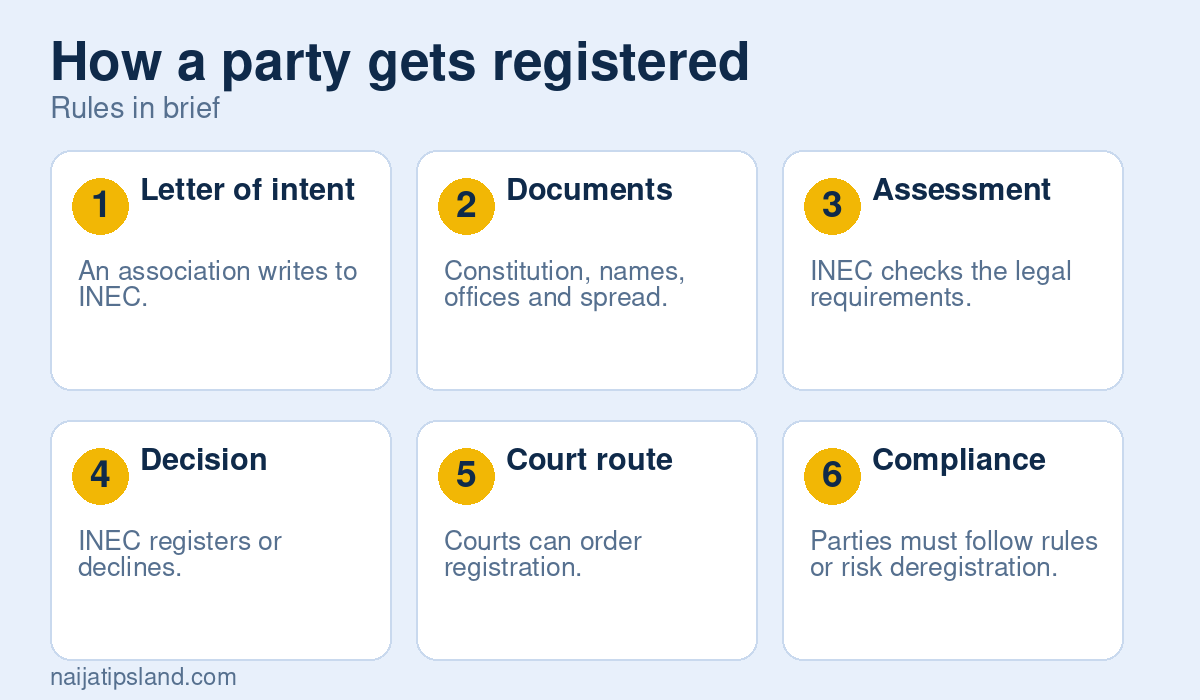
INEC’s registration process sets a deliberately high bar, partly to prevent an unmanageable proliferation of parties on the ballot. A prospective party must submit a formal application demonstrating national spread, typically requiring evidence of membership and organizational structure across a significant number of states and the Federal Capital Territory, not just a single region.

Applicants must also submit a constitution and manifesto consistent with Nigeria’s constitutional requirements, including provisions barring parties organized around ethnic, religious, or regional exclusivity, at least on paper. INEC reviews these submissions and can reject applications that fail to meet documentation or structural standards.

Registration isn’t permanent once granted. INEC applies performance thresholds tied to election results, and parties that fail to win a minimum share of votes or seats in specified elections risk deregistration. This is exactly why Nigeria’s party count fluctuates: dozens of parties have been registered and later deregistered since 1999, some through court-ordered reinstatement afterward. Experts tracking the list note that these thresholds make it genuinely hard for small, poorly resourced parties to hold onto registration long term, which explains why the roster trends toward consolidation over time even as new parties periodically apply.

How Have Nigeria’s Parties Performed in Recent Elections?

The 2023 general election reshaped assumptions about Nigeria’s party balance. APC’s Bola Tinubu won the presidency, but Labour Party’s Peter Obi and PDP’s Atiku Abubakar both posted strong showings that broke the historical two-party lock on presidential vote share, particularly in urban centers and the South East and South South regions where Labour Party overperformed expectations.

At the National Assembly level, APC and PDP still captured the overwhelming majority of seats, though party defections since the election have further consolidated APC’s position. Reports of PDP senators crossing over to APC pushed the ruling party closer to a two-thirds majority, a threshold with real constitutional significance for passing certain legislation and constitutional amendments.

Off-cycle and by-elections since 2023 have shown a mixed picture heading toward 2027. APC has continued to win local contests in several states, but internal party voices have flagged concerns about weak candidate quality as a risk for the next cycle. Meanwhile, opposition coalition talk, including PDP’s stated ambitions to unseat APC in states like Kwara, suggests 2027 will test whether APC’s current dominance holds or whether the fragmentation seen in 2023 deepens further.

Why an Accurate Party List Matters to You

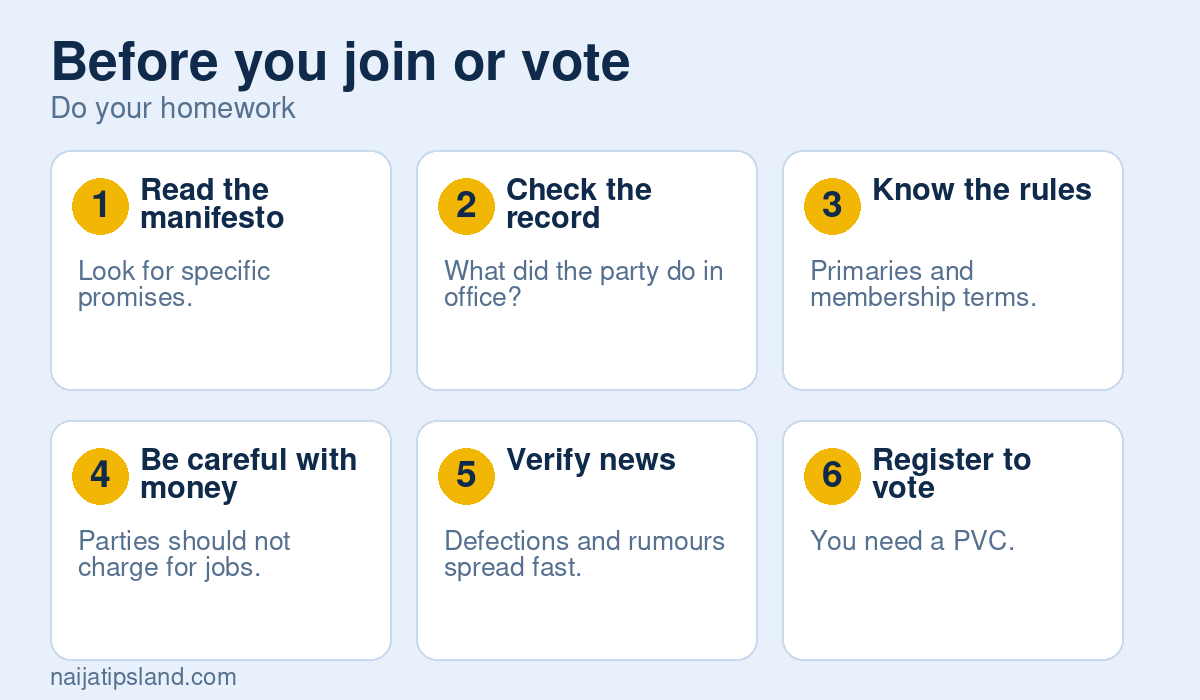
A voter who can’t tell a currently registered party from a deregistered one risks wasting a vote, or worse, being misled by a candidate campaigning under a defunct banner. An accurate, INEC-sourced roster gives you the footing to vote with confidence, hold your representatives accountable, and argue politics with facts instead of rumor. If you spot a discrepancy between this list and INEC’s own page, or hear about a party update before it’s widely reported, share it through Naijatipsland’s community submission channels so other readers can verify it too.

Frequently Asked Questions About Nigeria Political Parties

How many political parties are registered in Nigeria right now?
Reports citing INEC put the number at 18 as of the most recent appraisal, though the official INEC list is the only source you should treat as final, since courts and deregistrations shift the count between cycles.

What is the difference between INEC and LASIEC?
INEC handles national party registration and federal, state, and local elections across Nigeria. LASIEC is Lagos State’s own election commission, and its registered parties list confirms which parties can specifically contest Lagos state and local elections.

Which are the biggest political parties in Nigeria?
APC and PDP hold the largest share of National Assembly seats, according to Wikipedia’s tracker of Nigerian parties. Labour Party, NNPP, and APGA also carry significant regional or demographic influence.

Can a deregistered party come back onto the list?
Yes, through a court order. Nigerian courts have reinstated previously deregistered parties in past cycles, which is why checking INEC’s “last updated” date matters before assuming a party’s status is permanent.

How do I know if a party’s listed leadership is current?
Check the party’s individual profile on INEC’s political parties index, which lists the recognized chairperson and secretary. Some parties face ongoing leadership disputes, so the INEC-listed name is the one with official standing until a court rules otherwise.

Do smaller parties actually matter in Nigerian elections?
Yes, particularly at the local government level. Smaller and regional parties occasionally outperform national expectations in specific wards or council areas, even when the same parties have little presence in national polling.

Sources

NTL
We will be happy to hear your thoughts

      Leave a reply

      Nigeria's Fast-Growing Online Forum for News & Discussions
      Logo
      1