


TL;DR:
- Analyzing trending hashtags helps your content connect to active conversations and expand your reach effectively.
- Using 3–5 relevant niche hashtags boosts engagement, while generic tags often lose algorithmic value in 2026.
Hashtag analytics is the process of gathering and interpreting data on trending hashtags to improve content visibility and audience engagement across social media platforms. If you want to know why analyze trending hashtags matters for your content strategy, the answer is direct: data-driven hashtag choices connect your posts to active conversations, expand your reach, and reveal what your audience actually cares about. Platforms like X, Instagram, LinkedIn, and YouTube all reward relevance, and hashtag analysis is how you prove it. The difference between guessing and knowing which tags to use can determine whether a post reaches 500 people or 50,000.
Why analyze trending hashtags to grow your social media reach?
Hashtag analysis gives you a measurable edge over posting without a plan. Posts using 3–5 relevant, niche-specific hashtags increase reach and interactions by about 30% compared to generic or excessive tags. That number means one simple change in how you tag content can shift your results significantly, without changing anything else about your post.

The choice between niche and generic hashtags is not a matter of preference. It is a performance question. Niche hashtags under 500,000 posts outperform mega hashtags by 3x to 10x on engagement per impression across platforms. Generic discovery tags like #FYP or #love provide no measurable algorithmic benefit in 2026. They are diluted by saturation and signal nothing useful to platform algorithms about your content.
On X specifically, the data is clear. Using 1–2 relevant hashtags yields approximately 21% more engagement than posts with zero hashtags. The myth that zero hashtags perform better only holds for large accounts with massive existing followings. For most social media users and digital marketers, skipping hashtags is leaving reach on the table.
The benefits of trending hashtags go beyond raw numbers. On LinkedIn, niche professional hashtags connect posts to specific industry conversations. On Instagram, targeted tags place your content in front of users actively searching that topic. On X, joining a trending conversation with a relevant tag can expose your post to thousands of new readers within hours.
- Niche hashtags (under 500,000 posts) outperform mega tags by up to 10x on engagement per impression
- 3–5 relevant hashtags per post is the proven sweet spot for reach and interaction growth
- Generic tags like #FYP and #instagood have lost algorithmic value and waste hashtag slots
- Platform algorithms use hashtags as contextual signals, not just discovery tools
- Hashtag analysis reveals which tags your audience actually engages with versus which ones just look popular
Pro Tip: Before posting, check the post volume of any hashtag you plan to use. If it has more than 1 million posts, it is likely too saturated to deliver meaningful reach for most accounts.
What metrics and tools should you use to analyze hashtags?
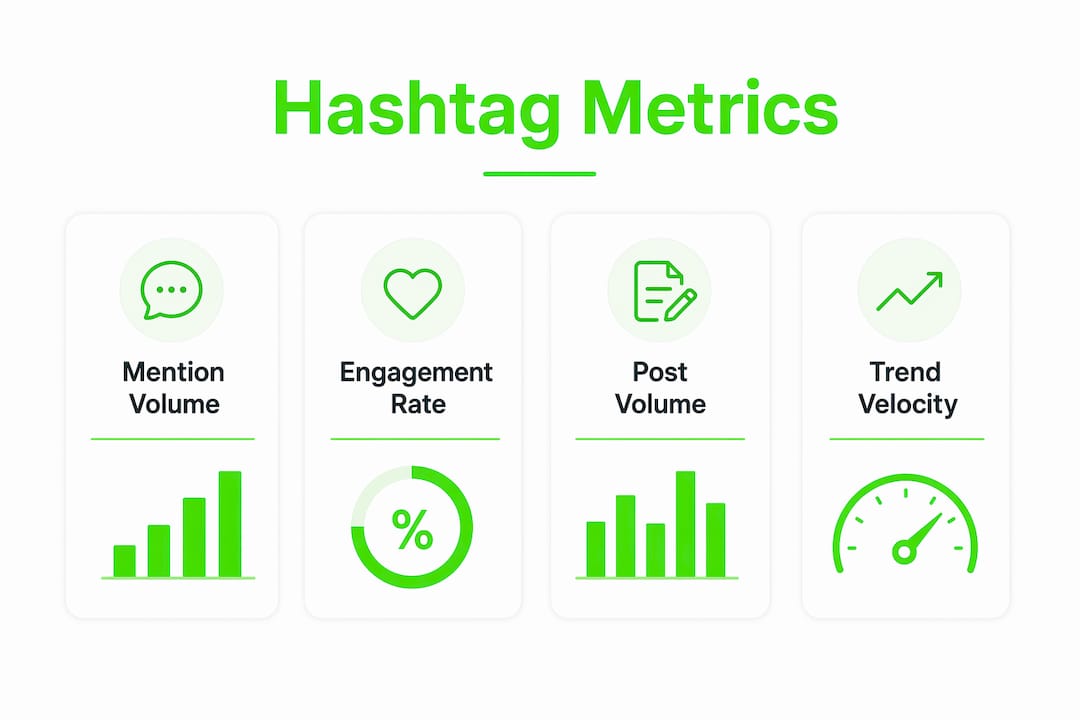
Effective hashtag analysis requires more than counting how many times a tag appears. The industry term for this deeper work is hashtag analytics, which covers campaign effectiveness, audience sentiment, and cross-platform performance. Simple tracking, by contrast, only measures mention volume. Tracking hashtags differs from analytics in a critical way: tracking tells you how often a tag appeared, while analytics tells you whether it actually worked.
The key metrics to monitor are:
- Mention volume — how frequently a hashtag appears across platforms within a given time window
- Reach — the total number of unique accounts exposed to posts using that hashtag
- Engagement rate — likes, comments, shares, and saves divided by impressions, expressed as a percentage
- Sentiment analysis — whether the conversation around a hashtag is positive, negative, or neutral
- Cross-platform performance — how the same hashtag performs on Instagram versus X versus LinkedIn
Sample size matters for reliable results. Stable median estimates require 50 or more engagement-bearing samples, and reliable metrics for the “recent” tab on Instagram require 200 or more samples. Pulling data from fewer posts produces misleading averages that can send your strategy in the wrong direction.
| Metric | What it measures | Why it matters |
|---|---|---|
| Mention volume | Frequency of hashtag use | Identifies trending vs. fading tags |
| Reach | Unique accounts exposed | Shows actual audience size |
| Engagement rate | Interactions per impression | Reveals content resonance |
| Sentiment | Tone of conversation | Flags brand risk or opportunity |
| Cross-platform data | Performance across networks | Guides platform-specific strategy |
AI-powered trend monitoring now tracks over 30 social networks and 150 million websites for real-time spikes in hashtags and sentiment. That scale of monitoring is what separates surface-level tracking from genuine competitive intelligence. Native platform analytics rarely provide that depth. Third-party analytics tools deliver better competitor benchmarking and sentiment analysis than built-in dashboards alone.
Pro Tip: Always normalize engagement by follower count when comparing hashtag performance across accounts of different sizes. A post from a 1,000-follower account with 50 likes outperforms a post from a 100,000-follower account with 200 likes on a per-follower basis.
Why timing and relevance are critical in trending hashtag strategies
Timing is the variable most digital marketers underestimate. Brands that act within 24–48 hours of a trending hashtag’s emergence consistently achieve higher engagement than those who join late. A hashtag that peaks on monday and gets used on thursday is no longer a trend. It is noise.
Relevance is equally non-negotiable. Forcing an unrelated hashtag into a post to chase volume damages brand perception. Audiences notice when a brand uses a hashtag that has nothing to do with its content. The short-term visibility gain is not worth the long-term credibility loss.
Before joining any trending hashtag, run a quick relevance check:
- Does the hashtag topic connect directly to your content or brand? If the link requires explanation, it is too weak.
- Is the hashtag still in its growth phase? Check post timestamps to confirm the trend is active, not fading.
- What is the dominant sentiment around the tag? Joining a hashtag with a negative or controversial tone can associate your brand with that sentiment.
- Has the hashtag’s meaning shifted? Some tags start with one intent and get repurposed by communities in unexpected ways.
- Is your audience actually using this hashtag? Check whether your followers or target readers engage with this tag organically.
The brands that win with trending hashtag strategies are the ones that move fast and stay relevant. Speed without relevance is spam. Relevance without speed is a missed opportunity. Both conditions need to be true at the same time.
How do trending hashtags reflect social behavior and cultural participation?
Hashtags are social scripts, not just search tools. Hashtags provide a compact participation script that lets users join live conversations by expressing jokes, opinions, or identity. The behavior around a hashtag drives its virality, not the tag itself. This distinction changes how you should interpret trend data.
Every trending hashtag moves through a lifecycle: trigger, spread, mutation, and saturation. The trigger is the original event or post that sparks the tag. Spread happens when early adopters amplify it. Mutation occurs when communities begin using the tag in new or ironic ways. Saturation is when the tag becomes so common it loses meaning and algorithmic value.
“Recognizing these behavioral patterns helps predict if a hashtag will be a short spike or a lasting trend.” — Trend Lifecycle Guide
For digital marketers, the mutation phase is the most dangerous. A hashtag that started as a positive brand conversation can shift meaning rapidly when communities repurpose it. Monitoring engagement metrics in real time lets you catch these shifts before they become a problem.
The importance of hashtag analysis extends to cultural literacy. On Nigerian platforms and across African social media, hashtags often carry community-specific meanings that do not translate directly from Western contexts. Understanding the social layer behind a tag, not just its volume, is what separates a marketer who reads data from one who understands people.
Key Takeaways
Analyzing trending hashtags is the most direct way to connect your content to active conversations and measurable audience growth in 2026.
| Point | Details |
|---|---|
| Niche hashtags outperform generic ones | Tags under 500,000 posts deliver up to 10x better engagement per impression than mega tags. |
| Sample size affects reliability | You need 50+ engagement samples for stable estimates and 200+ for reliable recent-tab metrics. |
| Timing determines trend impact | Joining a trending hashtag within 24–48 hours of emergence consistently drives higher engagement. |
| Tracking and analytics are different | Mention counts tell you frequency; analytics tell you whether a hashtag actually drove results. |
| Hashtags reflect social behavior | Understanding the lifecycle and cultural meaning of a tag prevents brand missteps and missed opportunities. |
Hashtag analysis: what the data keeps telling me
Most digital marketers treat hashtag analysis as a one-time setup task. They research tags before a campaign launch, apply them, and never revisit the data. That approach misses the entire point. Hashtag performance shifts weekly, sometimes daily, and the tags that worked in january may be saturated by march.
The mistake I see most often is confusing popularity with relevance. A hashtag with 10 million posts looks impressive until you realize your content is buried under millions of other posts the moment you publish. A hashtag with 80,000 posts in your specific niche gives your content a real chance to surface. The data has been consistent on this for years, and yet the pull toward big numbers is hard to resist.
The other pattern worth calling out is the over-reliance on native analytics. Platform dashboards show you basic reach and impression data, but they do not show you how your hashtag performance compares to competitors, what the sentiment trend looks like over time, or which tags are gaining momentum before they peak. Third-party analytics close that gap. If you are serious about online trends in Nigeria and beyond, investing in deeper analytics is not optional.
My practical advice: build a monthly hashtag audit into your content calendar. Pull performance data, drop the tags that are losing traction, and test two or three new niche tags each cycle. Treat hashtag strategy as a living process, not a fixed list. Platforms evolve, algorithms shift, and audience behavior changes. The marketers who stay ahead are the ones who keep checking the data.
— Naijatipsland
Naijatipsland and your digital marketing edge
Staying current with social media trends requires more than a one-time read. Naijatipsland covers the digital trends, media shifts, and engagement strategies that matter most to Nigerian and African audiences.
Whether you are tracking the digital ads impact in Nigeria or trying to understand how media shapes public conversation, Naijatipsland publishes practical, research-grounded content that keeps you informed. The platform covers everything from entertainment updates to political commentary, giving digital marketers a real-time pulse on what Nigerian audiences are talking about and why it matters for your content strategy.
FAQ
What does hashtag analytics mean?
Hashtag analytics is the process of measuring and interpreting data on hashtag performance, including reach, engagement rate, sentiment, and cross-platform results. It goes beyond simple mention counts to evaluate whether a hashtag actually drove campaign results.
How many hashtags should you use per post?
Posts using 3–5 relevant, niche-specific hashtags consistently outperform posts with zero or excessive tags. On X, even 1–2 relevant hashtags yield approximately 21% more engagement than posts with none.
Why do generic hashtags like #FYP stop working?
Generic discovery tags provide no measurable algorithmic benefit in 2026 because they are saturated with millions of posts. Platform algorithms use hashtags as contextual signals, and high-volume generic tags send no useful signal about your content’s topic or audience.
How quickly should you join a trending hashtag?
Brands that engage within 24–48 hours of a hashtag’s emergence achieve the highest engagement. Joining after the trend peaks means your content competes with far more posts and reaches a declining audience.
What is the difference between hashtag tracking and hashtag analytics?
Hashtag tracking measures how often a tag appears across platforms. Hashtag analytics measures campaign effectiveness, sentiment trends, and cross-platform performance, providing the depth needed for competitive benchmarking and strategic decisions.