Last updated: 23 October 2026 · By Naijatipsland Editorial Team · Editorial policy
In Nigeria, you do not just marry a person; you marry a family. In-laws can be a huge blessing, with free childcare, wise counsel and a wider circle of love. They can also become the loudest voice in a marriage, shaping where you live, how you spend money and when you have children. The line between support and interference is not always obvious, and many couples learn it the hard way.
This guide looks at what Nigerian and international research says about in-laws and marriage, why tensions arise, and practical, polite ways to protect your marriage without cutting off your family.
What the research says
Researchers have studied in-law relationships in Nigeria and abroad. The findings below come from three different studies, so read them as signals rather than universal rules.
Kwara State, Nigeria: interference and stress
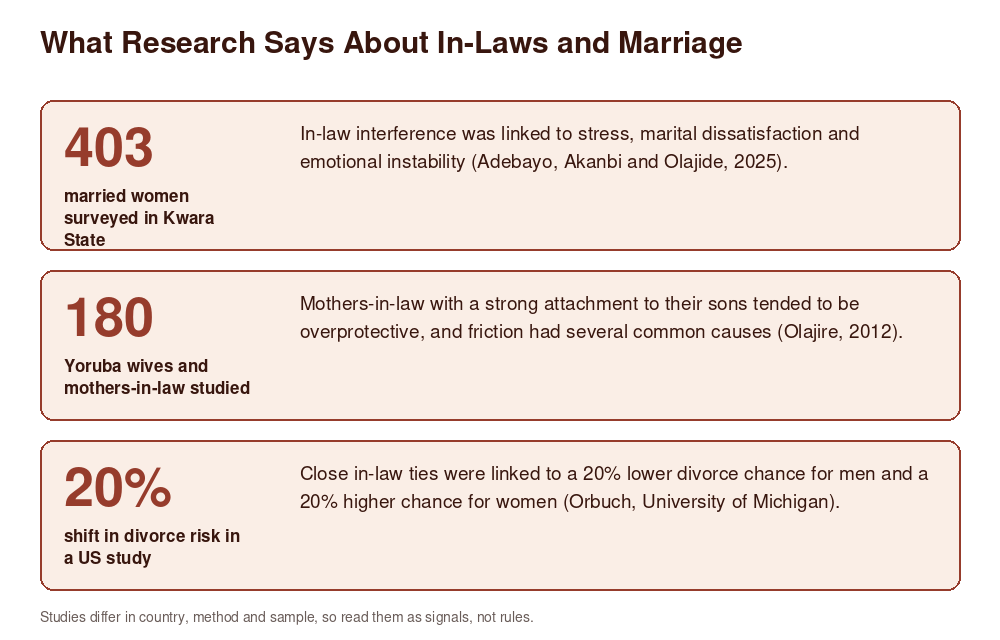
A 2025 study by Adebayo, Akanbi and Olajide surveyed 403 married women across nine local government areas in Kwara State. It found that in-law interference was linked to stress, marital dissatisfaction and emotional instability. Factors such as years in marriage, education, religion and the number of children influenced both how much interference a woman experienced and how stable she felt. The authors recommend counselling that helps couples set clear limits with in-laws and communicate better.
South-western Nigeria: the wife and mother-in-law relationship
An earlier study by Oluyinka Olajire (2012) looked at 90 wives and 90 mothers-in-law in three communities in south-western Nigeria, using questionnaires and focus groups. It reported several common causes of friction and found that mothers-in-law with a strong emotional attachment to their sons tended to be overprotective. Its recommendations are balanced: mothers-in-law should learn to let go and give the new couple space while still supporting them, and daughters-in-law should be respectful and tolerant, remembering that they may one day be mothers-in-law themselves.
A US study: closeness cuts both ways
A University of Michigan researcher, Dr Terri Orbuch, reported that close relationships with in-laws were associated with a 20 percent lower chance of divorce for men, but a 20 percent higher chance for women. Her explanation was that family ties are central to many women’s identity, so they are more likely to experience in-laws as meddling. This is American data and shouldn’t be applied directly to Nigeria, but it hints at something many Nigerian couples will recognise: husband and wife often experience the same family very differently.
Why in-law tension happens
- Different expectations of the new couple. Parents often expect to stay central in their child’s life, especially an only son or first daughter.
- Money. Support for relatives is a cultural expectation, but it can collide with the couple’s own budget, rent and school fees.
- Children and timelines. Questions about when to have a baby, how many children and what to name them can feel like pressure.
- Household roles. Cooking, hosting and childcare duties are often judged against a mother-in-law’s standards.
- Divided loyalty. The partner caught in the middle may avoid conflict, leaving the other spouse feeling alone.
- Living arrangements. When couples share a compound or a house with parents, there is less privacy and more opportunity for friction.
Set boundaries early, and keep them warm
Therapists quoted in coverage of the Michigan study suggest setting boundaries early, revisiting them as circumstances change, and using warm language when you decline an invitation or ask for space. A line like “We are really trying to build our relationship right now” lets a family hear a limit without feeling rejected. They also recommend listening respectfully to advice without being obliged to follow it, and staying financially independent from parents.
Five lines that stay polite
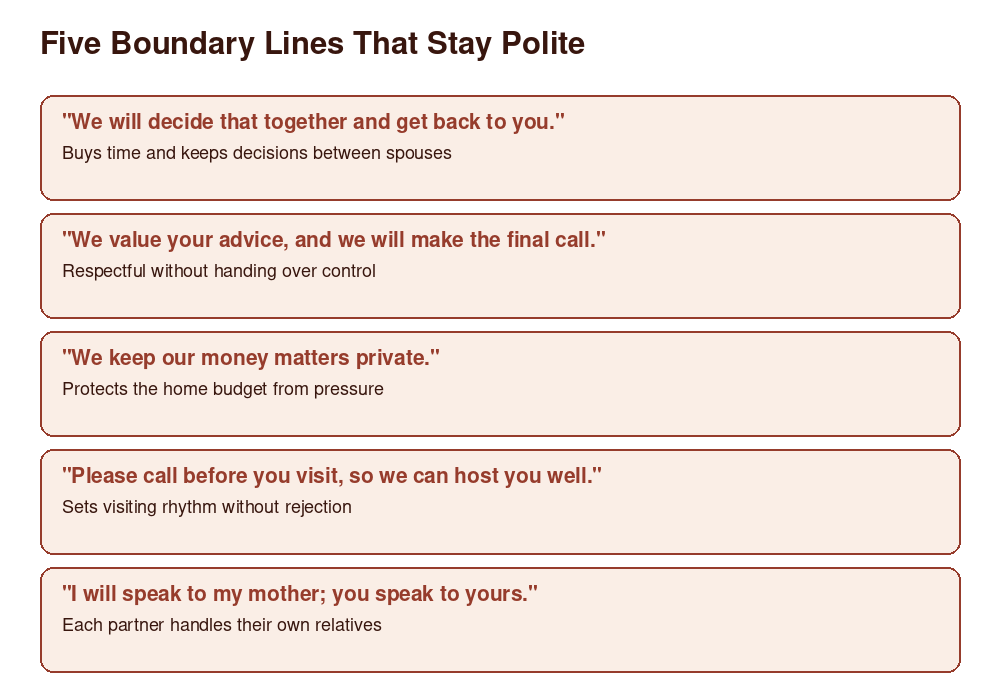
- “We will decide that together and get back to you.” Buys time and keeps decisions between spouses.
- “We value your advice, and we will make the final call.” Respectful without handing over control.
- “We keep our money matters private.” Protects the household budget from pressure.
- “Please call before you visit, so we can host you well.” Sets a visiting rhythm without rejection.
- “I will speak to my mother; you speak to yours.” Each partner handles their own relatives.
Who should decide what?
Many conflicts disappear once a couple agrees on which decisions are theirs alone, which they will discuss with family, and which each partner handles on their own side. Here is one framework; adapt it to your circumstances and customs.
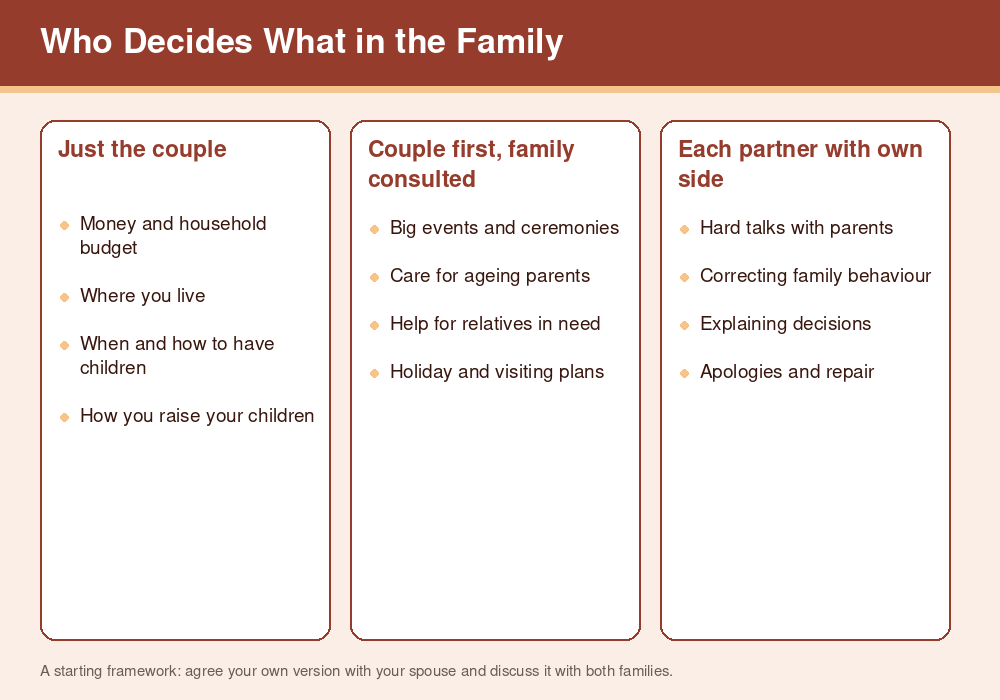
- Just the couple: household budget, where you live, when and how to have children, how you raise them.
- Couple first, family consulted: big ceremonies, care for ageing parents, help for relatives in need, holiday and visiting plans.
- Each partner with their own side: hard conversations with parents, correcting family behaviour, explaining decisions, apologies and repair.
What to do if you are the partner in the middle
- Do not disappear. Staying silent while your spouse is criticised tells them they are on their own.
- Talk to your own parents. Say it kindly, privately and early: “We love you, and we need space to run our home.”
- Back your spouse in front of family. Disagree with them in private if needed, not in front of relatives.
- Keep family out of arguments. Venting to your mother about your spouse often makes things worse.
- Keep showing love to your parents. Boundaries are not rejection. Regular calls, visits and gifts within your means keep goodwill.
If you are the in-law
Parents who want a good relationship with a married child can help by asking before offering advice, avoiding comparisons, welcoming the spouse as family and resisting the urge to take sides. The south-western Nigeria study’s advice to mothers-in-law, to let go while still supporting, is a good motto.
Living with in-laws
If you share a home with parents, agree house rules early: who cooks and when, how visitors are handled, what is shared and what is private, and how money for the household is managed. A defined space for the couple, even one room, helps preserve privacy and respect.
When to get help
- You and your spouse keep fighting about the same family issue with no progress.
- One of you feels constantly anxious, unwelcome or controlled.
- Family members are making major decisions for you.
- Respect has broken down and talks have turned into insults.
A licensed counsellor or a trusted faith leader who respects both sides can help. The Kwara State study specifically recommends counselling that teaches couples to set limits with in-laws and communicate more effectively. If anyone, including a relative, is threatening you or being violent, treat it as a safety issue: tell someone you trust and contact the police or a local support organisation.
Frequently asked questions
Is it normal for in-laws to be involved in a Nigerian marriage?
Yes. Extended family involvement is part of Nigerian culture and can be a real source of support. Problems begin when involvement becomes control, especially over money, children and daily decisions.
How do I stop my mother-in-law interfering without being disrespectful?
Be warm and clear: thank her for her concern, say that you and your spouse will decide, and keep your tone polite. Your spouse should deliver difficult messages to their own mother.
Should I tell my spouse everything my family says to me?
Share what affects your marriage and decisions, but avoid passing on every unkind remark. The goal is to solve problems, not to start fights.
How much money should we give to relatives?
Agree a figure or percentage together, in advance, and review it each year. Help given by agreement causes far less resentment than help given in secret or under pressure.
Does marrying a close-knit family mean there will be more conflict?
Not necessarily. Close families can be a great support. What matters is whether the couple shares the same boundaries and presents a united front.
This article is for general information and is not a substitute for professional counselling.
Sources
- Adebayo, Akanbi and Olajide (2025), In-Law Interference and Emotional Stability of Married Women in Kwara State, Nigeria, Journal of Guidance and Counselling Studies
- Olajire (2012), Wife-Mother-in-Law Relationship and Violence among Yoruba Women of Southwestern Nigeria, American Journal of Sociological Research
- KSL, Setting boundaries with in-laws key to happy marriage, study says (reporting Dr Terri Orbuch, University of Michigan)