
How to Find Low-Competition Keywords for a Nigerian Blog (2026): A Free, Step-by-Step Method


Last updated: 6 November 2026 · By Naijatipsland Editorial Team · Editorial policy
Most new Nigerian blogs fail to get Google traffic for one simple reason: they target keywords that established sites, news brands and big international publishers already own. A low-competition keyword is the opposite: a search that real people make, where the current results are weak enough that a new or small site has a fair chance of reaching page one. This guide gives you a free, repeatable method to find those keywords, read the numbers in the tools correctly, check the results page by hand, and keep a simple sheet so you always know what to write next.
About the figures in this guide: tool limits and definitions come from the tools’ own pages and a published comparison of free tools that was tested in October 2026, and we re-checked what we could on 6 November 2026. Free-tier limits change often, so confirm inside each tool. We have not included search-volume numbers for specific Nigerian keywords, because we could not measure them with a paid tool for this update; the example keyword patterns below are illustrations, not data.
What does low competition actually mean?
There is no single official definition, so it helps to split it into three parts. First, link competition: how many other websites link to the pages already ranking. Second, content competition: whether those pages truly answer the question, are up to date and match what searchers want. Third, authority competition: whether the results are dominated by big brands, national newspapers or government sites that a small blog cannot realistically outrank in the short term.
A keyword is low competition for your site when the first page shows weakness on at least two of the three, and when your blog can add something the current results lack, such as Nigerian prices in naira, local steps, or first-hand experience. That last point matters because Google’s own guidance says content should be created mainly to help people, not to attract search visits, and it asks writers to show who wrote a page, how it was made and why it exists. You can read it in Google’s helpful content guidance.
The six-step method at a glance
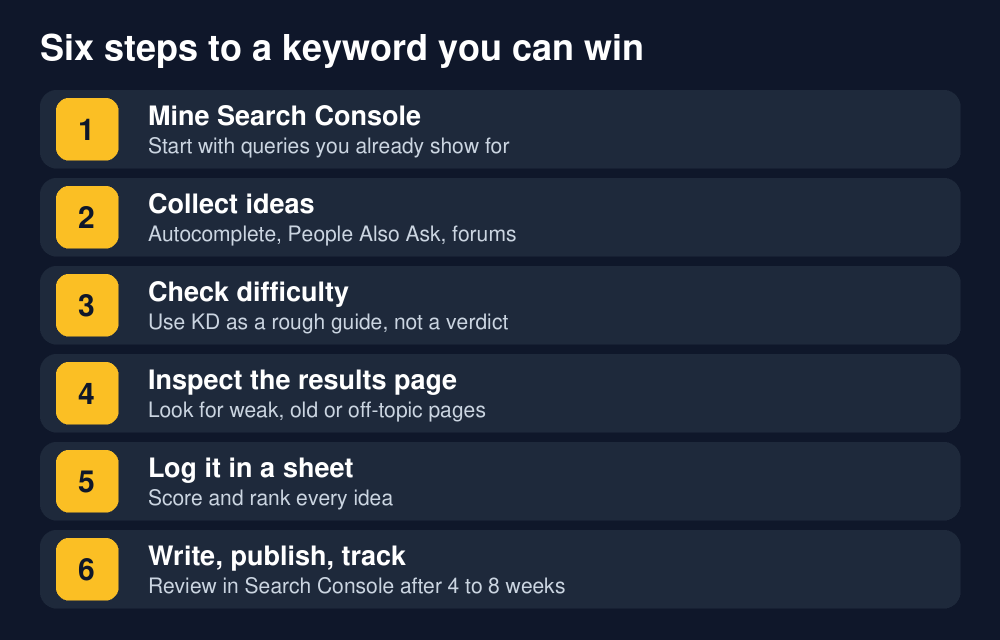
Work through the steps in order. Steps one and two build a list of ideas, steps three and four filter that list, and steps five and six turn the best ideas into published pages and learning.
Step 1: Start with Google Search Console
If your blog is already live and verified in Search Console, you are sitting on your best keyword source. The Performance report shows clicks, impressions, click-through rate and average position, and you can break the table down by query, page, country and device, according to Google’s Performance report help. The default view covers the past three months, and you can change the date range at the top of the report.
Here is a simple routine:
- Open Performance, switch on Average position, and set the date range to the longest option you have.
- Add a Country filter for Nigeria if most of your readers are in Nigeria, or leave it off if you serve the diaspora too.
- Open the Queries tab and sort by impressions.
- Look for queries where your average position is roughly between 8 and 30. You already appear, but not on the first page.
- Click a query and then the Pages tab to see which page is showing. Improve that page, or write a more focused new page if none of your posts answers the query properly.
These are often the quickest wins because Google has already decided your site is somewhat relevant. If your site is new and Search Console is empty, move to step two and come back in a few weeks. If Search Console is not set up yet, our guide to starting a blog in Nigeria covers the basics, and the WordPress plugins guide explains an SEO plugin that makes verification easier.
Step 2: Collect ideas the way Nigerians actually search
Free tools show what has been measured. Your own eyes show how people really phrase things. Spend twenty minutes doing the following for each topic on your list:
- Google autocomplete: type your topic slowly and write down every suggestion. Then add a letter after it (a, b, c) to see more.
- People Also Ask: search your topic, open the question boxes and note the repeated questions. Each one is a possible section or a separate post.
- Related searches: scroll to the bottom of the results page and copy the suggested searches.
- Forums and groups: browse Nairaland, Reddit, Facebook groups and WhatsApp communities in your niche and note the questions people keep asking and the words they use.
- Your own comments and messages: readers often ask the exact long question you should answer.
Pay attention to Nigerian wording and context. People search with “in Nigeria”, with naira amounts, with state or city names, with exam and policy names, and sometimes in Pidgin. Searches that combine a general topic with a Nigerian detail are usually narrower and less crowded than the general version, and it is where a local blog has an edge. The table below shows patterns to try. These are illustrative patterns, not measured keywords.
| Pattern | Example idea | Why it can be easier |
|---|---|---|
| Topic + “in Nigeria” + year | how to register a .ng domain in 2026 | Global sites rarely cover Nigerian steps and prices |
| Price or cost in naira | cost of starting a poultry farm in Nigeria | Prices change, so old pages go stale |
| Beginner problem + fix | why my WordPress site is slow on MTN data | Specific problems get thin answers |
| Audience qualifier | side businesses for Nigerians living in the UK | Narrow audience, fewer targeted pages |
| Comparison | Nigerian web hosts compared by renewal price | Requires real research, which many skip |
| Question form | can I run a blog without a laptop in Nigeria | Matches how people ask on a phone |
Step 3: Check difficulty and volume with free tools
Once you have a list of 30 to 50 ideas, use a tool to attach rough numbers. No free tool is perfect, and their numbers will not match each other, so use them to compare ideas, not to promise traffic. Here is what is available at the time of writing.
| Tool | What it gives you | Free limits to know |
|---|---|---|
| Google Search Console | Real queries, impressions and positions for your own site | Free for verified sites; only shows what you already appear for |
| Ahrefs free keyword generator | Keyword ideas with volume and keyword difficulty; you can enter up to ten words or phrases | Ahrefs does not state a cap on the page; some data may be hidden until you sign up |
| Ahrefs Webmaster Tools | Site audit, backlinks and organic keywords for sites you verify | 5,000 crawl credits per project per month; up to 1,000 backlinks and 1,000 organic keywords shown at once |
| Google Keyword Planner | Search volume estimates and keyword ideas | Google says you must complete account setup including billing information; SEOs have long reported that low-spending accounts get less precise data |
| Ubersuggest (free) | Keyword ideas and difficulty | 3 searches or reports per day; 40 per day in the Chrome extension; up to 3 keyword lists of 30 keywords (tested October 2026) |
| Semrush (free) | Keyword Magic Tool | 10 reports per day and 10 results per report in the interface (tested October 2026) |
Two practical tips. First, do your searches in batches and save results straight away, because daily limits are small. Second, set the country to Nigeria where the tool allows it, because global volume can badly overstate demand for a Nigerian-specific topic.
Step 4: Read keyword difficulty without being fooled
Keyword difficulty, or KD, is a score from 0 to 100 that estimates how hard it is to reach the first page. Ahrefs says its score is based on the number of websites linking to the top ten ranking pages, and it describes it as a fixed benchmark that does not reflect your own site’s authority. See Ahrefs’ own explanation in its keyword difficulty guide.
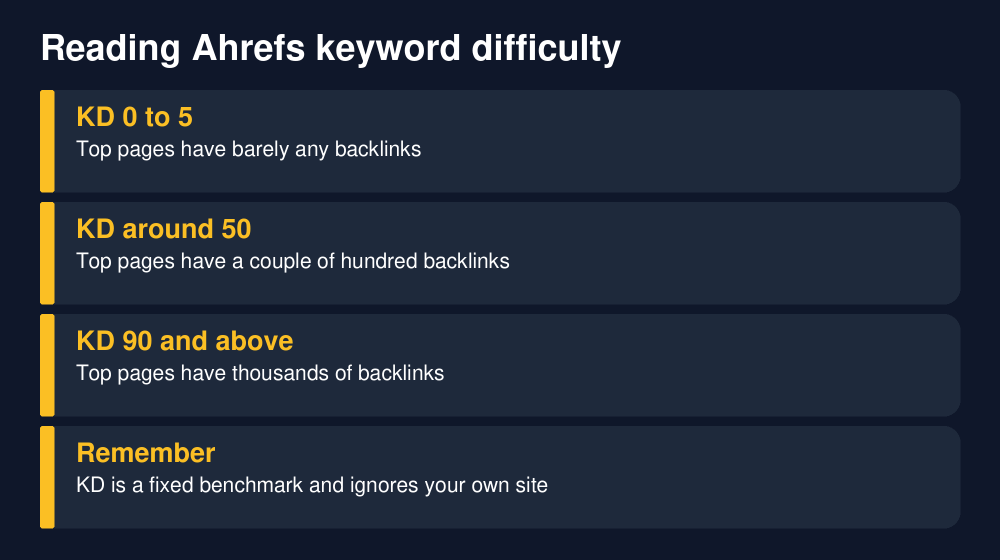
Ahrefs notes that at KD 0 to 5 the top pages barely have backlinks, around KD 50 they have a couple of hundred, and at 90 and above they have thousands. For a new blog, the sensible zone is the low end of the scale. Other tools use different formulas, so a KD of 20 in one tool does not equal 20 in another. Treat difficulty as a way to rank your own list from easiest to hardest.
Three cautions apply:
- KD ignores content quality. A keyword with low KD can still be hard if the top pages are excellent and match the search intent perfectly.
- Low volume is not failure. A keyword with only a modest number of monthly searches can still bring steady, targeted readers, and one page often ranks for many related searches.
- Zero volume is not always zero. Tools can show 0 for new topics that real people still search. Check autocomplete and forums before you discard an idea.
Step 5: Inspect the results page by hand
This is the step most beginners skip, and it is the most reliable. Search your keyword in a private browser window, ideally with the location set to Nigeria, and study the first ten results.
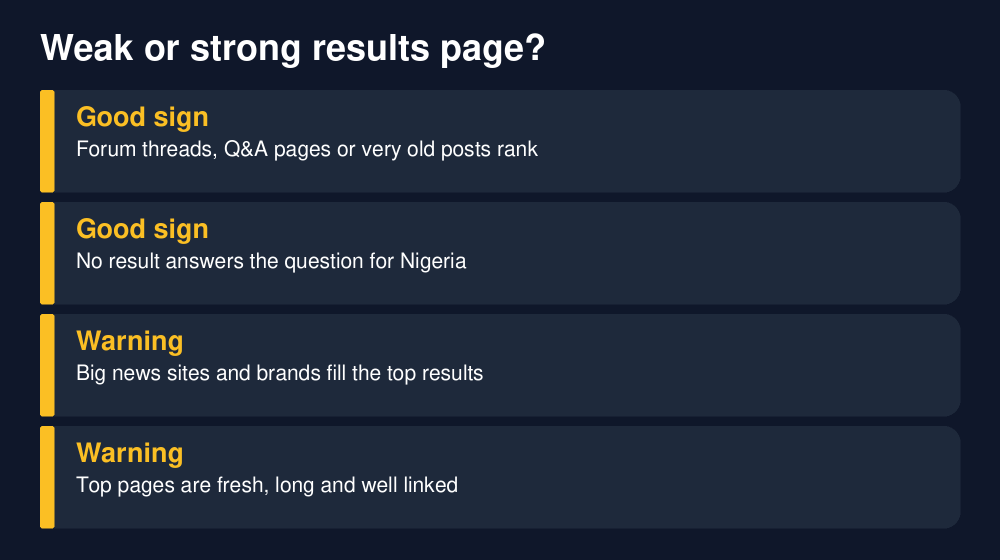
Ask these questions:
- Who ranks? If the page is full of national newspapers, banks, government sites and global brands, the keyword is probably hard. If you see forum threads, Q&A pages, small blogs or social posts, it is probably easier.
- How old are the results? Pages from several years ago on a topic that changes (prices, rules, apps) are an opening for a fresh, accurate guide.
- Do they answer the exact query? If the top results are only loosely related, a focused page can win.
- What format wins? If the results are videos or product pages, a blog post may not match what Google wants to show. Match the format or pick another keyword.
- Is there a Nigerian gap? If every result is written for the US or UK, a page with Nigerian prices, steps and examples is a real improvement.
- Can you add first-hand value? Screenshots, receipts, tested steps and personal experience are hard for competitors to copy.
Step 6: Build a simple keyword sheet and score it
Put every idea in a free spreadsheet (Google Sheets works well on a phone and laptop). Use these columns:
- Keyword
- Estimated monthly searches (from your tool, with the tool name noted)
- Difficulty (KD or equivalent)
- Search intent (learn, compare, buy, local)
- Results page notes (who ranks, how old)
- Our gap (what we can add)
- Priority score (1 to 5, your judgement)
- Existing post to update, or new post
- Publish date and the date to review in Search Console
A simple rule for the priority score: give 2 points if the results page looks weak, 2 points if you can add something the others lack, and 1 point if the topic fits your niche and you can write it well. Write the 4 and 5 scores first. Before writing a new page, also check whether you already have a post on the topic; two pages chasing the same query compete with each other, and updating the older one is usually better.
After you publish: track, improve, link
Give a new page four to eight weeks, then open Search Console and see which queries it appears for. If it shows on page two, improve the title, headings and internal links, and add the missing questions you found in People Also Ask. Link to the new page from related posts and from your homepage navigation where it fits. For ideas on turning traffic into income once it arrives, read how to make money blogging in Nigeria, and if your site feels slow, our guide to cheap reliable hosting for Nigerian bloggers explains what to check. Do not update dates without making real improvements; Google lists faking freshness among the warning signs of content made for search engines first.
Common mistakes to avoid
- Chasing the biggest volume. Head terms like “make money online” are dominated by giants.
- Trusting one tool. Compare two sources and your own page-one check.
- Writing thin pages for tiny keywords. A page must be genuinely useful, not a few lines to hit a phrase.
- Ignoring intent. If searchers want a list of prices, a long essay will not rank.
- Stuffing the keyword. Use it naturally in the title, first paragraph and a few headings, then write for people.
- Never reviewing. Search Console shows what is working; use it every month.
Frequently asked questions
What is a low-competition keyword?
It is a search term where the pages currently ranking are weak enough that a smaller site has a realistic chance of reaching page one. Weakness can mean few backlinks, thin or outdated content, forum or Q&A results, or no result written for Nigerian readers.
What keyword difficulty score is good for a new Nigerian blog?
Aim for the low end of whichever tool you use. In Ahrefs, KD 0 to 5 means the top pages barely have backlinks. Scores differ between tools, so also check the results page by hand.
Can I find keywords completely free?
Yes. Google Search Console, autocomplete, People Also Ask, forums, the Ahrefs free keyword generator and the limited free plans of tools like Ubersuggest and Semrush are enough to start. Keyword Planner is free to use but needs account setup with billing details.
Do I need to target Nigeria specifically?
If your readers are in Nigeria, yes. Use Nigeria as the country in tools and include local details, such as naira prices and Nigerian steps, because global data can mislead.
How long until a low-competition keyword ranks?
It varies. Google does not guarantee timing. Check Search Console after four to eight weeks, and keep improving the page if it appears but sits on page two.
Is it worth writing for keywords with very low search volume?
Often yes, if they are specific and match your niche. One page can rank for many related searches, and targeted readers are more likely to stay, subscribe or buy.
Should I update old posts or write new ones?
If you already have a post on the topic, improve it first. Write a new post only when no existing page truly answers the query.
Can AI tools find keywords for me?
They can suggest ideas and questions, but they do not replace real search data or a manual results check. Google asks creators to be clear about how content is produced and to focus on helping people.
Sources and notes: Google Search Central, helpful content guidance; Google Search Console Help, Performance report; Google Ads Help, Keyword Planner account setup; Ahrefs, keyword difficulty guide, free keyword generator and Webmaster Tools pages (viewed 6 November 2026); Indie Stack Lab, free keyword research tools compared (limits tested 21 October 2026). Free-tier limits change frequently. The keyword examples are illustrations, not measured data, and we do not endorse any tool.





Here is a quick challenge: pick one topic you want to write about this week and run it through steps 2 to 5 above. Tell us in the comments what you found on the results page — forums and old posts, or big brands? I will give feedback on whether it looks winnable.
— Ade Adeniyi