Business News Today, 12 November 2026: Naira slips to N1,430 on street, CBN mops up N1.5tn, Dangote pricing shift


Last updated: 12 November 2026 · By Naijatipsland Editorial Team · Editorial policy
Morning roundup · Thursday 12 November 2026 · By Ade Adeniyi, Founder and Editor
Good morning. The naira slipped on both the official and street markets as festive and election-season demand for dollars builds, while the Central Bank kept mopping up cash from banks. Petrol pricing is changing again at the Dangote refinery, payment companies have a firm data deadline, and stocks fell for a second day. Here is the business picture in plain language.
Today at a glance
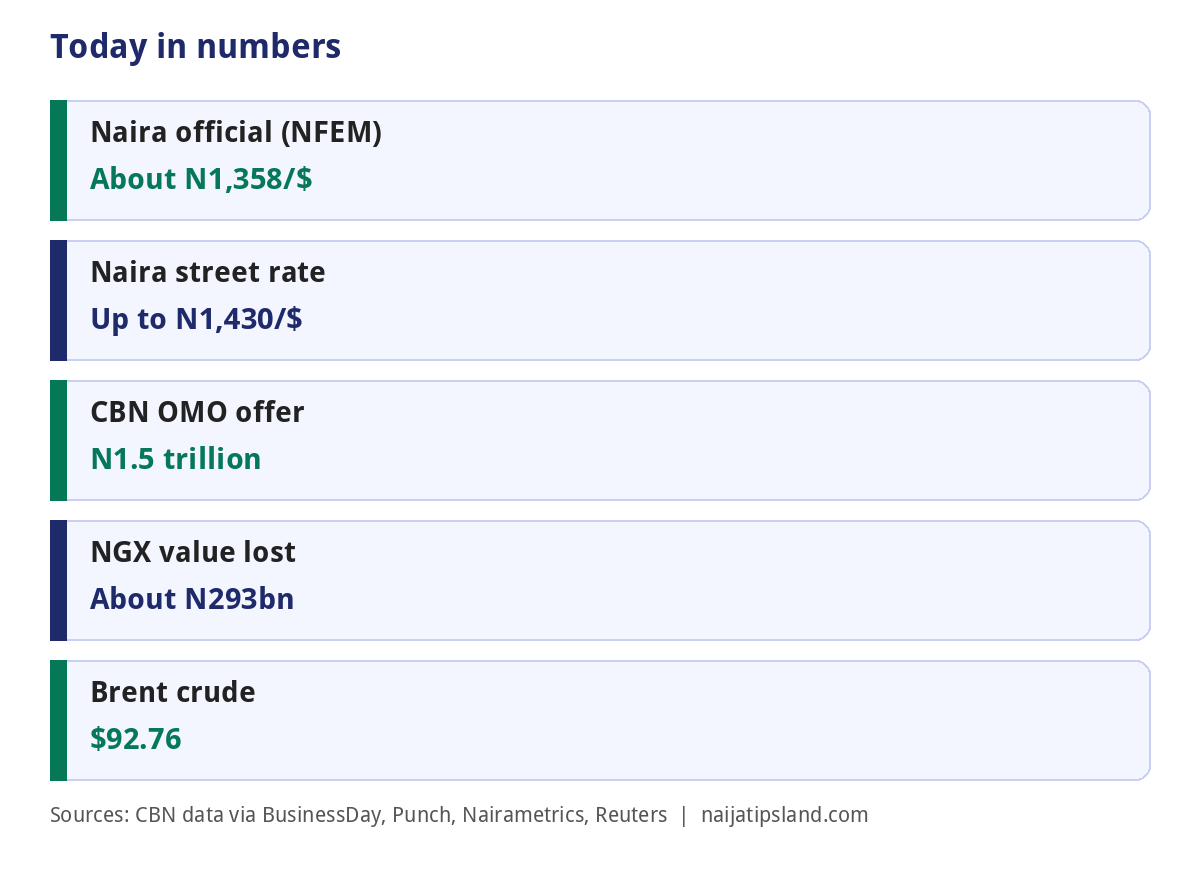
- Naira weakens to about ₦1,358/$ at the official window and ₦1,430 on the street, a 10-month parallel-market low.
- CBN holds its third OMO auction in eight days, offering ₦1.5 trillion to soak up excess bank cash.
- Dangote refinery reportedly returns to global-benchmark petrol pricing and trims its marketer group to 25.
- CBN insists payment data must be stored in Nigeria from 1 January 2027, with no grace period.
- NGX All-Share Index falls 0.18%, wiping about ₦293 billion off share values.
- Brent crude bounces to about $92.76 a barrel as OPEC+ output jumps.
1. Naira under pressure on both markets
What happened
The naira weakened at the Nigerian Foreign Exchange Market (NFEM) on Wednesday, with CBN data showing deals between about ₦1,352.75 and ₦1,365 and the rate settling near ₦1,358.34 per dollar, down from ₦1,350.86 on Tuesday. Turnover slowed after a busy Tuesday, when about $813.5 million changed hands. On the parallel market, dealers quoted the dollar at up to ₦1,430, its weakest level in about 10 months, widening the gap with the official rate to roughly ₦70 to ₦80. External reserves were reported just under $55 billion. Analysts link the pressure to seasonal year-end demand, election-related spending and foreign portfolio outflows.
Why it matters
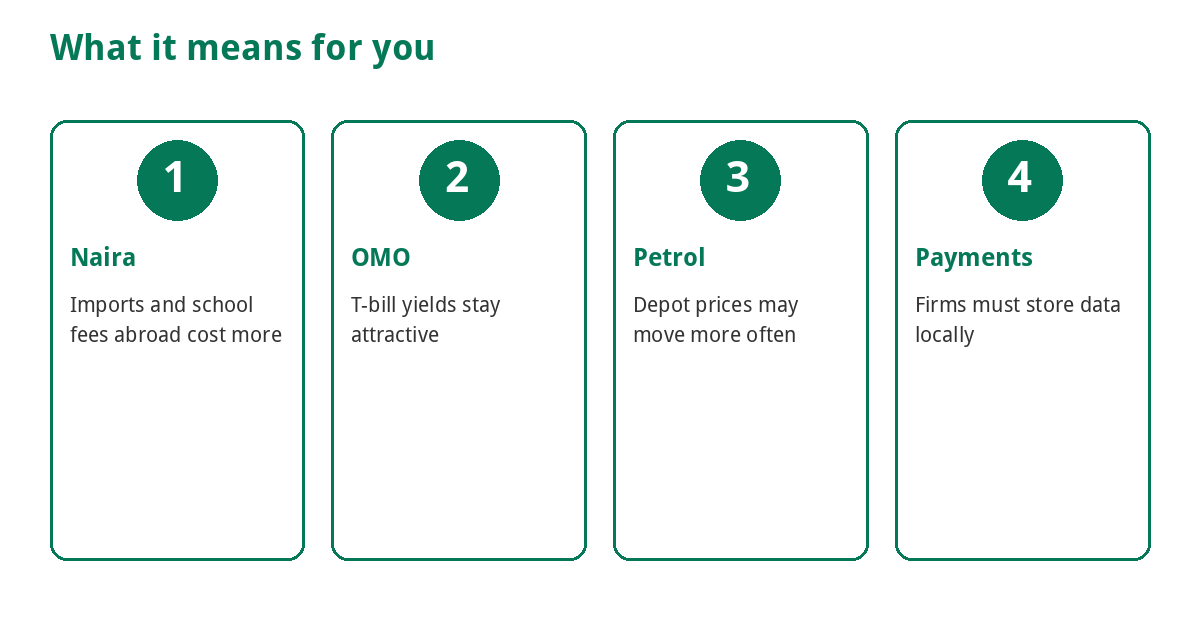
A weaker naira raises the cost of imported goods, school fees abroad and travel ahead of Christmas. Families receiving money from abroad get more naira per dollar, but should compare official and street rates before converting. See the latest on our dollar to naira exchange rate today page.
Source: BusinessDay; MarketForces Africa; InvestorsKing.
2. CBN keeps draining cash from the banking system
What happened
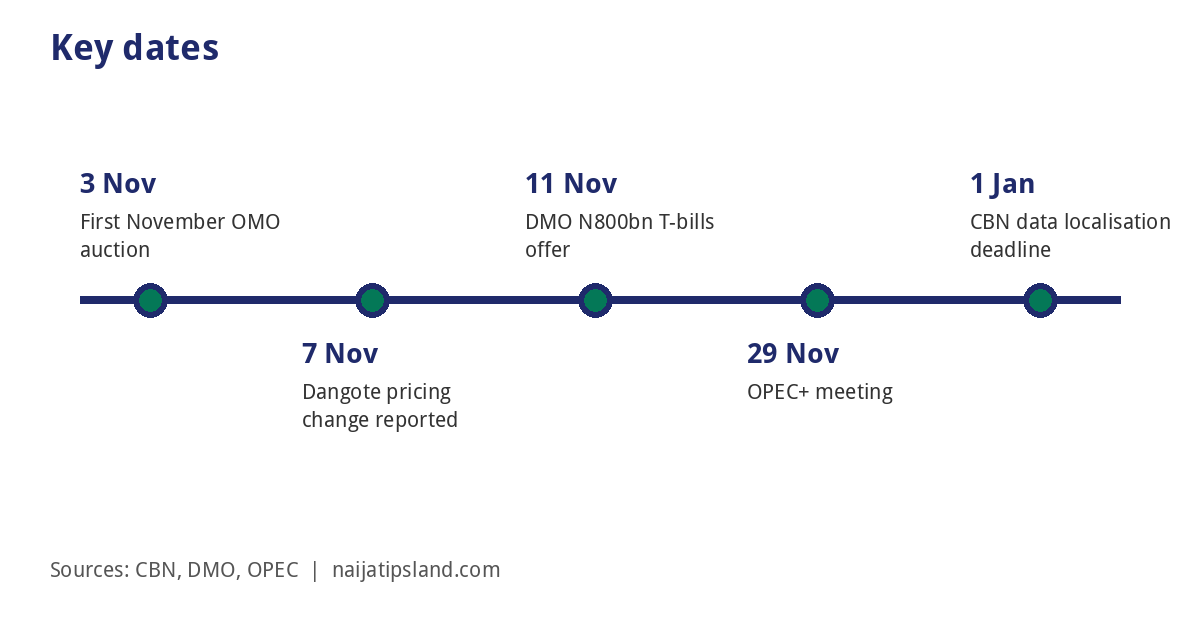
The Central Bank offered another ₦1.5 trillion in Open Market Operations (OMO) bills on Tuesday, split equally across 154-, 252- and 329-day tenors. It was the third such auction since 3 November; the first two alone saw ₦5.667 trillion allotted, close to the ₦6.18 trillion sold in all of October. Banking-system liquidity had risen about 15% in a week to ₦8.5 trillion on 6 November, and dealers expect another ₦2.45 trillion of inflows this week, mostly from maturing OMO bills. Banks’ deposits at the CBN’s Standing Deposit Facility fell to about ₦5.9 trillion after earlier settlements. The Debt Management Office also offered ₦800 billion in Treasury Bills on Wednesday.
Why it matters
Mopping up excess naira helps limit inflation and supports the currency. For savers, it keeps yields on Treasury Bills and money-market funds attractive, though borrowing stays expensive for small businesses.
Source: Punch; The Sun; Daily Times.
3. Dangote refinery reportedly changes how it prices petrol
What happened
Industry publication PetroleumPrice.ng, as reported by Legit.ng, says the Dangote refinery has dropped its fixed gantry price for petrol and returned to a price linked to a five-day average of a European gasoline benchmark (EBOB), with a loading price of about ₦1,250 per litre from 7 November. It has also reportedly cut its distribution consortium from 37 to 25 marketers, keeping firms such as NNPC, MRS, NIPCO and Ardova. Diesel reportedly stays on fixed pricing. The refinery has not publicly confirmed the details. Pump prices still vary widely, with motorists paying roughly ₦1,255 at some NNPC stations and up to about ₦1,420 elsewhere.
Why it matters
A benchmark-linked price means depot prices can move more often, up or down, with global gasoline markets. That could pass on falling world prices faster, but also bring sudden increases. Watch your local pump prices rather than the loading figure, which excludes transport and margins.
Source: Legit.ng; Legit.ng (MEMAN data).
4. CBN: payment data must be in Nigeria by 1 January 2027
What happened
In a new set of frequently asked questions released on Wednesday, the CBN said its data localisation deadline of 1 January 2027 stands, with no automatic grace period, phased compliance or exemption for legacy systems. The rule, first issued in June, covers banks, microfinance banks, mobile money operators, switches and payment service providers. It applies to payment transaction data and supporting records such as logs, backups, disaster-recovery copies and fraud data. Where international card schemes or correspondent banks must process a transaction, only the data needed may be sent abroad, and it must still be stored in Nigeria. Technology experts at a Lagos banking forum urged banks to expand local data-centre capacity ahead of the deadline.
Why it matters
Fintechs and banks that host data overseas face costly migrations within seven weeks. Customers could see brief service disruptions during switch-overs, so keep a backup payment option over the holidays.
Source: New Telegraph; ThisDay.
5. Stocks fall for a second day
What happened
The NGX All-Share Index fell 451.92 points, or 0.18%, to 251,861.24 on Wednesday, and market value dropped about ₦293 billion to ₦163.53 trillion. Okomu Oil fell the maximum 10% to ₦1,148.60 and Nascon lost about 9%, while all five large banks in the FUGAZ group closed lower, led by First HoldCo. Losers outnumbered gainers 29 to 23. The index is still up about 62% for the year.
Why it matters
After a strong year, investors are locking in profits, and higher Treasury Bill yields offer a safer alternative. Long-term investors should focus on company results rather than daily swings.
Source: Nairametrics; New Dawn; THEWILL.
6. Oil bounces back as OPEC+ pumps more
What happened
Brent crude settled up about 1.4% at $92.76 a barrel on Wednesday after Iran denied talks with Washington. OPEC’s monthly report showed the group and its allies raised output by about 2.04 million barrels a day in October to 41.23 million, as disrupted Gulf supplies returned. The US Energy Information Administration expects Brent near $100 for the rest of 2026, easing to about $77 by late 2027.
Why it matters
Oil revenue funds a large share of Nigeria’s budget and dollar supply. Prices in the $90s help, but a longer-term slide towards the $70s would squeeze 2027 revenue projections.
What to watch next
- Results of the CBN’s latest OMO auction and Wednesday’s Treasury Bills sale.
- Whether the naira’s official rate holds below ₦1,360 as December demand rises.
- Official confirmation of Dangote’s new pricing and any change in pump prices.
- Payment firms’ readiness for the 1 January 2027 data deadline.
Frequently asked questions
Why is the naira weakening now?
Analysts point to seasonal year-end demand for dollars, election-related spending and some foreign investors taking money out, which outweighs the supply of dollars for now.
What are OMO bills?
They are short-term securities the CBN sells to banks and investors to take excess naira out of circulation, which helps control inflation and support the currency.
Will petrol now cost ₦1,250 at the pump?
Not necessarily. That figure is a reported refinery loading price. Pump prices also include transport, distribution costs and marketers’ margins.
This roundup summarises reporting by the outlets credited under each story, in our own words. Follow Naijatipsland Updates on WhatsApp for the next edition. Spotted an error? Tell us and we will correct it under our editorial policy.