
UK to Nigeria Transfer Delayed or Frozen? Why It Happens and How to Fix It (2026)

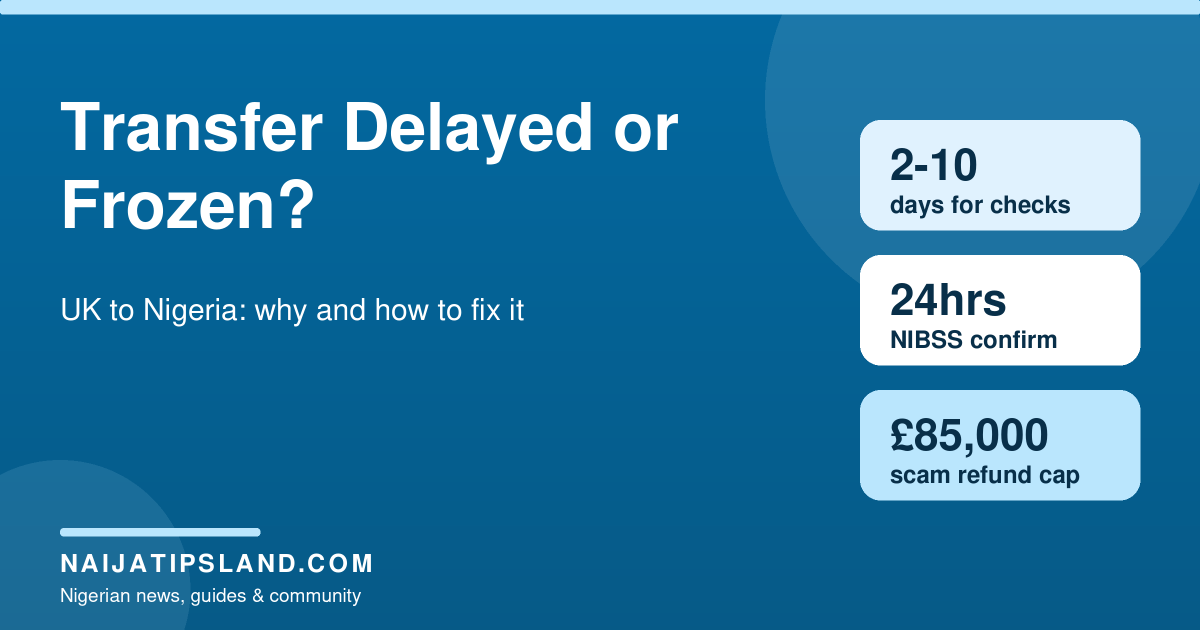
Last updated 23 November 2026. Transfer times, limits and rules change, so check the estimate shown for your own transfer and your provider’s current help pages. This is general information, not financial or legal advice.
You send money from the UK, the app says it is on its way, and hours later your family in Nigeria still has nothing. Or the status has said “processing” for three days. It is a miserable position to be in, particularly when the money is for school fees, rent or a hospital bill. Most late transfers have an ordinary cause and get sorted once you know which stage the money is stuck at.
This guide explains the usual reasons a UK to Nigeria transfer is delayed or put on hold, how long each stage can take, what to do in what order, and how to complain if you get no help. If you are still choosing how to send, our guide to sending money from the UK to Nigeria for school fees and the daily pound to naira rate article are worth a look first.
First, work out which stage the money is at
A transfer has three separate clocks, and a provider’s headline speed usually describes only the last one.
- Your money reaching the provider. A card payment can be instant. A bank transfer can take days.
- The provider converting and checking. This is where security and compliance reviews happen.
- The Nigerian payout. The money goes through a Nigerian bank or partner and lands in the recipient’s account.
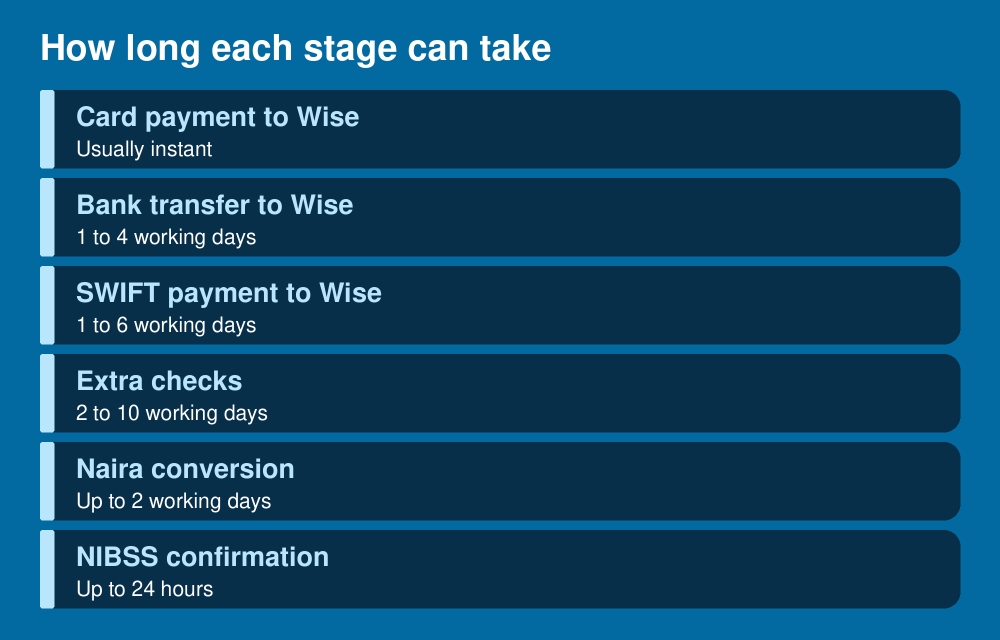
Wise’s published figures show how this adds up. Funding by card is usually instant, by bank transfer one to four working days, and by SWIFT one to six working days. Once Wise has received and converted your money, its naira guide says it usually reaches a Nigerian bank account the same working day. Conversion can take up to two working days, and NIBSS, Nigeria’s interbank settlement system, can take up to 24 hours to confirm a payment’s status. None of that begins until Wise actually has your money, so a transfer that is still waiting on your own bank has not started its Nigerian leg.
Other providers publish different figures. WorldRemit says 90% of its Nigeria transfers reach its local partners within minutes, and Taptap Send publishes a 95% under two minutes figure for bank transfers. Remitly gives an estimate for each transfer rather than a corridor-wide time. Those are averages for most transfers, not a promise for yours. Use the estimate shown on your own transfer, and start chasing only when that time has passed and the status does not explain why.
The usual reasons a transfer is late
Security and compliance checks
This is the most common reason for a transfer that sits in “processing”. Providers can ask for photo ID, proof of address or proof of where the money came from, especially on a first transfer, a larger amount or a new recipient. Wise says additional checks usually take 2 to 10 working days and that it cannot speed them up. WorldRemit says some transfers are held for security checks and are usually released within an hour, and that if it asks for ID, the document must be government issued, in date, clear and readable.
If you get an email asking for documents, respond inside the provider’s own app or website. Do not send ID to a number or link you found through a search advert or a message.
Wrong or mismatched recipient details
For Wise you need the recipient’s full name in English characters, the bank code and a 10-digit account number. A typo in the account number or a name that does not match what the bank holds can delay or return a payment. One guide says a returned Wise transfer can take up to five working days to come back to you, sometimes longer, so check every field before you press send. Type the name exactly as the bank has it, including middle names.
Problems on the Nigerian account
A Nigerian bank account normally needs a Bank Verification Number (BVN), a National Identification Number (NIN) or both linked to it. One guide to the corridor says a basic account with neither can be put on “post no debit or credit” under a Central Bank of Nigeria directive from December 2023, which would mean incoming money does not land until it is fixed. It also notes banks flag accounts where the BVN and NIN show different spellings or dates of birth. I could not find a regulator page that sets this out in plain English, so ask your family to confirm with their own bank that the BVN and NIN are linked and match, and what the account can receive from abroad.
Weekends, holidays and banking hours
Estimates count working days. Taptap Send warns that Nigerian banks typically do not process transfers at weekends, so a Friday transfer can show up on Monday. A UK bank holiday delays the funding leg while Nigerian banks are open, and a Nigerian holiday can delay the payout while your UK bank is fine.
“Sent” does not always mean “in the account”
Wise marks a transfer complete when it has sent the money to the recipient’s bank, not when the recipient can spend it. WorldRemit’s “sent to local partners” wording is the same sort of step. Money can sit with the receiving bank for a while. Ask the recipient to look at their full transaction history, not only their alerts, since the credit may show under the provider’s banking partner rather than your name.
What to do, in order
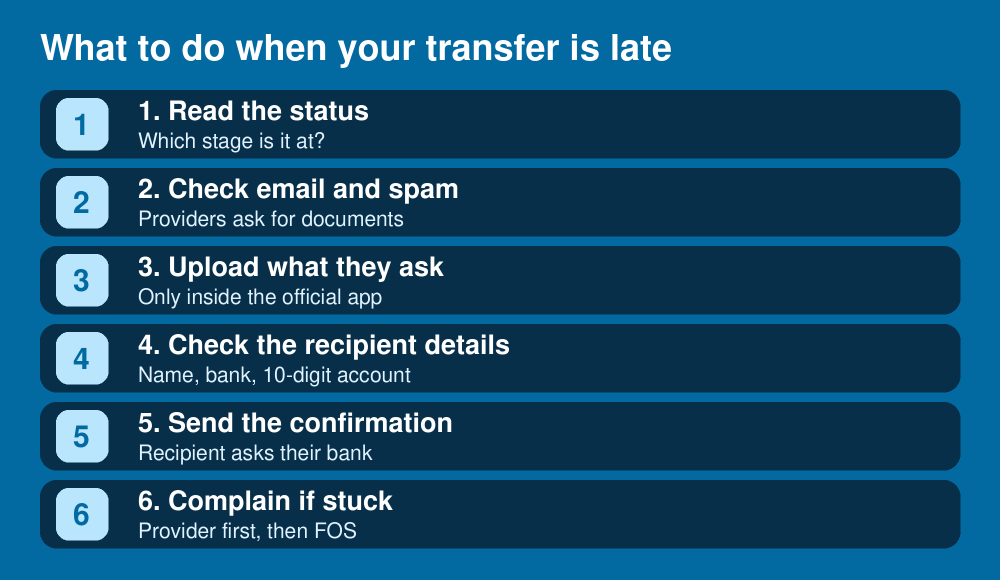
- Open the transfer in your app and read the status. Note the stage and the delivery estimate.
- Check your email, spam folder and the Activity section for a request from the provider.
- If it asks for documents, upload them straight away through the official route.
- Check the recipient’s name, bank and account number against what your family sees on their banking app.
- If the status says the money has been sent to the recipient’s bank, download the transfer confirmation (Wise calls it that) and send it to your family so their bank can search for the payment using the reference.
- If the estimate has passed with no explanation, contact the provider through its signed-in help page and ask which stage the transfer is at, whether any documents are needed, and for an updated estimate.
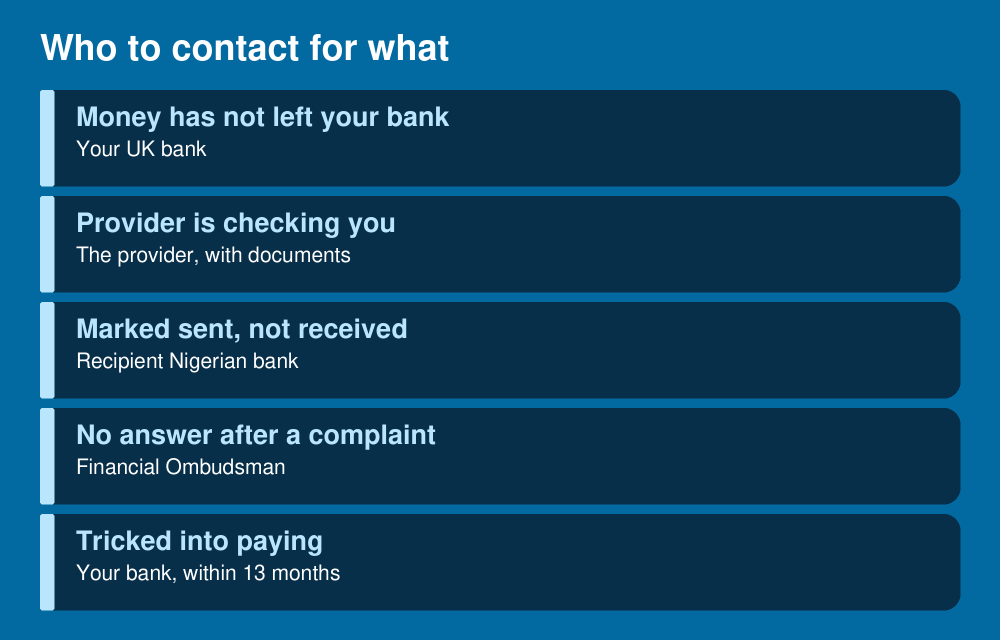
If you paid by bank transfer and the provider says it has not received your money, check you used the exact payment reference it gave you, and ask your UK bank to confirm the payment was sent and to trace it if needed. Before you have paid, you can usually cancel yourself. Once the money has entered the recipient’s banking system, a transfer generally cannot be cancelled.
For repeat sends, a few habits cut the risk. Verify your account before you need to send, so the ID check is done in advance. Save the recipient’s details once, correctly. Send on a weekday morning, not late on a Friday. For larger amounts, expect questions and have proof of source of funds ready, such as a payslip, sale agreement or savings statement. Our guide to sending money to Nigeria at Christmas covers the busy season in more detail.
If nobody solves it: the complaint route
If a regulated UK provider has not explained or fixed the delay, complain to it in writing first and keep your transfer number, screenshots and emails. The Financial Ombudsman Service says a firm must reply within 15 days, either with a response or to explain why it cannot yet, and must send its final response within 35 days. If you are unhappy with that response or it does not arrive in time, you can take the complaint to the Ombudsman, which is free. Check that your provider is authorised by the FCA before you send, since that is what gives you a complaints route.
If you were tricked into sending the money
A different set of rules applies if you were scammed, for example by someone posing as a relative, a landlord or a school. Since 7 October 2024 UK banks and payment firms must reimburse victims of authorised push payment scams over Faster Payments and CHAPS, up to £85,000 per claim. The rules cover payments made to another UK account, you must report the scam within 13 months of the last payment, and the firm may deduct an excess of up to £100. The Payment Systems Regulator says you can usually expect a decision within five business days and no later than 35 business days. If you lost more than £85,000, or you disagree with the outcome, the Financial Ombudsman Service can still look at your case. Contact your bank straight away if you think you have been scammed, and use the number on the back of your card.
These rules cover UK-account payments. A scam that involved a payment leaving the UK in another way may fall outside them, so tell your bank exactly how the money was sent.
Warning signs of a fake “transfer fix”
- Anyone who contacts you first offering to “release” a frozen transfer for a fee.
- A support number from a search advert or social post instead of the provider’s own app.
- Requests for your full card details, online banking password or a one-time passcode.
- Pressure to pay again to “unlock” the first payment.
- Messages saying the transfer is stuck because of an “anti-money-laundering fee” payable to an individual.
A genuine provider asks for documents inside its app or website. It does not ask you to pay an extra personal fee to release your own money.
Frequently asked questions
How long should a UK to Nigeria transfer take?
It depends on how you pay, the provider and any checks. Wise says the Nigerian leg usually completes the same working day once it has your money, but funding by bank transfer can take one to four working days. Use the estimate on your own transfer.
Why is my transfer on hold?
Usually because the provider wants to confirm your identity or the source of the money. Check your email and the provider’s app for a request. Wise says extra checks typically take 2 to 10 working days.
Can I cancel a delayed transfer?
Often yes, before the provider has sent the money on. After the money has gone into the recipient’s banking system, cancelling is generally not possible. Ask the provider what your options are.
My app says sent, but my family has nothing. What now?
Ask them to check their full transaction history, then give them the transfer confirmation with its reference so their bank can trace the credit. Also confirm their BVN and NIN are linked and match.
Who do I complain to?
Complain to the provider first. If you are unhappy with its final response, or it does not reply in time, you can refer the complaint to the Financial Ombudsman Service.
Can I get my money back if I was scammed?
If you were tricked into a Faster Payments or CHAPS payment to a UK account on or after 7 October 2024, you may be reimbursed up to £85,000. Report it to your bank as soon as you can.
Sources
- Wise Help Centre: Guide to NGN transfers
- Wise Help Centre: I’m expecting money, but it hasn’t arrived yet
- Wise: What affects transfer speed
- WorldRemit: Transfer processing
- WorldRemit: Money not received
- Afromium: How long a transfer to Nigeria takes (23 September 2026)
- Afromium: Why is my Wise transfer taking so long (22 September 2026)
- Boki: Sending money from the UK to Nigeria (6 November 2026)
- The Radar: Sending money from the UK to Nigeria (20 November 2026)
- Payment Systems Regulator: APP fraud reimbursement protections
- FCA: Fraudulent payments
- Financial Ombudsman Service: Scams where you’ve been tricked into making a payment
Join the discussion
Have you tried this, or do you have a question we did not answer? Be the first to share your experience. Leave a comment below. Every comment is read by the editor before it appears.




Editor note: has a transfer to Nigeria ever been held up for you or your family? Tell us which provider, how long it took and what finally fixed it. Please leave out account numbers, transfer references and other private details. – Ade