Education News Today, 18 November 2026: Allowance Overpayments to Be Recovered, UniCross Strike Off, US Student Stay Cap Scrapped

Last updated: 18 November 2026 · By Naijatipsland Editorial Team · Editorial policy
Morning roundup · Wednesday 18 November 2026 · By Ade Adeniyi, Founder and Editor
Good morning. Some university and polytechnic workers may soon see deductions from their pay, after the wages commission ordered tertiary institutions to claw back overpaid allowances. Lecturers at UniCross are back at work, the UniAbuja land row has taken another turn, lawmakers want corps members posted nearer home, and a US court has protected international students’ right to stay for the length of their studies.
Today at a glance
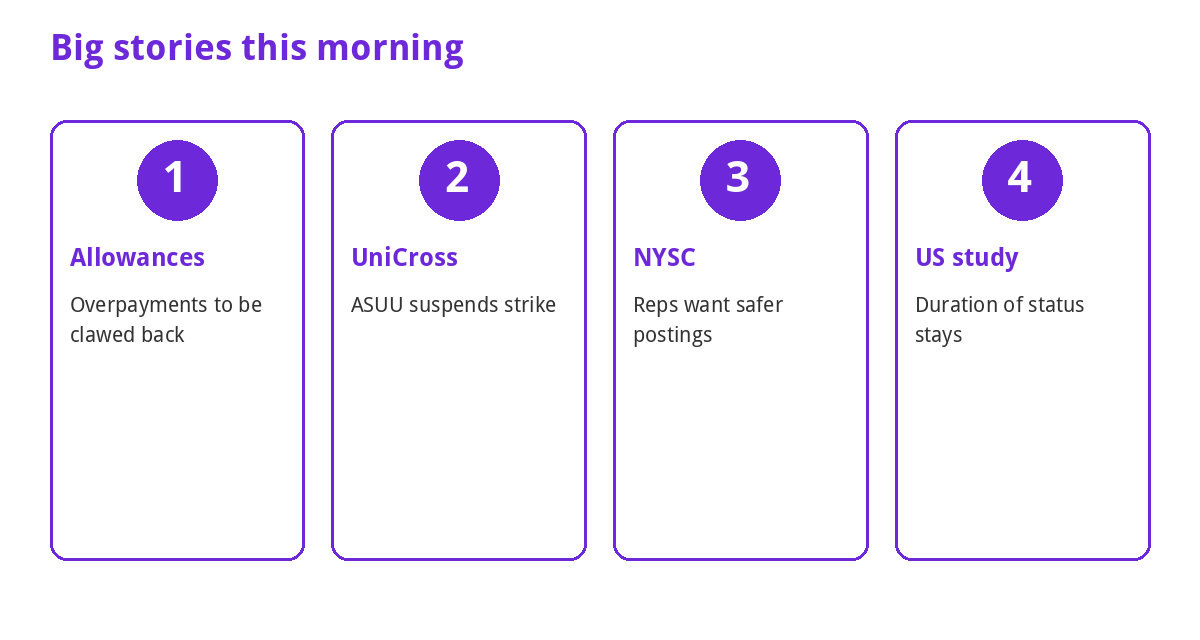
- Wages commission orders federal tertiary institutions to recover allowance overpayments within three months.
- ASUU at the University of Cross River suspends its strike.
- UniAbuja unions reject the FCT Administration’s account of the land reduction.
- Reps ask NYSC to post corps members closer to home where routes are unsafe.
- US court throws out the rule that would have capped student stays at four years.
1. Tertiary institutions told to recover overpaid allowances
What happened
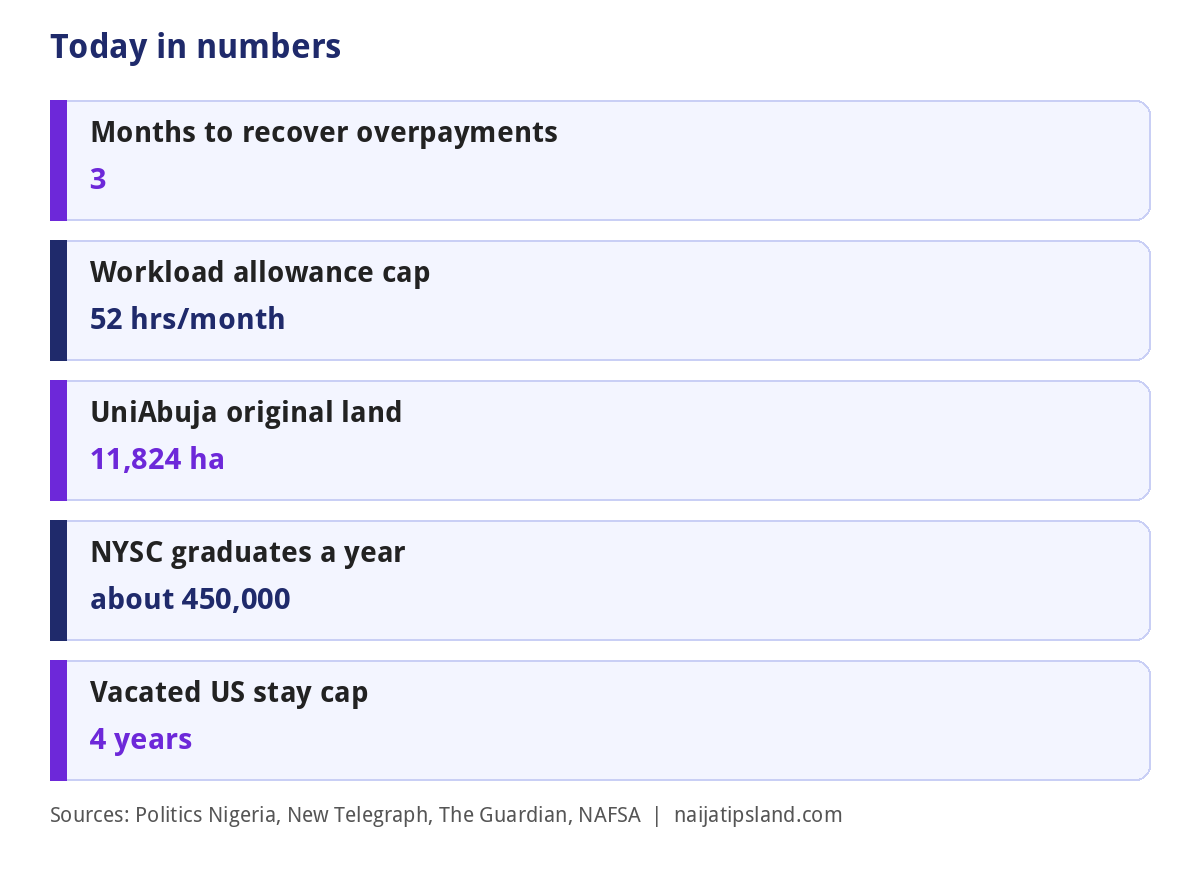
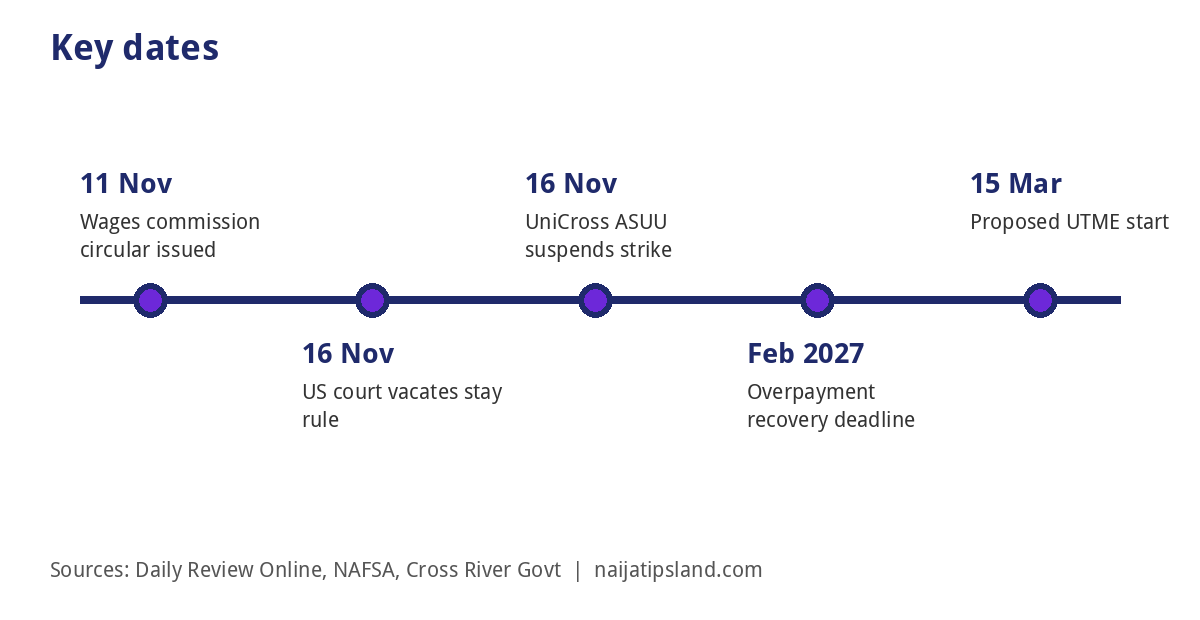
A circular dated 11 November from the National Salaries, Incomes and Wages Commission, signed by its chairman Junaid Bindawa, tells federal universities, polytechnics and colleges of education to recover any excess payments made under the 2025/2026 agreements with education unions within three months. It caps the Excess Workload Allowance for ASUU and NASU members in federal universities at 52 hours a month. It also says the academic tools allowance applies only to staff on the CONUASS and CONPCASS salary structures, which leaves out vice-chancellors, rectors, provosts and health workers on CONHESS and CONMESS. A coalition of health professionals in tertiary institutions has called the circular discriminatory and threatened to go to court.
Why it matters
Workers who were paid more than the commission says they should have been could see deductions before February. Disputes over how agreements are implemented have triggered strikes in the past, so students and parents should keep an eye on how the unions respond.
Source: Politics Nigeria; Daily Review Online.
2. UniCross lecturers suspend their strike
What happened
ASUU’s University of Cross River branch voted at an emergency congress on Monday 16 November to suspend the strike it resumed on 2 November. The state government says Governor Bassey Otu approved the new academic tools allowance and that September and October salaries have been paid. Branch chairman Patrick Ushie told the News Agency of Nigeria the suspension was in the interest of students and parents, but stressed that not all demands have been met, including some non-financial parts of the 2025 agreement and old check-off dues.
Why it matters
UniCross students lost two weeks of lectures. The session began on 19 October and the strike started two weeks later. Lectures should now resume, though the union has warned that unresolved issues could bring it back out.
Source: NewsVerge (NAN); Cross River State Government.
3. UniAbuja land row: unions reject the FCTA’s account
What happened
The Joint Action Committee of University of Abuja unions and students said on Tuesday that the 2016 technical committee report used to justify cutting the university’s land from 11,824.04 hectares was never endorsed by the university. They said the university rejected the proposal at an FCDA meeting in March 2022, and they want every allocation made on the land reversed and President Tinubu to step in. On Monday, Lere Olayinka, an aide to FCT Minister Nyesom Wike, said five of the 12 committee members came from the university, that the committee had recommended only 100 hectares, and that Wike instead approved 4,519.80 hectares. He also alleged the university had itself allocated 100 hectares to the EFCC without FCTA approval.
Why it matters
The two sides now disagree on basic facts, including whether the university took part in the review at all. Land meant for future campus growth is at stake, and the unions say the December 2025 ASUU agreement commits government to protecting university land.
Source: New Telegraph; TVC News.
4. NYSC: Reps want safer postings, camps are overflowing
What happened
The House of Representatives on Tuesday adopted a motion by Makki Yalleman asking NYSC to review its deployment policy so corps members can be posted closer to their home states where long journeys pass through unsafe routes. Committees were given six weeks to report back. Separately, Benue lawmaker Philip Agbese urged governors to expand orientation camps, pointing to more than 4,300 people sent to the Sagamu camp built for about 2,000 and over 11,000 deployed to Lagos. NYSC also said on Tuesday that Oyo corps members who passed out on 29 October have now received their delayed October allowance, which it blamed on a glitch in the federal payment system.
Why it matters
About 450,000 graduates are now mobilised every year, and the NYSC director-general expects that to reach 500,000 to 600,000. Any change to posting rules would affect every family with a graduate heading to camp. Our NYSC guide covers mobilisation, allowance and camp requirements.
Source: The Sun; The Guardian; Daily Post.
5. US court scraps four-year cap on student stays
What happened
A federal judge in Massachusetts on Monday 16 November vacated the Department of Homeland Security rule that would have replaced “duration of status” with fixed admission periods of up to four years for F-1 students and J-1 exchange visitors. The rule would also have forced students to apply to USCIS for more time and limited changes of course, transfers and second degrees. The court found the rule arbitrary and said its academic limits went beyond DHS’s legal powers. The case was brought by NAFSA, the Presidents’ Alliance and several unions. The government can still appeal.
Why it matters
Nigeria sends more students to the United States than any other African country. For now, Nigerians on F-1 visas keep the old rules: they can stay as long as they are enrolled and following their programme, including long PhDs, without filing extensions. Universities advise students to watch for an appeal.
Source: NAFSA; Brown University ISSS; Nixon Peabody.
What to watch next
- How ASUU, SSANU and NASU respond to the overpayment recovery order.
- House committee report on NYSC deployment, due within six weeks.
- Whether the US government appeals the duration of status ruling.
- Any presidential response to the UniAbuja land dispute.
- Opening date for JAMB 2027 UTME registration. The exam is proposed for 15 to 25 March 2027; see our JAMB updates page.
Frequently asked questions
Will university workers have money deducted from their salaries?
Possibly. The wages commission has told federal tertiary institutions to recover any overpayments within three months. How much, and from whom, depends on each institution’s calculations under the circular.
Do Nigerian students in the US need to apply for an extension of stay now?
No. With the rule vacated, duration of status still applies and students do not need to file with USCIS. Check with your school’s international office if you are unsure.
Is NYSC changing how corps members are posted?
Not yet. The House has only asked NYSC to review its deployment policy. Until NYSC announces a change, current posting rules apply.
This roundup summarises reporting by the outlets credited under each story, in our own words. Follow Naijatipsland Updates on WhatsApp for the next edition. Spotted an error? Tell us and we will correct it under our editorial policy.