

Last updated: 14 November 2026 · By Naijatipsland Editorial Team · Editorial policy
A fever that will not go away sends many Nigerians straight to the pharmacy or the lab asking for a “malaria and typhoid test”. It is such a common pairing that the two illnesses are often treated as one. They are not. Typhoid is a bacterial infection spread through contaminated food and water. Malaria is a parasite spread by mosquito bites. They need completely different medicines, and taking the wrong one wastes time while the real illness gets worse.
This guide explains how typhoid and malaria symptoms overlap and differ, why the commonly used Widal test can mislead, which tests are more reliable, and when to get urgent help. It is written for readers in Nigeria and for Nigerians in the UK who travel home. It is general information, not a diagnosis, and it does not replace seeing a doctor.
Why typhoid and malaria are so easy to confuse
The World Health Organization (WHO) says typhoid illness is “often clinically non-distinguishable from other febrile illnesses”. In plain English, the symptoms look like many other fevers, malaria included. A Nigerian Medical Journal study of adults with fever at a teaching hospital in Benin City made the same point: the signs of typhoid, such as fever, headache, joint pain, nausea, vomiting, constipation and diarrhoea, cannot be separated from other causes of fever such as malaria on symptoms alone.
That is why doctors rely on tests, and why guessing from how you feel is risky. For background on malaria warning signs that people often ignore, see our guide to 12 malaria symptoms Nigerians ignore.
Malaria: what the symptoms look like
The NHS lists these symptoms of malaria, noting that it “can be hard to spot”:
- a high temperature, or feeling hot, cold or shivery
- sweating
- headaches and feeling confused
- feeling very tired and sleepy, especially in children
- feeling and being sick, tummy pain and diarrhoea
- loss of appetite and muscle pains
- yellow whites of the eyes or skin (jaundice), although this may be less noticeable on brown or black skin
- a sore throat, cough and difficulty breathing
Symptoms usually appear between 7 and 18 days after an infected mosquito bite, but the NHS says they can sometimes appear months later and, rarely, years later. Malaria often shows as fevers that rise and fall in waves with shaking chills and heavy sweating, although this pattern is not reliable in every patient. The NHS describes malaria as an emergency that needs to be treated quickly with antimalarial medicines, because people can die from it if it is not diagnosed and treated in time.
Typhoid: what the symptoms look like
According to the NHS, typhoid fever symptoms usually begin within 3 weeks of infection but can take up to 6 weeks. They include:
- a high temperature that may slowly get worse over a few days
- headache, chills, aches and pains
- coughing
- feeling tired or sick and not feeling hungry
- constipation, or finding it hard to poo
- tummy ache and diarrhoea, which usually come after the other symptoms
- in some people, a rash of light-pink spots, usually on the upper body, which the NHS notes can be hard to see on black or brown skin
Medical guidance from Medecins Sans Frontieres describes the typical fever as one that gradually increases during the first week, stays high in the second week, and eases from the third or fourth week. Some patients also have a pulse that is slower than expected for the height of the fever, known as relative bradycardia. The WHO adds that typhoid can lead to serious complications and death if untreated, and that the risk of dying falls from around 10 to 30 per cent without treatment to about 1 to 4 per cent with appropriate treatment.
Side-by-side: how the two fevers often differ
Because there is so much overlap, treat the table below as a rough guide only. A doctor will not decide on this alone, and neither should you.
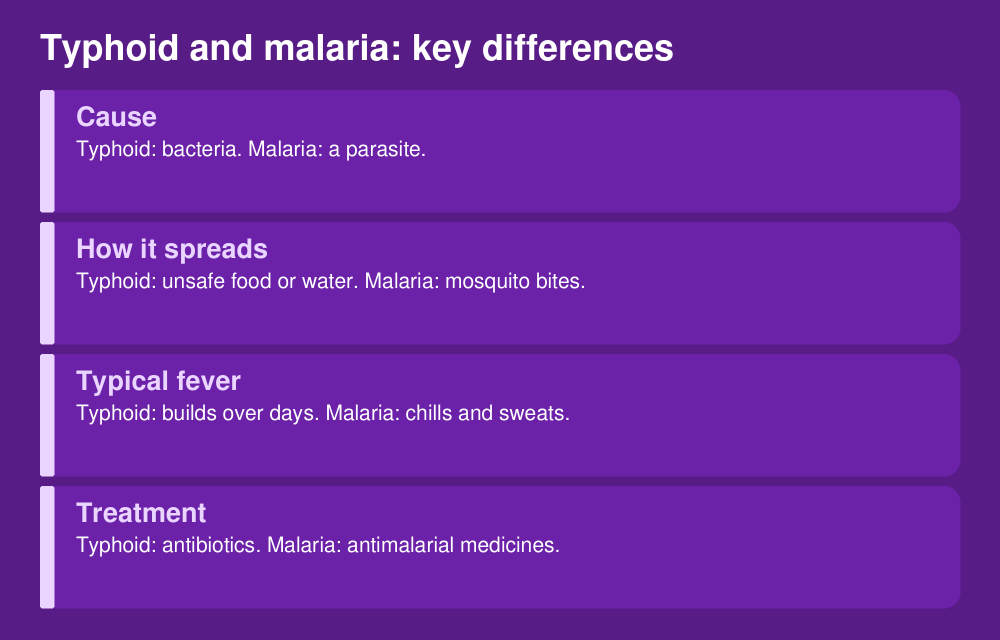
- Cause: typhoid is caused by Salmonella Typhi bacteria; malaria is caused by Plasmodium parasites.
- How you catch it: typhoid through food or water contaminated with faeces; malaria through the bite of an infected Anopheles mosquito.
- Fever pattern: typhoid tends to climb over several days and stay high; malaria tends to come in waves with chills and sweats.
- Tummy symptoms: constipation, loss of appetite and abdominal pain are especially linked to typhoid. A Nigerian study of 810 patients with suspected typhoid found anorexia, constipation, abdominal pain, an enlarged spleen and a slow pulse were the features that differed significantly in confirmed cases.
- Treatment: typhoid needs antibiotics chosen by a doctor; malaria needs antimalarial medicines. Antibiotics do not treat malaria, and antimalarials do not treat typhoid.
The Widal test problem
In many Nigerian clinics and laboratories, typhoid is still diagnosed with the Widal test, which looks for antibodies in the blood rather than the bacteria itself. Researchers have repeatedly warned that a single Widal result is not a dependable answer:
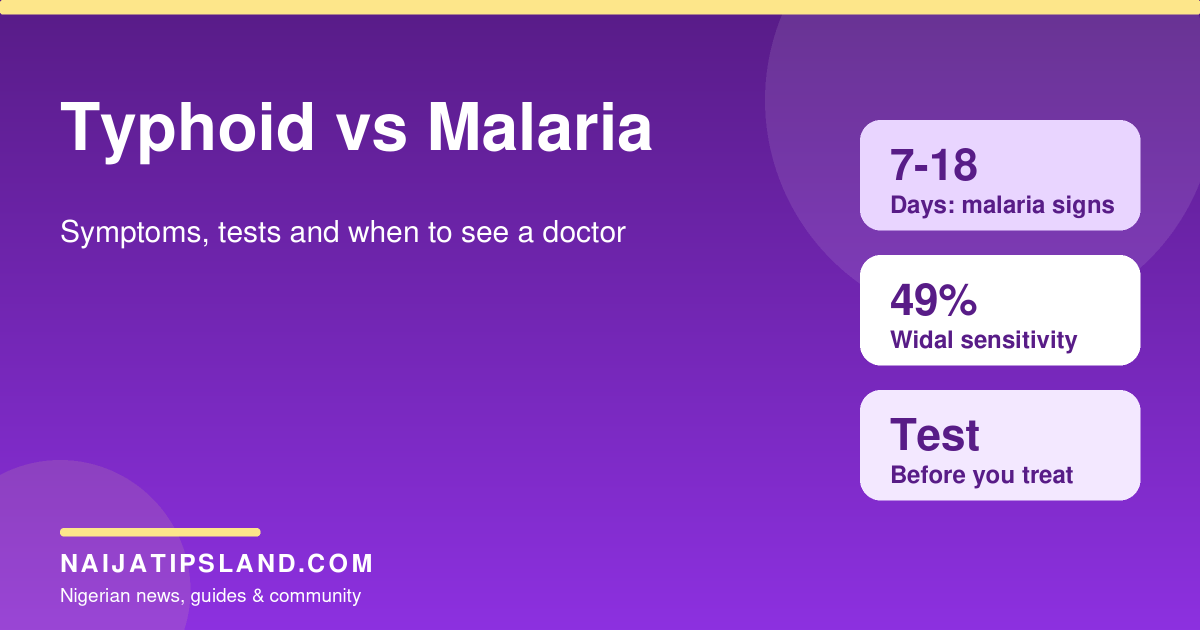
- A study published in the Malawi Medical Journal tested 810 febrile Nigerian patients with suspected typhoid. Only 14.1 per cent had a positive blood, stool or urine culture. The Widal test picked up only 49.1 per cent of true cases (sensitivity) and was right about 90.7 per cent of those without typhoid (specificity). The authors concluded the test “performed poorly” and that malaria was the more common cause of fever, with a high rate of false-positive Widal results among people who had malaria parasites in their blood.
- A University of Benin Teaching Hospital study of 271 adults found 45.8 per cent were Widal-positive but only 22.1 per cent grew Salmonella on blood culture. It reported a Widal sensitivity of 35 per cent and a specificity of 51 per cent, and concluded that a single Widal test “is not a valid diagnostic option” for typhoid.
- A Dartmouth literature review titled “Dispelling the malaria-typhoid co-infection myth in Nigeria” argues that the belief that most feverish patients have both diseases may be misleading because of the limits of the Widal test, which cannot tell a past infection, a current infection or typhoid vaccination apart.
In practice, this means a positive Widal result on its own does not prove you have typhoid, and a patient told they have “malaria and typhoid” may have only one of them, or neither. If you were told you have both, it is reasonable to ask what exactly was tested and whether a blood culture or a malaria rapid test was done.
Which tests to ask for
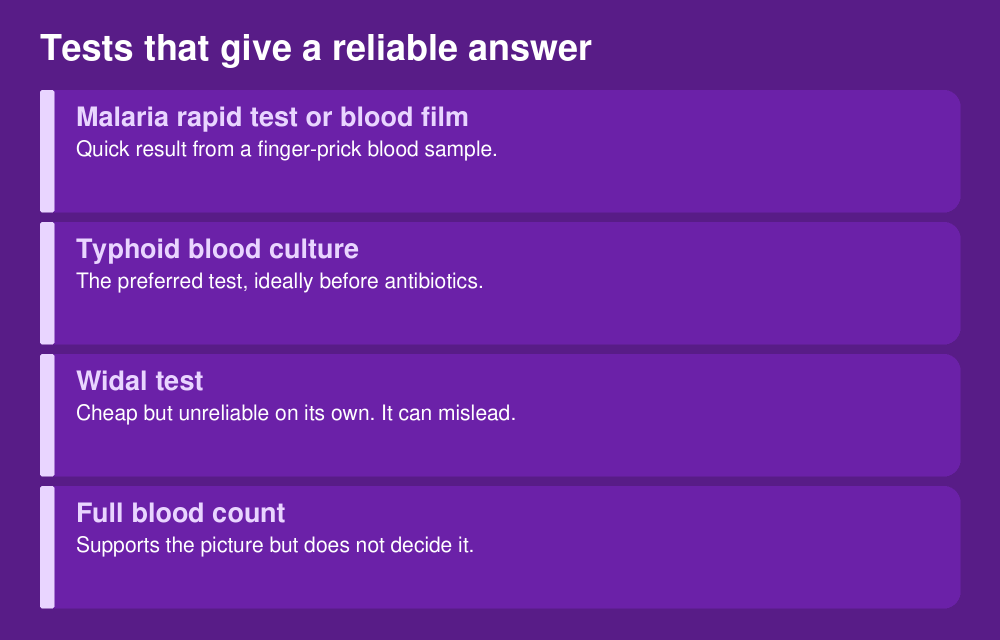
For malaria: a rapid diagnostic test or a blood film under the microscope (thick and thin smear) gives a dependable result, often within the hour. This is the standard way to confirm malaria in a patient with fever, and it also shows how heavy the infection is.
For typhoid: the WHO says blood culture is the preferred laboratory method in most places where typhoid is common, and that current antibody tests lack specificity. Blood cultures work best early in the illness and ideally before antibiotics are started. Culture can also show which antibiotics will work, which matters because the WHO warns that antibiotic resistance, including extensively drug-resistant strains, is making treatment harder in the most affected regions. If no culture is possible, the WHO advises checking for other local causes of fever and watching how the patient responds to treatment.
Other tests: a full blood count can support the diagnosis, but it does not decide it. In places where both diseases are common, doctors may test for both at the same time, particularly if a fever does not improve with first treatment.
What treatment looks like (and why you should not self-treat)
The NHS says typhoid fever is treated with antibiotics, sometimes with medicine to lower the temperature, and that you may still have a high temperature for around 5 days after starting treatment. It stresses finishing the whole course even if you feel better, because symptoms can return, usually within 2 weeks of finishing treatment. MSF guidance explains that the choice of antibiotic depends on how resistant local strains are, so the right drug and dose is a decision for a doctor, not something to copy from a friend.
Malaria is treated with antimalarial medicines prescribed according to national guidelines, and people with severe malaria need hospital care. Buying antibiotics or antimalarials over the counter without a test can hide the real cause, encourage resistance and delay the correct treatment. For general advice on other common illnesses, see our guide on natural remedies for common illnesses in Nigeria, which also explains when home care is not enough.
Complications and when to get urgent help
Untreated typhoid can lead to internal bleeding or an infection of the lining of the tummy (peritonitis), according to the NHS. The NHS says to call 999 or go to A&E in the UK if you have:
- a sudden stomach pain that keeps getting worse
- black or dark red poo
- vomit with blood in it, or vomit that looks like ground coffee
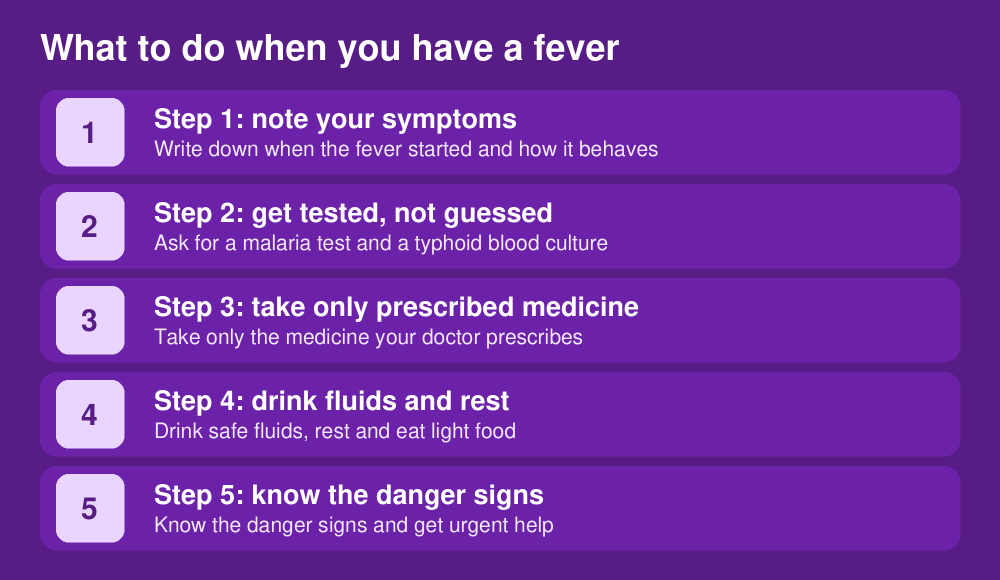
In Nigeria, go to the nearest hospital or emergency unit for the same signs. For malaria, seek urgent care for confusion, extreme sleepiness, difficulty breathing, repeated vomiting, yellowing of the eyes or skin, very dark urine or fits. Young children and pregnant women can become seriously ill quickly and should not wait.
If you have travelled to Nigeria from the UK
Many readers live in the UK and visit Nigeria. The NHS says that if you have malaria symptoms and have travelled to a country where malaria is found in the last 12 months, you should ask for an urgent GP appointment or get help from NHS 111. Government travel guidance advises seeking medical help for a fever during or after travel, even weeks or months later, and telling the doctor where you have been. The same applies to typhoid: the NHS advises getting help from NHS 111 if you have travelled to an area with typhoid and feel unwell, even if you have been vaccinated.
Before you travel, speak to your GP, nurse or a travel clinic about malaria tablets, bite avoidance and the typhoid vaccine. The NHS says the typhoid vaccine is available free on the NHS for travellers who need it. The UK health protection advice for malaria is easy to remember as ABCD: be aware of the risk, avoid bites, take preventive tablets if advised, and seek a prompt diagnosis if you get a fever.
How to lower your risk
- Typhoid: drink treated, boiled or bottled water, wash hands with soap after using the toilet and before eating, wash and cook food well, and avoid food prepared in unhygienic conditions. People recovering from typhoid should not prepare food for others until a doctor confirms they are clear, because some people carry the bacteria after they feel better.
- Malaria: sleep under an insecticide-treated net, use repellent, close or screen windows, clear standing water around the home, and follow your clinician’s advice on preventive medicine if you are travelling or pregnant.
- Vaccines: typhoid conjugate vaccines are recommended by the WHO and are used in several African countries. A 2026 review in Discover Public Health says Nigeria had not yet introduced them nationally, so ask a doctor or pharmacist about typhoid vaccination options that are available to you.
You may also find it useful to read our guide to food myths Nigerians believe, which covers safe food habits alongside common health misconceptions.
FAQ
Can you have typhoid and malaria at the same time?
Yes, it is possible, but it is probably less common than people think. Researchers say the widespread belief in malaria-typhoid co-infection is partly due to false-positive Widal results. The only way to know is proper testing for each illness.
Is a positive Widal test enough to confirm typhoid?
No. Nigerian studies show the Widal test has low sensitivity and can give false positives after past infection, vaccination or malaria. Blood culture is the preferred test.
Which has a higher fever, typhoid or malaria?
Either can cause a high temperature. The pattern can differ, with typhoid often building over days and malaria often coming in waves, but this is not a rule you can rely on at home.
Can I treat both at once to be safe?
Do not self-medicate. Taking antibiotics and antimalarials without testing can mask the true cause, waste money and add to antibiotic resistance. A doctor can decide whether treatment for both is justified in your case.
How long does it take to recover?
It depends on the illness, how early it was treated and the patient’s health. The NHS says fever can last around 5 days after antibiotics begin in typhoid, and MedlinePlus says symptoms usually improve in 2 to 4 weeks with treatment. Malaria treatment is usually quicker, but severe malaria needs hospital care.
Who is most at risk of severe disease?
Young children, pregnant women, older adults and people with other health conditions. They should be seen early and not left to wait out a fever.
This article is general information and not medical advice. It does not diagnose any condition. If you or someone you care for has a fever, see a doctor, nurse or pharmacist, and get urgent help immediately if there are any danger signs.
Sources
- NHS: Typhoid fever
- NHS: Malaria
- WHO: Typhoid fact sheet
- WHO: Typhoid health topic
- WHO: Typhoid surveillance standards
- Ohanu et al., Malawi Medical Journal (2019): Typhoid fever among febrile Nigerian patients, Widal test performance and antibiotic resistance
- Nigerian Medical Journal (2016): Widal test, blood culture and malaria co-infection at University of Benin Teaching Hospital
- Dispelling the Malaria-Typhoid Co-infection Myth in Nigeria: A Literature Review
- Medecins Sans Frontieres: Enteric (typhoid and paratyphoid) fevers
- MedlinePlus: Typhoid fever
- GOV.UK: Malaria health advice for travellers
- Discover Public Health (2026): Systemic barriers and strategies for typhoid conjugate vaccine introduction in Nigeria
Join the discussion
Have you tried this, or do you have a question we did not answer? 1 reader has already shared their view. Naijatipsland members help each other with real, first-hand experience.






Editor’s note: this guide is general information based on NHS, WHO and published Nigerian studies, and is not medical advice or a diagnosis. Typhoid and malaria can both be serious, and only a test can tell them apart. If you or your child has a fever that is getting worse, see a doctor the same day and tell them about any recent travel. – Ade