
Best Cryptocurrency Exchanges in Nigeria After the SEC and CBN Rules (November 2026): Who Is Approved and How to Stay Safe

Last updated: 12 November 2026 · By Naijatipsland Editorial Team · Editorial policy
Nigeria has one of the most active crypto markets in the world, but the rules have changed more in the past two years than in the decade before. In 2026, the Investments and Securities Act 2025 brought crypto firmly under the Securities and Exchange Commission (SEC), the SEC expanded its incubation programme for exchanges, and on 5 November 2026 the Central Bank of Nigeria (CBN) brought in a new rulebook for stablecoins, wallets and peer-to-peer (P2P) trading.
So which exchanges can you actually use, and what does “approved” mean? This guide explains the current position in plain terms, lists the firms the SEC has admitted, and sets out how to use any exchange more safely. It is information, not investment advice: crypto is high-risk, and prices can fall fast.
The short answer
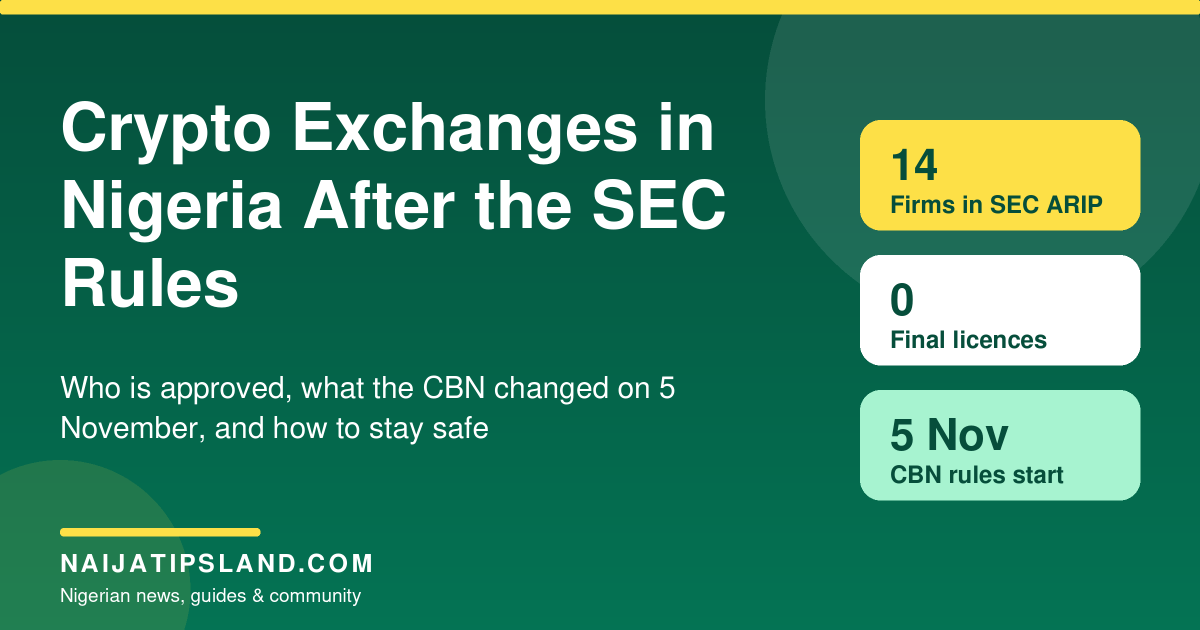
- No crypto firm in Nigeria holds a final SEC licence yet. In late October 2026, the SEC said publicly that no digital asset operator has obtained final registration.
- 14 firms are in the SEC’s Accelerated Regulatory Incubation Programme (ARIP) with an Approval-in-Principle, which allows limited, conditional operation.
- Busha and Quidax are the two firms the SEC itself lists as digital asset exchanges. Others admitted include Luno Nigeria, KuCoin Nigeria and Yellow Card.
- New CBN rules from 5 November 2026 require licences for stablecoin, wallet, transfer and P2P services, with 180 days for existing firms to apply.
What changed: the SEC, ISA 2025 and ARIP
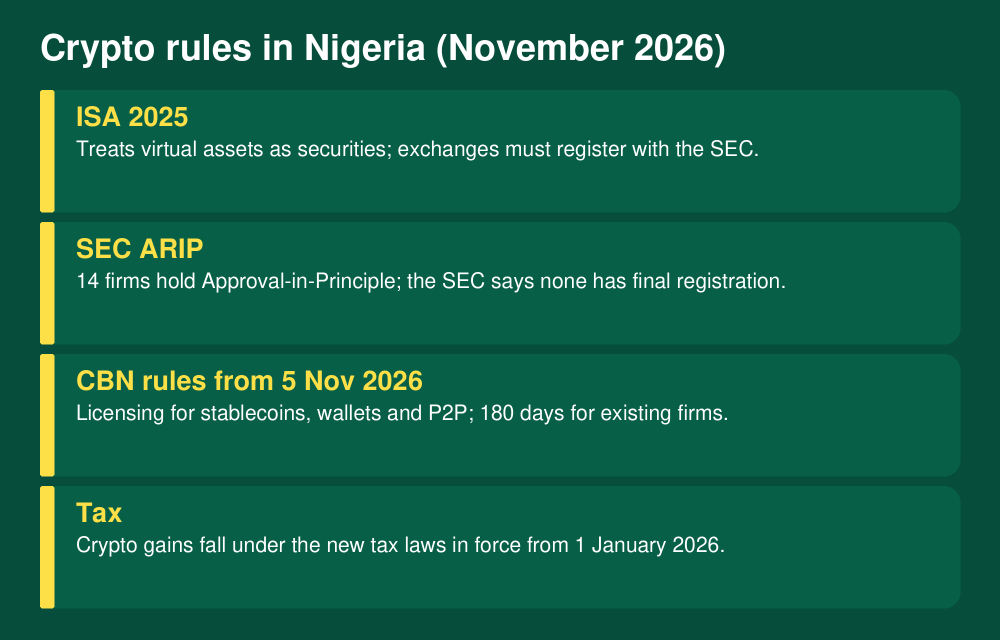
The Investments and Securities Act 2025 expanded the legal definition of securities to include virtual assets such as cryptocurrencies and tokens, and requires virtual asset service providers (VASPs) and exchanges to register with the SEC. The SEC’s earlier digital asset rules set out licence types for exchanges, custodians and offering platforms.
Because full registration has been slow, the SEC created ARIP in 2024. Firms admitted to the programme receive an Approval-in-Principle that lets them operate within a restricted scope while the SEC watches them closely. In October 2026 the SEC was blunt about what this means: an approval in principle is not a final operating licence, it is conditional on continuous compliance, and it can be withdrawn. Participants must stay within the activities they presented to the SEC, are barred from promotional activity, and face regular reporting and inspections.
The SEC also raised the minimum capital for digital asset exchanges from ₦500 million to ₦2 billion. New applicants must meet the higher figure, and existing operators have until 30 June 2027.
The firms in the SEC’s programme
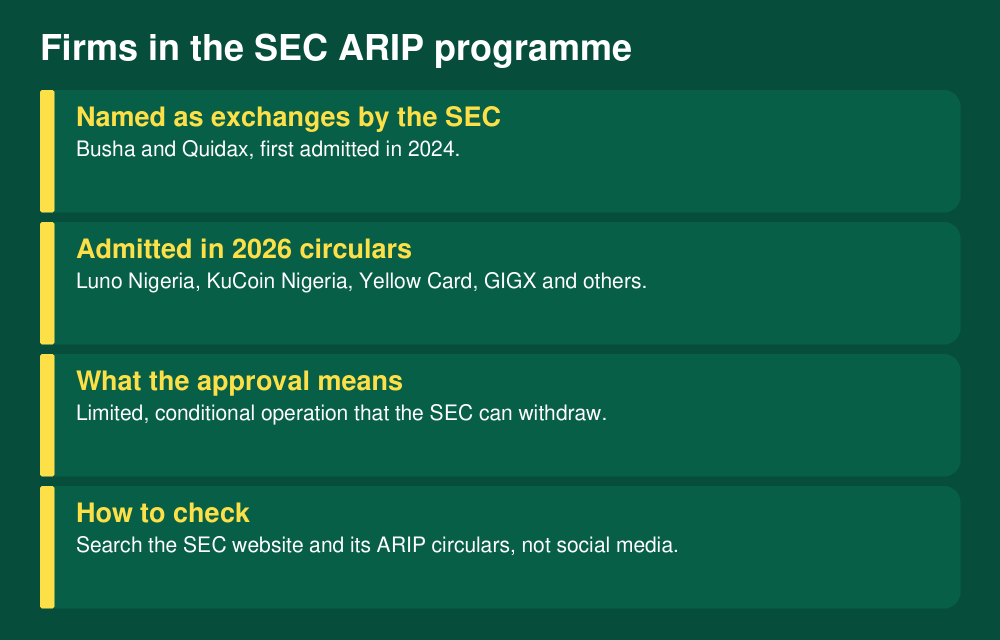
Busha and Quidax were the first exchanges admitted, in 2024. Three SEC circulars in 2026 grew the programme to 14 firms. Based on the SEC’s published lists, as compiled by trackers in October and November 2026, the firms are:
- Busha (Busha Digital Limited): listed by the SEC as a digital assets exchange
- Quidax (Quidax Technologies Limited): listed by the SEC as a digital assets exchange
- Bitbarter, Blockvault, GetEquity, KoinKoin, Luno Nigeria, Trovotech, Wrapped CBDC (the cNGN stablecoin), GIGX, KuCoin Nigeria, BC Access (Nigeria), Pisi Payments and Yellow Card
The 2026 circulars name these firms but do not all say which services each was admitted for, so do not assume every one is an exchange. Admission is also not an endorsement of any product, price or investment. Always check the SEC’s own website and circulars for the current list, because firms can be added or removed.
Global platforms that are not on the list may still be reachable from Nigeria, but using them carries extra risk: you have no Nigerian regulator to complain to, and services can be cut off with little notice, as Nigerians saw in 2024 when Binance stopped naira trading.
What the new CBN rules mean for you
On 5 November 2026, the CBN’s Regulations for the Operations of Non-Security Virtual Assets in Nigeria took effect. The SEC still covers crypto treated as securities and investments; the CBN now covers the payment side, including stablecoins, wallets, transfers, remittances and P2P trading. Key points for ordinary users:
- Licences are required. Issuing, exchanging or facilitating regulated virtual assets without CBN authorisation is prohibited, including for foreign firms targeting Nigerians. Existing operators have 180 days to apply.
- P2P platforms need approval and must run customer checks and transaction monitoring. TechCabal reported that the CBN wants crypto P2P payments linked to bank transactions.
- Stablecoins need reserves. Issuers must hold full reserves, cannot pay interest to holders, and must let customers redeem at face value. Algorithmic stablecoins are banned.
- Stablecoins are not bank deposits and are not protected by NDIC deposit insurance.
- Complaints have deadlines. Licensed operators must acknowledge complaints within two business days and give a final response within 20 business days.
- High capital requirements: ₦15 billion for dollar-backed stablecoin issuers, ₦10 billion for naira-backed issuers and ₦1 billion for other service providers.
In practice, expect apps to tighten identity checks, change P2P features and possibly pause some services while they apply for licences.
How to choose an exchange
Because no exchange has a final licence, “best” here means the one that gives you the most protection and the fewest surprises. Ask these questions:
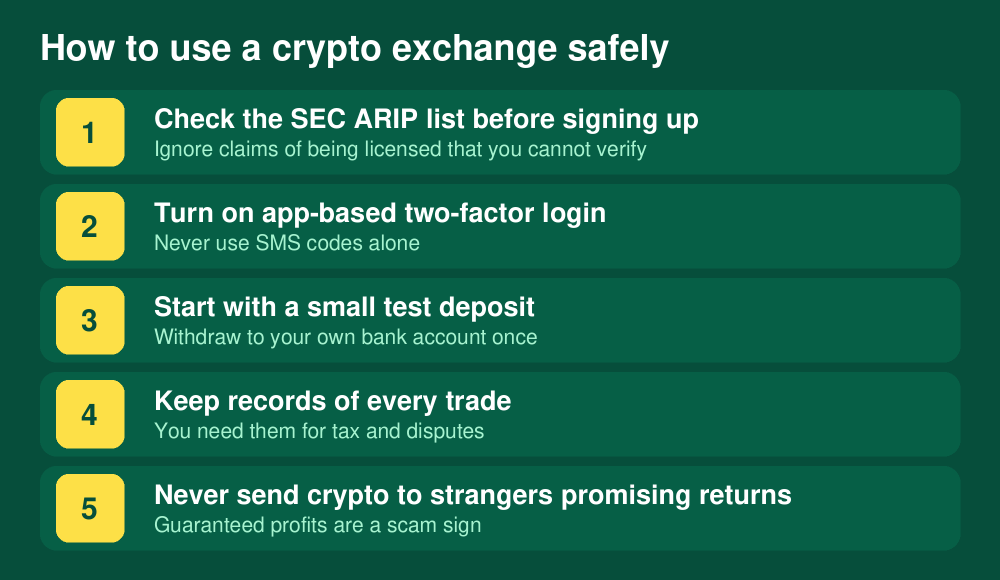
- Is it on the SEC’s ARIP list? Check the SEC website yourself. Be wary of any app that calls itself “fully licensed”.
- Does it have a Nigerian company and support? Local incorporation, a physical address and responsive support matter when something goes wrong.
- What are the real costs? Compare the trading fee, the spread between buy and sell prices, and deposit and withdrawal charges. Spreads can cost more than the advertised fee.
- How do naira deposits and withdrawals work? Prefer direct bank transfers in your own name over arrangements involving strangers.
- What security does it offer? App-based two-factor authentication, withdrawal address whitelisting and clear policies on how customer assets are held.
If you are new to crypto, read our explainer on how cryptocurrency works and Nigeria’s rules first, and our step-by-step guide on how to buy Bitcoin and USDT in Nigeria.
Tax on crypto in Nigeria
Under the new tax laws in force from 1 January 2026, virtual assets are taxable and service providers have reporting duties to the tax authority. Gains from selling or swapping crypto can be taxable. Keep a record of every purchase, sale and transfer, with dates and naira values, and speak to a tax adviser if you trade regularly or in large amounts.
Common crypto scams to avoid
- “Guaranteed” daily returns from trading bots, mining pools or “account managers”. Nobody can guarantee crypto profits.
- Fake exchange apps and websites that copy real brands. Download apps only from official stores and check the developer name.
- P2P traps, such as fake payment screenshots or reversed transfers. Release crypto only when the money is confirmed in your own account.
- Recovery scams promising to get back money you lost, for a fee.
Our guide to safer investment options for beginners compares crypto with lower-risk choices such as money market funds and Treasury bills.
Frequently asked questions
Is crypto legal in Nigeria?
Yes. Crypto is regulated rather than banned. The ISA 2025 puts virtual assets under the SEC, and from 5 November 2026 the CBN also licenses stablecoin, wallet, transfer and P2P services. Firms must be authorised by the relevant regulator.
Which crypto exchanges are licensed in Nigeria?
None holds a final licence yet. 14 firms are in the SEC’s ARIP programme with a conditional Approval-in-Principle, and the SEC lists Busha and Quidax as digital asset exchanges. Check the SEC website for the current list.
Is my money protected if an exchange fails?
Crypto held on an exchange is not covered by NDIC deposit insurance, and stablecoins are explicitly not bank deposits. That is why it matters to use firms under Nigerian supervision, keep only what you need on any platform and never invest money you cannot afford to lose.
Can I still use P2P trading?
P2P trading continues, but under the CBN’s new rules P2P platforms need approval and must run identity checks and monitoring. Expect stricter verification and changes to how payments are made.
Sources
- Nairametrics: SEC says no digital asset operator has final registration under ARIP (29 October 2026)
- VASP Tracker: SEC Nigeria ARIP list (October 2026)
- BusinessDay: What the CBN’s new crypto rules mean for your wallet (November 2026)
- Legit.ng: CBN sets capital requirements for stablecoins (November 2026)
- The Block: Nigeria’s central bank introduces stablecoin licensing rules (6 November 2026)
- Afriwallstreet: SEC raises exchange capital to ₦2 billion (July 2026)
- Global Legal Insights: Fintech laws and regulations 2026, Nigeria
- Securities and Exchange Commission Nigeria







Editor’s note: this is not investment advice. Crypto prices can fall sharply, and in Nigeria no exchange yet holds a final SEC licence. If you choose to use one, check the SEC’s own lists and never invest money you cannot afford to lose. – Ade