
How to Get a Mortgage in Nigeria (2026): NHF Loan, Bank and MREIF Options, Requirements and Costs

Last updated: 11 November 2026 · By Naijatipsland Editorial Team · Editorial policy
Owning a home in Nigeria usually means saving for years and building in stages. A mortgage lets you move in earlier and spread the cost over many years. Nigeria’s mortgage market is still small, but there are now three realistic routes for ordinary earners: the National Housing Fund (NHF) loan from the Federal Mortgage Bank of Nigeria (FMBN), the single-digit MREIF mortgages sold through banks, and conventional loans from banks and primary mortgage banks. This guide explains how each works in 2026, who qualifies, what documents you need and what you will really pay each month.
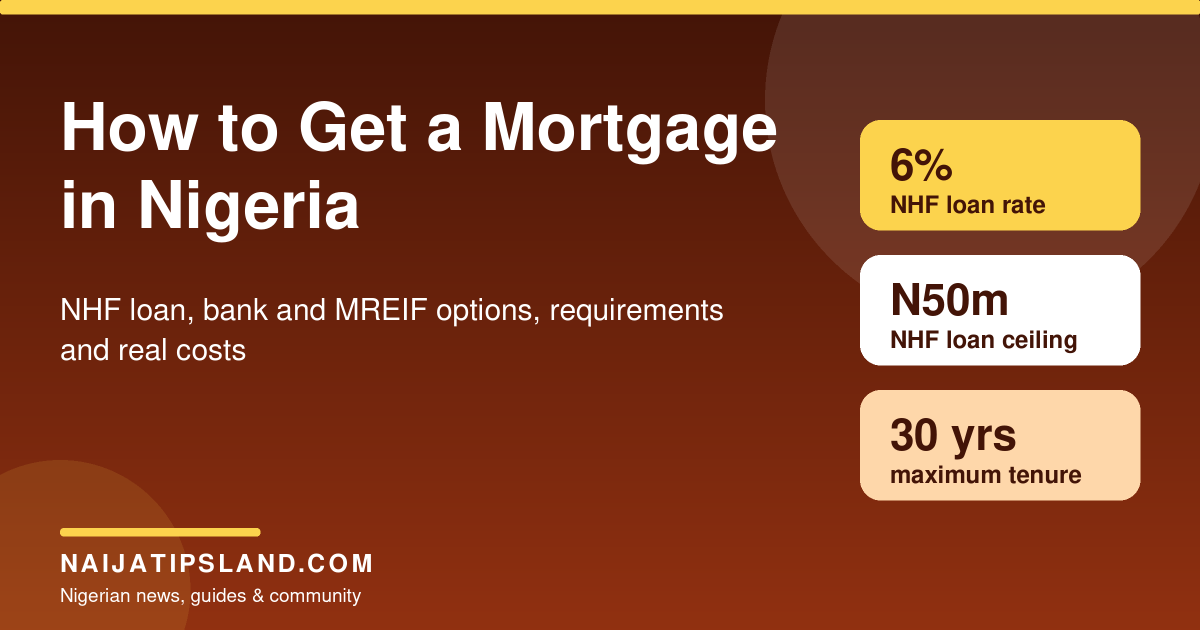
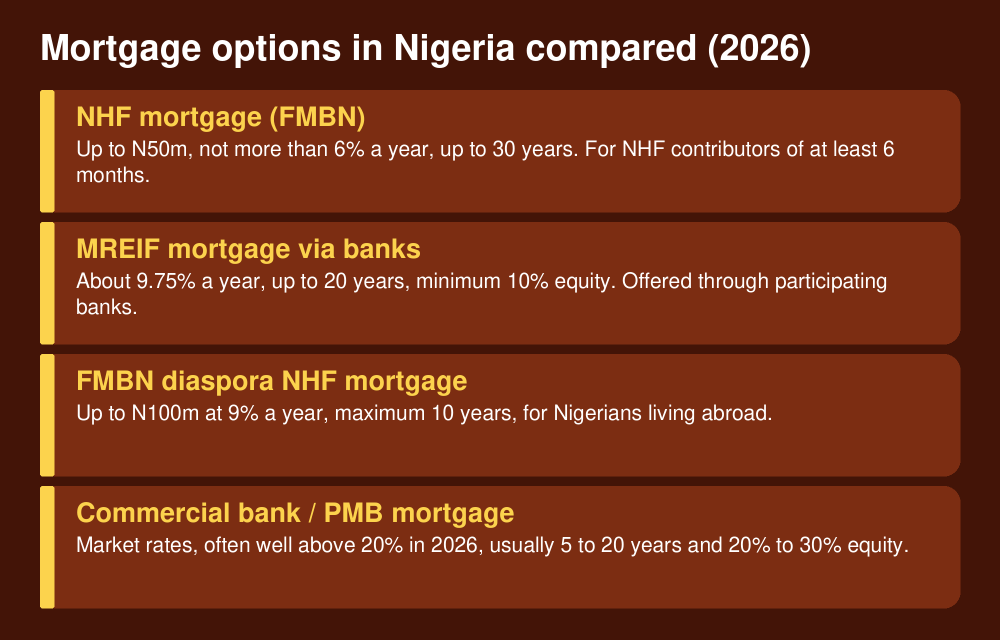
Quick answer: if you are a salary earner contributing to the NHF, the cheapest option is an NHF mortgage of up to N50 million at not more than 6% a year over up to 30 years, applied for through an FMBN-accredited primary mortgage bank after at least six months of contributions. If you need more, or you do not qualify, ask participating banks about MREIF home loans at about 9.75% for up to 20 years. Nigerians abroad can apply for FMBN’s diaspora mortgage of up to N100 million at 9%.
Option 1: The NHF mortgage (cheapest)
The National Housing Fund is a savings scheme set up by law in 1992. Workers contribute a small share of their monthly basic salary (2.5% under the NHF Act), usually deducted by their employer, and self-employed people can register and contribute directly. In return, contributors can borrow from the fund once in a lifetime at a low, fixed rate.
Key terms in 2026
- Maximum loan: N50 million (raised from N15 million). The amount you actually get depends on your income, your ability to repay and the property value.
- Interest rate: not more than 6% a year, as set by the NHF Act.
- Tenure: up to 30 years.
- Uses: buying a home, building, home improvement and renovation.
- Eligibility: Nigerian, at least 18 years old, a registered NHF contributor for at least six months, with evidence of regular income to repay.
In October 2026 the Minister of Housing and Urban Development proposed raising the maximum NHF mortgage to N85 million and directed FMBN to lend at least 70% of the previous year’s NHF contributions as mortgages. Treat the higher ceiling as a proposal until FMBN confirms it. FMBN collected N152.4 billion in NHF contributions in 2025 and said in October 2026 that it had approved N208 billion in housing loans financing 6,911 homes.
How to apply for an NHF mortgage
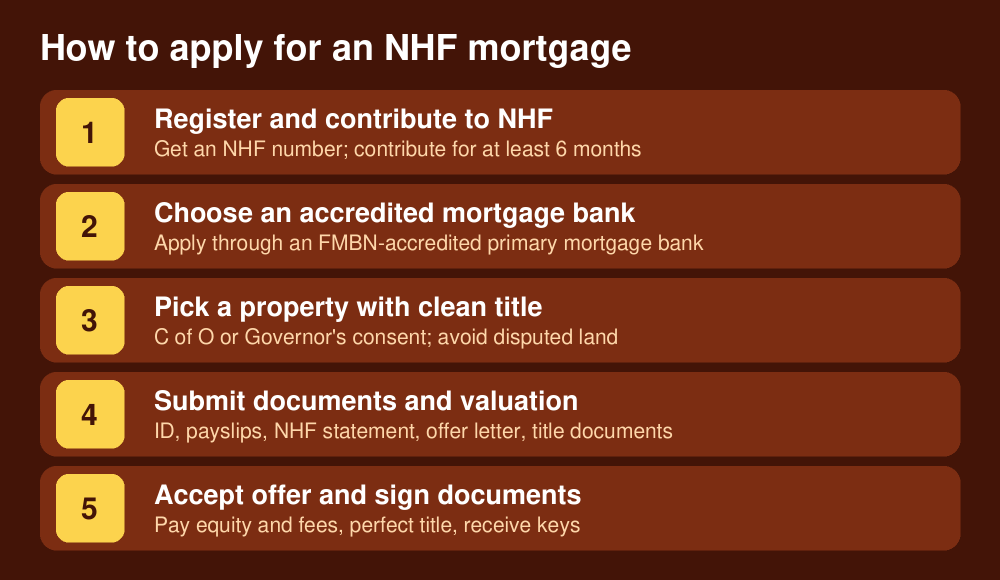
- Register with the NHF and contribute. Ask your HR or payroll team for your NHF number and check your contribution statement with FMBN. If you are self-employed, register directly. You need at least six months of contributions before applying.
- Choose an FMBN-accredited primary mortgage bank (PMB). NHF loans are not paid to you directly; FMBN lends through accredited mortgage banks, which handle your application.
- Find a suitable property. It must have a clean, registrable title such as a Certificate of Occupancy (C of O) or Governor’s consent, and pass the lender’s valuation. FMBN-backed estates and developer schemes can speed things up.
- Submit your documents. The PMB will review your income, run credit checks and value the property.
- Accept the offer, pay your equity and fees, and complete title perfection. Repayments are usually deducted from your salary.
Documents you will usually need
- Completed application form from the PMB
- Valid ID (NIN slip, international passport or driver’s licence), BVN and passport photographs
- NHF registration number and contribution statement
- Letter of employment or confirmation, recent payslips and six to twelve months of bank statements
- For the self-employed: CAC documents, tax clearance and audited accounts or bank statements
- Property documents: title deed, survey plan, building plan approval and offer letter or sale agreement
- Valuation report and, for construction loans, a bill of quantities
Option 2: MREIF mortgages through banks (about 9.75%)
The Ministry of Finance Incorporated (MOFI) Real Estate Investment Fund, known as MREIF, provides long-term funds to participating banks so they can offer single-digit mortgages. When FirstBank and MOFI unveiled their scheme in January 2026, they described loans of up to 20 years at about 9.75% a year, a minimum equity contribution of 10%, and refinancing through the Nigeria Mortgage Refinance Company (NMRC). One bank’s MREIF product described in August 2026 offered loans from N10 million to N100 million with a minimum property value of N12.5 million.
MREIF loans suit salary earners and business owners who want more than the NHF ceiling or who do not contribute to the NHF. Ask your bank whether it participates, which estates or developers it accepts, and how long approval takes.
Option 3: Commercial bank and mortgage bank loans
Conventional mortgages are priced at market rates. Even after the CBN cut its benchmark rate from 26.5% to 23% in September 2026, banks were slow to lower lending rates: ThisDay reported that the average maximum lending rate actually rose to 32.62% in October 2026. Expect rates well above 20%, tenures of about five to 20 years and equity of 20% to 30% of the property price. These loans can still make sense for higher earners buying quickly or bridging until an NHF or MREIF loan is approved, but compare the total cost carefully.
Option 4: FMBN diaspora mortgage
FMBN launched its Diaspora NHF Mortgage Loan in London on 7 August 2026. It offers up to N100 million at 9% a year with a maximum tenure of 10 years. Applicants register under the NHF and complete KYC remotely, so you do not need to travel home to apply. If you live abroad, also read our guides to investing in Nigerian real estate from abroad and building a house in Nigeria from the diaspora.
What will you really pay each month?
The table below shows the approximate monthly repayment on a N30 million loan at different rates, using a standard repayment formula. Your lender’s figures may differ slightly because of fees and insurance.
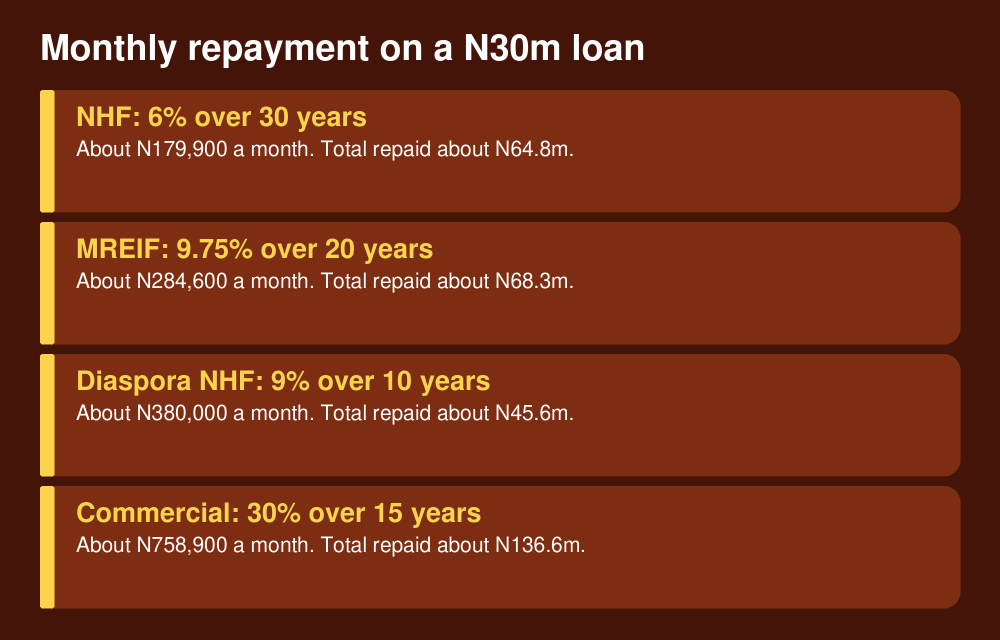
The difference is huge. An NHF loan at 6% costs about N179,900 a month over 30 years, while a commercial loan at 30% over 15 years costs about N758,900 a month for the same amount. Most lenders want repayments to stay within roughly a third of your monthly income, so an NHF loan of N30 million suits someone earning around N550,000 to N600,000 a month or more.
Other costs to budget for
- Equity contribution: often 10% for MREIF and higher for commercial loans; NHF requirements depend on the loan size and lender.
- Valuation, legal and processing fees charged by the mortgage bank.
- Title perfection: Governor’s consent, registration and stamp duties vary by state and can be significant.
- Insurance: mortgage protection (life) cover and property insurance are usually compulsory.
- Repairs and service charges on estates.
How to improve your chances of approval
- Check that your employer has actually remitted your NHF deductions; gaps can delay you.
- Keep your credit history clean. See our guide on how to improve your credit score in Nigeria.
- Choose properties with complete, verifiable titles and from developers your lender already works with.
- Save a larger deposit. A bigger equity contribution lowers the loan, the repayment and the lender’s risk.
- Keep consistent bank statements that show your salary or business income clearly.
Mortgage scams to avoid
- Agents who promise “guaranteed NHF approval” for a fee. Applications go through accredited mortgage banks only.
- Estates advertised as “NHF-backed” or “FMBN-approved” without written confirmation from FMBN or the lender.
- Requests to pay deposits into personal accounts.
- Land or houses without verifiable titles; always run a search at the state land registry with your own lawyer.
FAQ
Who can get an NHF mortgage?
Nigerians aged 18 or over who are registered NHF contributors and have contributed for at least six months, with enough regular income to repay.
Is the NHF interest rate really 6%?
Yes. The NHF Act caps the rate to contributors at not more than 6% a year, fixed for the life of the loan.
How much can I borrow under NHF?
Up to N50 million in 2026, but the amount approved depends on your income, repayment capacity and the property value. A proposal to raise the ceiling to N85 million was announced in October 2026.
Can self-employed people get a mortgage?
Yes. Register and contribute to the NHF directly, and keep business records, tax clearance and bank statements to prove income.
Can I get a mortgage in Nigeria while living abroad?
Yes. FMBN’s diaspora mortgage offers up to N100 million at 9% over up to 10 years, and some banks also lend to Nigerians abroad.
How long does approval take?
It varies. Clean titles and complete documents speed things up; title perfection is often the slowest step.
Sources
- FMBN: National Housing Fund loan conditions
- Legit.ng: Requirements for the N50m NHF housing loan
- Nairametrics: FG proposes N85 million mortgage ceiling
- Nairametrics: FMBN approves N208 billion in housing loans
- Nigeria Housing Market: FMBN diaspora mortgage
- Brandspur: FirstBank and MOFI single-digit mortgage scheme
- ThisDay: Average maximum lending rate rises to 32.62%
Join the discussion
Have you tried this, or do you have a question we did not answer? 1 reader has already shared their view. Naijatipsland members help each other with real, first-hand experience.






Editor’s note: many readers tell me a mortgage in Nigeria is impossible, but the NHF and MREIF schemes have changed the numbers for salary earners. Check that your employer is actually remitting your NHF deductions before you start, and never pay a “processing agent” outside the bank. Ask your questions below. – Ade