
How to Become a Nurse in the UK from Nigeria: NMC Registration Guide (2026)

Last updated: 7 November 2026 · By Naijatipsland Editorial Team · Editorial policy
Nursing is still one of the most direct routes from Nigeria to a UK career, and the Nursing and Midwifery Council (NMC) is the gatekeeper. You cannot work as a registered nurse in the UK until you are on the NMC register, and the process for Nigerian-trained nurses has several stages: proving your qualification, proving your English, passing the two-part Test of Competence, and only then registering. This guide, written from the UK for Nigerian and diaspora readers, explains each stage in order, with the official figures as published by the NMC and GOV.UK at the time of writing (7 November 2026). Fees and rules change, so always confirm on the official pages before you pay for anything.
The route at a glance
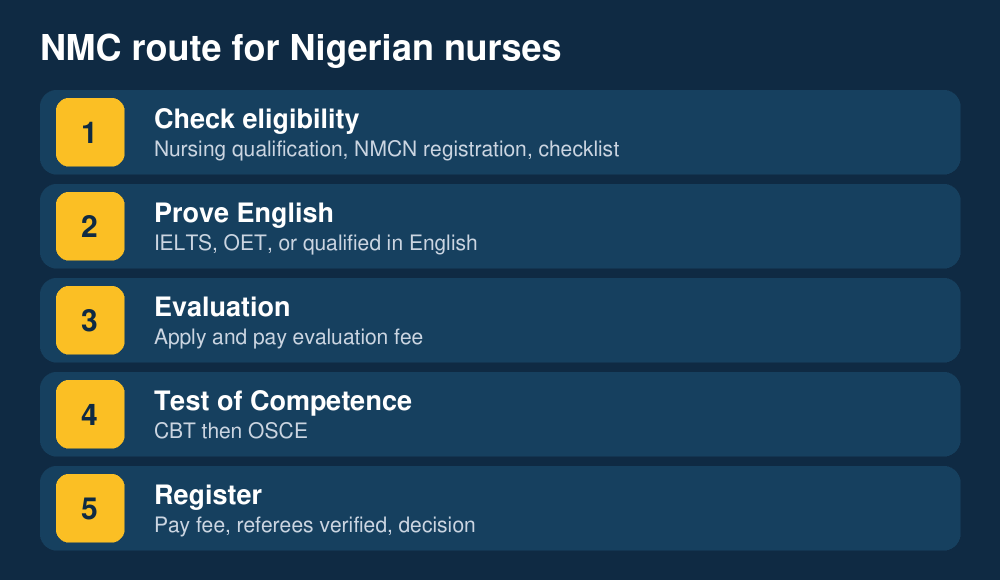
The NMC describes its overseas process in five steps: check you are ready to register, complete the eligibility and qualification application (paying the evaluation fee), take the Test of Competence if the NMC asks you to, complete the registration application, then wait for the NMC to evaluate your application and verify your referees. In practice, most Nigerian nurses also line up a UK employer, a Certificate of Sponsorship and a Health and Care Worker visa alongside these steps.
Step 1: Check you are eligible
The NMC assesses your nursing qualification and registration. Typically you will need a nursing qualification that meets the NMC’s standards, and evidence of being registered in Nigeria, usually with the Nursing and Midwifery Council of Nigeria (NMCN), plus your practice history. The NMC also takes health and character declarations and references. Because requirements are detailed and individual, use the NMC’s own pre-application checklist tool for nurse and midwife applicants before you start.
Step 2: Prove your English
Everyone who applies to the NMC must show they can communicate in English, and the NMC accepts three types of evidence: an approved English language test, a nursing qualification taught and examined in English, or recent practice in English (one year as a nurse in a country where English is the majority language). Nigerian-trained nurses whose degrees were taught in English may be able to use the qualified-in-English route, so check this before paying for a test.
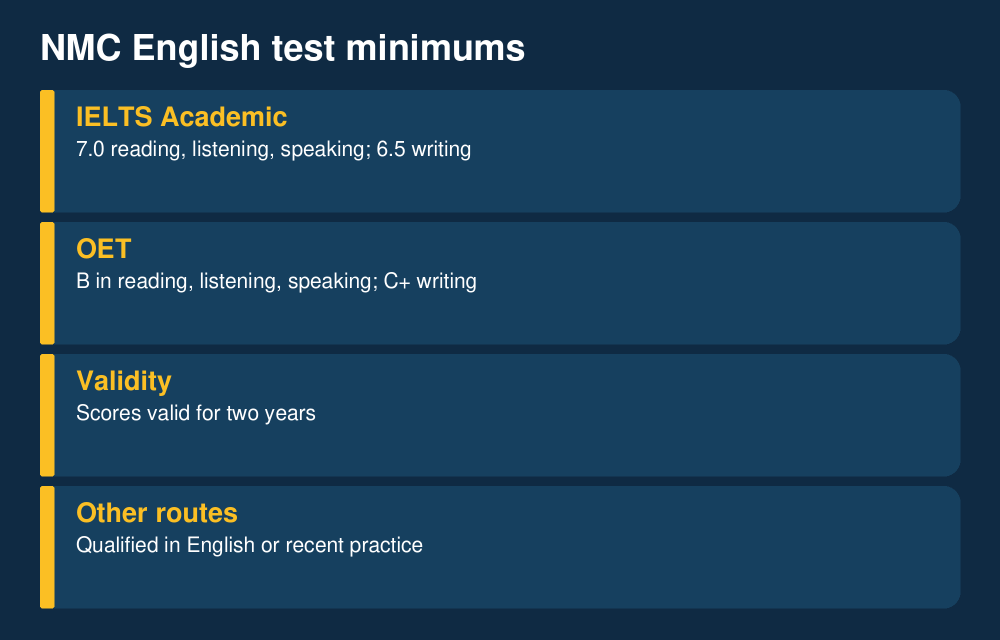
If you take a test, the NMC accepts only two: IELTS Academic and OET. The published minimums for a single sitting are:
- IELTS Academic: at least 7.0 in reading, listening and speaking, and at least 6.5 in writing.
- OET: grade B (350 or above) in reading, listening and speaking, and grade C+ (300 or above) in writing.
You may combine scores from two sittings if the tests are taken within 12 months of each other, both are no more than two years old when your application is assessed, and every score in each sitting meets the NMC’s floor (for IELTS, at least 6.5 in listening, reading and speaking and at least 6.0 in writing). Test scores are valid for two years. The NMC has a test-combining calculator on its website.
n
Step 3: Apply for the evaluation of your qualification
You create an NMC online account, submit your eligibility and qualification application and pay the non-refundable evaluation fee. The NMC then confirms whether you need to take the Test of Competence.
Step 4: Pass the Test of Competence (CBT and OSCE)
The Test of Competence has two parts. The computer-based test (CBT) is a multiple-choice exam on nursing theory, with clinical and numeracy sections. Once you pass it you book the Objective Structured Clinical Examination (OSCE), a practical exam with timed stations that test clinical skills, communication and professional behaviour. Many Nigerian nurses sit the CBT at a test centre before travelling and take the OSCE in the UK at an NMC-approved centre. Preparation materials and information booklets are published free on the NMC website, and these are the safest study sources.
Step 5: Register and get the job and visa in place
After the Test of Competence you complete your registration application and pay the registration fee. The NMC then verifies your referees and decides your application. Most overseas nurses are recruited by an NHS trust or private provider that holds a sponsor licence and issues a Certificate of Sponsorship; the visa is the Health and Care Worker visa. Nurses can apply under occupation codes including 2231 to 2237 (for example registered specialist nurses, mental health nurses and children’s nurses). You will usually need to be paid at least £25,000 or the going rate for the job if higher, and many roles follow the NHS pay scales by band and location. The standard application fee on GOV.UK is currently £324 for up to three years and £628 for longer stays, per person. Check GOV.UK for the Immigration Health Surcharge position and for any dependants’ fees, because these change.
For more on visa routes and employers, read our guides to the UK Skilled Worker visa for Nigerians, best UK recruitment agencies for Nigerians and our Japa guide hub.
How much does it cost?
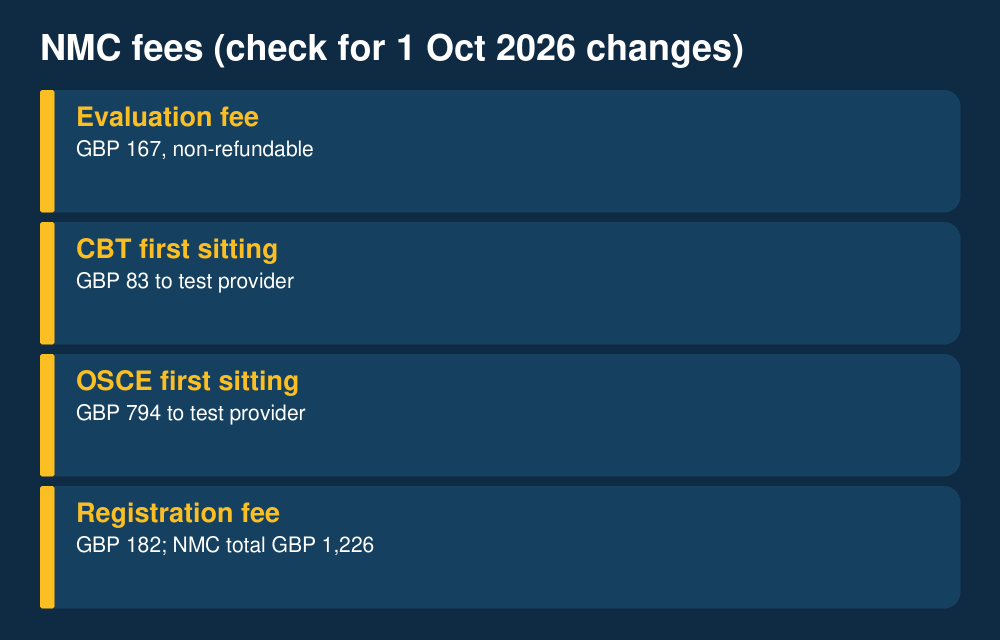
According to the NMC’s costs page, the main fees for the overseas nurse route are:
- Qualification evaluation fee: £167 (non-refundable)
- CBT first sitting: £83, paid to the test provider
- OSCE first sitting: £794, paid to the test provider
- Registration fee: £182
- NMC’s total for fees and tests: £1,226, higher if you need resits
Resit costs shown by the NMC include £70 (CBT clinical only), £50 (CBT numeracy only), £794 (full OSCE resit if you fail eight or more stations) and £397 (partial OSCE resit if you fail up to seven stations). Important: the NMC page carries a notice that its fees increased on 1 October 2026, and the NMC has announced that the annual registration fee rises from £120 to £143 a year, so the figures above may not match what you are charged. Confirm the current amounts on the NMC site before paying. English tests (IELTS or OET), flights, accommodation, and your visa are on top of the NMC’s costs. Some employers reimburse or cover some costs; get this in writing and never pay a recruiter for a job offer.
How long does it take?
Third-party guides suggest the whole journey can take anything from several months to around 18 months depending on exam dates, document verification from Nigeria and employer recruitment timelines. Treat any recruiter promising a fixed timeline with caution.
What do UK nurses earn?
NHS nurses in England are paid under Agenda for Change. Newly qualified nurses generally start at Band 5, and one commonly quoted range for Band 5 is around £30,000 to £36,000 depending on experience, with additional High Cost Area Supplement in London. Pay scales are revised each year, so check the NHS Employers pay tables for the current figures.
Common mistakes to avoid
- Paying for an English test when your degree was taught in English and the qualified-in-English route would be accepted.
- Letting test results expire before the NMC assesses your application.
- Paying agents who guarantee jobs or registration. Only the NMC registers nurses, and only a licensed sponsor can employ you on the visa.
- Using unofficial study materials that do not match the NMC’s published test content.
Frequently asked questions
Can a Nigerian-trained nurse work in the UK straight away?
No. You must be on the NMC register first, which means passing the evaluation and the Test of Competence unless the NMC tells you otherwise.
Which English test is better, IELTS or OET?
Both are accepted. OET is built around healthcare settings, while IELTS Academic is more widely available. The NMC’s minimum scores differ for each, so choose the one you can reliably score the required grades on.
Do I need a job offer before applying to the NMC?
No, the NMC application is separate from the visa. You do need a sponsored job offer for the Health and Care Worker visa.
Can I sit the CBT in Nigeria?
Third-party guides report CBT centres in Lagos and Abuja, but availability changes, so check the NMC’s Test of Competence page and the test provider.
How long is my CBT pass valid?
Check the NMC’s current rules, because the validity period applies to when you must complete your OSCE and registration.
Can my family come with me?
Dependants can usually apply, but they pay their own visa fees and surcharge. Check GOV.UK for current dependant rules and fees.
Sources
- NMC: how much is it going to cost?
- NMC: English language requirements
- NMC: IELTS Academic minimum scores
- NMC: OET minimum scores
- NMC: first increase in registration fees for 11 years
- GOV.UK: Health and Care Worker visa costs
- GOV.UK: Health and Care Worker visa, your job
This guide is general information, not immigration or legal advice. Rules and fees change; check the NMC and GOV.UK before you apply. Written by Ade Adeniyi, naijatipsland.com.
Join the discussion
Have you tried this, or do you have a question we did not answer? 2 readers have already shared their views. Naijatipsland members help each other with real, first-hand experience.









Update from the editor: nurses, please confirm every fee on the NMC website before paying, as the NMC changed some fees on 1 October 2026. Ask your questions below and I will try to help. Ade Adeniyi
Update from the editor: nurses, please confirm every fee on the NMC website before paying, as the NMC changed some fees on 1 October 2026. Ask your questions below and I will try to help. Ade Adeniyi