Signs of a Healthy Relationship in Nigerian Culture: What to Look For and What to Fix

Last updated: 23 October 2026 · By Naijatipsland Editorial Team · Editorial policy
In Nigeria, a relationship is rarely just about two people. Parents, siblings, church or mosque, village, WhatsApp family group and the state of the economy all have a seat at the table. That makes it hard to tell what a healthy relationship actually looks like, because what family approves of and what makes you happy are not always the same thing.
This guide sets out the signs of a healthy relationship in a Nigerian setting, drawing on recent survey data from Nigerians themselves, long-running relationship research, and national health survey figures. It is practical rather than preachy: green flags to look for, warning habits to fix early, and when to get help.
What Nigerians say about love right now
The Zikoko State of Love 2026 survey, which gathered responses from more than 10,000 Nigerians between October and November 2025, gives a useful snapshot of how people are experiencing relationships today.
- 80% said the economy has affected their love life.
- 53% said they are in relationships without clear labels.
- 40% of married respondents said they married mainly for love.
- 26% cited poor communication as a reason for a breakup.
- 17% of couples split expenses equally.
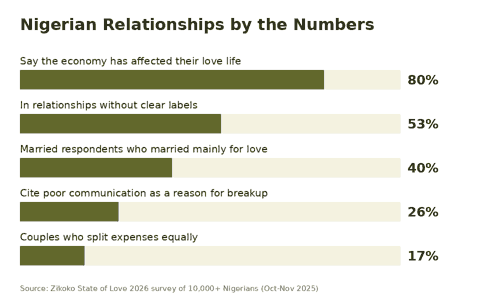
Two things stand out. Money pressure is now part of nearly every relationship conversation, and unclear expectations (no labels, no talk about who pays for what) cause as much friction as any dramatic argument. A healthy relationship is usually one where these things are discussed openly instead of assumed.
Green flags in a Nigerian relationship
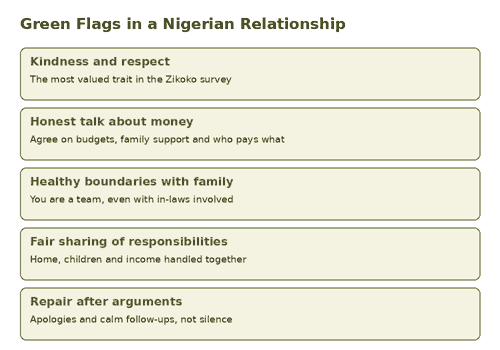
In the same survey, kindness and respect came out as the most valued trait. That fits what relationship researchers have found for decades: the couples who last are not the ones who never argue, but the ones who treat each other well while they do.
1. Kindness and respect, even in disagreement
Your partner speaks to you the same way in private as in front of family and friends. They do not mock you, shame you for your background, or use your struggles as a joke. Disagreement does not turn into insult.
2. Honest talk about money
With rising prices, money is one of the biggest pressure points. A healthy couple can say plainly what they earn, what they owe, what they send home to relatives and what they want to save. Only 17% of couples split expenses equally, which is fine; what matters is that the arrangement is agreed, fair to both and revisited when things change, rather than quietly resented.
3. Healthy boundaries with family
In Nigerian culture, in-laws and extended family are involved, and that can be a real source of support. The green flag is a partner who stays respectful to your family while keeping decisions about the home, children and money between the two of you. Warm involvement is healthy. Control is not.
4. Fair sharing of responsibilities
Traditional expectations still push most domestic work onto women, even when both partners work. A healthy relationship adjusts the load to the real situation: who is earning, who is tired, who has time. Nobody should be doing a second shift in silence.
5. Repair after arguments
Every couple argues. Healthy ones come back afterwards: one person says sorry or reaches out, the issue is actually discussed, and the same fight is not repeated every month. Being able to repair matters more than avoiding conflict.
6. Clear labels and expectations
More than half of respondents said they were in relationships without clear labels. Ambiguity can feel safe, but it often leaves one person hoping for more. A partner who can say what the relationship is and where it is going is showing basic respect.
Four warning habits and how to fix them
Psychologist John Gottman, after decades of studying couples, identified four communication habits that strongly predict relationship trouble, which he called the “Four Horsemen”. They appear in every culture, including ours. Each has a practical fix.
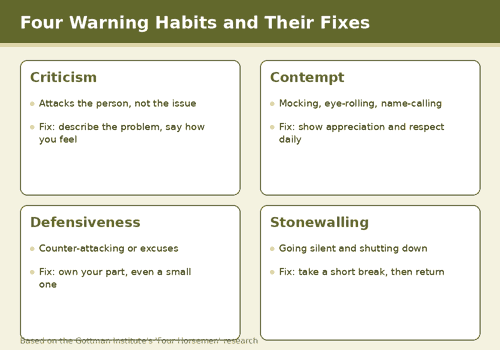
- Criticism (attacking character: “You are lazy”). Fix: describe the issue and your feeling instead: “I feel stressed when the dishes pile up. Can we share them?”
- Contempt (sneering, eye-rolling, mockery). Fix: build a habit of appreciation; say one thing you respect about your partner every day.
- Defensiveness (excuses and counter-blame). Fix: accept a small part of the responsibility, even if only a little.
- Stonewalling (shutting down and going silent). Fix: say you need a 20-minute break, then actually come back to the conversation.
Contempt is considered the most damaging of the four. If it is regular in your relationship, take it seriously.
Red flags that are not a communication problem
Some things should not be treated as a habit to improve. Control over your phone, movements, money or friendships, threats, humiliation, or any physical violence are signs of abuse, and no amount of better communication fixes them.
This is not rare. The Nigeria Demographic and Health Survey 2018 found that roughly one in three ever-married women had experienced spousal violence (physical, sexual or emotional). If you are in danger, or think you might be, the priority is safety:
- Tell a trusted person and agree a code word with them.
- Keep important documents and some money where you can reach them quickly.
- Contact the police, a state Ministry of Women Affairs office or a reputable domestic-violence support organisation near you.
- In an emergency, call your local emergency number.
Handling in-laws without losing your marriage
Most couples face pressure from relatives at some point. A few habits help:
- Present a united front. Disagree in private, not in front of family.
- Let each partner handle their own relatives. Your spouse speaks to their parents, and you speak to yours.
- Agree your limits in advance: how much money goes to relatives, how often visits happen, who is involved in decisions about children.
- Stay respectful. Boundaries can be firm and polite at the same time.
When to consider counselling
Counselling is not a last resort. Many couples use it before marriage, or when the same argument keeps repeating. It can help if you cannot talk about money without a fight, if one person has stopped sharing anything, or after a major event such as infidelity, job loss or a bereavement. Look for a licensed counsellor or a respected faith-based counsellor you both trust. Counselling is not appropriate as a substitute for safety if there is violence in the home.
A quick self-check for couples
- Do we talk honestly about money and plans?
- Do we feel respected, including during disagreements?
- Can we say sorry and actually repair afterwards?
- Do we share the work of running the home and family?
- Do we make decisions together, and do our families respect that?
- Do we both feel safe?
If most answers are yes, you are on solid ground. If some are no, treat them as a to-do list rather than a verdict.
Frequently asked questions
What is the most important sign of a healthy relationship in Nigeria?
Respondents to the Zikoko State of Love 2026 survey ranked kindness and respect as the most valued trait. In practice, that means treating each other well in daily life and during disagreements.
Is it normal to argue in a healthy relationship?
Yes. Conflict is normal. What matters is how you argue (without contempt or insults) and whether you repair afterwards.
Should couples split bills equally?
Not necessarily. Only 17% of couples in the survey split expenses equally. A fair arrangement is one both partners understand and agree on, taking income into account.
How do I know if my partner’s family is overstepping?
If relatives make decisions that belong to you and your partner (money, children, where you live), or if your partner will not set any limits, boundaries need to be discussed.
Can a relationship with domestic violence be fixed with counselling?
Safety comes first. Violence and control are not communication problems, and couples counselling is generally not recommended while abuse is happening. Seek support from people trained in this area.
This article is for general information and is not a substitute for professional advice.
Sources
- Zikoko, State of Love 2026 survey (10,000+ Nigerians, October to November 2025)
- National Population Commission and ICF, Nigeria Demographic and Health Survey 2018
- The Gottman Institute, The Four Horsemen: Criticism, Contempt, Defensiveness and Stonewalling
Join the discussion
Have you tried this, or do you have a question we did not answer? Be the first to share your experience. Leave a comment below. Every comment is read by the editor before it appears.