Last updated: 23 October 2026 · By Naijatipsland Editorial Team · Editorial policy
Gym memberships in Nigeria can be hard to justify. Monthly fees, transport to get there, unreliable power, and a packed schedule all add up, and plenty of people quietly stop going after a few weeks. The good news is that you do not need a gym to meet the basic recommendations for staying healthy. Walking, bodyweight exercises, stairs, skipping and even dancing at home can cover most of what an adult needs, and they cost nothing or close to it.
This guide covers why this matters in Nigeria, what the World Health Organization recommends, free ways to exercise, a simple seven-day plan, and how to stay consistent. If you do want gym options and costs, our separate guide on affordable gyms and fitness routines in Nigeria covers that.
Quick note: this is general information, not personal medical advice. If you have a heart condition, high blood pressure, diabetes, are pregnant, or have not exercised for a long time, speak to a doctor before starting a new routine.
Why this matters: many Nigerian adults are not active enough
A systematic review and meta-analysis of community studies in Nigeria pooled data from 15 studies covering 13,814 adults. It estimated that about 52% of Nigerian adults were physically inactive, meaning they did not meet recommended activity levels. The review found inactivity was higher in women (55.8%) than men (49.3%), and much higher in urban residents (56.8%) than rural residents (18.9%). It also estimated that the number of inactive Nigerians aged 20–79 rose from 14.4 million in 1995 to 48.6 million in 2020.
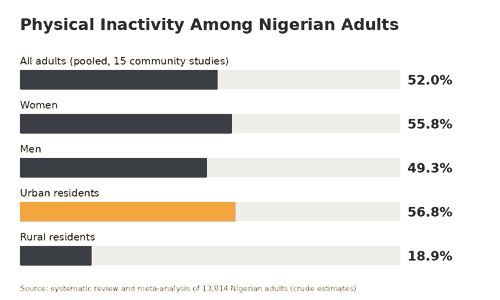
The urban figure is worth noticing. City life often means long commutes, desk jobs, little green space and long hours in traffic. You do not need to fix the whole city; you just need to build movement into your own day.
Globally the picture is similar. The WHO says about 31% of adults, roughly 1.8 billion people, do not meet recommended activity levels.
What the WHO recommends for adults
The WHO 2020 guidelines for adults say:
- Aerobic activity: 150–300 minutes of moderate-intensity activity per week, or 75–150 minutes of vigorous-intensity activity, or an equivalent mix.
- Muscle strengthening: regular strength work on major muscle groups, usually put as at least two days a week.
- Sitting less: limit sedentary time and replace some of it with movement of any intensity.
- Some activity beats none: if 150 minutes feels impossible, start smaller and build up.
“Moderate” means you are breathing harder but can still talk, such as a brisk walk. “Vigorous” means you can only say a few words at a time, such as running or fast skipping. Thirty minutes of brisk walking on five days a week reaches 150 minutes.
Free ways to exercise in Nigeria
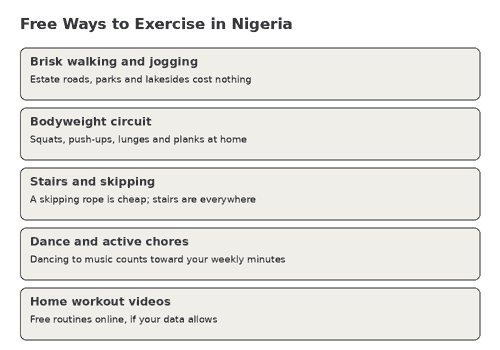
1. Brisk walking and jogging
The cheapest and most underrated option. Walk or jog on estate roads, in a park, around a stadium or along a lakeside. Early morning or evening is usually cooler. Choose a safe, well-lit route, tell someone where you are going if you are alone, and avoid busy roads without footpaths. If walking outside is not safe where you live, walk laps inside a compound or on a flat rooftop.
2. A bodyweight circuit at home
You can build strength without weights. A basic circuit:
- Squats: 12–15 reps
- Push-ups (on your knees if needed): 8–12 reps
- Lunges: 10 per leg
- Plank: 20–40 seconds
- Glute bridges: 12–15 reps
Do the whole list, rest a minute, and repeat two or three times. That takes about 20 minutes and hits the major muscle groups.
3. Stairs and skipping
Stairs are free cardio. If you live in or work in a building with several floors, skip the lift sometimes. A skipping rope is one of the cheapest pieces of equipment you can buy and is an efficient vigorous workout; start with 30-second rounds and build up. Land softly and skip on a flat surface.
4. Dancing and active chores
Dancing to Afrobeats in your living room counts as exercise if it raises your heart rate. So does vigorous cleaning, washing clothes by hand, or carrying shopping. These will not replace structured exercise, but they help you break up long periods of sitting.
5. Free workout videos, if you have data
Free beginner routines are available on YouTube and other platforms. Search for beginner bodyweight workouts and follow along. Download a few videos on Wi-Fi if mobile data is expensive. Business Post’s recent analysis of Nigerian Google search trends noted growing interest in bodyweight training and beginner routines, which suggests many people are already moving in this direction.
A simple seven-day plan
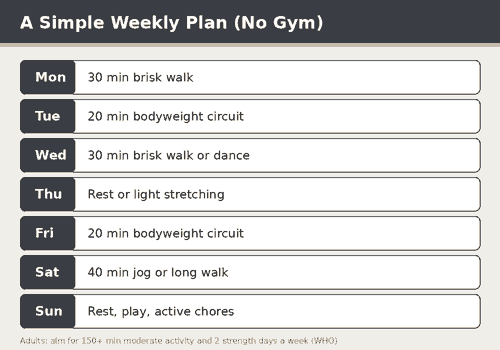
- Monday: 30-minute brisk walk
- Tuesday: 20-minute bodyweight circuit
- Wednesday: 30-minute brisk walk, or dance
- Thursday: rest or light stretching
- Friday: 20-minute bodyweight circuit
- Saturday: 40-minute jog or long walk
- Sunday: rest, play with the kids, or do active chores
That adds up to roughly 120–130 minutes of aerobic activity plus two strength sessions. Add a short walk on Thursday or Sunday and you pass 150 minutes. If you are new to exercise, begin with half of this and increase each week.
How to make it stick
- Start smaller than you think. Ten minutes a day is better than a perfect plan you drop after a week.
- Fix a time. Link exercise to something you already do, such as before breakfast or right after work.
- Find a partner. A friend, spouse or neighbour makes it easier to show up.
- Track it simply. A note on your phone or a calendar tick is enough.
- Plan for power cuts, rain and heat. Keep an indoor option, like the bodyweight circuit, for days when you cannot go out.
- Sit less. Stand up and move for a few minutes every hour if you have a desk job.
Eating well on a budget
Exercise helps, but food matters too. You do not need special products. Cooking at home, buying vegetables and fruit from local markets, and drinking water instead of sugary drinks are affordable steps. Be cautious about expensive supplements and “detox” products, which have little evidence behind them.
When to stop and get medical help
- Chest pain or pressure, severe breathlessness, or dizziness while exercising.
- Sudden sharp joint or muscle pain, especially after a fall or twist.
- Palpitations that do not settle after you rest.
- Any exercise that makes an existing condition worse.
The bottom line
You do not need a membership to be fit. Brisk walking, a few bodyweight exercises, stairs, skipping and dancing can cover the WHO targets for most healthy adults. Start small, be consistent, and build up. If you can afford a gym later, you will arrive with a habit already in place.
Frequently asked questions
Can I really get fit without a gym?
Yes. Aerobic activity and basic strength work, both of which the WHO recommends, can be done at home or outdoors with little or no equipment.
How much exercise do I need each week?
For most adults, 150–300 minutes of moderate activity or 75–150 minutes of vigorous activity, plus strength work on at least two days a week, according to the WHO guidelines.
Is walking enough?
Brisk walking counts as moderate exercise and is a good base. Add some strength exercises twice a week for balanced fitness.
What if I only have 10 minutes a day?
Do it anyway. Short bouts add up, and the WHO stresses that any activity is better than none.
Sources
- Systematic review and meta-analysis, “Epidemiology of physical inactivity in Nigeria” (15 community studies, 13,814 adults).
- World Health Organization, 2020 Guidelines on Physical Activity and Sedentary Behaviour.
- World Health Organization, Physical Activity fact sheet (global inactivity statistics).
- Business Post Nigeria, analysis of Nigerian fitness search trends (September 2026).
Join the discussion
Have you tried this, or do you have a question we did not answer? Be the first to share your experience. Naijatipsland members help each other with real, first-hand experience.