


TL;DR:
- Posts become viral by triggering high-arousal emotions, providing practical value, and offering social benefits to sharers. Early engagement, format, and deliberate seeding significantly influence virality regardless of follower count.
Posts go viral when they trigger high-arousal emotion, deliver practical value, and give the sharer a social reason to pass them on. Research by Berger & Milkman confirms that content evoking awe, anger, or anxiety spreads significantly faster than content that evokes sadness or no emotion at all. Follower count is almost never the deciding factor. The deciding factors are psychological triggers, platform format, and early seeding.
Primary drivers of viral spread:
- High-arousal emotion (awe, anger, anxiety)
- Social currency (the post makes the sharer look good)
- Practical value (useful information people want to pass on)
- Narrative structure (a story with tension and resolution)
- Mere exposure and repetition
- Reciprocity (share something useful, get engagement back)
- Specific social proof (peer-level examples, not celebrity counts)
TL;DR action: Before you post, ask yourself: “Will sharing this make my audience look smart, caring, or informed?” If the answer is no, reframe it until it is.
Table of Contents
- What can you check before you hit “post”?
- Why do people actually share content?
- How do platform algorithms shape what goes viral?
- How do you write a viral-ready post for a community forum?
- What are the risks of chasing virality?
- How do you know if your post is going viral?
- How do you run a simple test to improve your posts?
- Key Takeaways
- Naijatipsland’s perspective on what actually works
- Recommended research and further reading
What can you check before you hit “post”?
- Write a hook that stops the scroll. Your first line is your headline. State the payoff immediately: “This trick saved me ₦50,000” beats “I want to share something.” You have about two seconds.
- Pick one high-arousal emotion to aim for. Awe, anger, or anxiety all increase sharing compared with neutral or sad content. Choose the emotion deliberately, then write toward it.
- Add a utility cue. A checklist, a numbered tip, or a specific number (“3 steps,” “in 24 hours”) signals practical value and makes the post feel worth saving and sharing.
- Frame it as insider knowledge. Berger’s research shows that insider framing triggers sharing because it improves the sharer’s social image. “Most people don’t know this about…” is a proven opener.
- Plan your seed. Decide who gets the first reply or share before you publish. A single early comment from a trusted contact can push the post into the algorithm’s amplification zone.
Pro Tip: If you are promoting yourself or a brand, lead with the value, not the name. Embed the promotion inside a story or tip. Tellis et al. found that prominent brand placement reduces sharing rates; subtle integration performs better every time.
Why do people actually share content?
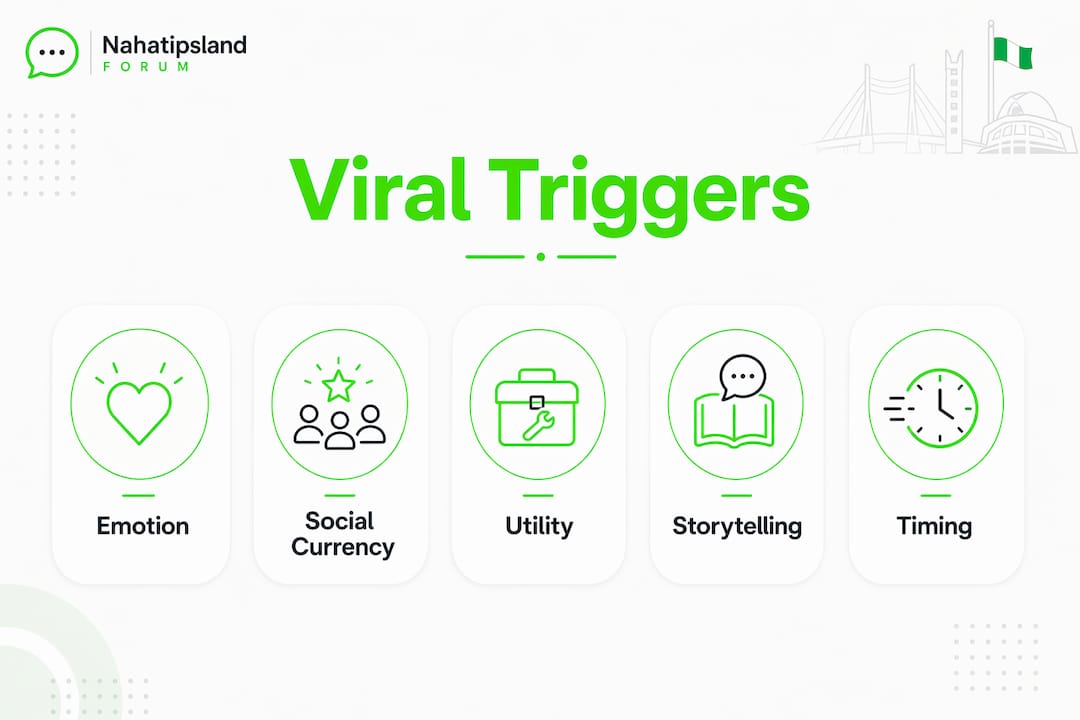
Sharing is not random. Virality is predictable and driven by seven psychological triggers; stacking three or more of them multiplies spread, rather than simply adding up.
The core principles:
- High-arousal emotion: Awe increased sharing notably in Berger & Milkman’s New York Times study; anger and anxiety also outperformed neutral content. Sadness reduced it.
- Social currency: People share what makes them look good. Design your post to benefit the sharer’s image, not just your own.
- Practical value: How-tos, checklists, and specific numbers outperform cleverness alone, reliably and repeatedly.
- Narrative: A post with a clear beginning, conflict, and resolution holds attention and gets shared because stories are easier to retell.
- Mere exposure: Familiarity breeds liking. Repeating a strong post builds favorability even when the audience does not consciously remember seeing it before.
- Reciprocity: Sharing genuinely useful content creates a social obligation to engage back.
- Specific social proof: Peer-level examples (“someone from Lagos did this”) outperform raw follower counts.
“Content that evokes high-arousal emotions — awe, anger, and anxiety — is more viral. Content that evokes low-arousal or deactivating emotions, such as sadness, tends to be less viral. The same content can be reframed as more emotional and activating to increase its chances of going viral.” — Berger & Milkman, What Makes Online Content Viral?
A post about a local power outage that frames the situation as outrage-worthy (“NEPA did it again — here is what you can do right now”) stacks anger, practical value, and social currency in one sentence. That combination is why it spreads.

How do platform algorithms shape what goes viral?
Early engagement and format fit matter more than follower count. Algorithms on every major U.S. platform reward content that generates fast interaction in the first 30–60 minutes after posting.
- TikTok: The first 1–2 seconds must hook visually. The algorithm tests your video on a small audience; strong completion rates push it wider. Keep videos under 90 seconds for maximum completion.
- X (formerly Twitter): Threaded posts with a strong opening tweet perform better than single-tweet dumps. Replies and quote-posts in the first hour signal quality to the algorithm.
- Facebook and Instagram: Shareable link posts with a clear image and a question in the caption drive comment volume. Emotional ads outperform informational ones on general platforms; moderate video length is optimal for sharing.
- Reddit: Upvote velocity in the first two hours determines front-page eligibility. Titles that frame a post as a question or a surprising fact consistently outperform declarative statements.
- Community forums (Naijatipsland-style): The thread title is everything. A clear, specific hook in the subject line drives click-through; the first reply sets the tone for the entire thread.
Timing note: Posts published Tuesday through Thursday between 9 AM and 12 PM (U.S. Eastern Time) tend to catch the highest active-user windows on most platforms. For Naijatipsland, evening hours (7–10 PM WAT) align with peak Nigerian forum activity.
How do you write a viral-ready post for a community forum?
The single most important forum tactic is a social-currency hook in your opening line. Give readers a reason to share before they finish the first sentence.
Hook templates that work on forum threads:
- “I just found out something about [topic] that most people here don’t know…”
- “This happened to me in Lagos last week — and it could happen to you.”
- “Quick tip that saved me [specific outcome] — sharing because it’s too useful to keep.”
Formatting for readability:
- Keep paragraphs to 2–3 lines in a forum thread. Long walls of text kill engagement.
- Use bold for key points so skimmers can follow the argument.
- Add one image or GIF near the top. Visual content increases click-through in thread listings.
- Post your first comment immediately after publishing. Seed it with a question or an additional fact to trigger early replies.
Do / Don’t for Naijatipsland community norms:
- Do cite a source or personal experience to build credibility.
- Do invite a response: “What do you think?” or “Has this happened to you?”
- Don’t open with a brand name or a sales pitch. Lead with value first.
- Don’t post the same content word-for-word in multiple threads on the same day.
Pro Tip: Use the Trojan Horse method: wrap your self-promotion inside a genuinely useful story. Share the lesson first, mention the source last. Readers share the lesson; the source travels with it.
What are the risks of chasing virality?
Chasing virality without guardrails can cause real harm and trigger moderation action. Deceptive, hateful, or misleading tactics will get your post removed and your account flagged.
Concrete risks and how to reduce them:
- Misinformation: Verify every claim before posting. One false statistic can define your forum reputation permanently. Link to primary sources.
- Social risk for political content: University of Arkansas research shows politically charged content spreads less when the poster’s audience is diverse, because users avoid the social risk of alienating contacts. Know your audience before posting political content.
- Harassment escalation: Anger-inducing posts spread fast but can attract pile-ons. Moderate your thread actively and close comments if the tone turns hostile.
- Privacy and doxxing: Never share another person’s private information, location, or identifying details without consent. This is both an ethical violation and a legal exposure. For safe civic discussion, Naijatipsland’s guide on discussing politics online is worth reading before you post.
One-sentence legal note: sharing third-party personal data or copyrighted media without permission can expose you to civil liability under U.S. copyright law and platform terms of service — always verify rights before you post.
How do you know if your post is going viral?
Engagement velocity and share rate matter more than raw likes. A post with 50 shares in the first two hours is performing better than one with 500 likes spread over a week.
| Metric | What it measures | Early viral signal |
|---|---|---|
| Share rate | Shares ÷ impressions | Above 3% within 2 hours |
| Engagement velocity | Engagements per hour | Doubling each hour for 3+ hours |
| Outbound reposts | Cross-platform pick-up | Appearing on a second platform organically |
| Reach growth | New accounts reached | Accelerating, not plateauing |
Measurement tips:
- Record your baseline: track your last 10 posts’ share rates before you experiment.
- Use native analytics (X Analytics, Meta Insights, or forum post stats) to pull hourly data for the first 6 hours.
- Cross-platform pick-up (your forum post appearing on X or WhatsApp groups) is the strongest signal that organic virality is underway.
For amplification tools and case studies on platform-specific growth, Nowix offers X-focused amplification resources worth reviewing.
How do you run a simple test to improve your posts?
Design small tests that vary only one element at a time. Changing the hook, the image, and the timing simultaneously tells you nothing useful.
- Select a thesis. Example: “A question-based headline outperforms a statement headline for this topic.”
- Publish two variants. Post Variant A in the morning, Variant B in the evening (or use two similar threads). Keep everything else identical.
- Seed consistently. Give each variant the same first-comment seed and the same number of early shares.
- Measure for a fixed window. Compare share rate and engagement velocity at the 24-hour mark.
- Pick a winner and document it. Record what changed and by how much. Run the next test on a different variable.
Experiment templates:
- Headline A/B: “Question hook” vs. “Statement hook” on the same topic.
- Image vs. no image: Same post body, one with a relevant image, one without.
Pro Tip: Recycle your top-performing posts. Mere exposure research shows that repeating a strong post 5–7 times over 60 days increases audience favorability, even when users don’t consciously recall seeing it before. Space reposts at least 10 days apart and update the hook slightly each time.
Key Takeaways
Posts go viral when they stack at least three psychological triggers — high-arousal emotion, social currency, and practical value — and reach the right audience in the first hour after posting.
| Point | Details |
|---|---|
| Stack three or more triggers | Combining emotion, social currency, and utility multiplies spread beyond additive effects. |
| Seed early and deliberately | Identify your first commenter or sharer before you publish to trigger algorithmic amplification. |
| Measure velocity, not likes | Track share rate and engagements per hour in the first 2–6 hours, not total likes. |
| Avoid political posts with diverse audiences | Social risk reduces sharing when your audience holds mixed views, per University of Arkansas research. |
| Recycle top posts safely | Repost strong content several times over about two months, spacing reposts at least 10 days apart. |
Naijatipsland’s perspective on what actually works
The conventional wisdom says you need a big following to go viral. That is wrong, and the data backs it up. What you actually need is a post that makes the reader look good for sharing it.
On Naijatipsland, the posts that consistently generate the most thread activity are not from the accounts with the most followers. They are from posters who frame a relatable experience as insider knowledge, add a specific detail that makes the post feel credible, and drop it at a time when the community is already active. A post about a trending current-affairs topic, framed as “here is what most people are missing,” regularly outperforms a straightforward news summary because it gives the reader a social reason to share.
What backfires, repeatedly, is leading with a brand or a self-promotion. Readers scroll past it. The Trojan Horse principle is not a trick; it is a recognition that people share what benefits them, not what benefits you. Build the value first, and the promotion travels with it.
For posters who want to stay ahead of what is spreading on the forum, tracking local entertainment updates and current-affairs threads gives you a live feed of what the community is already primed to share.
Recommended research and further reading
- Berger & Milkman (2012), What Makes Online Content Viral? — The foundational study on emotion and sharing, using nearly 7,000 New York Times articles. Read the paper.
- University of Arkansas, Walton College — Research on social risk and why political content spreads less across diverse audiences. Read the findings.
- Tellis, MacInnis et al. (2019) — Study on brand prominence, emotional ads, and video length in viral sharing. Read the study.
- BriskTool synthesis of seven viral principles — Accessible summary of Berger’s framework and mere-exposure research. Read the summary.
- Naijatipsland: Viral marketing strategy guide — Deeper case studies and strategy-level examples for forum posters. Read the guide.
- Naijatipsland: Social media growth workflow for Nigeria — Practical posting schedules and seeding tactics tailored to Nigerian creators. Read the workflow.