

TL;DR:
- Online censorship is a deliberate restriction of internet content by authorities, affecting nearly half the global connected population. Different types include state censorship, platform moderation, and self-censorship, each with distinct legal and technical characteristics. Governments employ layered methods like DNS blocking, deep packet inspection, and shutdowns to control access, often targeting specific content reflective of their political and cultural priorities.
Most people assume the internet is a fundamentally open space. That assumption is wrong, and the gap between perception and reality affects billions of people. To define online censorship accurately is to understand that it is not a fringe issue in faraway countries. 40% of global internet users live in countries classified as Not Free or Partly Free online. That is nearly half the world’s connected population operating under restricted access. Whether you are an activist, a student, or simply someone who values access to honest information, understanding online censorship meaning at a foundational level is the first step toward protecting your digital rights.
Table of Contents
- Key Takeaways
- How to define online censorship: core concepts
- Technical methods behind online censorship
- Global patterns in censored content
- State censorship vs. platform moderation vs. self-censorship
- What you can do about online censorship
- My perspective on what most people get wrong
- Stay informed and engaged on Naijatipsland
- FAQ
Key Takeaways
| Point | Details |
|---|---|
| Online censorship is deliberate | Authorities or platforms suppress specific content by intent, not accident, with technical or legal force. |
| Three main types exist | State censorship, private platform moderation, and self-censorship operate differently with distinct legal implications. |
| Technology enables fine-grained control | Methods like Deep Packet Inspection allow governments to block specific content without shutting down the entire internet. |
| Self-censorship is the most invisible type | Fear of repercussion causes individuals and media to restrict their own expression before any state action occurs. |
| Circumvention tools have real limits | Standard VPNs and proxies often fail against sophisticated censorship systems that use IP blocking and DNS poisoning. |
How to define online censorship: core concepts
Online censorship is the deliberate suppression, restriction, or control of content, communication, or information on the internet by an authority with the power to enforce that restriction. The word “deliberate” matters. A server going offline is not censorship. A government ordering an ISP to block a news website is.
Censorship requires authority and intent. The actor doing the suppressing and the reason behind it are both central to any legal or civil liberties analysis. This distinction shapes how advocates respond, which legal remedies exist, and how affected communities organize.
Here are the core categories you need to understand when working through online censorship definitions:
- State censorship: A government or government-backed entity directly restricts content, blocks websites, or mandates that internet service providers filter specific material. This is the most legally consequential form.
- Private platform moderation: A tech company removes or limits content based on its own terms of service. This is not legally censorship in most democratic frameworks, though it raises serious free expression concerns.
- Self-censorship: Individuals or media organizations preemptively limit their own expression to avoid punishment, social backlash, or professional consequences. No external actor needs to act. The chilling effect does the work.
- Hybrid censorship: Governments compel private platforms to remove content. When that happens, the legal line between platform moderation and state censorship blurs significantly.
Understanding online censorship laws requires recognizing that each category carries different legal weight. In the United States, the First Amendment only restrains government actors, not private companies. In authoritarian states, there is often no legal distinction at all because the government controls both law and platform.
Pro Tip: When researching a censorship incident, always ask who ordered the removal and under what authority. That single question separates genuine state censorship from platform policy disputes.
Technical methods behind online censorship
Governments do not flip one switch to control the internet. They use a layered set of technical tools, each with different levels of precision, cost, and visibility to the average user.
- DNS blocking: The Domain Name System functions like the internet’s address book. When a government orders DNS blocking, your request to visit a website gets redirected or returns an error, even though the website itself still exists on a server somewhere.
- IP blocking: Every server has a numeric IP address. Authorities can instruct ISPs to drop all traffic to specific IP addresses. Entire platforms can disappear from a country’s internet this way.
- Deep Packet Inspection (DPI): This is the most sophisticated tool in use today. DPI inspects traffic patterns to identify and block VPNs and specific protocols without even accessing encrypted content. It analyzes the shape and timing of data, not just its destination.
- Internet shutdowns: The bluntest tool available. Over 180 shutdown incidents were documented globally in 2024, most tied to elections, protests, or military operations. Nigeria itself experienced targeted shutdowns during periods of civil unrest.
- Targeted content filtering: Keyword-based systems scan content in real time and block pages that contain flagged terms, a method widely used in Gulf states and parts of Southeast Asia.
The table below gives you a clear comparison of these methods:
| Method | How it works | Detectability by users |
|---|---|---|
| DNS blocking | Redirects domain lookups | Easy to detect and sometimes bypass |
| IP blocking | Drops traffic to specific addresses | Moderate; VPNs can circumvent it |
| Deep Packet Inspection | Analyzes traffic metadata | Hard to detect; blocks VPNs too |
| Internet shutdown | Cuts connectivity at ISP level | Immediately obvious |
| Keyword filtering | Scans content for flagged terms | Invisible to most users |
Russia offers a well-documented example of how these methods combine. The country blocks independent media, messaging apps, and LGBTQ+ resources using multiple simultaneous methods. Outlets like Meduza and Bellingcat, plus platforms like Telegram’s web version, are all restricted through stacked technical barriers.
Pro Tip: If you are trying to determine whether a site is blocked by your ISP or simply down, use a tool like OONI Probe. It is designed specifically to detect censorship rather than standard outages.
Global patterns in censored content
Online censorship meaning varies by geography, and so does the content being targeted. Governments block specific content categories that reflect their political, cultural, and religious priorities, rather than blocking the internet wholesale. This selective approach allows them to maintain controlled digital environments while preserving access for economic activity.
The most common categories of blocked content include:
- Adult content: Blocked across 16 countries in the Middle East and South Asia, making it the single most frequently restricted content category in those regions.
- Political opposition and news media: Authoritarian governments routinely block websites that report critically on leadership or organize dissent. Press freedom has reached its lowest level in 25 years globally, and online access restrictions are a major driver.
- LGBTQ+ content: Targeted across dozens of countries, often under morality or public order justifications.
- VPNs and circumvention tools: Governments increasingly block the tools people use to bypass censorship. China’s Great Firewall and similar systems use IP range blocking and DNS poisoning to shut down popular VPN services.
- Social media platforms: Twitter, Facebook, and WhatsApp have all been blocked in various countries during politically sensitive periods.
The Freedom House Internet Freedom scores measure obstacles to access, content limits, and user rights violations on a scale of 0 to 100. Countries like China, Cuba, and Iran consistently score in the lowest range. Countries with moderate restrictions, including several in sub-Saharan Africa, occupy the middle tier. Understanding these scores helps you locate any country’s censorship reality quickly.
Here is a comparison of censorship approaches across political systems:
| Political system | Primary censorship targets | Common methods used |
|---|---|---|
| Authoritarian | Political opposition, journalists, LGBTQ+ | DPI, IP blocking, shutdowns |
| Theocratic | Adult content, religious dissent | DNS blocking, filtering |
| Democratic with restrictions | Piracy, child safety content | Court orders, platform pressure |
| Conflict zones | Any information about conflict | Targeted shutdowns, media bans |
State censorship vs. platform moderation vs. self-censorship
This is where most public confusion lives. People use the word “censorship” loosely, often applying it to platform policy decisions that have a very different legal character than state action. Getting this distinction right matters enormously if you are an activist or a student trying to understand your rights.
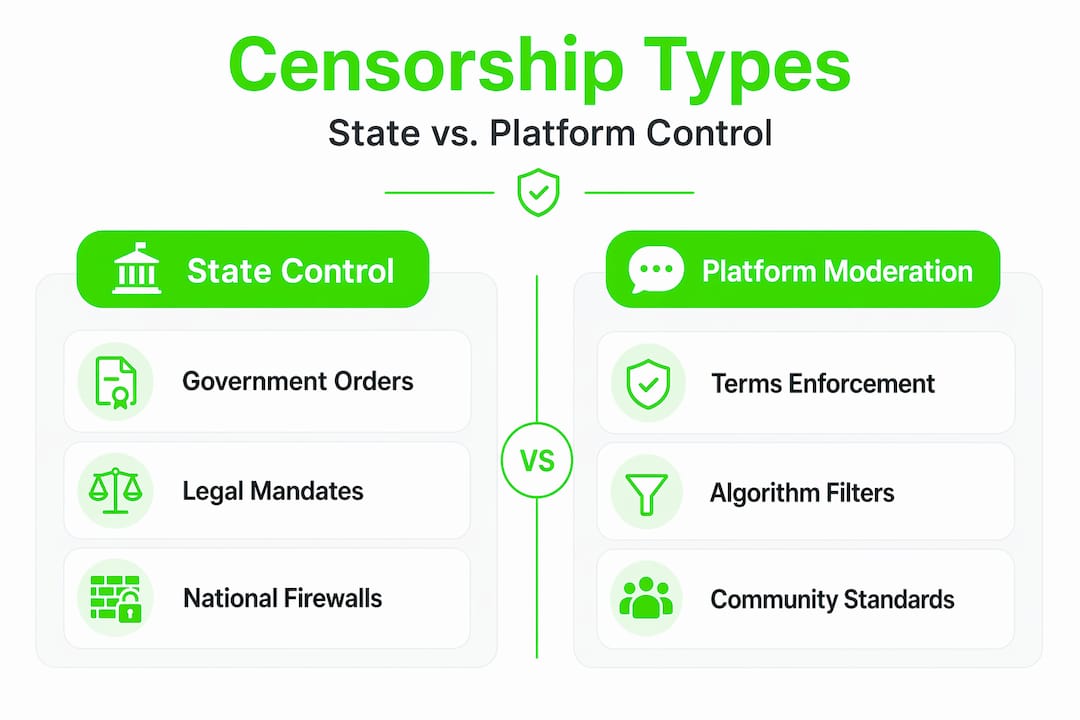
Private platforms operate under their own terms of service. When Facebook removes a post for violating community standards, that is content moderation, not censorship in the legal sense. You can read more about content moderation in the Nigerian context to understand how these distinctions play out locally. The important line is: did a government direct that removal?
When governments compel platforms to act, the legal nature of the restriction changes entirely. The legal distinction between state and platform action determines what remedies are available to users whose content was removed. In a state-compelled removal, you may have constitutional or human rights claims. In a purely private moderation decision, you generally do not.
Self-censorship sits in a different category again. It requires no court order, no government directive, and no platform policy. The chilling effect of feared repercussion causes individuals and media organizations to stay silent before any authority acts. Media industries have historically reminded their members to self-regulate precisely to avoid triggering formal state regulation.
Self-censorship is often the most effective form of control a government can achieve, because it operates entirely inside the minds of the people it silences.
For activists and digital communities, recognizing self-censorship as a real and measurable phenomenon is critical. The absence of certain stories, voices, or perspectives in online spaces is often not accidental. It is frequently the product of calculated fear.
What you can do about online censorship
Understanding the types of online censorship is only useful if it leads somewhere practical. Here is a clear path from awareness to action:
- Verify before you assume. Not every inaccessible website is censored. Use OONI Probe or similar tools to confirm whether a block is censorship-based or a technical issue.
- Use the right circumvention tools. Standard VPNs are increasingly unreliable. Sophisticated censorship systems use IP range blocking and DNS poisoning that defeat most commercial VPN products. Tools like Tor or obfuscated proxies offer stronger protection against DPI-based filtering.
- Protect your online privacy proactively. Understanding online privacy protection is inseparable from understanding censorship. Surveillance often accompanies restriction, and your browsing data can be used against you.
- Document and report censorship incidents. Organizations like Access Now, Article 19, and the Electronic Frontier Foundation track and publicize censorship globally. Reporting incidents contributes to the public record.
- Engage in digital literacy advocacy. Teaching others to recognize censorship, not just experience it, is one of the most effective long-term responses. Share credible resources. Challenge misinformation about what internet freedom actually means.
Pro Tip: Tor Browser is free, well-maintained, and specifically designed to route traffic through multiple encrypted relays, making it significantly harder for censors to block or trace. It is slower than a standard browser but far more resilient against the methods described above.
My perspective on what most people get wrong
I have followed the evolution of internet censorship closely, and what strikes me most is how consistently people underestimate its sophistication. There is a widespread belief that censorship is about crude shutdowns or easily bypassed firewalls. That was partially true in 2005. It is not true now.

What I have seen is that the most effective censorship today is barely visible. It does not block everything. It blocks just enough to shape behavior, to make certain kinds of research feel risky, to make dissent feel isolated. That is what DPI-based infrastructure enables. Fine-grained, targeted, deniable control.
The other thing I think people get wrong is treating self-censorship as somehow less serious than state action. In my view, it is often more serious because it is self-sustaining. A government that creates enough fear does not need to keep issuing orders. The population manages itself.
My practical advice: stop thinking about censorship as something that happens elsewhere. Track how information flows and gets restricted in your own country, your own platforms, your own community. That awareness is what protects you when the restrictions intensify.
— Naijatipsland
Stay informed and engaged on Naijatipsland
Understanding online censorship is only the beginning. How you show up online, what you say, and where you engage all carry real consequences in a world where digital expression is increasingly policed.
At Naijatipsland, we cover the stories and discussions that matter to Nigerian internet users, from press freedom updates to platform moderation debates. Your digital image shapes your opportunities in ways most people do not anticipate, and understanding censorship gives you the context to protect it. You can also join the conversation directly. Participating in online discussions is one of the most concrete ways to push back against silence, whether it is state-imposed or self-inflicted. Explore our forum, submit your perspective, and stay connected.
FAQ
What does online censorship mean?
Online censorship refers to the deliberate suppression or restriction of internet content, communication, or information by an authority with the power to enforce that restriction. It can be carried out by governments, government-compelled platforms, or through technical infrastructure like DNS blocking and Deep Packet Inspection.
What are the main types of online censorship?
The three primary types are state censorship (government-directed restrictions), private platform moderation (company-enforced content rules), and self-censorship (individuals limiting their own expression out of fear). Each type has different legal implications and requires different responses.
How do governments technically block internet content?
Governments use several methods including DNS blocking, IP blocking, Deep Packet Inspection (DPI), keyword filtering, and full internet shutdowns. DPI is particularly powerful because it can identify and block VPN traffic by analyzing metadata patterns, not just destination addresses.
Can VPNs bypass online censorship reliably?
Not always. Standard VPNs and residential proxies are increasingly ineffective against advanced censorship systems that deploy IP range blocking and DNS poisoning. Tools like Tor or obfuscated proxies offer stronger protection, particularly in high-censorship environments like China or Russia.
Which countries have the worst online censorship?
According to Freedom House data, China, Cuba, Iran, and Russia consistently rank among the worst for internet freedom. Russia has emerged as a leading example of layered censorship, blocking independent media, messaging platforms, and LGBTQ+ content simultaneously across multiple technical channels.