Business News Today, 9 November 2026: Oil swings on Iran signals, naira slips to N1,394 on street, CBN N15bn stablecoin rule


Last updated: 9 November 2026 · By Naijatipsland Editorial Team · Editorial policy
Morning roundup · Monday 9 November 2026 · By Ade Adeniyi, Founder and Editor
Good morning. Oil opened the week lower on Iran peace hopes, the naira lost ground on the street as dollar demand rose, and the CBN’s new crypto rules are drawing pushback from smaller fintechs. Here is the money news that matters today, in plain language.
Today at a glance
- Brent dips below $98 then recovers as Washington sends mixed Iran signals.
- Naira weakens 1.79% on the street to an average of ₦1,394/$; official rate near ₦1,347.
- Stock market enters the week below 250,000 points after turnover fell 67%.
- CBN stablecoin rules: ₦15bn capital for dollar-token issuers; experts fear small players will be shut out.
- Invisible payments now take 72% of Nigeria’s FX use.
- ₦50,000 NERSI grant: how payments work and how to avoid scams.
1. Oil: lower open, then a rebound
What happened
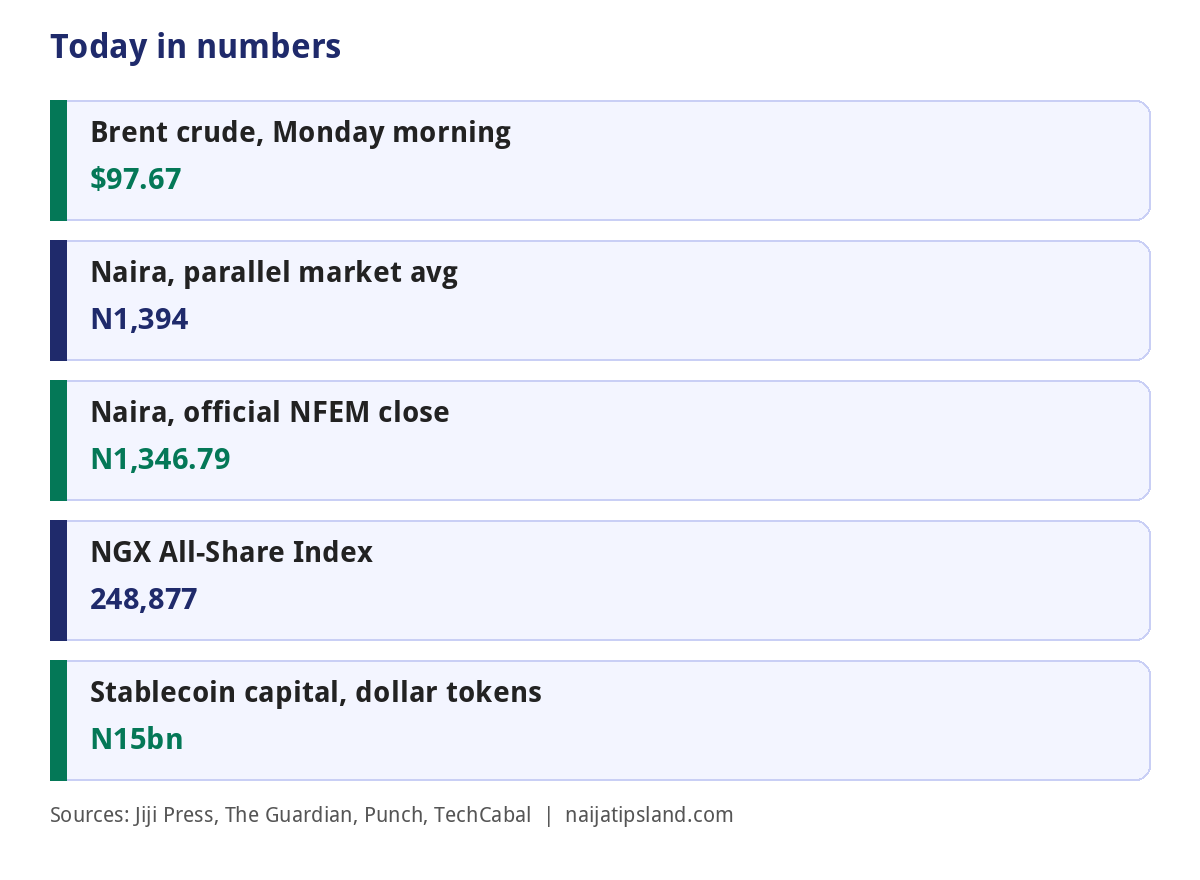
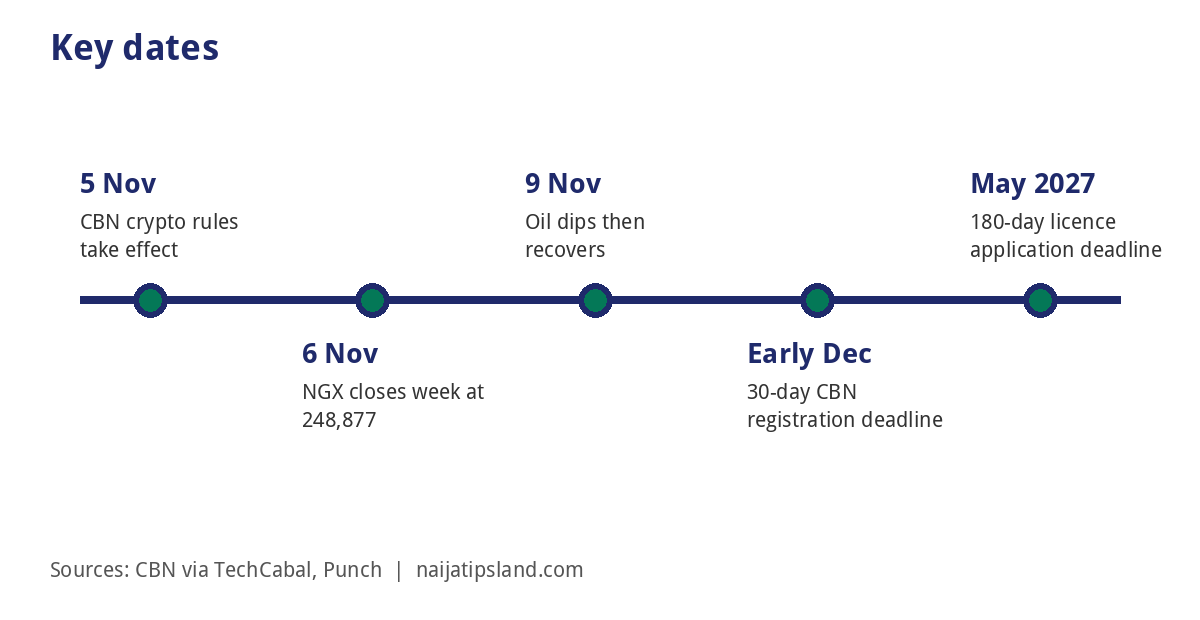
Brent crude opened Monday lower after President Trump said new strikes on Iran were “highly unlikely” if talks progress, briefly dropping more than $1. It was around $97.67 a barrel by mid-morning in Asia, down 64 cents, while US WTI was near $90.50. Prices then recovered towards $98 after US Secretary of State Marco Rubio said talks with Tehran were not productive. Physical Gulf crude told a different story: Abu Dhabi’s Murban grade rose about 3.4% to $99.17, a sign real barrels remain scarce while shipping through Hormuz is still disrupted. Brent fell more than 16% last week.
Why it matters
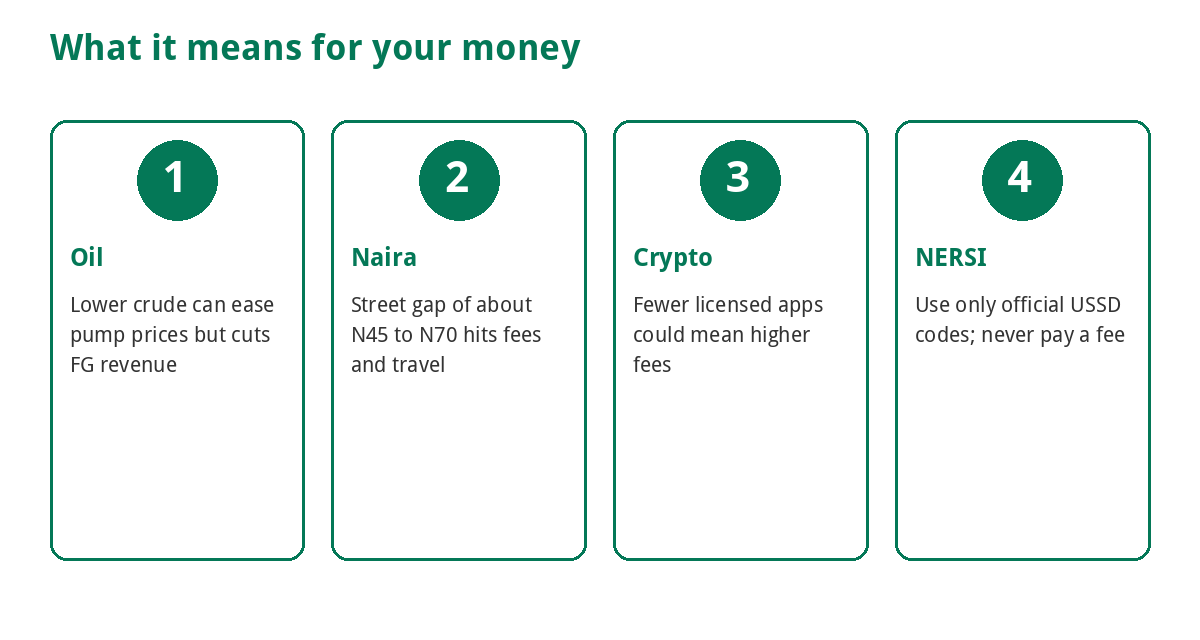
Nigeria’s 2026 budget and dollar earnings depend on crude, so a sustained slide would mean less revenue for FAAC and less FX support for the naira. On the other hand, cheaper crude usually means cheaper petrol and diesel at depots within weeks.
Source: Jiji Press; Gulf News.
2. Naira: street rate slips as demand picks up
What happened
The naira weakened 1.79% at the parallel market last week to an average of ₦1,394 per dollar, from ₦1,369 a week earlier, with analysts pointing to seasonal payments and a firmer US dollar. At the official Nigerian Foreign Exchange Market (NFEM) it closed Friday at ₦1,346.79, almost unchanged. Trading on the official window slowed sharply: CBN daily figures for 2 to 5 November add up to about $1.45 billion, against roughly $4.1 billion the previous week. Weekend street quotes ranged from about ₦1,390 to ₦1,415.
Why it matters
A gap of ₦45 to ₦70 between bank and street rates hits people paying school fees abroad, travellers and small importers who cannot get dollars from banks. Lower official turnover can mean thinner supply, so watch whether the gap widens before Christmas. Check today’s figures on our dollar to naira rate page.
Source: The Guardian; The Rio Times.
3. Stocks: below 250,000 as traders step back
What happened
The NGX All-Share Index ended last week at 248,877.22 points, down 2.13%, after slipping under the 250,000 level. Turnover collapsed: 2.83 billion shares worth ₦208.4 billion changed hands, a 67% drop in value from the week before. Banking stocks fell 2.45% and industrial goods 4.35%. Honeywell Flour gained almost 31% to ₦29.50, while Vitafoam lost about 19%. Analysts at Cordros expect some bargain hunting this week after the nine-month earnings season, though heavy selling in large stocks may cap gains. Others still see the index ending the year near 280,000, helped by the expected Dangote refinery listing.
Why it matters
The market is still up about 60% this year, so many pension funds and retail investors are sitting on gains. Low turnover plus election-season caution means sharper swings are possible. New investors should avoid borrowing to buy and spread their risk.
4. CBN crypto rules: big capital bar for stablecoins
What happened
Under the CBN’s new Regulations for the Operations of Non-Security Virtual Assets, effective 5 November, issuers of dollar-linked stablecoins such as USDT or USDC tokens offered to Nigerians must be locally incorporated with at least ₦15 billion paid-up capital. Naira-backed stablecoin issuers need ₦10 billion and other crypto service providers, such as wallets and custodians, ₦1 billion. Algorithmic stablecoins and interest payments on stablecoins are banned, holders must be able to redeem at face value, and converting naira into a foreign-currency stablecoin needs CBN approval. Existing operators must register within 30 days and apply for a licence within 180 days. Industry voices quoted by New National Star warn the thresholds could push smaller local fintechs out.
Why it matters
Millions of Nigerians use stablecoins to save in dollars, pay foreign suppliers or receive money from abroad. The rules should make platforms safer, but fewer licensed players could mean higher fees and a narrower choice of apps, and peer-to-peer dollar trades will face closer monitoring. Our diaspora money guide covers safer ways to send money home.
Source: TechCabal; Legit.ng; New National Star.
5. Where Nigeria’s dollars go: mostly “invisibles”
What happened
CBN data for the second quarter of 2026 show total foreign exchange use of about $18.3 billion, up from $16.2 billion in the first quarter and $12 billion a year earlier. “Invisibles”, meaning payments for services and financial transactions rather than physical goods, took $13.2 billion or 72% of the total, the fifth quarter in a row they beat goods imports. Financial services alone used $9.6 billion. Goods imports took $5.1 billion. Analysts at Quest Merchant Bank expect usage to keep rising as external buffers improve.
Why it matters
Dollars are flowing more to things like loan repayments, investor exits, school fees, travel and services than to factory inputs. That supports confidence in the market but does less for local production and jobs. It also explains why demand can jump around dividend and payment seasons.
Source: Tribune; Investors King.
6. ₦50,000 NERSI grant: how it is paid
What happened
The Humanitarian Affairs ministry says the ₦50,000 National Emergency Relief and Stabilisation Intervention covers vulnerable households in all 36 states and the FCT, chosen from the National Social Register using NIN records. Nobody can apply or pay to be added. Selected people get an SMS from one of five providers (ALAT, MoMo PSB, NairaGram, OPay or Moniepoint), must accept the offer, and receive the money in a mobile wallet. Payments are in phases. OPay and Moniepoint warn they will never ask for PINs, OTPs or “processing fees”. Independent Newspaper reports that rights group SERAP has asked the government to publish the beneficiary list.
Why it matters
For poor households, ₦50,000 can cover food or rent for weeks. Scammers are already sending fake messages, so use only the official USSD codes and the helpline 0700-022-2222. Questions about transparency are likely to grow as the payments run alongside the election campaign.
Source: The Guardian; Legit.ng; Independent.
What to watch next
- Trump’s meeting with Qatar’s prime minister on Iran, a key signal for oil.
- Whether the street-to-official naira gap widens this week.
- Any date for the Dangote refinery share listing.
- Crypto platforms’ registration with the CBN within 30 days.
Frequently asked questions
Is USDT now banned in Nigeria?
No. The rules do not ban dollar stablecoins, but anyone issuing or offering them to Nigerians must be licensed and locally incorporated. Algorithmic stablecoins are banned.
Why is the black market rate higher than the bank rate?
Many people cannot get dollars from banks quickly for travel, fees or small imports, so they pay more on the street. The gap was about ₦45 to ₦70 at the weekend.
How do I know if I am a NERSI beneficiary?
You will get an SMS from one of the five approved providers, or you can dial your provider’s official code. If nobody contacts you, you are not in the current batch; never pay anyone to be added.
This roundup summarises reporting by the outlets credited under each story, in our own words. Follow Naijatipsland Updates on WhatsApp for the next edition. Spotted an error? Tell us and we will correct it under our editorial policy.