
Renting in the UK as a New Nigerian Arrival (2026): Deposits, Credit Checks and Scams


Last updated 19 November 2026. This guide covers England. Scotland, Wales and Northern Ireland have their own rules, and the law has changed this year, so check GOV.UK or Shelter before you sign or pay anything. I am a writer, not a solicitor. Where I rely on a secondary source rather than an official one, I say so.
Moving to the UK is stressful enough before you have to find somewhere to live. The first rental is where many new arrivals lose money, either to a real landlord who asks for more than the law allows or to a fake advert that takes a deposit for a flat that does not exist. I have seen both happen to people I know, so I want to set out the rules and the traps as plainly as I can.
You do not need a UK credit history to rent here, though it makes things easier. You do need the right to rent, a way to show you can afford the place, and a healthy suspicion of anyone who wants money before you have seen the property.
What changed in England on 1 May 2026
The Renters’ Rights Act 2025 began its first phase on 1 May 2026, according to the property trade body Propertymark and the law firm CMS. A few points matter for a new arrival:
- Landlords can no longer ask for several months of rent upfront. CMS says they may only ask for payment for each rental period, such as monthly in advance, even if the tenant offers to pay early.
- Rental bidding is banned. A landlord cannot invite offers above the advertised rent.
- Most tenancies are now periodic, which means they run on until ended rather than for a fixed term. Section 21 “no-fault” evictions have been abolished. A tenant can end the tenancy by giving two months’ notice.
- Rent can go up once a year through a formal notice that gives at least two months’ warning, and you can challenge it at the First-tier Tribunal.
- Landlords cannot unreasonably refuse a request to keep a pet.
- Councils can fine landlords up to £7,000 for lesser breaches and up to £40,000 for serious or repeated ones, or prosecute.
This matters because older advice, including some articles still ranking on Google, tells people with no UK history to offer six or twelve months of rent upfront. For most new tenancies in England that is now the wrong advice. If an agent asks for it, ask for the request in writing.
The money you can be asked for
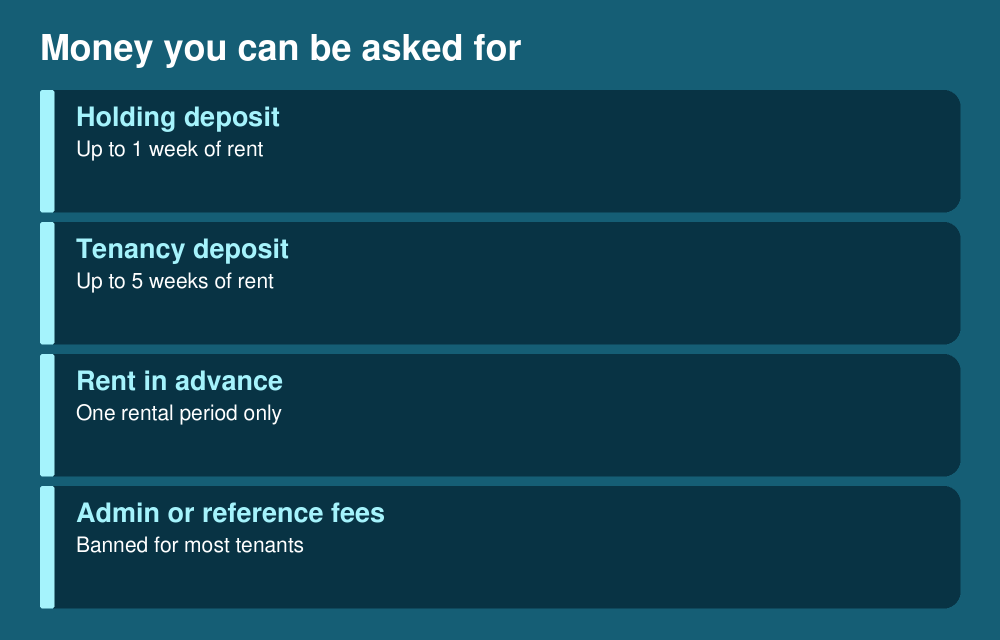
The Renters’ Rights Act did not change the Tenant Fees Act 2019, which still governs what you pay at the start. In England, for a standard tenancy, the main rules are:
- A holding deposit of up to one week’s rent, paid to take the property off the market while checks are made.
- A tenancy deposit of up to five weeks’ rent when the annual rent is below £50,000.
- The first rental payment, for one rental period.
- No fees for referencing, admin, inventory or contract changes in most cases.
The deposit has to be protected in a government-approved scheme, and the landlord or agent must tell you which one. Confirm the details in writing and check them on the scheme’s own website. Our cost to relocate from Nigeria to the UK guide has the wider budget, and the first 30 days checklist covers what else needs doing after you land.
Right to rent checks
Landlords and agents in England must check that every adult living in the property has the right to rent. Citizens Advice explains how this works:
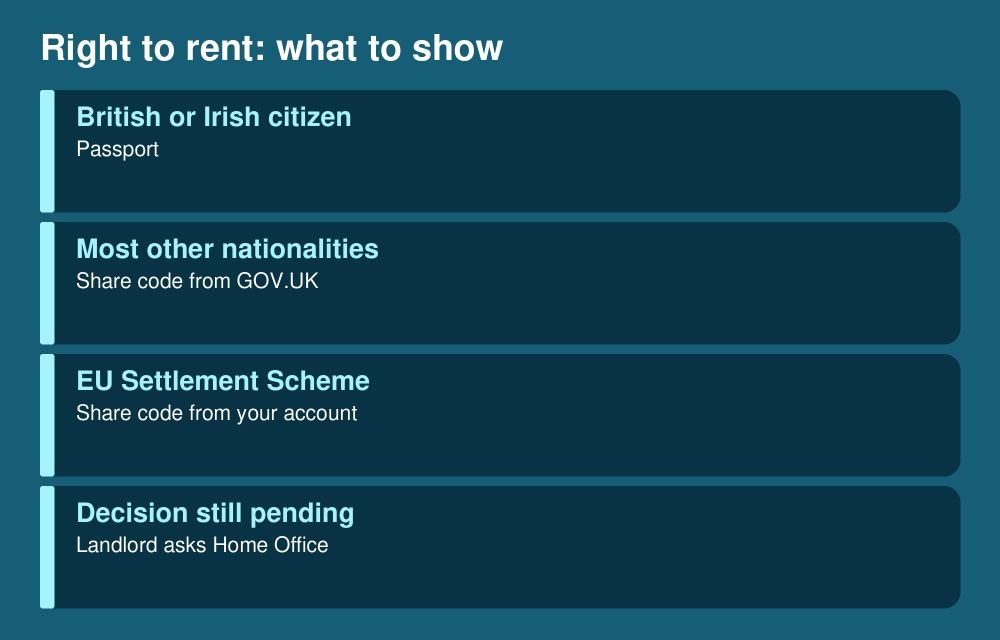
- British citizens usually show a passport. Irish citizens show a passport too.
- Most other nationalities prove their status with a share code from GOV.UK, which the landlord uses to check online.
- If you are on the EU Settlement Scheme, you send a share code from your online account. If you are waiting for a decision, there are alternative routes, such as the certificate of application.
- If you cannot provide documents and your application is pending, the landlord can ask the Home Office to run a check, and the reply should come within two working days.
Landlords may not refuse you because of your race or nationality if you have the right to rent. They may not refuse you because you have children or receive benefits, though they can ask about both when they check affordability. The government also published an updated landlord code of practice for the right to rent scheme dated 1 October 2026. If a landlord seems confused about how to check you, ask them to use the official GOV.UK service rather than guessing.
Generate your share code before you start viewing, and check that the details match the name on your other documents. Share codes expire, so you may need a fresh one when a landlord is ready.
What to do when you have no UK credit history
A new arrival has no UK credit file, so a landlord or agent has little to look at. Their referencing company will usually ask for proof of income and a reference from an employer or previous landlord. These are common routes that new arrivals use:
- Show a signed UK job contract or offer letter, and your first payslips once you have them.
- Provide bank statements, including from Nigeria if that is all you have, with a short note explaining the source of savings.
- Offer a UK-based guarantor if you know someone who is willing. Some agents also accept paid guarantor services, which the landlords’ body NRLA has written about for students, though you should read the terms and cost carefully.
- Ask your employer, university or a sponsor for a letter confirming your role and start date.
- Look for landlords who rent directly and may take a more flexible view of a first-time tenant than a large agency.
While you search, start building a UK financial footprint. Open a UK bank account, register on the electoral roll once you are eligible, and set up a phone contract and utilities in your own name. Credit reference agencies use these, and a thin file grows over months. I would not pay a company that promises to fix your credit score, because the basics are free.
How rental scams work
Action Fraud, the UK’s national fraud reporting centre, describes the pattern. Scammers advertise a property that does not exist, has already been let, or has been offered to several people at once. They ask for an upfront fee before you can view it, and push you to pay quickly. Newcomers are targeted because they often search from overseas and cannot attend a viewing.
Action Fraud lists these warning signs:
- You are asked to pay before you or a trusted contact has seen the property.
- You are pressured to transfer a large sum fast.
- You are told to use a money transfer service such as Western Union.
- The advertiser cannot be verified.
- The price is much lower than similar places nearby.
Its advice is to avoid sending money until you are sure the person is genuine, and to ask a friend, relative, employer or university to check the property in person if you are arranging it from abroad. It also suggests asking for the tenancy agreement and safety certificates, and getting the bank details directly from the landlord or agent after completing those checks. If you have been scammed, report it to Action Fraud.
Two extra habits help. Search the property address on the Land Registry and on the agent’s own website, and check that the agent belongs to a redress scheme. If you plan to pay by bank transfer, pay the holding deposit into a business account in the agent’s name rather than a personal account. Our guides on avoiding internet scams and property scams aimed at the diaspora cover the same tricks in a Nigerian setting.
Before you sign
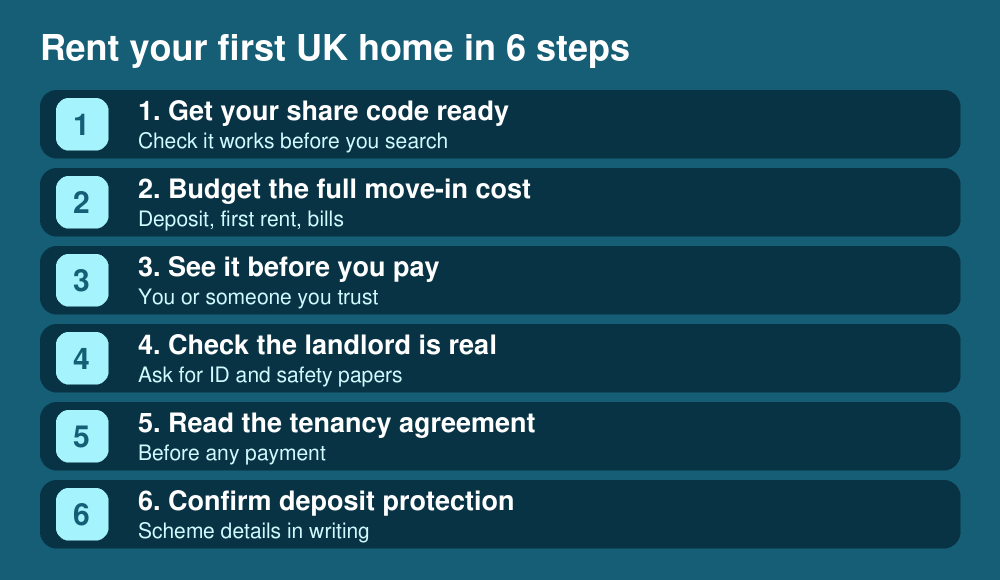
- Read the whole tenancy agreement. Check the rent, who owns the property, the deposit scheme and the notice terms.
- Ask for the gas safety certificate, the electrical safety report and the energy performance certificate.
- Take dated photos of the property on move-in day and send them to the landlord by email.
- Keep every receipt and message. Pay by bank transfer so there is a record.
- Check that the deposit has been protected and that you received the prescribed information about it.
If you are renting a room in a shared house, ask whether it needs a licence, because many houses of multiple occupation do. Shelter and Citizens Advice both offer free help if a landlord is pressuring you, and your local council has an enforcement team for unlicensed or unsafe lets.
If you want to read more
The japa guide hub collects our relocation guides, and if you are sending money home or paying fees from the UK, this comparison of UK to Nigeria transfers may help with the budget.
FAQ
Can I rent in the UK before I arrive?
Yes, but it is risky. Use a reputable agent, ask a trusted person to view it, and never pay a deposit for a property that you or someone you trust has not seen.
Do I need a UK guarantor?
Not always. Many landlords accept proof of income or an employer letter. A guarantor helps when you have no UK history, and some agents accept paid guarantor services.
How much deposit will I pay?
Usually up to five weeks of rent when the annual rent is below £50,000, with a holding deposit of up to one week that normally counts toward the first payment.
Can a landlord ask for six months of rent upfront?
For most new tenancies in England, no. Since 1 May 2026 the landlord may only ask for payment for each rental period. Ask for any such demand in writing.
What is a share code?
A code you generate on GOV.UK that lets a landlord check your immigration status online for the right to rent check.
What should I do if I think I have been scammed?
Contact your bank straight away, then report it to Action Fraud.
This article gives general information and is not legal advice. Rules differ across the UK nations and change over time, so confirm details with GOV.UK, Shelter or Citizens Advice.
Sources
- CMS: Renters’ Rights Bill becomes Renters’ Rights Act, 15 key points
- Propertymark: 1 May is the date for tenancy reforms under the Renters’ Rights Act
- Citizens Advice: Information landlords ask for when you start renting
- Action Fraud: Rental fraud
- GOV.UK: Right to rent code of practice, 1 October 2026
- Shelter England: First time renters
Join the discussion
Have you tried this, or do you have a question we did not answer? 1 reader has already shared their view. Naijatipsland members help each other with real, first-hand experience.







Editor note: have you rented a home in the UK as a new arrival? Tell us in the comments what the landlord or agent asked you for, what surprised you and what you would do differently. Please leave out your address and any ID numbers. We read every comment. – Ade