Business News Today, 18 November 2026: NGX Loses N2.3trn, Naira Hits N1,445 on Street, AfDB Backs SMEs


Last updated: 18 November 2026 · By Naijatipsland Editorial Team · Editorial policy
Morning roundup · Wednesday 18 November 2026 · By Ade Adeniyi, Founder and Editor
Good morning. The stock market gave back a big chunk of value on Tuesday as Dangote Cement hit its daily limit down, and the naira kept losing ground on the street as year-end dollar demand builds. The finance minister also tried to explain why your market basket still feels expensive. Here is the money news that matters this morning.
Today at a glance
- Naira weakens to about ₦1,445/$ on the street as weekly dollar inflows fall to $807.6 million.
- NGX loses ₦2.3 trillion as Dangote Cement drops 9.99% in one day.
- Oyedele: falling inflation means prices rise more slowly, not that they fall.
- AfDB approves $102 million for Sterling Bank to lend to small businesses and farmers.
- Non-oil exports hit a record $6.1 billion; export phase of the National Single Window starts 14 December.
- CBN gives final approval to a new non-interest lender, Milestone Global Bank.
1. Naira slides on the street as dollar inflows drop
What happened
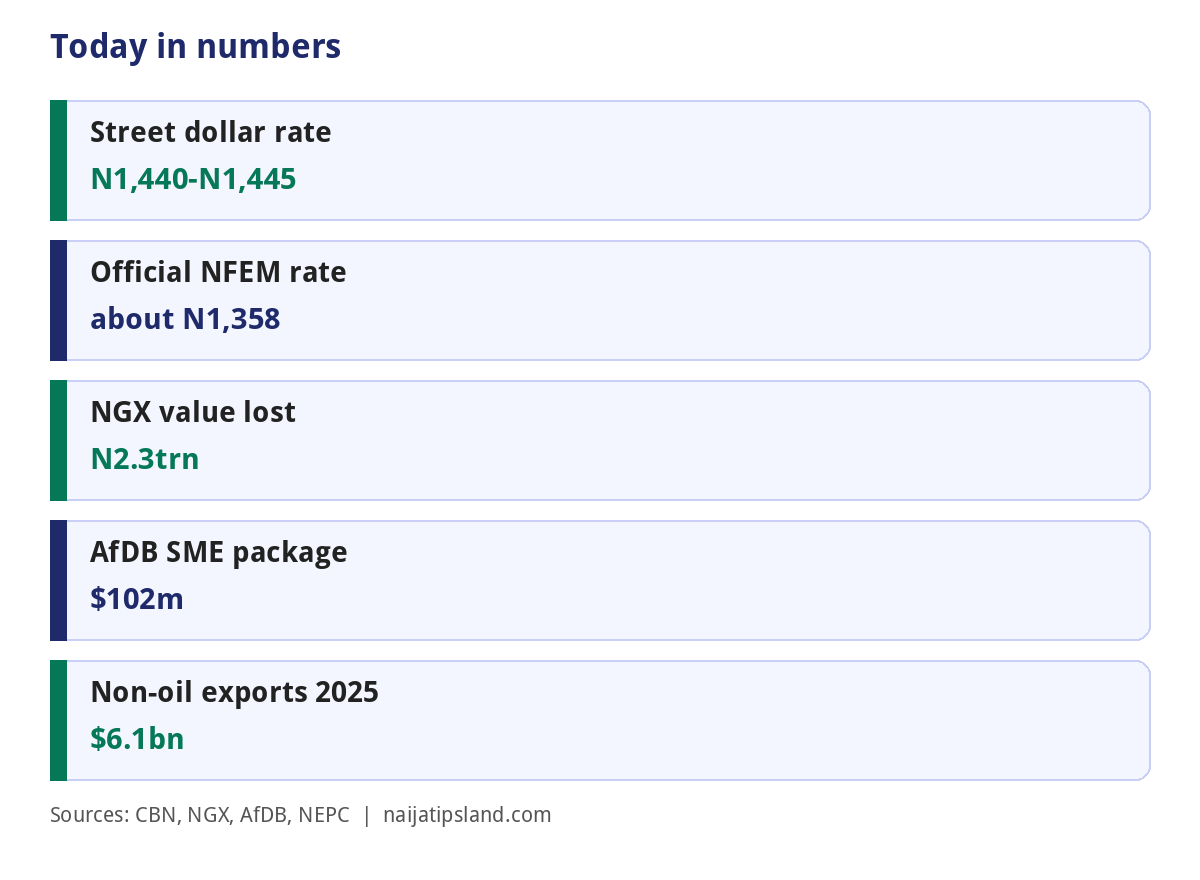
At the official Nigerian Foreign Exchange Market (NFEM), the naira traded between ₦1,354 and ₦1,364.50 per dollar on Tuesday, with CBN data putting the session’s weighted rate at about ₦1,358. On the parallel market, Lagos and Abuja dealers quoted ₦1,435 to ₦1,445, up from about ₦1,430 on Monday. BusinessDay, as reported by Lagos Metropolitan, said foreign currency inflows into the official market fell to $807.6 million last week, and Monday’s NFEM turnover dropped by about 60%. Vanguard said external reserves have eased by roughly $390 million from their late-October peak of $55.26 billion but remain well above last year’s level.
Why it matters
A gap of about ₦80 between the official and street rates means importers, travellers and people paying school fees abroad are paying more. December usually brings extra demand for dollars, so pressure may continue for a few weeks. Check our daily dollar to naira rate page before you change money.
Source: Vanguard; Lagos Metropolitan (BusinessDay); Arbiterz.
2. NGX loses ₦2.3 trillion as Dangote Cement falls 10%
What happened
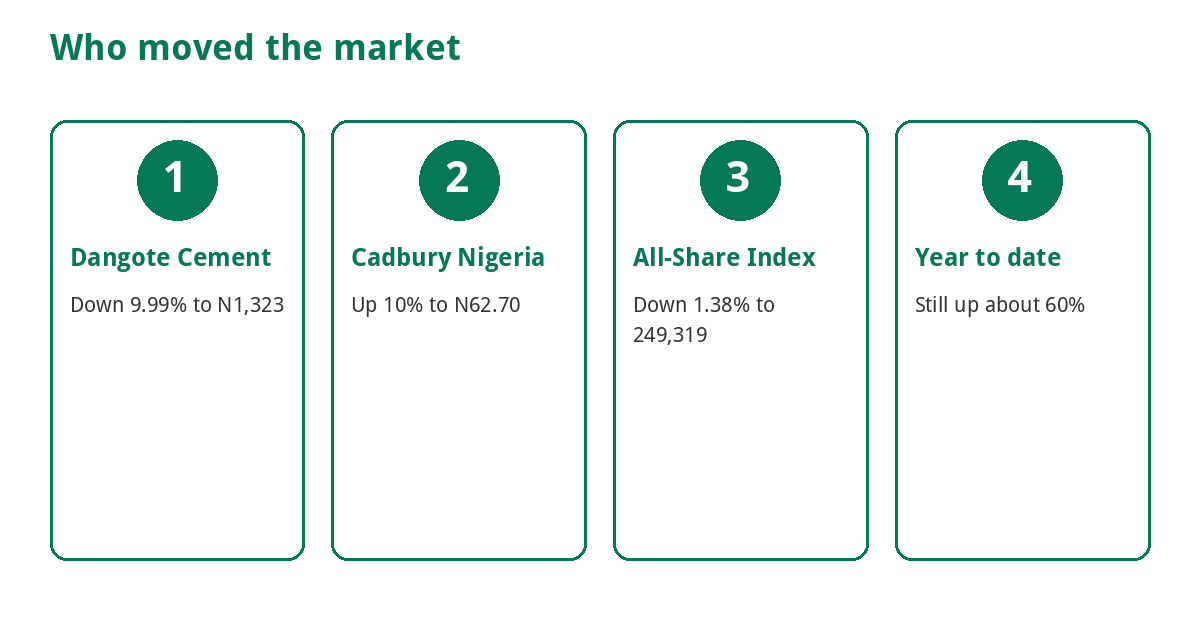
The NGX All-Share Index fell 1.38% on Tuesday to close at 249,318.65 points, and market value dropped about ₦2.3 trillion to ₦161.88 trillion. The main cause was Dangote Cement, which fell by the 9.99% daily limit to ₦1,323 a share. NGX Group, John Holt, Red Star Express and GTCO also lost ground. More stocks actually rose than fell, led by Cadbury Nigeria, up 10% to ₦62.70. The index is still up about 60% for the year but now down around 2% for November. ThisDay put the fall down to profit-taking; no company announcement explaining the Dangote Cement drop had been reported.
Why it matters
Dangote Cement is so large that one bad day for it drags the whole index, and with it the value of many pension and mutual fund portfolios. If you hold shares, a day like this is a reminder to spread your money across different stocks.
Source: ThisDay; Nigerian Tribune.
3. Oyedele explains why prices still feel high
What happened
Speaking at the World Public Relations Forum in Abuja on Tuesday, Finance Minister Taiwo Oyedele said many Nigerians doubt the October inflation figure of 14.06%, a six-year low, because bread and milk are still expensive. He explained that lower inflation means prices are going up more slowly, not coming down. He also warned that when people stop trusting official numbers, traders raise prices in advance and the fear becomes real. He said government must explain progress without ignoring hardship, adding that a budget line is not the same thing as a working hospital.
Why it matters
This is the gap many families feel every week. Prices only actually fall when supply improves, the naira strengthens or costs like fuel and transport drop. Lower inflation does mean your money should lose value more slowly from here.
Source: Independent; The Sun.
4. AfDB approves $102 million for Sterling Bank to fund small businesses
What happened
The African Development Bank approved a $102 million package for Sterling Bank on Tuesday. It is made up of a $50 million credit line, a $20 million sustainable loan, a $2 million low-cost loan for farmers and a $30 million trade finance guarantee. At least 30% of the credit line is set aside for businesses owned or led by women and young people. The AfDB expects it to support at least 200 businesses and up to 6,000 jobs, and to reach more than 5,000 farmers hit by insecurity, displacement or climate shocks. Interest rates for borrowers were not published.
Why it matters
Long-term, cheaper loans are hard for small firms to get in Nigeria. If you run a business in health, education, farming, clean energy or transport, it may be worth asking Sterling Bank about the new facility.
5. Record non-oil exports; Single Window export phase starts 14 December
What happened
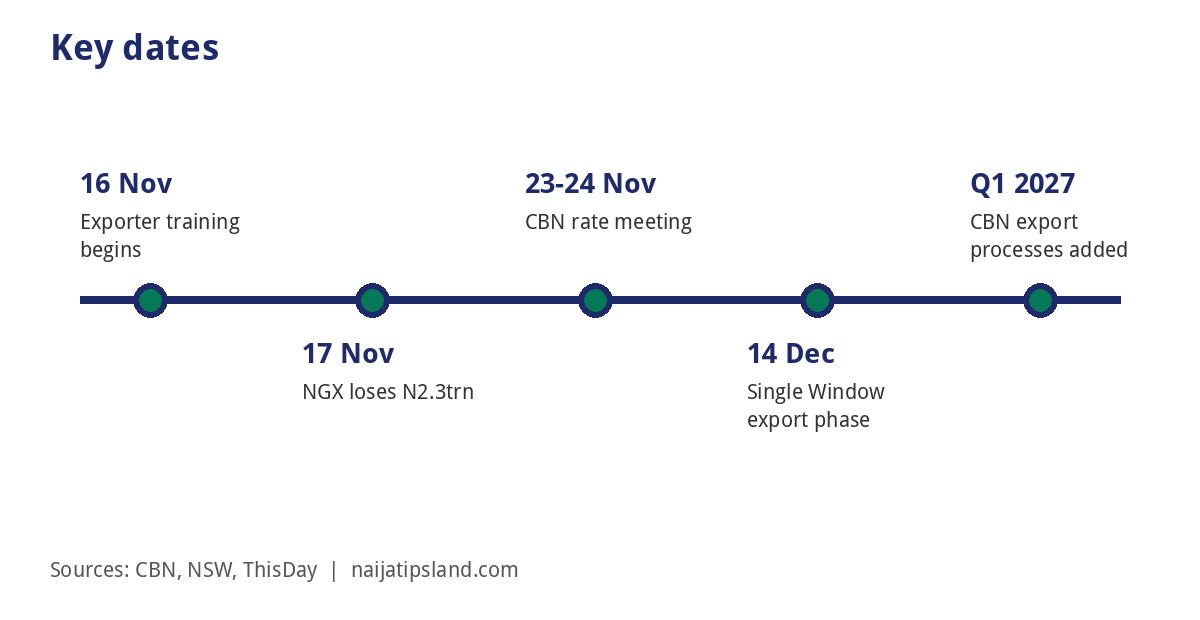
At a stakeholders’ meeting in Abuja, NEPC chief executive Nonye Ayeni said Nigeria’s non-oil exports reached a record $6.1 billion in 2025, up 11.5%, with 281 products shipped to 120 countries. Tola Fakolade, who heads the National Single Window project, said the platform has processed over 169,000 import permits and more than ₦17 billion in agency payments since March. Its export phase begins on 14 December, letting exporters apply for licences and certificates in one place. Processes linked to the CBN, such as export proceeds forms, follow in early 2027. Exporter training started on 16 November in Abuja, Lagos, Kano and other cities.
Why it matters
Fewer offices and less paperwork mean lower costs for small exporters of food, crafts and manufactured goods. More non-oil exports also bring in dollars that help steady the naira.
Source: ThisDay; The Guardian; BusinessDay.
6. CBN approves a new non-interest bank
What happened
Milestone Global Bank said on Tuesday that it has received final approval from the Central Bank of Nigeria to operate as a regional non-interest bank. Its chief executive, AbdulFattah Amoo, said the bank met the CBN’s rules on capital, governance and non-interest compliance. It plans branches in Abuja, Kano and Kaduna plus digital services, but has not given a launch date. Regional non-interest banks must hold at least ₦10 billion in capital under the CBN’s 2024 recapitalisation rules.
Why it matters
Non-interest banks offer financing based on leasing and profit-sharing rather than interest. A new player adds competition alongside Jaiz, TAJBank, Lotus and others, which could mean better products for customers in the North.
Source: Leadership; The Business Times.
What to watch next
- The CBN’s Monetary Policy Committee meeting on 23 and 24 November.
- Whether Dangote Cement recovers or the sell-off spreads.
- Year-end dollar demand and the gap between official and street rates.
- Exporter registration ahead of the 14 December Single Window launch.
Frequently asked questions
If inflation is falling, why are prices not coming down?
Inflation measures how fast prices rise. When it falls from, say, 20% to 14%, prices are still going up, just more slowly. Prices fall only when costs or supply change.
What is the dollar to naira rate today?
On Tuesday the official NFEM rate was around ₦1,358 to ₦1,363 per dollar, while street dealers quoted ₦1,435 to ₦1,445. Rates change daily, so check before you trade.
When does the National Single Window export phase start?
The first batch starts on 14 December 2026. CBN-related export processes are expected in the first quarter of 2027.
This roundup summarises reporting by the outlets credited under each story, in our own words. Follow Naijatipsland Updates on WhatsApp for the next edition. Spotted an error? Tell us and we will correct it under our editorial policy.