
How to Make Suya at Home (2026): Yaji Spice, Oven and Grill Methods, and UK Substitutes


Last updated 17 November 2026. Prices and stock of UK ingredients change, so check the shop before you order.
Anyone who has stood at a roadside suya stand in Lagos or Abuja at nine at night knows the smell: charcoal smoke, peanuts and chilli, and thin slices of beef curling at the edges. The good news for those of us in the UK is that you can get very close to it at home with a grill pan, an oven or a barbecue. The meat is cheap, the spice mix takes ten minutes, and the method is much simpler than the queue at the stand suggests.
This guide covers the yaji (the spice mix), how to slice and marinate the beef, three cooking methods with temperatures, what to do if you cannot find kuli-kuli, and how to store what is left. I compared recipes from Serious Eats, African Vibes, Zena’s Kitchen and Elle Gourmet, and checked food safety against Food Standards Agency and NHS guidance.
What suya is, and what makes it taste like suya
Suya is thinly sliced meat, usually beef, rubbed with yaji and cooked over hot coals. It comes from northern Nigeria, where it is associated with Hausa meat sellers, often called mai suya, and it is now eaten across the country and in the diaspora. It is sold in newspaper or foil with sliced raw onion, tomato and sometimes cabbage, plus an extra dusting of yaji.
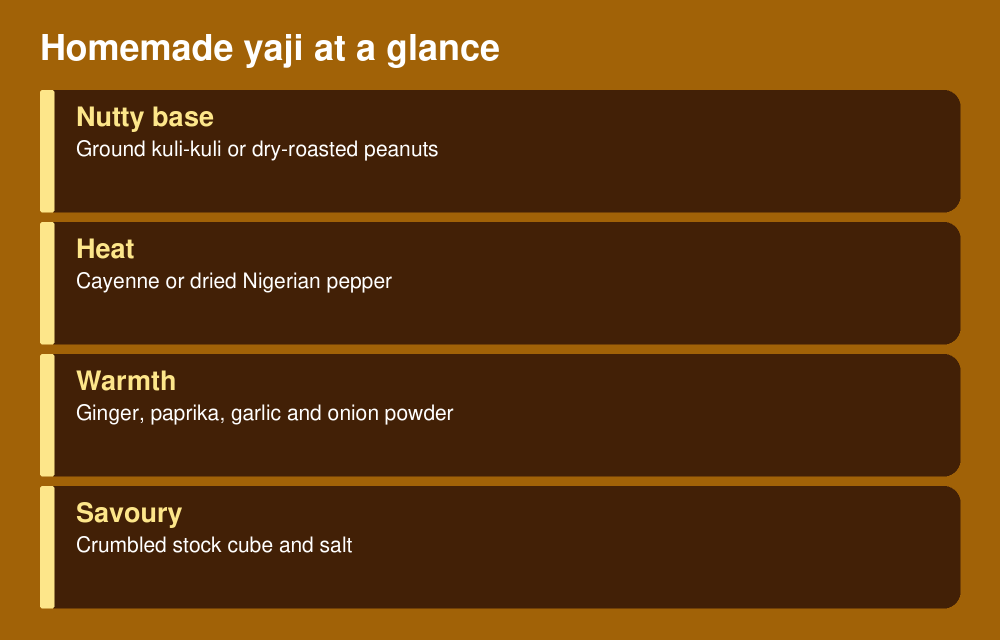
Yaji, also spelled yagi, is the part that matters. It is built on ground kuli-kuli, the dry, defatted peanut snack, mixed with ginger, chilli and other spices. Zena’s Kitchen describes the full process: peanut paste has its oil pressed out, the cake is fried or roasted into kuli-kuli, and that is ground again and blended with the spice to make yajin kuli. At home, most cooks skip straight to a ground peanut base.
Homemade yaji (suya spice)
Every recipe I looked at differs slightly, which tells you the mix is forgiving. This is a middle-of-the-road version based on the African Vibes and Serious Eats ratios, and it makes enough for about 800 g to 1 kg of beef with some left to serve on the side.
- 1/2 cup (about 60 g) finely ground kuli-kuli, or dry-roasted unsalted peanuts ground to a dry powder
- 1 tablespoon ground ginger
- 1 tablespoon smoked or sweet paprika
- 2 teaspoons cayenne pepper, more if you like it hot
- 1 tablespoon onion powder
- 1 teaspoon garlic powder
- 2 stock cubes, crushed to a powder
- 1 teaspoon salt
- 1/2 teaspoon ground grains of selim (uda), optional but worth adding if you have it
If you grind your own peanuts, pulse them in short bursts. Run the processor too long and the peanuts turn to butter, which makes the mix clump. Kuli-kuli is already dry, so it grinds more easily. Elle Gourmet’s version goes further, with ehuru, uda, uziza and alligator pepper toasted and ground into the base, then left to rest for two or three days before re-grinding. That is a good project for a weekend, but not necessary for a first attempt.
Spoon a quarter of the finished mix into a separate bowl before any raw meat touches the rest. That is your finishing spice, and keeping it separate means you can safely sprinkle it on the cooked meat.
A note on allergies: yaji is made with peanuts. If anyone eating has a peanut allergy, do not serve it. A mix made without peanuts is a different thing and I would not call it suya.
Which beef to use and how to cut it
Recipes use skirt steak, sirloin or rump. Whichever you choose, you want a lean cut with little gristle, because the slices are so thin that fat and sinew turn chewy. Trim away anything silvery or hard.
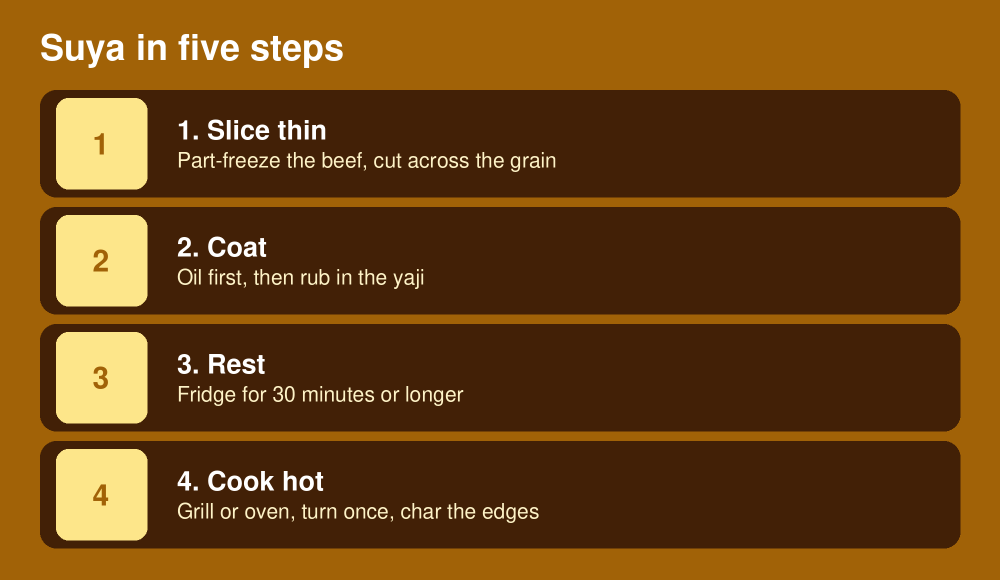
The slicing is where most home suya goes wrong. Wrap the beef tightly and put it in the freezer for 15 to 30 minutes until it is firm but not frozen solid. Serious Eats and African Vibes both recommend this. Then slice across the grain into strips about 3 mm (1/8 inch) thick. Strips roughly 5 cm long and 2.5 cm wide are easy to thread. If your slices are ragged, do not worry, they still taste good. If they are thick, the outside will char before the middle cooks.
How to make suya, step by step
1. Coat the beef
Put the sliced beef in a large bowl. Drizzle over about 2 tablespoons of groundnut (peanut) oil, or any neutral oil if you prefer, and toss. Add most of the yaji, keeping the quarter aside, and massage it in until every piece is coated. Some recipes add the oil after the spice, and some add none at all. I like oil first, because it helps the spice stick and the meat does not dry out so quickly.
2. Rest it
Cover and refrigerate for at least 30 minutes. One hour is better, and up to 8 hours is fine. Serious Eats gives 30 minutes to 8 hours. Longer than that and the salt starts to firm up the surface of such thin meat.
3. Skewer
If you use wooden skewers, soak them in water for 30 minutes so they do not burn. Thread each strip on by piercing it in two or three places and bunching it up like an accordion, so the meat lies flat and tight together. Leave a few centimetres of bare stick at the bottom for a handle. Metal skewers need no soaking.
4. Cook it hot
High heat and short time is the rule. You want charred edges and a cooked middle. Here are three ways, in order of how close they get to street suya.
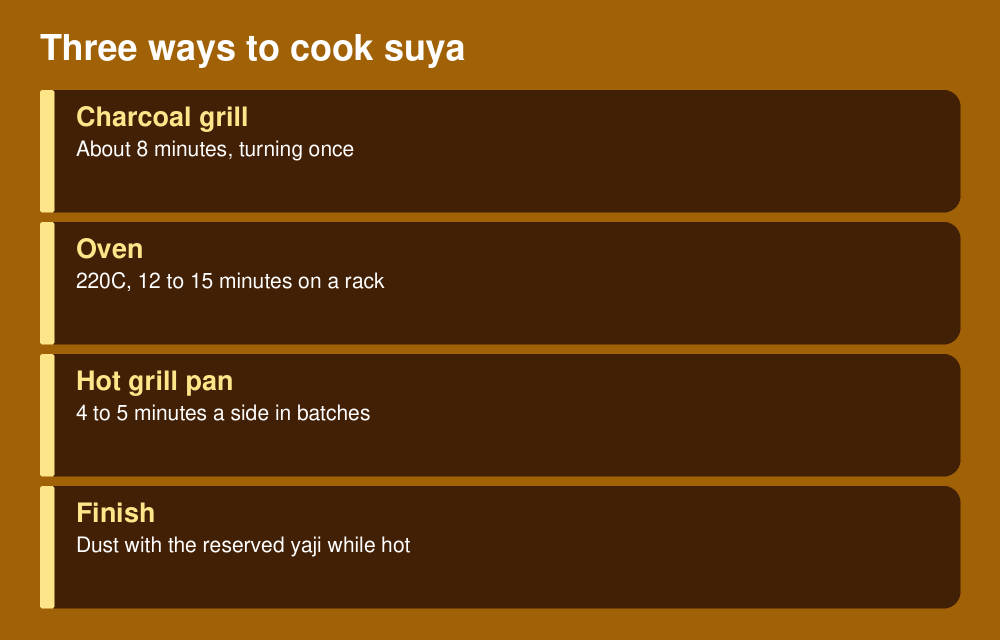
- Charcoal or gas barbecue: cook over direct heat for about 8 minutes, turning once or twice, until the edges are charred. Zena’s Kitchen calls the barbecue the best method. Move the skewers if there are flare-ups from the oil.
- Oven: heat to 220°C (200°C fan). Lay the skewers on a wire rack over a baking tray so the air can circulate underneath, and cook for 12 to 15 minutes, turning once. For more char, finish for 2 to 3 minutes under the grill. African Vibes uses 230°C for 10 to 12 minutes, then a 2-minute grill.
- Grill pan or heavy frying pan: get the pan very hot, cook in small batches for 4 to 5 minutes a side, and open a window. Overcrowding the pan steams the meat.
5. Finish and serve
As soon as the skewers come off the heat, dust them with the reserved yaji. Rest them for two or three minutes, then serve with sliced red onion, tomato wedges and a little cabbage, plus lime if you like. Mai suya often puts extra raw onion on the plate, and the sharpness cuts the richness of the peanut.
Food safety, in plain terms
The NHS says you can eat whole cuts of beef pink in the middle as long as the outside is fully cooked, but suya strips are thin and heavily handled, so cook them until there is no pink and they are steaming hot. The Food Standards Agency lists 70°C for 2 minutes in the centre as one safe time and temperature combination, and says to check with a clean probe if you want to be sure.
Do not wash the raw beef, because the splashing spreads bacteria around the sink. Use a separate board and knife for raw meat, and wash your hands before touching the finishing spice. If you do have leftovers, cool them quickly and put them in the fridge within one to two hours.
Making suya in the UK: what to buy and what to swap
You do not need to go far. African and Caribbean shops in most cities sell ready-made yaji, and online sellers ship across the UK. On Etsy UK, for example, 100 g bags of suya spice were listed from around £5, with larger or two-pack sets nearer £19 to £20 at the time of writing. Check the label: some mixes are very hot, and some include extra ingredients such as cumin or fennel.
If you cannot find kuli-kuli, use dry-roasted unsalted peanuts or peanut powder. Chili Pepper Madness suggests a quarter cup of peanut powder in place of a half cup of whole peanuts. The flavour will be a little milder, but it works. For the chilli, cayenne is the common supermarket stand-in. Smoked paprika adds some of the barbecue flavour you lose when you cook indoors.
Storing yaji and leftover suya
Keep homemade yaji in an airtight jar somewhere cool and dry. Chili Pepper Madness gives about a month, and the fridge or freezer will extend that because of the peanut oil. Cooked suya keeps for up to two days in the fridge in a sealed container, which is the Food Standards Agency’s guidance for leftovers. Reheat it once, until it is steaming hot all the way through. A dry frying pan or a hot oven works better than the microwave, which makes the meat rubbery.
You can also use up the extra yaji. A spoonful goes well on roast chicken wings, fried plantain, boiled eggs or oven chips. If you are building a bigger Nigerian menu, my guides to ofada stew and ayamase and Nigerian jollof rice pair well with a plate of suya, and cooking Nigerian food abroad with local ingredients has more substitutions for UK kitchens.
Related guide (updated 17 November 2026)
How to make Nigerian pepper soup covers goat meat, catfish and chicken versions, what each spice does, how to stop the broth going bitter, and UK substitutes for ehuru and uziza.
Related guide (updated 17 November 2026)
How to make moi moi and akara walks through peeling beans, steaming and frying, fixes for common problems, UK substitutes and 2026 bean prices.
Frequently asked questions
What is yaji?
Yaji is the Hausa name for the spice mix used on suya. It is made from ground kuli-kuli or peanuts, ginger, chilli, onion, garlic, salt and other spices.
What is the best beef for suya?
A lean cut such as sirloin, rump or skirt steak. Remove gristle and slice across the grain, about 3 mm thick.
Can I make suya in the oven?
Yes. Cook on a wire rack at 220°C (200°C fan) for 12 to 15 minutes, turning once, then finish under the grill for extra char.
Can I make suya with chicken?
Yes, and many stands sell chicken suya as well. Chicken must be cooked all the way through, with no pink and clear juices, so slice it thin and cook a little longer.
How long should I marinate suya?
At least 30 minutes, ideally an hour or more, and up to 8 hours in the fridge.
Where can I buy suya spice in the UK?
African and Caribbean grocers, online African food stores and marketplace sellers. Read the label for peanut content and heat level.
Is suya safe for people with peanut allergies?
No. Yaji contains peanuts, so avoid it if anyone eating has a peanut allergy.
Sources
- Serious Eats: Nigerian Beef Suya
- African Vibes: Suya (Nigerian Spiced Beef Skewers)
- Zena’s Kitchen: Nigerian Beef Suya
- Elle Gourmet: Beef Suya with Yajin Kuli
- Chili Pepper Madness: Nigerian Suya Spice (Yaji)
- NHS: Meat in your diet
- Food Standards Agency: Safer food, better business, cooking safely
- Etsy UK: suya pepper listings









Editor note: suya is one of those foods where everyone has strong opinions about the spice mix. Do you like yours heavy on the peanut or heavy on the pepper? Tell us in the comments and say where in Nigeria your favourite suya spot is. – Ade