Business News Today, 16 November 2026: Inflation Data Due, Reserves Slip $300m, NGX Regains N2.2trn

Last updated: 16 November 2026 · By Naijatipsland Editorial Team · Editorial policy
Morning roundup · Monday 16 November 2026 · By Ade Adeniyi, Founder and Editor
Good morning. This is a big week for your money. October inflation figures are expected from the NBS, the naira ended last week slightly weaker as reserves slipped again, and the stock market clawed back part of its recent losses. We also look at new crypto rules from the CBN, a warning from bakers that should worry anyone who buys bread, and fresh moves in refining.
Today at a glance
- October inflation data is due this week; analysts expect a fifth straight monthly fall.
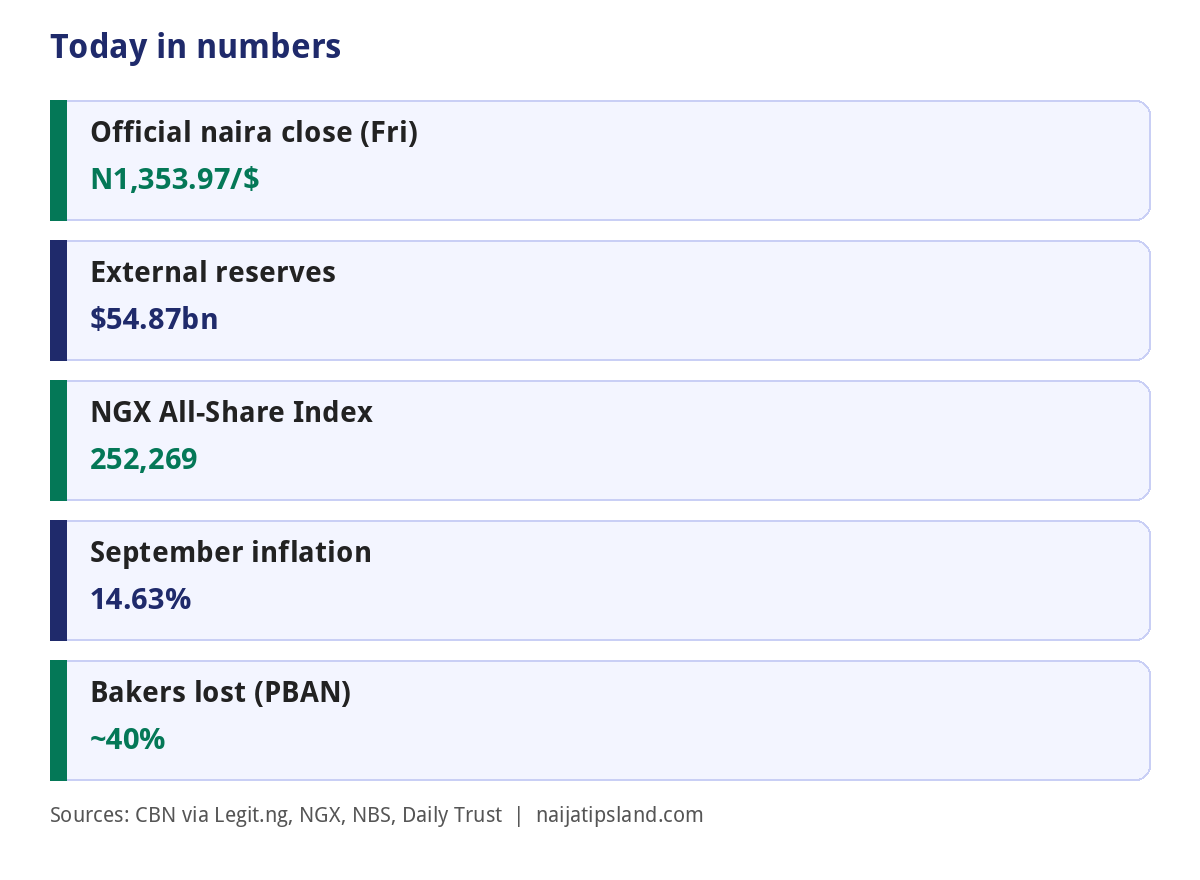
- Naira closes the week at ₦1,353.97/$ officially as reserves drop about $300 million in 10 days.
- NGX recovers ₦2.2 trillion, led by Dangote Cement, Oando and Seplat.
- CBN’s new virtual asset rules ban algorithmic stablecoins and license naira-backed coins.
- Bakers say 40% of members have gone under as diesel and loan costs bite.
- NNPC gets land for a proposed refinery in Edo as Dangote’s floating petrol price settles in.
1. October inflation figures expected, with analysts tipping another fall
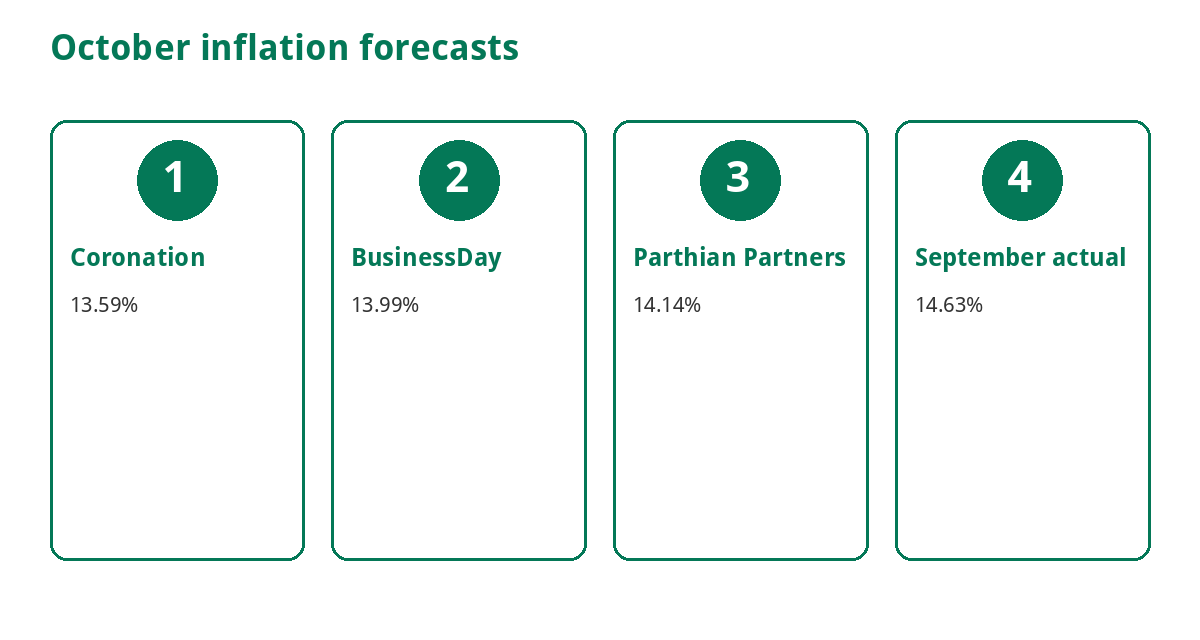
What happened: The National Bureau of Statistics is expected to publish October consumer price data around 16 November. Headline inflation was 14.63% in September, down from 15.93% in May. Forecasts point lower again: Coronation’s research arm expects 13.59%, BusinessDay’s model 13.99% and Parthian Partners 14.14%, helped by harvest-season food prices and a fairly steady naira. Core inflation eased to 12.95% in September. Analysts warn that high crude prices in October, when Brent averaged about $105.69 a barrel, could slow the relief on transport costs.
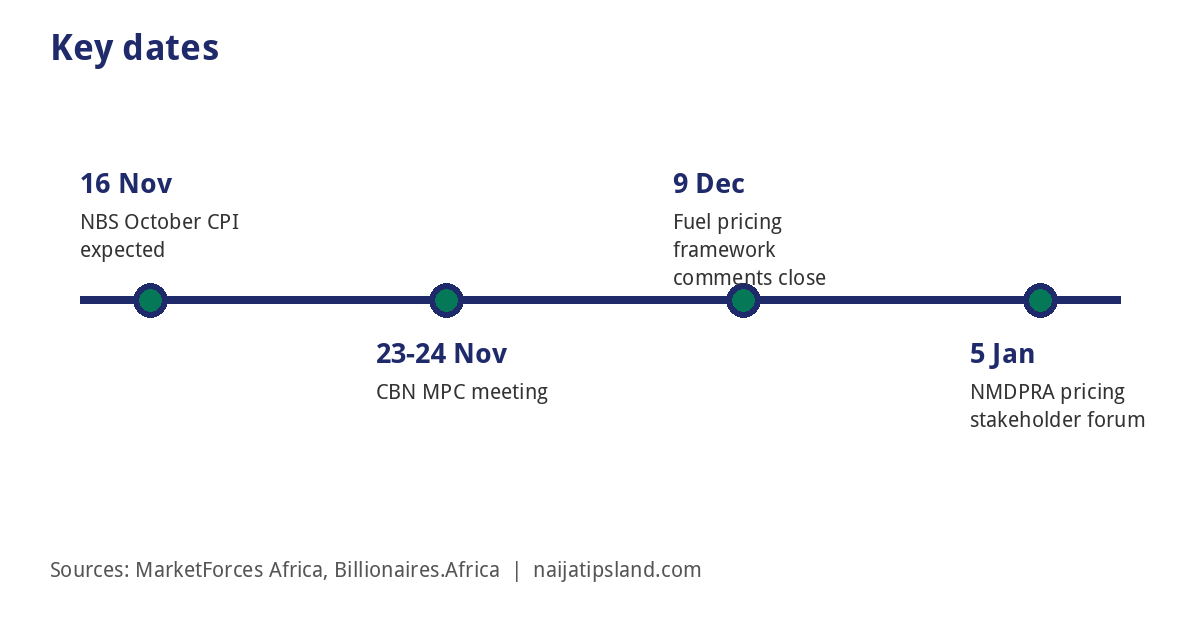
Why it matters: This is the last inflation reading before the CBN’s Monetary Policy Committee meets on 23 and 24 November. A clear fall would strengthen the case for further rate cuts, which businesses say they badly need.
Source: MarketForces Africa; BusinessDay; Parthian Partners.
2. Naira ends the week a little weaker as reserves slip
What happened: CBN data show the naira closed Friday at ₦1,353.97 per dollar in the official market, about 0.5% weaker than ₦1,346.79 a week earlier, after a sharp ₦10.50 drop on Wednesday. Parallel market quotes varied by report, from about ₦1,390 to ₦1,441. Gross external reserves fell to $54.87 billion on 12 November, down roughly $300 million from $55.17 billion on 2 November. Bonny Light crude eased about 2% to $96.93 a barrel over the week, and Cowry Asset Management warned weaker oil prices could reduce dollar inflows.
Why it matters: Reserves are the CBN’s cushion for defending the naira. A slow drift lower is not a crisis, but it bears watching if you price goods in dollars, pay school fees abroad or send money home. Check today’s rates on our dollar to naira page.
Source: Legit.ng; Daily Post; MarketForces Africa.
3. Stock market recovers ₦2.2 trillion
What happened: The NGX All-Share Index rose 1.36% last week to 252,269.16 points, lifting market value from ₦161.59 trillion to ₦163.80 trillion and taking back part of the ₦3.52 trillion lost the week before. Dangote Cement gained 9.61% to ₦1,469.90, Oando 14.8% to ₦38 and Seplat 1.51%. Champion Breweries topped the gainers with 27.27%. Banking and consumer goods stocks slipped, and while share volume nearly tripled to 8.03 billion, the value traded fell 11% to ₦185.36 billion. The year-to-date return stands at 62.11%.
Why it matters: The market is still up strongly for the year, but it has turned choppy as investors lock in profits ahead of year-end and the election. If you hold shares through a pension or investment app, expect more swings.
Source: TheCable; Legit.ng; Independent.
4. CBN bans algorithmic stablecoins and sets licences for crypto firms
What happened: The CBN’s new regulations for non-security virtual assets, dated 5 November, are now being studied closely by the industry. They ban algorithmic stablecoins and coins backed mainly by other crypto, create separate licences for naira-backed and foreign-currency stablecoins, and stop issuers paying interest or yield to holders. Holders must be able to redeem at face value within one business day. Existing operators have 30 days to register and 180 days to apply for a licence, with capital floors of ₦10 billion for naira issuers and ₦15 billion for foreign-currency issuers. Operating without a licence attracts a fine of at least ₦100 million.
Why it matters: Many young Nigerians use dollar stablecoins to save or receive payments. The rules should make legitimate platforms safer but could squeeze out smaller operators. Separately, the NDIC reminded savers that money in Ponzi schemes and unlicensed platforms is not insured.
Source: CoinMarketCap Academy; Builders in Fintech; Leadership.
5. Bakers say 40% of members have closed
What happened: The Premium Breadmakers Association of Nigeria said at its Lagos event that it has lost close to 40% of its membership in two years. Its president, Emmanuel Onuorah, said a bank quoted him 34% interest plus 20% counterpart funding on a ₦12 million solar loan, even after the CBN cut its benchmark rate to 23%. Another member said her monthly diesel bill rose from about ₦9 million to ₦19 million. Energy makes up roughly half of production costs, and switching a small bakery to CNG could cost ₦40 million to ₦50 million. Instead of raising prices, many bakers are moving to smaller loaves. ADC candidate Atiku Abubakar cited the figures in a campaign statement on Saturday; the government had not responded to the specific claims.
Why it matters: Bread is a daily staple for millions of households. Shrinking loaves are a quiet form of price rise, and closures mean lost jobs in a labour-heavy trade.
Source: Daily Trust; The Source; ThisDay.
6. NNPC secures land for Edo refinery; Dangote petrol now floats
What happened: Edo Governor Monday Okpebholo handed NNPC a Certificate of Occupancy for its proposed Oredo Refinery and Petrochemical Company in Benin City. NNPC downstream chief Mumuni Dagazau said the plant would add refining capacity and jobs, but no cost or timeline has been given. Meanwhile, Dangote Refinery’s switch back to pricing petrol off a five-day average of a European gasoline benchmark is now in its second week. Press reports put its loading price near ₦1,250 a litre, with diesel on a fixed price of about ₦1,720, and its approved marketers cut from 37 to 25. The downstream regulator is taking comments on a proposed pricing framework until 9 December.
Why it matters: With petrol now tied to global prices, pump prices can move up or down more often. More local refining should reduce import dependence over time, but only if projects like the Edo plant actually get built.
Source: THEWILL; USAfrica Online; Billionaires.Africa.
What to watch next
- The NBS October inflation release and how close it lands to forecasts.
- The CBN MPC decision on 23 and 24 November.
- Whether reserves keep falling and how the naira opens the week.
- Any change in Dangote’s floating petrol price as global gasoline moves.
- Crypto platforms’ first registrations under the new CBN rules.
Frequently asked questions
When is the next CBN interest rate decision?
The Monetary Policy Committee meets on 23 and 24 November 2026, with the decision usually announced at the end of the second day.
Why do Nigeria’s external reserves matter to ordinary people?
Reserves let the CBN supply dollars and steady the naira. Falling reserves can mean less room to defend the currency, which affects import prices and the cost of foreign payments.
Can I still use dollar stablecoins in Nigeria?
Yes, but only through licensed issuers and providers once the transition periods end. Foreign-currency stablecoins can be used for cross-border payments and remittances, not for settling everyday naira transactions unless the law allows it.
This roundup summarises reporting by the outlets credited under each story, in our own words. Follow Naijatipsland Updates on WhatsApp for the next edition. Spotted an error? Tell us and we will correct it under our editorial policy.