Business News Today, 15 November 2026: Banks Profit N4.8trn, UK Buys £1bn Nigerian Fuel, Cooking Gas Hits N1,800


Last updated: 15 November 2026 · By Naijatipsland Editorial Team · Editorial policy
Morning roundup · Sunday 15 November 2026 · By Ade Adeniyi, Founder and Editor
Markets are closed for the weekend, but there is plenty to digest before trading resumes on Monday. Big banks have cut their bad-loan provisions sharply, Britain is now buying more refined fuel than crude from Nigeria, the long-awaited AKK gas pipeline is nearing completion, and households are paying more for cooking gas. Here are the business stories that matter this morning.
Today at a glance
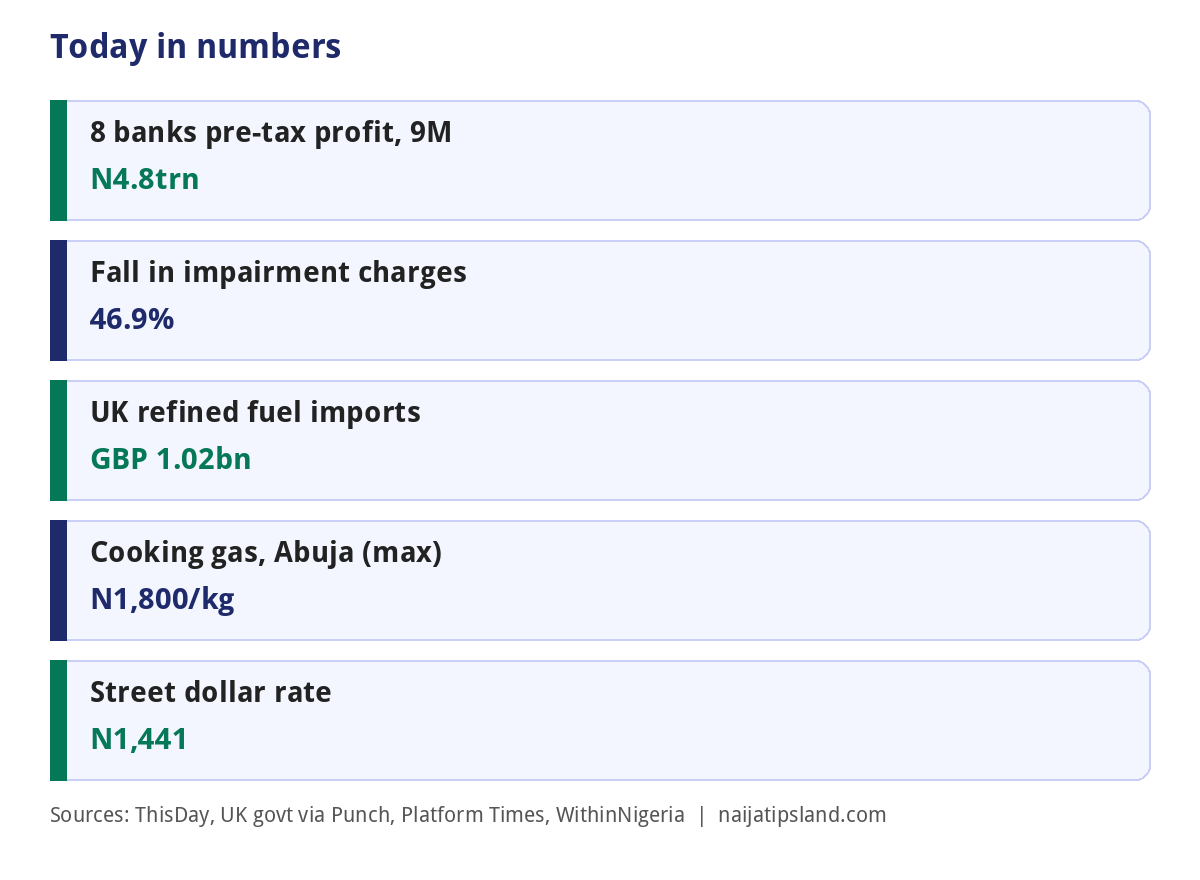
- Eight listed banks cut loan impairment charges by 46.9%; combined pre-tax profit reaches ₦4.8 trillion.
- UK imported £1.02 billion of refined petroleum from Nigeria in a year, overtaking crude.
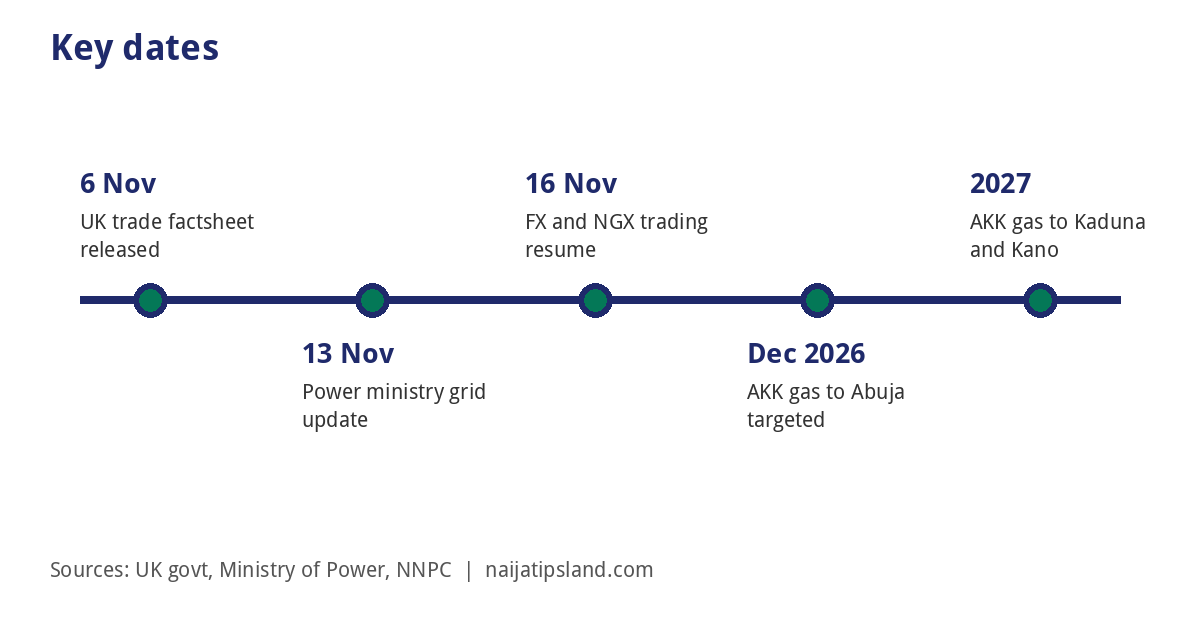
- AKK gas pipeline said to be 95% complete; gas to Abuja targeted before end-2026.
- Cooking gas hits up to ₦1,800/kg in Abuja after a 31.8% depot price jump.
- Power ministry: over 15,000 MVA of transmission capacity added since 2023.
- Naira heads into the new week near its weakest street level in 10 months.
1. Banks’ bad-loan charges fall 46.9%, lifting profits to ₦4.8 trillion
What happened
An analysis of nine-month results to September 2026 shows eight banking groups (Zenith, Access Holdings, GTCO, First HoldCo, Ecobank, Wema, Sterling and Jaiz) cut loan impairment charges to ₦1.01 trillion from ₦1.91 trillion a year earlier. Their combined profit before tax rose 12.2% to ₦4.8 trillion. Zenith and Access accounted for about ₦809 billion of the ₦906 billion drop in provisions. Results were mixed underneath: First HoldCo’s pre-tax profit jumped 60.8% to ₦911.24 billion, Wema’s rose 76.6% and Sterling’s 37.1% to ₦97.28 billion, while GTCO’s slipped 2.3% to ₦879.90 billion on higher funding and operating costs.
Why it matters
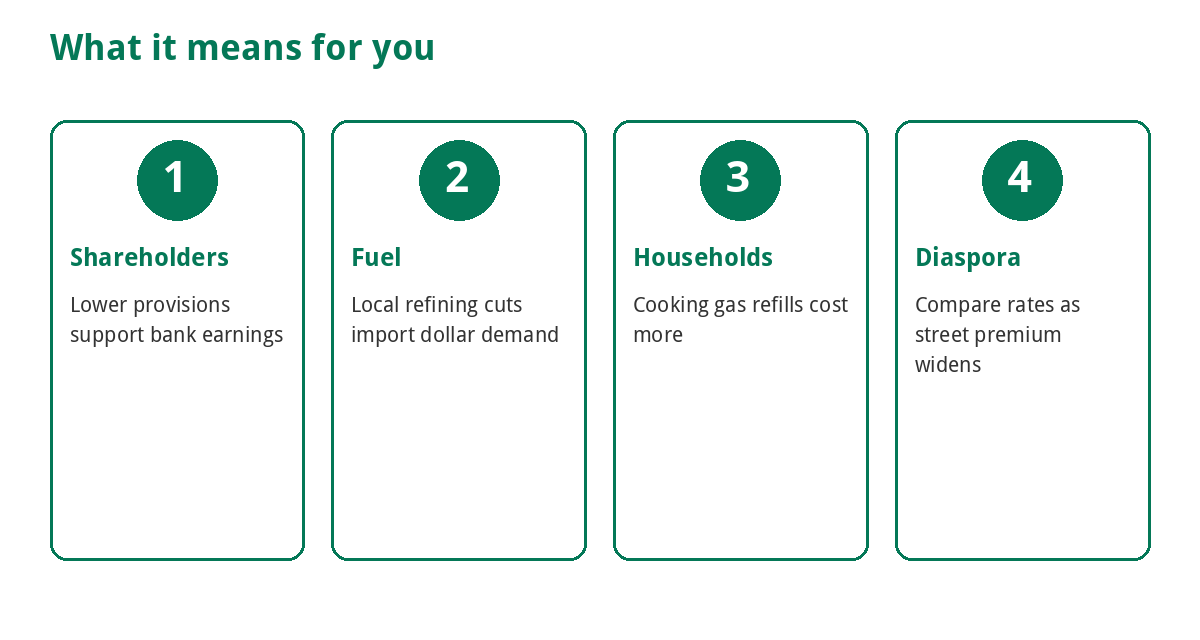
Lower provisions suggest borrowers are repaying better, which supports dividends for shareholders and bank capital as the recapitalisation programme winds up. But growth now depends more on core lending than on one-off gains.
Source: ThisDay; company filings via Aventure.
2. Britain now buys more Nigerian fuel than crude
What happened
A UK government trade factsheet released on 6 November shows Britain imported £1.02 billion of refined petroleum products from Nigeria in the 12 months to June 2026, more than double the previous year and 53.5% of all UK goods imports from Nigeria. Crude imports fell 56.2% to £550.3 million. UK refined fuel exports to Nigeria dropped 42.7% to £772.3 million, leaving Nigeria with a refined-products surplus of about £245 million with Britain. Total Nigerian goods exports to the UK rose 10.4% to around £1.9 billion. The shift is linked to the 650,000-barrel-per-day Dangote refinery.
Why it matters
Selling refined products instead of crude keeps more value, jobs and foreign exchange in Nigeria, and cutting fuel imports eases pressure on the naira.
Source: PM News/Punch; Plus234Feed.
3. AKK gas pipeline nears completion
What happened
NNPC Ltd says the 614-kilometre Ajaokuta-Kaduna-Kano (AKK) pipeline will boost compressed natural gas (CNG) availability across the North. The 40-inch line is reported to be about 95% complete, with gas deliveries to Abuja planned before the end of 2026 and to Kaduna and Kano in 2027. NNPC has reportedly secured $1.5 billion in financing backed by future pipeline throughput. An energy advocacy group cautioned that distribution networks must follow so gas actually reaches power plants and factories.
Why it matters
Cheaper gas in the North could power industries, cut generator costs and make CNG vehicles a real option against petrol and diesel.
Source: Leadership; News Agency of Nigeria.
4. Cooking gas climbs to ₦1,800/kg in Abuja
What happened
Market checks show retail prices of liquefied petroleum gas (cooking gas) have risen to as much as ₦1,800 per kilogram in parts of Abuja and ₦1,650 in Lagos and Ogun, after depot prices reportedly jumped 31.8% in a month, from ₦1,100 to ₦1,450 per kg. Some Lagos outlets raised prices by ₦200 per kg. The figures were also cited by ADC presidential candidate Atiku Abubakar, whose campaign said energy now makes up about half of bakers’ production costs and that many bakeries have shut. The Federal Government has not commented on the latest price rise.
Why it matters
A 12.5kg refill in Abuja now costs over ₦22,000 at the top end, squeezing family budgets and the costs of food vendors and bakers, which can feed into bread and food prices.
Source: Platform Times; News Central; Legit.ng.
5. Power ministry says grid capacity up 15,000 MVA
What happened
Power Minister Joseph Tegbe said more than 15,000 MVA of transmission capacity was added to the grid between 2023 and October 2026, including over 1,300 MVA from new substation equipment in places such as Kumbotoso, Apapa, Ijora and Ikeja in the last two months. He said ₦1.23 trillion had been raised under a ₦3.3 trillion plan to clear verified debts owed to generation companies, and that over 2.8 million customers had been metered. TCN says the grid can wheel about 8,700MW, but generation remains the bottleneck: peak delivery has never exceeded 5,801.84MW.
Why it matters
Paying GenCos and expanding the grid is meant to translate into more hours of supply; the test for households and businesses is whether bills and generator costs actually fall.
Source: The Guardian; The Sun; ThisDay.
6. Naira: street rate near 10-month low into the new week
What happened
With no official trading at the weekend, the latest CBN benchmark remains Friday’s close of about ₦1,354-₦1,358 per dollar. On the parallel market, dealers quoted about ₦1,436 to buy and ₦1,441-₦1,443 to sell on Saturday, close to the naira’s weakest street level in about 10 months. The street premium over the official window is now about 6%, wider than earlier in the year. Pound sterling sold at around ₦1,885-₦1,895 on the street.
Why it matters
A wider gap raises costs for anyone who relies on street dollars, from importers to families paying school fees abroad. Diaspora senders should compare rates before transferring. Track daily rates on our dollar to naira exchange rate today page.
Source: WithinNigeria; Osun Defender; Gatekeepers News.
What to watch next
- Monday’s reopening of the official FX window and NGX equities after last week’s gains.
- Remaining nine-month bank results and any interim dividend announcements.
- Oil prices as Strait of Hormuz incidents continue.
- Whether cooking gas depot prices ease, and NNPC’s timetable for first AKK gas to Abuja.
Frequently asked questions
What is a loan impairment charge?
It is money a bank sets aside from its earnings to cover loans that may not be repaid. Lower charges usually lift reported profit.
Why does the UK trade data matter to Nigerians?
It shows Nigeria earning more from refined fuel than crude in a key market, a sign local refining is adding value and reducing the need to import fuel with scarce dollars.
Why is the naira quoted at different rates?
The official rate comes from the CBN’s foreign exchange market, while the parallel (street) rate is set by dealers based on cash demand; the two can differ by several percent.
This roundup summarises reporting by the outlets credited under each story, in our own words. Follow Naijatipsland Updates on WhatsApp for the next edition. Spotted an error? Tell us and we will correct it under our editorial policy.