
How to Become a Software Developer in Nigeria Without a Degree (2026): Roadmap, Free Courses, Pay and First Job

Last updated: 11 November 2026 · By Naijatipsland Editorial Team · Editorial policy
You do not need a degree to become a software developer in Nigeria, but you do need a plan, a few hundred hours of practice and projects you can show an employer. Many working developers in startups, fintech companies and remote teams are self-taught or came through bootcamps. This guide sets out a realistic 2026 roadmap for readers without a university degree: what to learn first, which free and paid programmes to consider, what developers can expect to earn, how to build a portfolio and how to get your first job without falling for fake bootcamps.
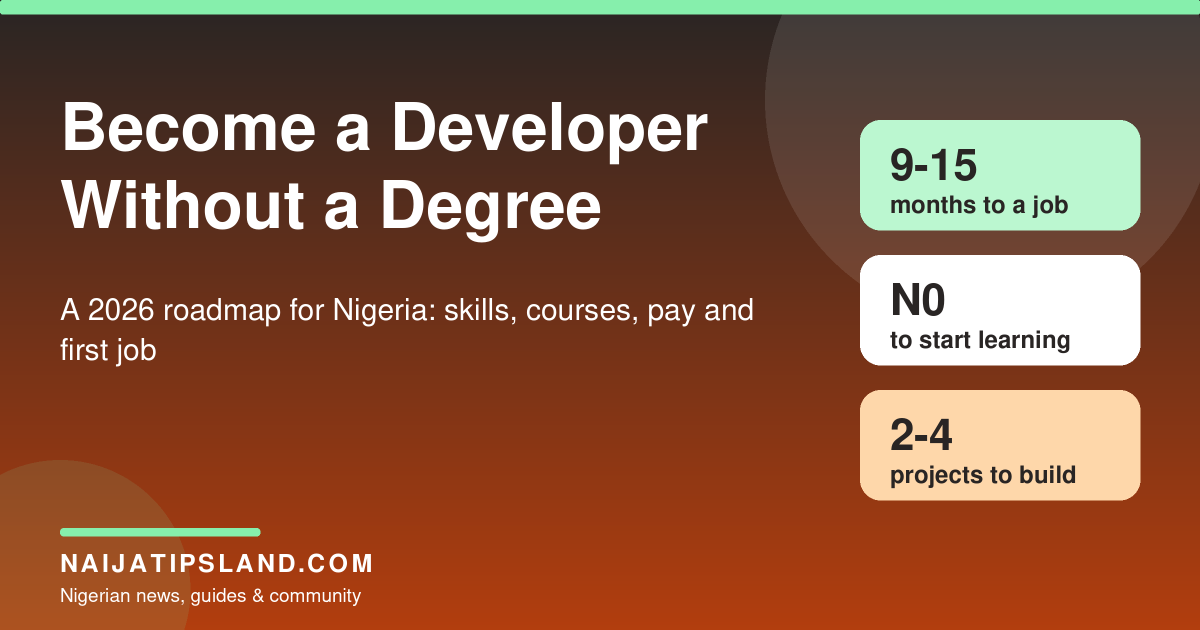
Quick answer: plan for roughly 9 to 15 months of steady practice, at least two to three hours a day, to reach a first junior role. Start with free material (freeCodeCamp, The Odin Project, CS50 or a free programme such as HNG or 3MTT), learn HTML, CSS, JavaScript and Git, then React, Node.js and databases. Build two to four deployed projects, and apply through referrals and communities as well as job boards.
This is general information, not career or financial advice. Pay and course prices are estimates and change quickly. Some of the figures below come from a training company’s own guide, so confirm them independently.
Can you really get a developer job without a degree?
Yes, in many parts of the market. A 2026 Legit.ng guide notes that startups and fintech employers weigh deployed projects, GitHub activity and technical tests more heavily than formal credentials. A guide from the training company McTaba Labs makes the same point, and says a degree is not strictly required for startups, remote companies or most technology-first employers.
There are limits. The same guide warns that some banks, telecom companies and government agencies still list degrees in their job adverts, so without one you may need extra effort to get through the first HR screen. If you want those employers, a referral from someone inside, or a strong portfolio, helps. A degree can also be added later through part-time study, so it is not an all-or-nothing choice.
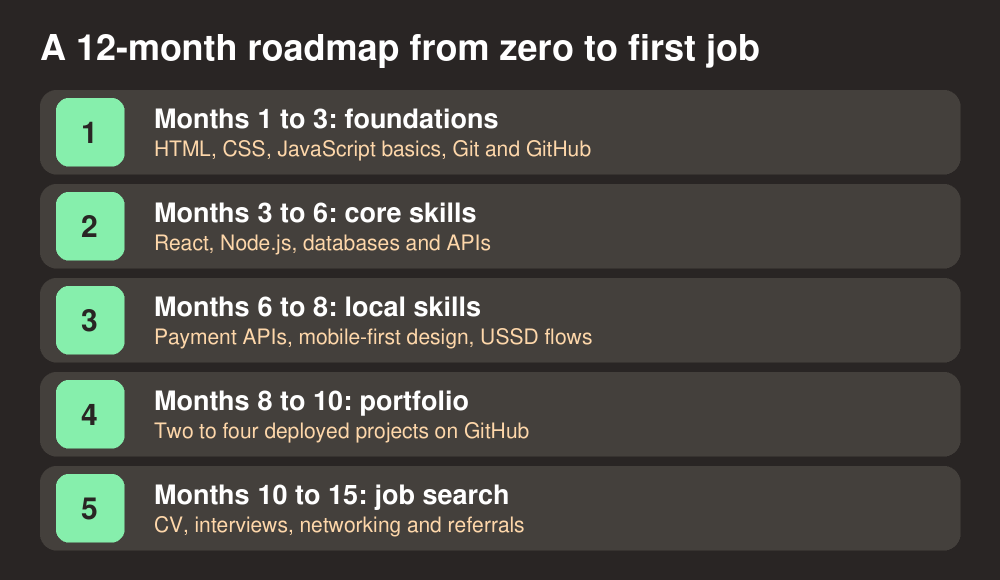
A 12-month roadmap
The timeline below follows the phases suggested by McTaba Labs, adjusted by me for readers who are working or studying at the same time. It is a guide, not a promise. Some people take longer, and that is normal.
Months 1 to 3: foundations
Learn HTML and CSS, then start JavaScript. Set up Git and GitHub, and get comfortable with the command line. Build tiny projects such as a personal page, a calculator and a to-do list. If your data is limited, our guide to free websites to learn programming in Nigeria includes data-saving tips.
Months 3 to 6: core programming
Go deeper into JavaScript, then learn React for the front end and Node.js for the back end. Add a database, REST APIs and, if possible, TypeScript. React is described in the McTaba guide as a strong front-end choice for the Nigerian market in 2026, but follow job adverts in your own area before committing.
Months 6 to 8: skills that matter locally
Learn how to integrate Paystack or Flutterwave payments, how bank transfer and USSD flows work, how to design mobile-first for users on low-end phones and, if you are interested, the WhatsApp Business API. These skills make your portfolio look relevant to Nigerian employers.
Months 8 to 10: portfolio
Build two to four projects and deploy them so employers can click and use them. At least one should include a payment flow. Put the code on GitHub with clear READMEs. Two or three finished projects beat a long list of half-finished tutorials.
Months 10 to 15: your first role
Prepare your CV and LinkedIn, practise basic interview questions and start applying. Aim at a mix: Lagos companies, Abuja tech firms, remote roles that hire in Africa and freelance work. McTaba notes that many positions are filled through referrals rather than job boards, so attend developer meetups and join communities.
Free ways to learn
- freeCodeCamp and The Odin Project: free, project-based curricula that cover web development from the beginning.
- CS50: Harvard’s free introduction to computer science, available online.
- HNG Internship: a free but competitive internship programme that gives practical team experience.
- 3MTT and Digital Skills Nigeria: Legit.ng lists these among the free government and open programmes. Check their current intake dates and requirements directly, as these change.
- Communities: Google Developer Groups (GDG) meetups and developer groups on X and Discord are good places for help and referrals.
For artificial intelligence, see our guide to AI courses for beginners in Nigeria, and for security careers see how to learn cybersecurity from scratch. Our Learn Tech Skills in Nigeria hub collects them all.
Paid bootcamps and programmes
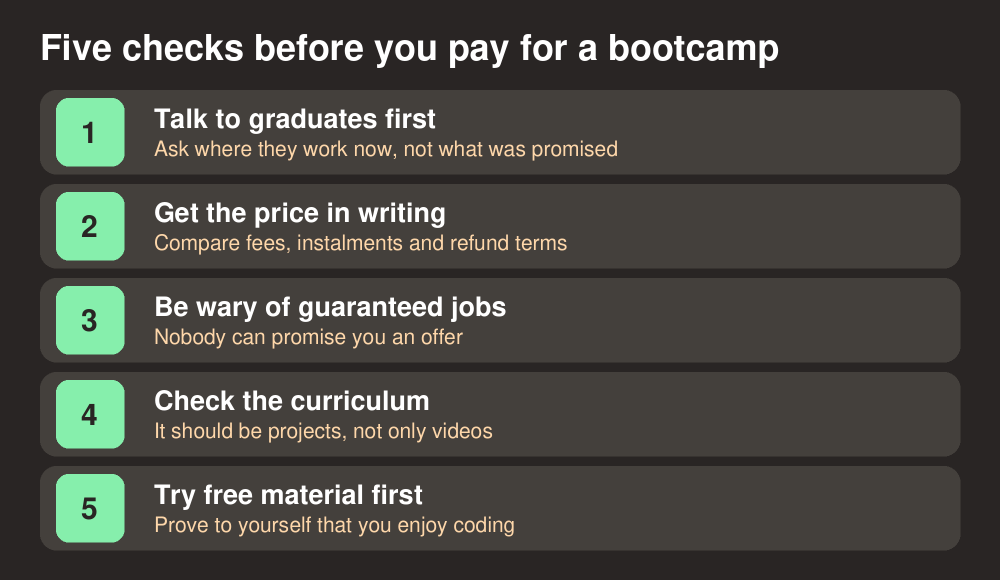
Paid options named in the sources I reviewed include AltSchool Africa, Decagon, Semicolon Africa and Andela. I have not verified current fees, intake dates or placement results for any of them, so ask each provider for the price in writing and speak to recent graduates before paying. McTaba Labs lists its own full-stack programme at KES 120,000 (roughly N140,000 to N220,000) and an intro course at KES 2,999, but as a seller of training it has an interest in the answer, so compare it with others. Exchange rates move, so confirm prices at checkout.
What do developers earn in Nigeria?
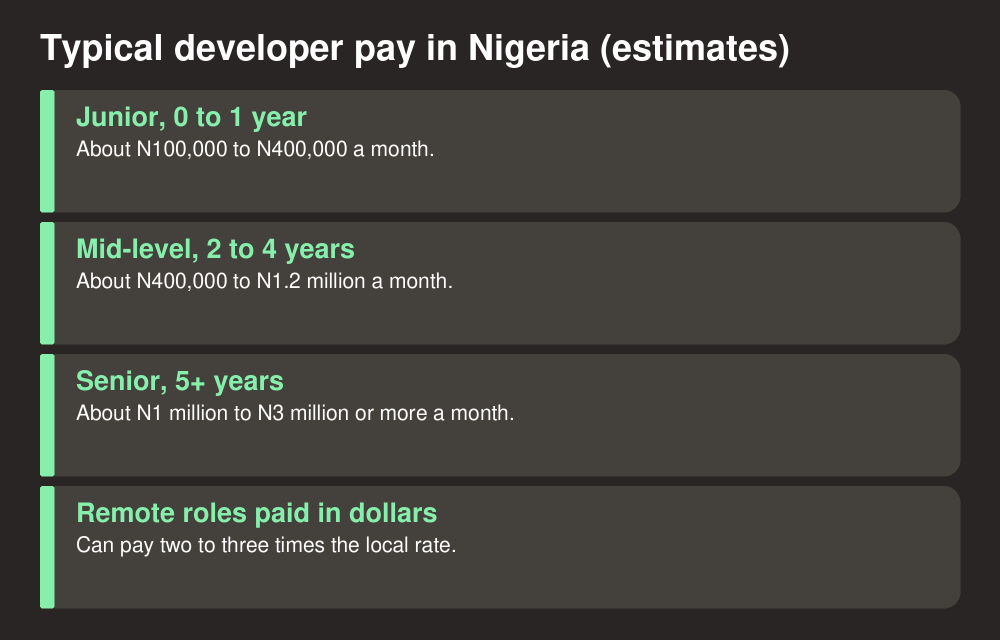
Pay varies widely and published data are patchy. McTaba gives rough monthly ranges: about N100,000 to N400,000 for juniors, N400,000 to N1.2 million for mid-level developers with two to four years of experience, and N1 million to N3 million or more for seniors. It adds that remote roles paid in dollars can pay two to three times the local rate, and it calls all of these directional estimates, not guarantees.
Legit.ng’s March 2026 comparison gives different numbers: a Glassdoor average of N420,000 a year for full-stack developers in Nigeria (June 2025 data), and N1.4 million to N8 million a year for experienced, lead and senior engineers. Its own summary also quotes N2.1 million to N4.2 million a year, which does not match the Glassdoor figure, so treat the exact numbers cautiously. For comparison, the same article puts the average UK full-stack developer salary at about £48,359 a year (DevITJobs and Morgan McKinley, March 2026). To see how this fits with other careers, read our guide to the best paying jobs in Nigeria.
How to get your first job
- Show deployed work. A live link and a clean GitHub repository speak louder than a certificate.
- Show you can work in a team. Use Git branches, write clear commit messages and, if you can, contribute to an open-source project.
- Write clearly. Remote employers value strong written English and comfort with tools such as Slack and GitHub Issues.
- Use referrals. Tell people you are looking, and join developer events and online communities.
- Take small contracts. Freelance work and internships give you experience to cite.
Bootcamp red flags
Be careful with any programme that guarantees a job, asks for large upfront payments with no refund terms, refuses to connect you with past students, or only sells video lessons with no projects or feedback. Search for independent reviews and check the company’s registration. If you are paying through a social-media account, stop and verify first.
A note for Nigerians in the UK
If you live in the diaspora, Legit.ng notes that UK apprenticeships can pay a salary and cover training fees, but eligibility is restricted to people with a long-term right to work in the UK, and international applicants generally need at least three years of UK residence and settled or similar status. Free UK options it lists include School of Code, nology and Full Stack Open.
FAQ
Can I become a software developer in Nigeria without a degree?
Yes, especially at startups, fintech companies and remote employers who focus on skills and projects. Some banks, telecoms and government bodies still ask for degrees, so expect extra effort there.
How long does it take?
Around 9 to 15 months of consistent practice, at least two to three hours a day, according to McTaba Labs. Legit.ng puts structured self-study at 12 to 18 months to junior job-readiness.
Which language should I learn first?
JavaScript is a common starting point because it works for both websites and servers. Python is another good option, especially if you are interested in data or AI.
How much does a junior developer earn?
McTaba estimates about N100,000 to N400,000 a month, but figures vary by employer and city. Check current job adverts.
Are free programmes enough?
They can be, if you build projects and keep going. Paid programmes add structure and community, but they are not a guarantee of a job.
Sources
- McTaba Labs: How to become a software developer in Nigeria (roadmap; written by a training provider)
- Legit.ng: How to become a full-stack developer in Nigeria vs the UK, and how earning potential compares (16 March 2026)
Join the discussion
Have you tried this, or do you have a question we did not answer? 1 reader has already shared their view. Naijatipsland members help each other with real, first-hand experience.





Editor’s note: I wrote this for readers who want a technology career but do not have a degree or the money for a long course. Every route here starts free. Please treat any programme that promises a guaranteed job with caution, and tell me below which resource helped you. – Ade