

Last updated: 11 November 2026 · By Naijatipsland Editorial Team · Editorial policy
Most Nigerians expect an election to end with one clear winner. But the Constitution sets a double test for the presidency, and it is possible for the candidate with the most votes to fall short of it. When that happens, the country does not simply hand the job to the leader. It goes to a second election, called a run-off. With the presidential poll scheduled for 16 January 2027, many voters are asking the same question: what happens if no candidate wins in the first round? This guide explains the rules in plain language, using official timetables, INEC statements and reputable explainers, and it treats every candidate and party exactly alike.
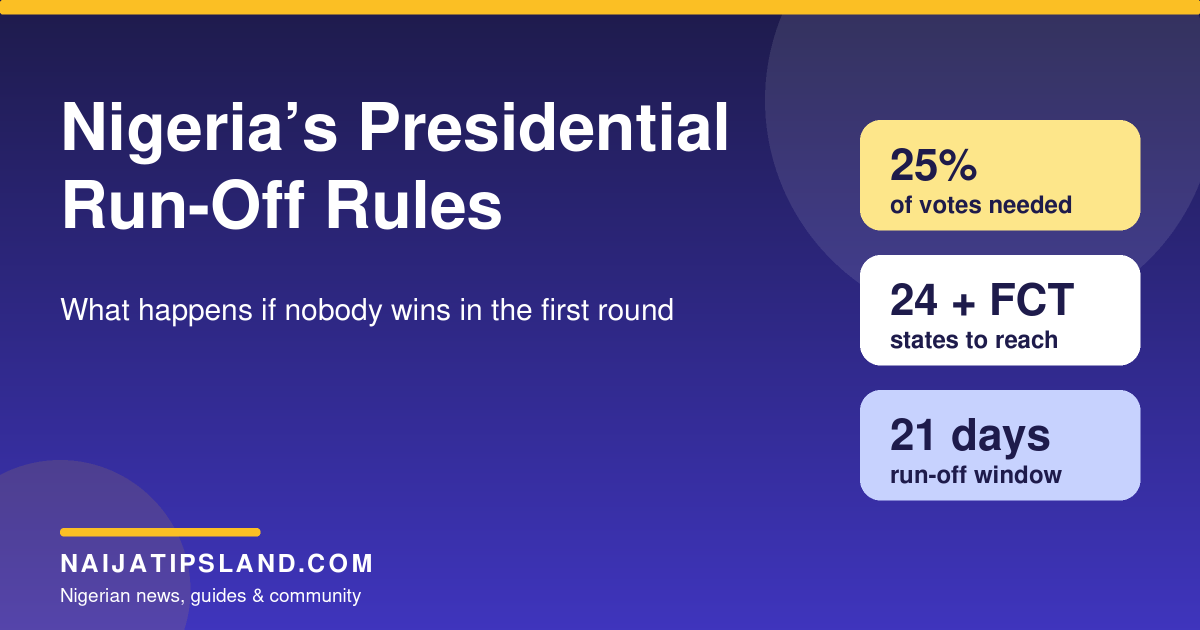
Quick answer: to win in the first round, a presidential candidate needs the highest number of votes and at least one-quarter of the votes cast in at least two-thirds of the states, plus the Federal Capital Territory (FCT). If nobody meets both conditions, INEC must organise a run-off between two candidates. INEC has said it has 21 days to hold it. If even that fails to produce a winner under the constitutional test, a further round is provided for, in which the candidate with the most votes wins.
This is general information, not legal advice. The Constitution and INEC’s official statements are the final authority.
The rule: Section 134 of the Constitution
The rule for electing a President is in Section 134 of the 1999 Constitution (as amended). It is a constitutional rule, not just an electoral law, so it does not change when the National Assembly passes a new Electoral Act. That matters this year, because INEC moved the 2027 dates after the Electoral Act 2022 was repealed and replaced by the Electoral Act 2026. The new Act changed pre-election timelines, but the winning test for the presidency still comes from the Constitution.
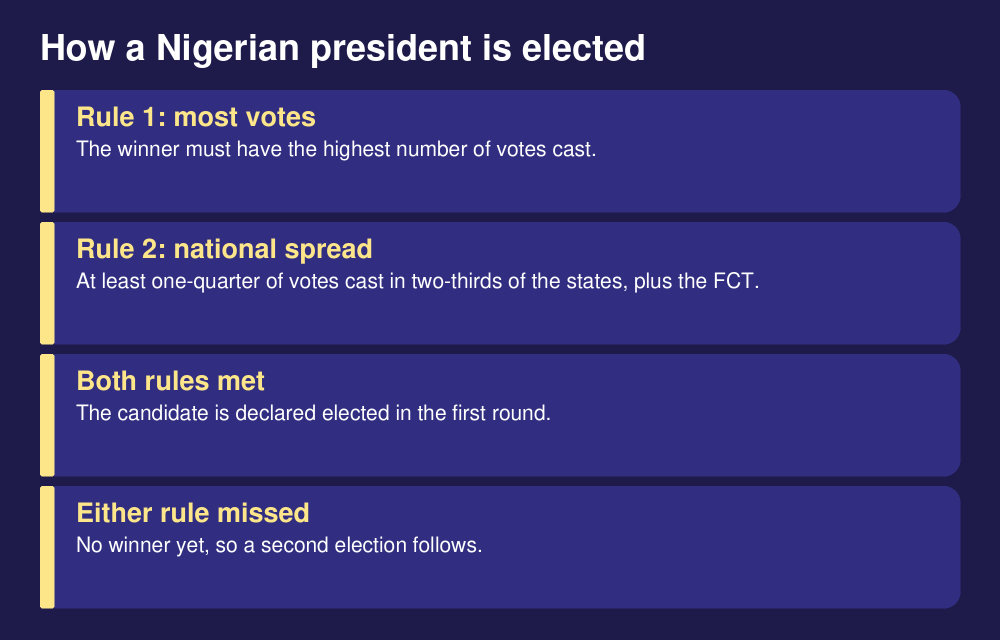
Under Section 134(2), a candidate is elected in the first round only if they meet both conditions:
- Highest number of votes cast nationwide.
- At least one-quarter (25%) of the votes cast in each of at least two-thirds of all the states, plus the FCT.
The second condition is a national-spread rule. It exists so that a President has support in many parts of a country that is diverse by region, religion and ethnicity, not only a large vote in a few places. In the 2023 cycle, the Centre for Democracy and Development (CDD) fact-check explained it as 25% in 24 of the 36 states, plus the FCT. Two-thirds of 36 is exactly 24, but some commentators have noted that the FCT is counted alongside the states, which can make the arithmetic look different (two-thirds of 37 units is about 24.7). If a close result ever turned on this point, the courts would have the final word, so treat any social-media arithmetic with caution.
Two conditions, four possible outcomes
To see how this works, use letters rather than names. Suppose Candidate A has the most votes nationally.
- A meets both conditions. A is declared elected in the first round. There is no run-off.
- A leads nationally but reaches 25% in too few states. A has the most votes but misses the spread rule. No candidate qualifies, so a run-off is held.
- Another candidate has the spread, but A has the lead. The winner must hold both at once. If the lead and the spread belong to different candidates, nobody qualifies and a run-off follows.
- No one comes close. With many candidates splitting the vote, nobody may reach 25% in enough states. A run-off follows.
The practical lesson is that a lead in raw votes is not enough on its own. A candidate can win more total votes than anyone else and still be forced into a second round if the support is concentrated in too few states.
Who contests the run-off?
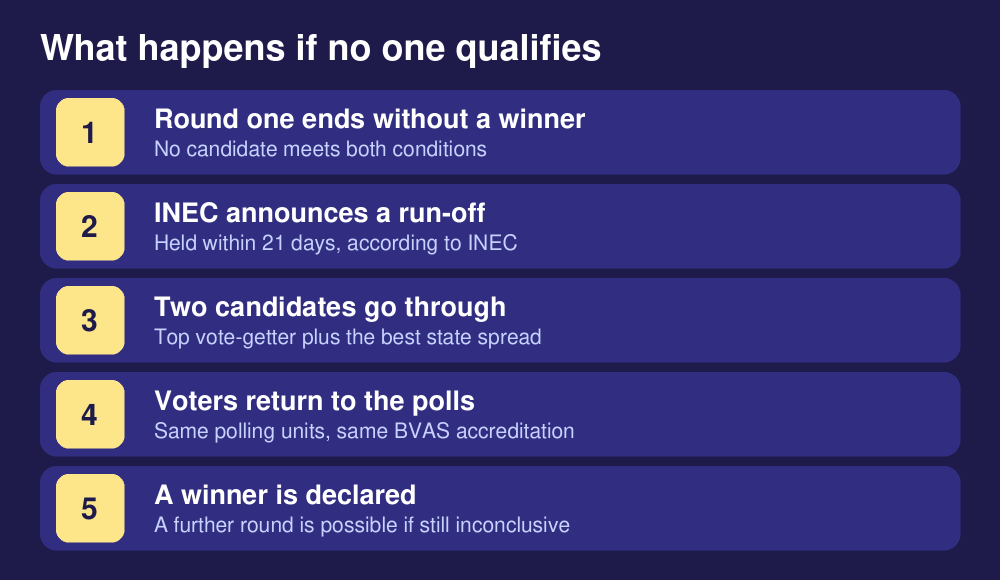
Only two candidates take part. According to INEC’s explanation of the rules, as reported by Nairametrics and Pulse, they are:
- the candidate with the highest number of votes in the first round; and
- one of the remaining candidates who has a majority of votes in the highest number of states (with ties resolved by the higher total vote).
This second place is not automatically given to the candidate with the second-highest national vote. It is decided by the number of states in which a candidate came first. That means the runner-up in raw votes and the second finalist can, in principle, be different people. The explainers we reviewed agree on this point, although the exact wording differs, so the Constitution itself should be consulted for the precise text.
When must the run-off be held?
INEC’s Director of Voter Education said in 2022, while preparing for the last cycle, that the Constitution gives the Commission 21 days to hold a run-off. Pulse’s explainer repeats the same period. You may still see older articles that say seven days, including a 2023 fact-check, so it is worth checking the current wording of Section 134 and any INEC statement before sharing a date. Pulse describes the 21 days as running from the first election, but the exact starting point (election day or declaration of results) should be confirmed in the constitutional text.
For 2027, the presidential and National Assembly elections are scheduled for Saturday, 16 January 2027, with the governorship and state assembly elections on 6 February 2027. Twenty-one days after 16 January is 6 February, which is the date set for the governorship polls. We have not found an INEC announcement of a specific run-off date, so there is nothing to report beyond the general rule. If a run-off becomes necessary, only INEC can fix and announce it, so follow the Commission’s official channels.
Why a short window?
A 21-day window forces INEC to plan for a second election before the first one has even happened. In 2022, the Commission said it would print double the ballot papers needed for the first round so that it was ready to move quickly, and it described the exercise as “reverse logistics”: collecting election materials and redeploying them within days. Sensitive materials are kept in secure custody, and the BVAS (Bimodal Voter Accreditation System) devices are treated as sensitive items under INEC’s control, with security agencies providing protection.
What if the run-off is also inconclusive?
The Constitution provides for a further election if the run-off does not produce a winner under the Section 134 test. Stears and the CDD fact-check both describe it this way: if neither finalist meets the required threshold in the second round, a third election is held, and the candidate with the highest number of votes is declared the winner. Because the finalists must meet the spread condition at each stage, the rules are built so that someone is always eventually elected. In practice, this stage has never been needed.
Explainers disagree on small details of the run-off test. Pulse describes the run-off winner as the candidate with a simple majority, while CDD quotes the Constitution as requiring both a majority and the spread condition. Rather than choosing between them, we recommend reading Section 134 directly and following any ruling or INEC guidance. Where a source is a news explainer, it is not the legal text.
Has Nigeria ever had a presidential run-off?
No. Stears reports that no Nigerian presidential or governorship election has ever gone to a run-off. The nearest the country came was in 1979, in a dispute over the Second Republic’s first presidential election. The candidate with the most votes had reached 25% in 12 states, while two-thirds of the then 19 states is 12.67, which raised the question of whether he needed 13. His team argued that his 19.9% in Kano was close enough to cover the shortfall. According to Stears, the Supreme Court ruled in his favour and he was sworn in. The case is still cited because it shows how small differences in arithmetic can have large consequences.
Supplementary elections, such as the Osun 2018 and Kano 2019 governorship contests, were reruns after inconclusive polls in specific areas. They were not run-offs under the national spread rule, so they should not be confused with it.
What this means for you as a voter
- Your first-round vote matters for the spread rule. Votes in every state count towards the 25% condition, so turnout everywhere affects whether a run-off is needed.
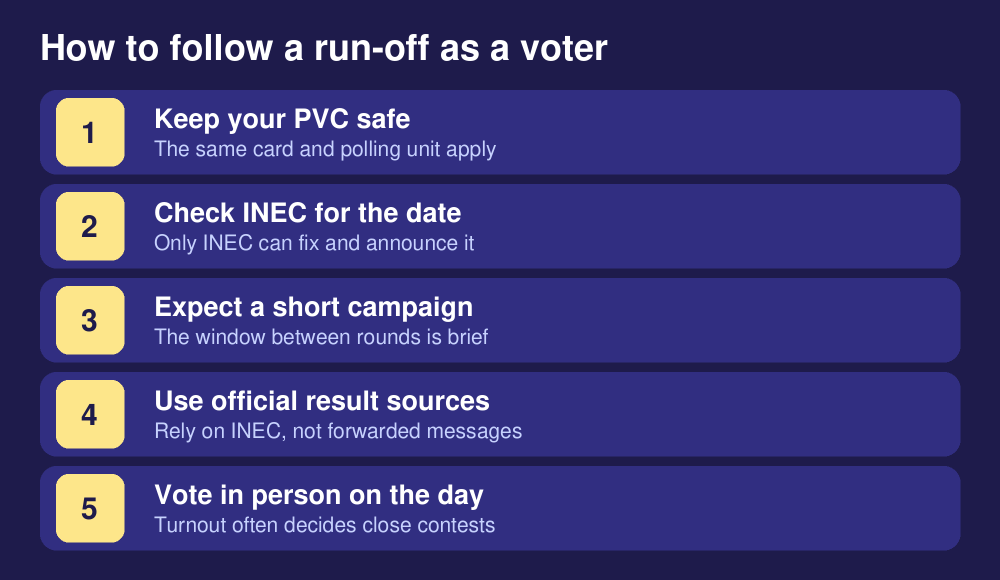
- Keep your PVC safe. If a run-off is called, you vote again at the same polling unit using the same card and BVAS accreditation. See our guide on how to find your INEC polling unit and how to vote on election day.
- Follow only official dates. Our 2027 election deadlines guide tracks INEC’s timetable, and the 2027 Nigeria Election Hub collects the latest official information.
- Be careful with forwarded messages. Claims about “automatic winners” or “cancelled” elections often spread quickly. Check inecnigeria.org.
- Diaspora readers: see our explainer on whether Nigerians abroad can vote in 2027.
FAQ
What is a presidential run-off in Nigeria?
It is a second election between two candidates, held when no candidate meets the Constitution’s winning test in the first round: the most votes and at least 25% of votes in two-thirds of the states plus the FCT.
How many states must a candidate win?
A candidate must reach at least 25% of the votes cast in two-thirds of the states, plus the FCT. In 2023, explainers described this as 24 of the 36 states plus the FCT.
Who qualifies for the run-off?
The candidate with the highest number of votes, and one other candidate with a majority of votes in the highest number of states. The second finalist may not be the national runner-up.
When must a run-off take place?
INEC has said it has 21 days to hold it. Older articles sometimes say seven days, so check the current constitutional text and INEC announcements.
Has Nigeria ever held a presidential run-off?
No. According to Stears, no presidential or governorship election has gone to a run-off. The closest case was the disputed 1979 result.
Did the Electoral Act 2026 change this rule?
The winning test comes from Section 134 of the Constitution, so a new Electoral Act does not rewrite it. The Act did change pre-election timelines, which is why INEC revised its 2027 dates.
Sources
- Stears: What is a run-off election and how would it happen in Nigeria?
- CDD Fact Check: how winners emerge in Nigerian presidential elections
- Pulse Nigeria: What is a run-off election and how is it conducted?
- Nairametrics: INEC explains how it is prepared for a possible presidential run-off
- AllAfrica: INEC reschedules the 2027 general election and releases a new timetable
- PLAC: The 2027 Electoral Calendar factsheet (March 2026)
- Constitute Project: Constitution of the Federal Republic of Nigeria (see Section 134)
Join the discussion
Have you tried this, or do you have a question we did not answer? 1 reader has already shared their view. Naijatipsland members help each other with real, first-hand experience.








Editor’s note: I wrote this explainer so every reader can understand the rules before the 2027 election, whoever they support. It names no candidate and favours no party. Please check the constitutional text and INEC statements for anything you plan to rely on, and ask your questions below. – Ade