
How to Study in Germany for Free as a Nigerian (2026): Costs, Visa, Blocked Account and Steps

Last updated: 9 November 2026 · By Naijatipsland Editorial Team · Editorial policy
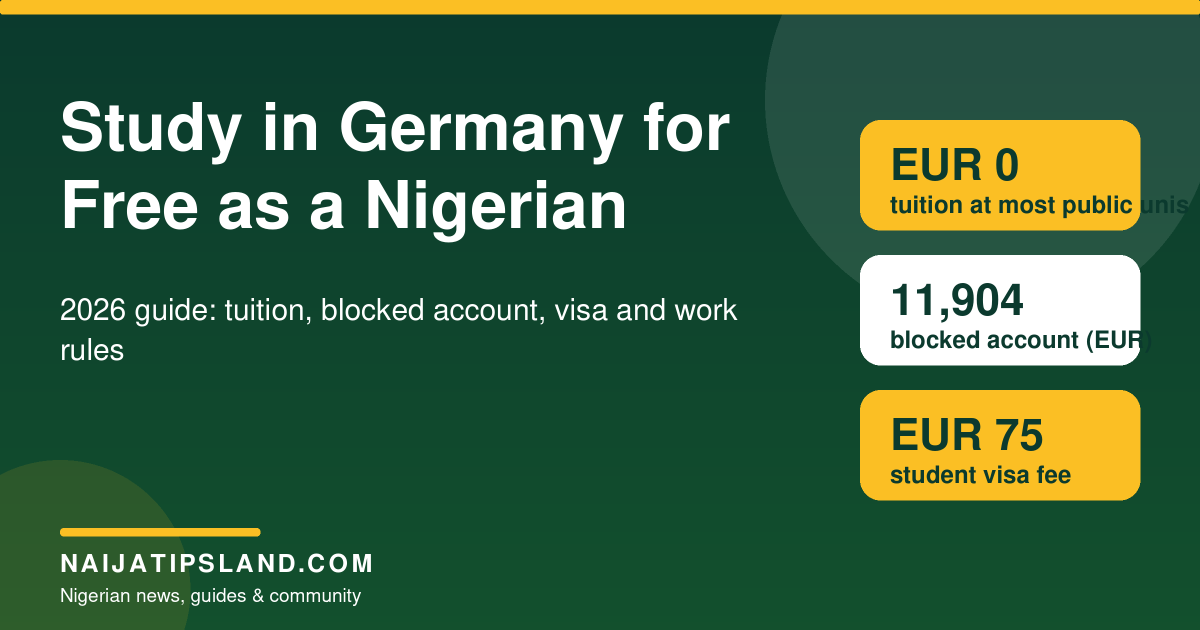
In brief: Yes, you can study in Germany for free or almost free as a Nigerian. Most public universities charge no tuition fees to international students, even for many Master’s programmes. You still pay a small semester contribution, you must prove you can fund your living costs (the blocked account figure for 2026 is €11,904 a year, or €992 a month), and a few places do charge: Baden-Württemberg asks non-EU students for €1,500 per semester and the Technical University of Munich charges non-EU students too. This guide walks through the steps from admission to visa, the real costs, the work rules and the scams to avoid.
Figures come from the DAAD, the German Federal Foreign Office and recent guides, and they change each year. Confirm every amount with your chosen university and the German embassy in Abuja or consulate in Lagos before you pay for anything.
Is university really free in Germany?
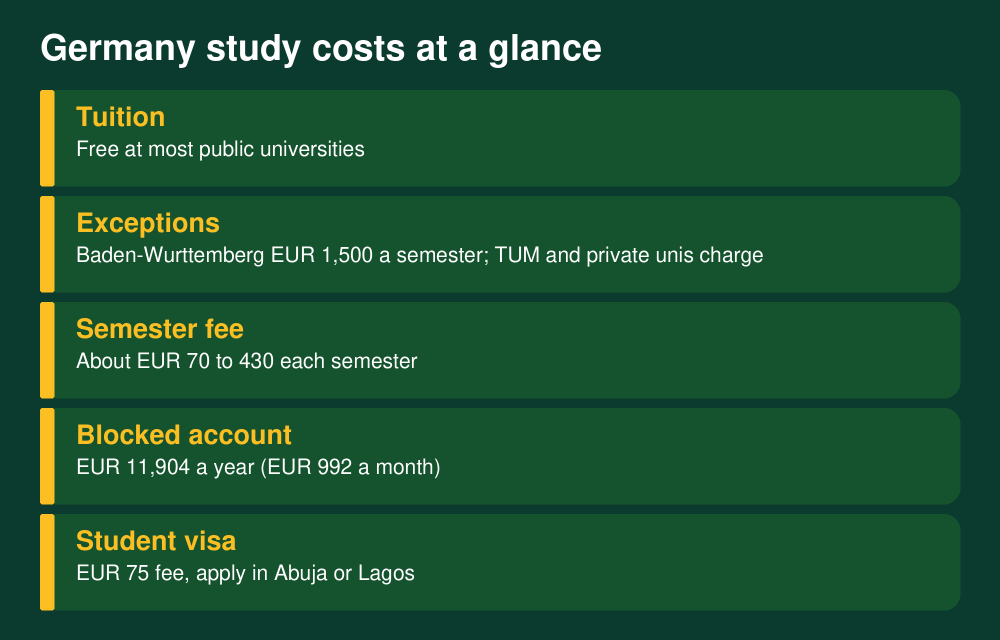
Germany abolished general tuition fees at public universities, and in most of its 16 states that still applies to non-EU students. ‘Free’ means free of tuition. You still pay a semester contribution (Semesterbeitrag), usually somewhere between about €70 and €430 depending on the university, which often includes a public transport ticket for your region. You also pay for housing, food, health insurance and books.
The exceptions matter. According to a 2026 tracker by MS in Germany, all public universities in Baden-Württemberg charge non-EU students €1,500 per semester, and the Technical University of Munich charges non-EU students from €2,000 to €6,000 per semester depending on level and programme. Some other Bavarian universities have announced plans to introduce fees. Private universities always charge tuition. Always read the fee page of each course you apply to.
Step 1: Choose a programme and check the entry rules
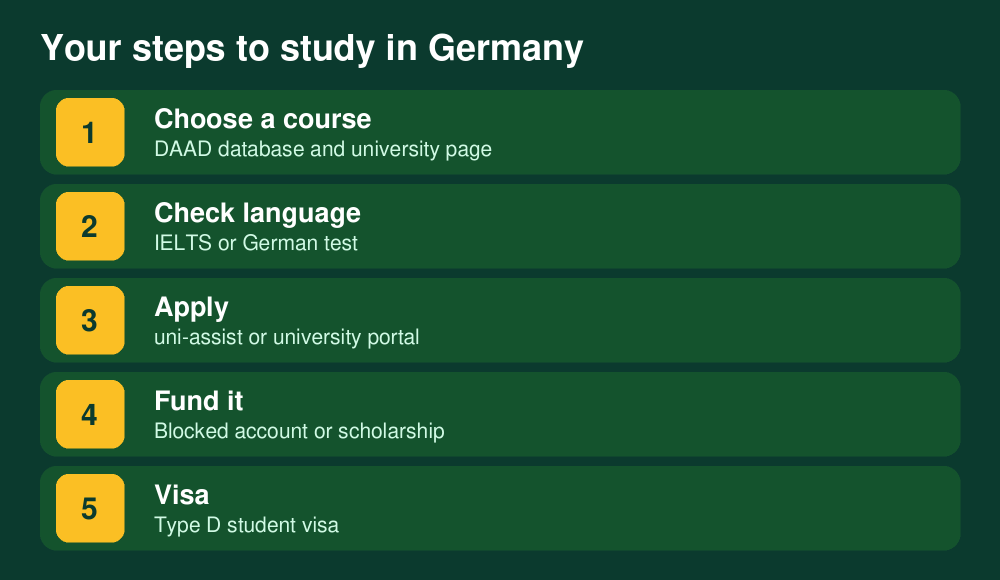
Use the DAAD course database at daad.de to filter by subject, degree, language of instruction and tuition. Then read the university’s own admission page. For a Bachelor’s degree, Nigerian applicants usually need a WAEC, NECO or NABTEB certificate plus proof of further study (many universities ask for one or two years at a Nigerian university, or a foundation course called Studienkolleg). For a Master’s degree you need your first degree certificate and transcripts, and some programmes ask for specific credits in the subject.
Check how Germany rates your qualification in the anabin database before paying application fees.
Step 2: Language requirements
English-taught Master’s programmes usually ask for IELTS Academic 6.0 to 7.0 or an equivalent test, although some universities waive the test if your Nigerian degree was taught in English. German-taught programmes normally require German at B2 or C1 (TestDaF or DSH). Learning even basic German makes daily life, part-time work and your later job search far easier.
Step 3: Documents and applying (uni-assist)
Many universities process international applications through uni-assist, which charges a fee per application, while others have their own portal. Prepare certified copies and translations of your certificates, transcripts, passport, CV, motivation letter and language proof. A common question is whether Nigerians need an APS certificate. Nigeria is not currently on the APS list, which applies to applicants educated in countries such as China, India and Vietnam, so do not pay anyone for an ‘APS service’ for Nigerian documents. Verify this on the embassy and university sites.
Step 4: Prove you can pay for your stay
For the student visa you must show funds for your first year. The usual route is a blocked account (Sperrkonto) with providers such as Fintiba or Expatrio, holding €11,904, from which you can withdraw about €992 a month once you arrive. Alternatives include a scholarship letter or a formal declaration of commitment from a resident sponsor. The DAAD offers scholarships for Nigerian students, including programmes aimed at development-related Master’s degrees, and these usually cover living costs, so check the DAAD scholarship database early because deadlines are often many months before the start of term.
Step 5: Apply for the student visa
Once you have an admission letter, apply for the national student visa (type D) at the German embassy in Abuja or consulate general in Lagos. The visa fee is €75. Bring your admission letter, proof of funds, health insurance, passport, photos, certificates and language proof. Appointments can be scarce, so book as soon as you hold your admission. Processing can take several weeks. After arrival you register your address, open a bank account and apply for a residence permit at the local immigration office.
What will it cost to live there?
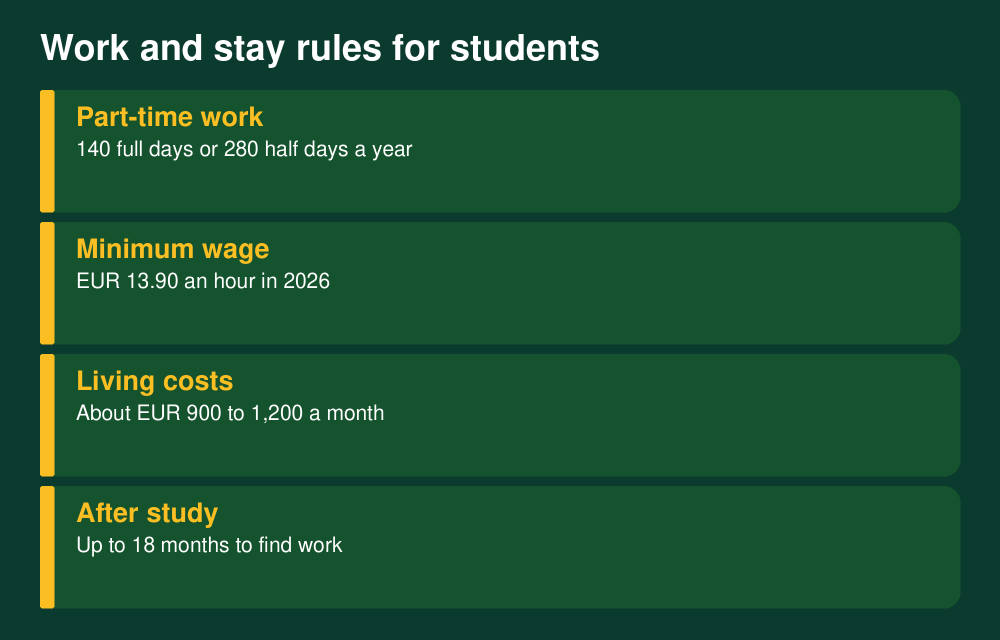
Plan on roughly €900 to €1,200 a month in most cities, with Munich, Frankfurt and Hamburg at the top end and smaller university towns cheaper. Rent is the largest cost, and a student hall room is usually cheaper than a private flat. Statutory health insurance for students is compulsory and costs around €120 to €150 a month, so check the current student rate with providers such as TK or AOK. Add the semester contribution twice a year and any fees at Baden-Württemberg or Bavarian universities.
Can you work as an international student?
Yes. Non-EU students may work 140 full days or 280 half days a year, with limits on self-employment. Student assistant (Hiwi) jobs at the university do not always count in the same way, so ask the immigration office. The statutory minimum wage in 2026 is €13.90 an hour. Part-time work helps, but it should not be your main plan for funding your course.
After graduation
Graduates can apply to stay up to 18 months to look for work matching their degree, and then move to a work permit such as the EU Blue Card if the job qualifies. If you are already a graduate and have no admission, read our guide to the Germany Opportunity Card (Chancenkarte).
Scams and mistakes to avoid
- Paying an agent for a guaranteed admission, a fake APS certificate or an ‘embassy slot’.
- Sending original certificates abroad to unknown agents.
- Applying to private or unrecognised institutions without checking accreditation.
- Missing deadlines: many winter-semester deadlines fall between May and July, and DAAD scholarships close earlier.
- Arriving without money for a deposit, since landlords often ask for up to three months’ rent as deposit.
Frequently asked questions
Is it really tuition-free for Nigerians?
At most public universities, yes. Baden-Württemberg and some Bavarian institutions charge non-EU students, and private universities always charge, so check each course.
How much money do I need for the visa?
The 2026 blocked account amount is €11,904 (€992 a month). Confirm the current figure with the embassy.
Do I need German?
Not for English-taught programmes, but you need German for German-taught courses and it helps for daily life and jobs.
Can I bring my family?
Family reunification for students is possible only if you can support them, which is difficult. Ask the embassy for the current rules.
How long does the visa take?
Several weeks, sometimes months at busy missions, so apply early.
This article is general information, not immigration or legal advice. Check official sources: the DAAD, the German Federal Foreign Office, your university and the embassy.
Join the discussion
Have you tried this, or do you have a question we did not answer? 1 reader has already shared their view. Naijatipsland members help each other with real, first-hand experience.






Ade Adeniyi here: if you are comparing countries, remember the blocked account figure and fees change each year, so always check the DAAD and the embassy before paying anyone. Which German city are you aiming for?