Signs a Partner Is Financially Responsible Before Marriage: What to Check and the Questions to Ask

Last updated: 23 October 2026 · By Naijatipsland Editorial Team · Editorial policy
Love can carry a relationship for a while, but bills carry it the rest of the way. In Nigeria, where prices change fast, family obligations are real and about eight in ten people say the economy has affected their love life, how a partner handles money tells you a lot about what married life will be like.
This guide covers the signs of a financially responsible partner, the questions to ask before marriage, the red flags to take seriously, and how to have the conversation without turning it into an interrogation.
Why money matters so much in marriage
Researchers keep finding the same thing: it is not how much couples earn, but how they handle money together, that shapes their marriage.
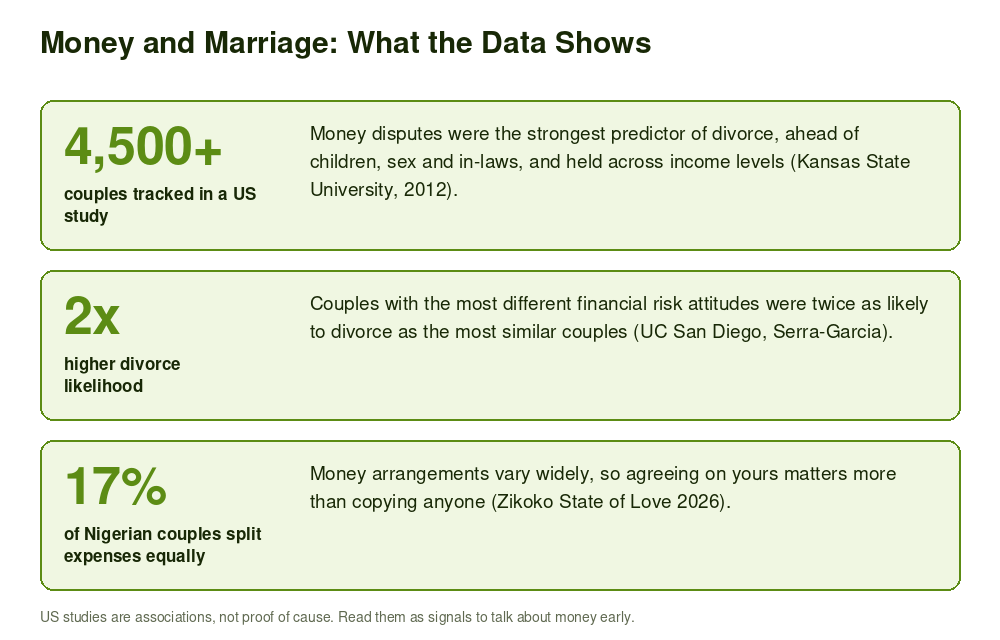
- Money fights are costly. A Kansas State University study led by Sonya Britt, using data from more than 4,500 couples in the US National Survey of Families and Households, found that money disputes were the strongest predictor of divorce among the factors studied, ahead of children, sex and in-laws. The result held after controlling for income, debt and net worth. Money arguments were also more intense and took longer to recover from than other arguments. These are associations from survey data, not proof of cause, and the data is American, but the pattern is a useful warning.
- Different money attitudes matter. Research by Marta Serra-Garcia at UC San Diego found that couples with the most dissimilar attitudes to risk were twice as likely to divorce as couples with the most similar ones, and differences in financial risk were the strongest predictor among the categories studied. The same research found that couples’ attitudes can grow more alike over time, which suggests that talking early helps.
- There is no single Nigerian model. In the Zikoko State of Love 2026 survey of more than 10,000 Nigerians, only 17 percent of couples split expenses equally. About three in ten men said they cover most expenses, compared with about one in ten women. The right arrangement is the one you both understand and agree on.
Seven money green flags in a partner
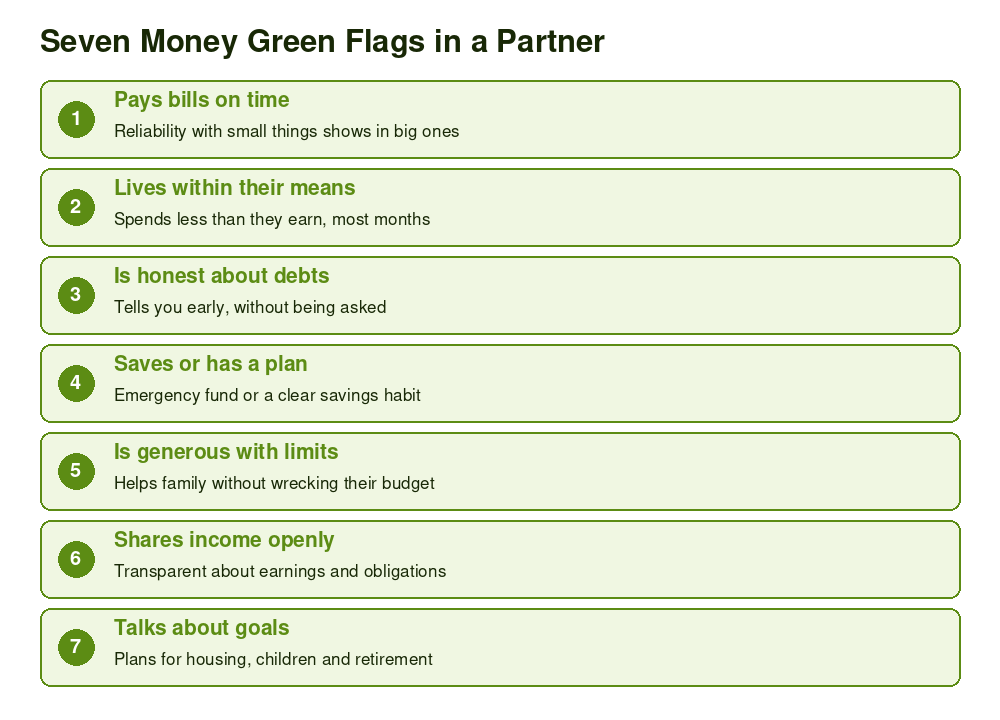
- Pays bills on time. Rent, data, school fees, loans. Reliability with small things shows in big ones.
- Lives within their means. They spend less than they earn most months, even if their earnings are modest.
- Is honest about debts. They tell you about loans, cooperative contributions and money owed to family early, without being asked.
- Saves or has a plan. An emergency fund, a savings habit, or a clear plan to build one.
- Is generous with limits. They help relatives, but not at the expense of their own stability, and they are willing to discuss how much.
- Shares income openly. They are willing to be transparent about what they earn and what they owe, especially as you get serious.
- Talks about goals. Housing, children, education, business plans and retirement are things they have thought about.
Red flags to take seriously
- Secrecy about income, savings or debt. Privacy is normal; hiding is not. A recent Zikoko story from April 2026 describes an engaged couple in which one partner felt uneasy because the other consistently gave vague answers about earnings while the other saw the questions as monitoring. Whichever side you are on, that kind of standoff needs an honest conversation before the wedding, not after.
- Chronic borrowing with no repayment plan, especially from you or your family.
- Lifestyle beyond means, such as constant spending on show, with debts growing.
- Pressure to pay for everything or to hand over money early in the relationship.
- Gambling or risky schemes presented as quick routes to wealth, including investment platforms that promise guaranteed returns.
- Financial control, such as wanting to manage all your money, restrict your access to funds or monitor every purchase. This is a warning sign of controlling behaviour.
- Treating money talk as an insult and refusing to discuss it at all.
Questions to ask before marriage
- What do you earn, and what is your income like across a normal year?
- What debts, loans or regular obligations do you have?
- How much do you send to family each month, and how do you expect that to change after marriage?
- Do you prefer joint accounts, separate accounts or a mix?
- Who will pay for rent, food, school fees and emergencies?
- How do you feel about risk: investing, business, borrowing?
- Will either of us stop working or reduce hours for children, and how would we manage on one income?
- What are our goals for the next one, five and ten years?
- What did your parents teach you about money, and what do you want to do differently?
A pre-marriage money checklist
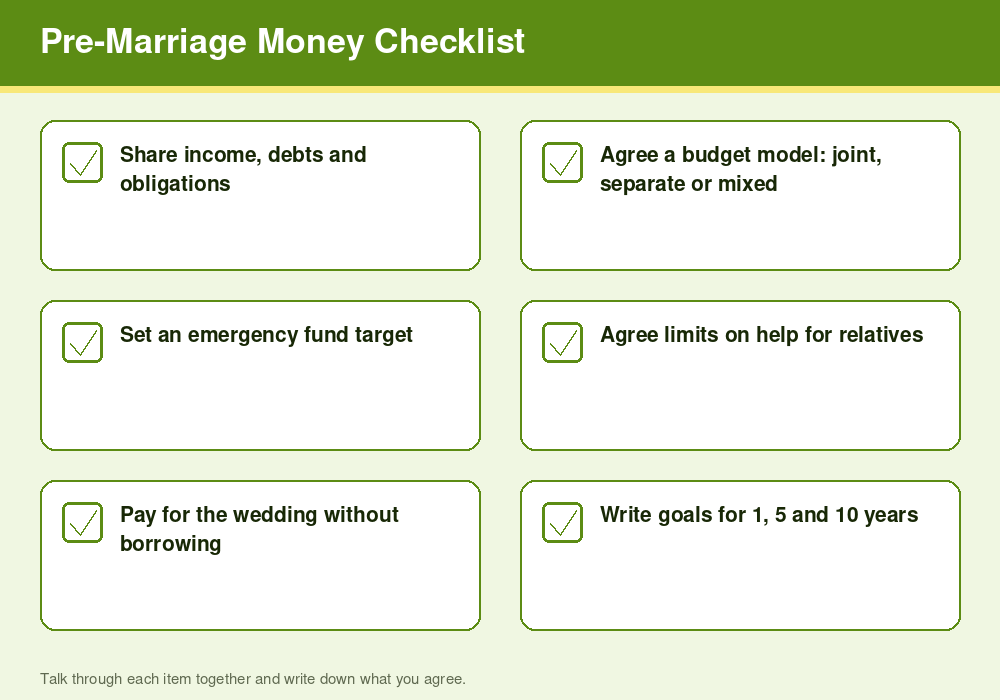
- Share income, debts and obligations.
- Agree a budget model: joint, separate or mixed.
- Set an emergency fund target.
- Agree limits on help for relatives.
- Pay for the wedding without borrowing.
- Write goals for one, five and ten years.
A BusinessDay personal finance piece on preparing for marriage suggests that both partners disclose all debts, calculate the combined total, and aim to reduce it before the wedding. It also suggests writing financial goals on cards and talking through them, building five to ten year goals into the budget, and avoiding lavish wedding spending that leaves a couple repaying debt for years. The article is general advice rather than Nigeria-specific, but the principle applies anywhere.
How to bring it up without a fight
- Choose a calm moment, not during an argument or when someone is stressed about money.
- Go first. Share your own situation honestly, and your partner is more likely to do the same.
- Be curious, not accusing. Ask “How do you think about this?” instead of “Why are you so careless?”
- Keep it ongoing. One long talk isn’t enough. Review every few months.
- Write it down. A shared note of what you have agreed prevents later disputes about memory.
Different earners, different models
Common arrangements include:
- Fully joint: all income goes into shared accounts. Simple, but needs high trust.
- Fully separate: each person pays an agreed share of bills. Clear, but can feel distant.
- Hybrid: a joint account for shared bills and savings, plus personal accounts for individual spending. A popular middle route.
- Proportional: each partner contributes the same percentage of income, which is fairer when earnings differ.
Whatever you choose, agree it explicitly and revisit it when jobs, children or income change.
When to get help
A financial adviser or a premarital counsellor can help if you find big differences in goals, one partner is carrying heavy debt, or money talks keep turning into arguments. If a partner is controlling your money or using it to threaten or isolate you, treat that as a safety issue and seek support from someone you trust or a local support organisation.
Frequently asked questions
Should couples share their salaries before marriage?
Most advisers recommend full transparency about income, debts and obligations before marriage, because surprises after the wedding damage trust. How you manage money afterwards is up to you.
Is it a red flag if my partner supports their family a lot?
Not by itself. Supporting relatives is common in Nigeria. The question is whether it is agreed, sustainable and discussed openly, rather than hidden or one-sided.
Should we have a joint account?
It depends on your preference and trust. Many couples use a joint account for shared bills and personal accounts for individual spending.
What if my partner earns much less than me?
Income gaps are common. What matters is respect, contribution in other forms, and a fair arrangement, for example proportional contributions.
How do I know if a partner is hiding debt?
Look for vague answers, sudden money requests, frequent calls from collectors or constant stress about money. Ask directly and calmly, and ask for transparency as your relationship becomes serious.
This article is general information and is not financial or legal advice.
Sources
- ScienceDaily, reporting Britt, Huston and Dew (Kansas State University, Family Relations, 2012): money arguments as a predictor of divorce
- UC San Diego Rady School of Management: Differences in financial risk preferences can make or break a marriage (2021)
- Zikoko, The State of Love 2026
- Zikoko, Love Currency: We Love Each Other, but She’s Not Open About Her Finances (April 2026)
- BusinessDay, 3 financial moves to make before getting married (2015)
Join the discussion
Have you tried this, or do you have a question we did not answer? Be the first to share your experience. Naijatipsland members help each other with real, first-hand experience.