


TL;DR:
- Nigeria’s low cybersecurity policy implementation exposes millions to cyber threats.
- Common threats include phishing, ransomware, identity theft, and social engineering.
- Building resilience and digital literacy are essential for personal and organizational security.
Nigeria’s internet population is growing fast, and so are the threats lurking behind every login screen. Most people assume cybercrime targets only banks and large companies, but the reality is different. Individual users, students, and small business owners face the same risks. What makes this more alarming is that only 27.78% of Nigerian institutions fully comply with the National Cybersecurity Policy and Strategy. That gap leaves millions of everyday Nigerians exposed. Understanding cybersecurity is no longer optional. It is a basic survival skill for anyone connected to the internet.
Table of Contents
- Understanding why cybersecurity is vital in Nigeria
- Major cyber threats facing Nigerians
- Effective cybersecurity strategies for Nigerian users
- Cybersecurity as a driver of opportunity in Nigeria
- A fresh perspective: Why Nigerian cyber security must focus on resilience, not just prevention
- Next steps: Engage securely, build your digital future
- Frequently asked questions
Key Takeaways
| Point | Details |
|---|---|
| Policy gaps remain | Nigeria has strong cybersecurity policies but faces challenges in enforcement and coordination. |
| Threats impact everyone | Both individuals and organizations are exposed to risks like phishing, ransomware, and data breaches. |
| Resilience matters | Building rapid response and adaptive strategies is crucial as digital threats evolve. |
| Safe careers exist | Cybersecurity offers empowering jobs and digital participation for Nigerian youth. |
| Actionable steps | Adopt strong passwords, MFA, regular backups, and updated policies to protect yourself online. |
Understanding why cybersecurity is vital in Nigeria
Nigeria has one of the fastest-growing digital populations in Africa. Young professionals, students, and entrepreneurs are coming online every day, using mobile apps, online banking, social media, and e-commerce platforms. This rapid growth is exciting, but it also creates a wider attack surface for cybercriminals.
The enforcement reality is sobering. The National Cybersecurity Policy and Strategy (NCPS) was designed to coordinate the country’s digital defense, but only 27.78% implementation has been recorded across institutions. That means the majority of organizations, and by extension, the users they serve, are operating without adequate protection.
Here is a snapshot of the most common cyber threats facing Nigerian users today:
- Phishing attacks: Fraudulent emails or messages designed to steal your login credentials
- Identity theft: Using your personal data to access accounts or commit fraud
- Ransomware: Malware that locks your files and demands payment for release
- SIM swap fraud: A growing problem tied to mobile money services in Nigeria
- Cyberbullying risks: Online harassment that affects mental health and safety
Organizations also face advanced persistent threats, insider attacks, and supply chain vulnerabilities. Understanding Nigeria’s cybercrime laws is equally critical, because awareness of your rights and obligations shapes how you respond to threats.
| Sector | Key Risk | Impact Level |
|---|---|---|
| Banking and fintech | Phishing, account takeover | Very High |
| Education | Data breaches, ransomware | High |
| SMEs | Social engineering, fraud | High |
| Individual users | Identity theft, SIM swap | Medium to High |
Beyond defense, cybersecurity is becoming a major career sector. Over 15,000 cybersecurity jobs remain unfilled in Nigeria, creating an urgent opportunity for trained youth. Adopting Zero Trust strategies, which operate on the principle of verifying every user and device continuously, is one approach institutions are moving toward. The gap between threat growth and policy enforcement makes every Nigerian a stakeholder in this conversation.
Major cyber threats facing Nigerians
Knowing the why, it is time to break down which threats Nigerians face and how to recognize them. Cyber threats are not abstract. They show up in a suspicious text message, a fake job offer on WhatsApp, or an email asking you to verify your bank details.
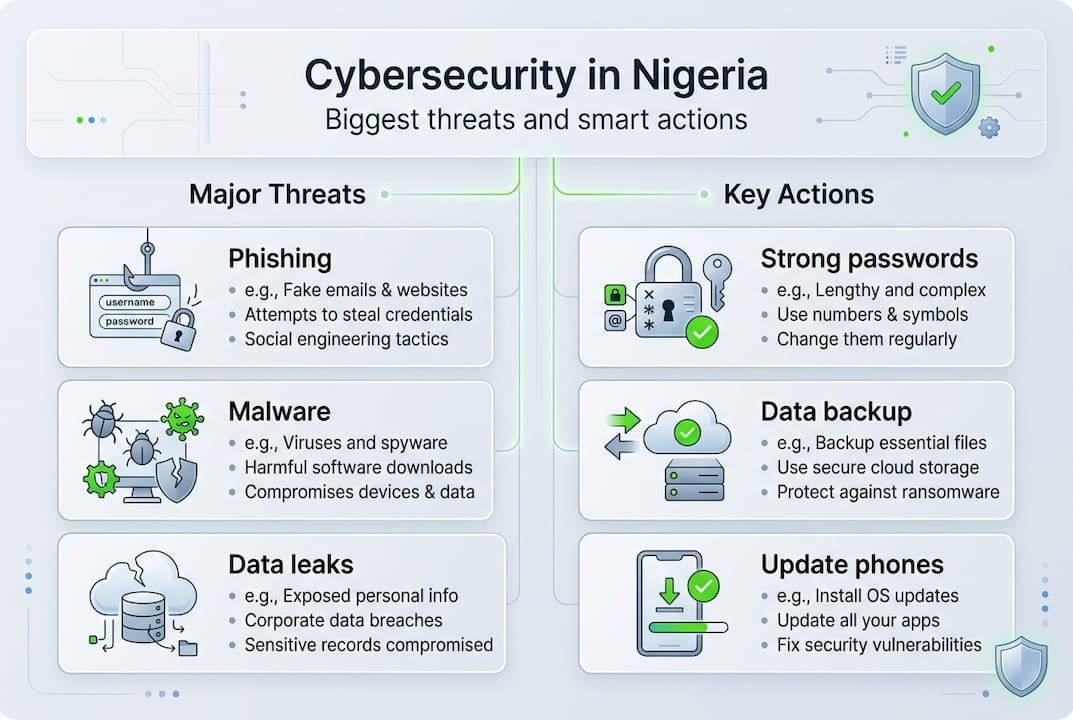
Phishing is the most common entry point. Attackers impersonate legitimate organizations to trick you into revealing passwords or financial information. Ransomware takes things further by encrypting your files until you pay a ransom. Data breaches expose large volumes of user information and often go unnoticed for months.

Here is how these threats differ for personal users versus organizations:
| Threat | Impact on Individuals | Impact on Organizations |
|---|---|---|
| Phishing | Loss of credentials, money | Corporate espionage, fraud |
| Ransomware | Lost personal files | Business shutdown, data loss |
| Data breach | Identity theft | Regulatory fines, reputation damage |
| Social engineering | Financial scams | Insider threats, leaked strategy |
New in 2026, non-human identities and quantum risks are emerging as the next frontier of threats. Bots and automated systems now carry out attacks faster than humans can respond. Quantum computing threatens to break existing encryption standards that currently protect sensitive data.
Steps to recognize a cyber threat early:
- Check the sender’s email address carefully before clicking any link
- Look for spelling errors or urgent language designed to pressure you
- Verify requests for personal or financial information through official channels
- Watch for unfamiliar login notifications on your accounts
- Report suspicious messages to your platform or IT team immediately
Pro Tip: Most breaches begin with a single compromised login. The moment you receive an unfamiliar login notification, treat it as a real threat and change your password immediately.
“The goal of modern cybersecurity is not just to stop attacks but to ensure your systems and habits are resilient enough to recover quickly when something gets through.”
For staying safe online, understanding these threats is the foundation. Building digital literacy skills helps you recognize manipulation and make smarter decisions in real time. The EFCC has already successfully convicted 3,175 cyber offenders, which shows that enforcement is improving. But personal vigilance remains your first line of defense. A full breakdown of types of cyber threats can help you go deeper into each category.
Effective cybersecurity strategies for Nigerian users
Once threats are clear, Nigerians need actionable solutions. Here is how to stay ahead.
For personal users, the basics go a long way:
- Use strong, unique passwords for each account. A password manager helps.
- Enable multi-factor authentication (MFA) on every platform that supports it
- Keep your software and apps updated to patch known vulnerabilities
- Avoid public Wi-Fi for sensitive transactions like mobile banking
- Back up your data weekly to a secure cloud or external drive
- Be cautious about what personal information you share on social media
For organizations, stronger structures are required. Zero Trust and multi-factor authentication are now mandated for Nigerian fintechs, reflecting a regulatory shift toward stricter standards. Zero Trust means no user or device is automatically trusted, even inside a company network. Every access request must be verified.
Organizational must-haves include:
- Incident response plan: A documented process for what to do when a breach occurs
- Cloud security protocols: Encrypting data stored and transmitted through cloud services
- Regular staff training: Human error is the leading cause of breaches, and education reduces this risk
- AI-driven detection tools: These monitor for unusual behavior in real time and flag anomalies early
Pro Tip: Back up your data weekly. Most ransomware attacks specifically target backup files, so store copies in more than one location and test your recovery process regularly.
For secure mobile technology practices, Nigerian users are increasingly accessing sensitive services via smartphone, which makes mobile security hygiene critical. Additionally, content moderation benefits extend to reducing exposure to scam content and harmful links in online communities. Learning multi-factor authentication setup steps for your specific apps will take less than ten minutes and could prevent months of financial and emotional damage.
Cybersecurity as a driver of opportunity in Nigeria
Finally, cybersecurity is not just defense. It is a gateway to participation and progress.
Nigeria has a youth population that is digitally active, ambitious, and largely underemployed in formal technology sectors. Cybersecurity offers a direct route into a high-demand field. Entry-level salaries range from ₦150k to ₦500k per month, with experienced professionals earning significantly more. This is not a distant opportunity. It is available now.
Here is how to get started:
- Take free or affordable online courses in cybersecurity basics (platforms like Coursera and Cybrary offer accessible options)
- Pursue recognized certifications such as CompTIA Security+, CEH, or CISSP
- Build practical skills through capture-the-flag (CTF) challenges and cybersecurity labs
- Join local and online communities focused on Nigerian tech development
- Apply for internships with Nigerian fintechs, government agencies like NITDA, or tech firms
“Cybersecurity skills are now a passport to economic participation in Africa’s digital economy. Every student who learns to protect systems is also learning to build them.”
Nigeria’s government has taken steps forward. NITDA (the National Information Technology Development Agency) has been rolling out cybersecurity awareness campaigns. The EFCC continues to prosecute cybercriminals, signaling that accountability is rising. Over 15,000 unfilled cybersecurity positions represent both a challenge and an enormous opportunity for trained Nigerians.
The digital economy also needs participants who understand security from the inside. Building digital debate skills and understanding how influencers shape online culture are increasingly tied to responsible, secure digital participation. Your knowledge protects not only you but also the communities you engage with online.
A fresh perspective: Why Nigerian cyber security must focus on resilience, not just prevention
Most cybersecurity conversations in Nigeria center on prevention. Lock the doors, train the staff, install the antivirus. Prevention matters, but it is no longer enough on its own.
Nigeria’s digital growth is outpacing security investment. New users come online every day without adequate training. New threats emerge faster than policies can respond. The honest truth is that breaches will happen. The question is whether you and your organization can recover quickly.
Resilience over prevention means building systems and habits that adapt after an attack, not just ones that try to block every entry point. Quantum computing risks and non-human bot identities are threats that no static firewall will stop permanently. What protects you is the ability to detect, respond, and rebuild fast.
Online communities like the value of online forums play an underestimated role here. When Nigerians share threat information, warn each other about scams, and teach digital hygiene in community spaces, that is collective resilience in action. We believe that the next layer of Nigerian cybersecurity is not just technical. It is social.
Next steps: Engage securely, build your digital future
You now have a clearer picture of Nigeria’s cybersecurity landscape and the tools to navigate it confidently. The logical next step is to put that knowledge into practice in safe, supportive digital spaces.
Naijatipsland.com is exactly that kind of space. Whether you are looking to share insights, learn from others, or stay updated on digital safety trends, our platform connects Nigerian internet users in a community built for engagement. Start by exploring guides on starting online discussions and reviewing forum etiquette to engage responsibly. You can also discover how community engagement benefits your mental health and builds your digital confidence. Your voice matters. Use it safely.
Frequently asked questions
How does weak cybersecurity threaten Nigerian students and professionals?
Weak cybersecurity leaves Nigerian users exposed to identity theft, financial fraud, and reputational damage. The implementation gap in Nigeria directly increases these risks for individuals who rely on under-protected institutions.
What are the best first steps for improving personal cyber security?
Start by using strong, unique passwords and enable multi-factor authentication across your key accounts, then keep your apps and software consistently updated.
Are there career opportunities in cybersecurity for Nigerian youth?
Yes. Cybersecurity is a rapidly growing field in Nigeria, with entry-level salaries from ₦150k to ₦500k per month and over 15,000 unfilled job positions across the sector.
Why is resilience as important as prevention in cybersecurity?
Resilience allows individuals and organizations to adapt and recover quickly from attacks. Given Nigeria’s rapid digital expansion, shifting focus to resilience is now a strategic necessity, not just a backup plan.