


TL;DR:
- Traditional media continues to shape Nigerian public discourse, cultural identity, and civic engagement across communities. Despite digital growth, radio, TV, and newspapers remain vital for information, civic education, and holding power accountable in Nigeria. Combining traditional outlets with digital sources offers the most comprehensive, credible understanding of current issues affecting Nigeria.
Many Nigerians and members of the diaspora assume that social media and digital news have taken over the information landscape, leaving radio stations, television broadcasts, and print newspapers behind. That assumption is understandable, but it misses a critical reality. Traditional media continues to anchor public discourse, shape cultural identity, and drive civic engagement across Nigeria’s 36 states and beyond. Whether you live in Lagos, London, or Atlanta, understanding how radio, TV, and newspapers still function at the heart of Nigerian society gives you a sharper, more accurate picture of how information and power interact in one of Africa’s most dynamic nations.
Table of Contents
- Traditional media in Nigeria: Core functions and cultural impact
- Educating the public: Traditional media’s role in awareness and civic action
- Traditional media vs. diaspora and digital platforms: Credibility, access, and influence
- Looking forward: Challenges and opportunities for traditional media in Nigeria
- Our perspective: Why traditional media matters more than ever for Nigerian dialogue
- Stay informed with trusted media resources
- Frequently asked questions
Key Takeaways
| Point | Details |
|---|---|
| Radio’s enduring power | Radio is the most influential medium in rural Nigeria, shaping opinions and fostering community discussion. |
| Media as public educator | Traditional media educates citizens about civic issues and corruption, empowering informed action. |
| Value of complementary sources | Traditional and diaspora media together offer a fuller, more diverse picture of Nigerian affairs. |
| Still trusted for credibility | Despite digital competition, newspapers and broadcasters are valued for reliable, investigative content. |
| Active engagement needed | Nigerians can best stay informed by using a mix of traditional and digital platforms to verify news. |
Traditional media in Nigeria: Core functions and cultural impact
To understand why traditional media endures, it is vital to look at its core functions and clear influence across Nigeria’s diverse communities.
Nigeria’s media ecosystem is one of the richest and most varied on the continent. You have three major categories doing heavy lifting every day: radio, television, and print newspapers. Each serves a distinct but overlapping role. Radio reaches deep into rural areas where electricity supply is irregular and mobile internet is limited. Television drives national storytelling, political debate, and entertainment culture. Newspapers provide detailed analysis, investigative reports, and authoritative records of public events.
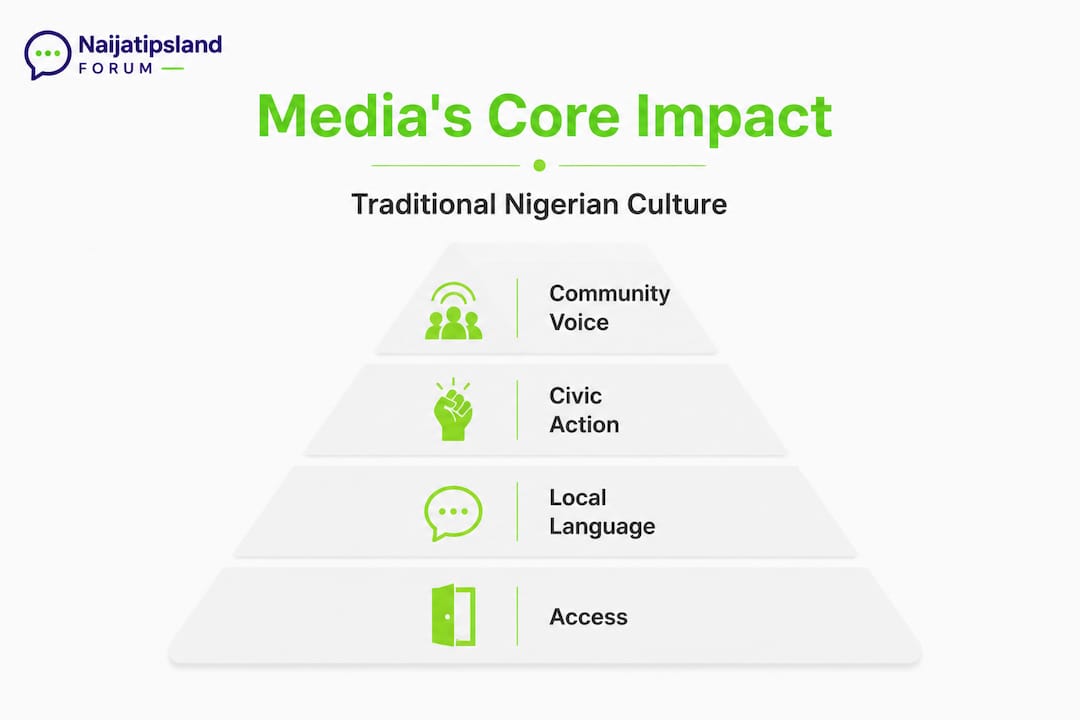
The numbers behind radio’s reach are striking. Radio in rural Nigeria is the most accessed traditional medium, with a 57.4% penetration rate in rural communities, and a remarkable 92.8% of respondents agree that radio directly influences opinion formation on public issues. That is not just audience loyalty. That is media shaping thought at a community level, one broadcast at a time.
Traditional media also plays a defining role in how Nigerians experience media’s cultural influence. Local language programming on stations like Rhythm FM, Wazobia FM, and Federal Radio Corporation of Nigeria (FRCN) outlets connects Yoruba, Hausa, Igbo, and other language groups to news and cultural programming that speaks directly to their lived experiences. This is something a generic digital news app rarely replicates.
Here is a summary of media type usage and influence across Nigeria:
| Media type | Primary audience | Key strength | Community influence level |
|---|---|---|---|
| Radio | Rural and semi-urban | Wide reach, low cost | Very high |
| Television | Urban and peri-urban | Visual storytelling, mass reach | High |
| Newspapers | Educated, urban readers | In-depth analysis, documentation | Moderate to high |
| Community radio | Local and rural | Hyper-local relevance | Very high |
Key roles traditional media plays in Nigerian society include:
- Identity formation: Broadcasting in local languages reinforces ethnic and regional pride
- Agenda setting: National TV stations like NTA and Channels TV determine which political issues receive attention
- Community cohesion: Community radio stations serve as notice boards for local events, health drives, and governance updates
- Credibility signaling: Print newspapers lend authority to stories that online-only outlets often cannot match
These functions do not disappear simply because a younger generation is scrolling through Twitter or TikTok. They adapt, but they do not vanish.
Educating the public: Traditional media’s role in awareness and civic action
Building on media’s foundational impact, it is essential to examine how these platforms actively educate and mobilize the population.
One of the most powerful but underappreciated roles of traditional Nigerian media is its capacity to drive civic awareness. When a television broadcaster runs a prime-time segment on budget padding in the National Assembly, millions of viewers receive a shared reference point. When a radio program explains how to register to vote in Hausa or Igbo, it is removing a barrier to democratic participation. These are not passive services. They are active contributions to governance and accountability.
Broadcast media raises public awareness on corruption, educates citizens on its consequences, and fosters community discussions through investigative journalism and public education programs. That finding is consistent with what you see in Nigerian newsrooms like Channels TV, TVC News, and respected print outlets like The Punch and Vanguard. Their investigative units have produced reporting that triggered legislative reviews, police investigations, and policy reversals.
Here is how traditional media turns information into civic action, step by step:
- Story identification: Journalists and editors pick issues affecting public welfare, such as fuel subsidy fraud or healthcare procurement scandals.
- Investigation and documentation: Reporters gather evidence through interviews, document requests, and on-the-ground reporting.
- Public broadcast or publication: The story reaches mass audiences through primetime TV, morning radio, or front-page newspaper placement.
- Public reaction: Citizens discuss the issue in homes, markets, and community meetings, creating organic civic conversation.
- Institutional response: Government agencies, legislators, or law enforcement agencies respond to public and media pressure.
- Follow-up reporting: Journalists track responses, keeping pressure on accountability.
This cycle is not theoretical. Investigative reporting in Nigeria has repeatedly demonstrated that when traditional outlets commit resources to a story, outcomes change. That is real power.
Democracy education also gets a direct boost from traditional media. During election cycles, broadcast stations run voter education campaigns that explain electoral processes, rights, and safeguards. In a country where civic literacy varies widely across regions, these campaigns are genuinely consequential.

Pro Tip: If you want to stay informed on issues affecting governance and public accountability, make it a habit to follow at least one traditional broadcast outlet and one investigative print publication alongside your social media feeds. The combination gives you both depth and speed.
| Civic function | Traditional media role | Measurable outcome |
|---|---|---|
| Voter education | Radio and TV campaigns | Higher rural voter registration |
| Anti-corruption reporting | Investigative journalism | Policy reviews, criminal referrals |
| Public health awareness | Government-sponsored broadcasts | Behavior change in health practices |
| Legislative accountability | Press gallery coverage | Increased public scrutiny of lawmakers |
Traditional media vs. diaspora and digital platforms: Credibility, access, and influence
With the media landscape evolving, it helps to contrast the strengths and unique challenges of traditional platforms with their digital and diaspora counterparts.
Traditional media in Nigeria does not operate in isolation. It exists alongside a growing ecosystem of digital news platforms, social media influencers, and diaspora-based outlets that serve Nigerians living outside the country. Understanding how these sources compare, and where they complement each other, helps you make smarter decisions about where you get your information.
Diaspora online media complements traditional media, providing alternative perspectives that are often seen as freer from local moderation, while simultaneously influencing homeland discourse in meaningful ways. Nigerian diaspora outlets operating from the United Kingdom, United States, and Canada regularly cover stories that domestic outlets are reluctant to publish due to advertiser pressure or political sensitivities.
“The influence of diaspora media on Nigerian public opinion is not simply about reach. It is about the perception of editorial independence, which traditional domestic outlets sometimes struggle to maintain under political pressure.”
This credibility gap is real, but it cuts both ways. Diaspora outlets sometimes lack the on-the-ground reporting infrastructure that traditional Nigerian stations have built over decades. A correspondent in Abuja knows the texture of a Senate hearing in ways that a London-based blogger may not.
Here is how the two categories stack up:
- Traditional Nigerian media strengths: Deep institutional knowledge, trained journalists, broadcast infrastructure, legal accountability
- Traditional media weaknesses: Political influence from ownership structures, censorship pressure, funding constraints
- Diaspora and digital media strengths: Greater editorial freedom, speed of publication, global reach, audience engagement
- Diaspora and digital media weaknesses: Less on-ground verification, inconsistent editorial standards, susceptibility to misinformation
The role of online communities in Nigeria’s media consumption has grown significantly, with platforms like Naijatipsland serving as aggregators where both traditional and digital content gets discussed and shared in real time. This blending is where the real magic happens for an informed citizen. Meanwhile, professional service providers like traditional media services show how the industry continues to invest in quality production and distribution infrastructure.
Understanding social media’s impact on Nigerian discourse also helps you see where traditional and digital forces intersect. A story broken by a newspaper gets amplified through Twitter and WhatsApp. A viral social media claim gets verified or debunked by a traditional broadcaster. Each platform needs the other.
Looking forward: Challenges and opportunities for traditional media in Nigeria
Having explored the current landscape, it is vital to look ahead at what traditional media must address to stay relevant and effective.
Traditional Nigerian media faces a set of real and pressing challenges. The digital advertising market continues to shift spending away from print and broadcast toward social and programmatic channels. That revenue pressure forces newsrooms to cut staff, reduce investigative budgets, and rely more heavily on sponsored content that can blur editorial independence. Trust in media institutions has also taken hits, driven by coverage that sometimes reflects the political allegiances of station owners rather than journalistic principles.
That said, the opportunities ahead are significant. Rural radio is still the dominant medium for opinion formation in rural Nigeria, and community radio networks continue to expand. Digital tools are also helping traditional outlets reach larger audiences without the cost burden of building new broadcast infrastructure. A newspaper that publishes compelling investigations online can now reach diaspora readers in Houston or Manchester as easily as readers in Ibadan.
Key challenges facing traditional media in Nigeria right now include:
- Declining advertising revenue as brands shift to digital platforms
- Political interference in broadcast licensing and editorial decisions
- Underfunded investigative units that reduce watchdog capacity
- Brain drain, where experienced journalists leave for better-paid digital or international roles
- Infrastructure gaps in power supply and distribution networks
Opportunities that traditional media should actively pursue include:
- Digital-traditional convergence: Newspapers and broadcasters that build strong web and mobile presences extend both their reach and their relevance
- Diaspora partnerships: Collaborating with diaspora outlets creates a cross-border editorial ecosystem that serves Nigerians everywhere
- Community storytelling: Deepening local language programming builds loyalty in communities that feel underserved by national platforms
- Grant-funded journalism: International foundations and development organizations fund investigative journalism, offering revenue that is independent of advertising
- Audience engagement platforms: Using forums and community tools alongside traditional broadcasts keeps audiences connected and participatory
The rise of trendsetting influences in Nigerian digital culture also creates openings for traditional media. A broadcaster who builds an audience relationship online and translates that trust back to their television or radio program creates a flywheel effect that strengthens both channels.
Pro Tip: As a media consumer, you are most informed and least manipulated when you actively use both traditional and online sources. Check a story on a national broadcaster, read the print investigation, then look at what diaspora outlets and credible community forums are saying. That triangulation protects you from the blind spots each platform carries alone.
Our perspective: Why traditional media matters more than ever for Nigerian dialogue
There is a tempting narrative floating around Nigerian digital spaces: that traditional media is slow, compromised, and already obsolete. It is a satisfying story, especially for younger audiences who trust their Twitter timeline more than NTA. We understand the frustration. But we think that story is incomplete in ways that actually harm civic life.
Here is what years of observing Nigeria’s evolving media environment has made clear to us. When traditional media weakens, the public scrutiny of power weakens with it. Investigative units at major newspapers and broadcast stations have produced the kind of documented, sourced accountability journalism that a Twitter thread simply cannot replicate. Not because Twitter lacks intelligence, but because journalism requires resources, legal protection, and institutional credibility that platforms alone do not provide.
The abandonment of traditional media also severs community ties in ways that often go unnoticed. Rural Nigerians who rely on community radio for health alerts, market prices, and local governance updates are not served by Instagram reels. When those radio stations collapse for lack of funding, those communities lose their primary connection to information that directly affects their survival and civic participation.
Our position is not that traditional media is perfect. It is not. Political ownership, inadequate funding, and self-censorship remain serious problems. But the solution is not to turn away from traditional media entirely. It is to demand better from it, support independent outlets, and understand how culture and media reinforce each other in ways that shape national identity over generations. Traditional and new media working together produce a stronger civic voice than either can manage alone.
Stay informed with trusted media resources
Staying on top of Nigerian news requires more than a single source. The information landscape rewards those who combine the depth of traditional reporting with the speed and range of digital platforms.
At Naijatipsland.com, you can follow journalist-led reporting projects that highlight the best of Nigerian investigative and community journalism, keeping you connected to stories that matter. You can also explore latest entertainment updates that cover Nigeria’s vibrant cultural scene, helping you stay engaged with the full range of conversations happening across the country. Join the community, submit your perspectives, and become part of a growing network of informed Nigerians here and around the world.
Frequently asked questions
Why is radio still so influential in rural Nigeria?
Radio remains accessible, affordable, and requires no internet connection, making it the most relied-upon source for news, community updates, and opinion formation in areas with limited digital infrastructure, with 57.4% rural penetration confirming its reach.
How does traditional media help combat corruption?
Broadcast media uses investigative journalism and structured public education programs to raise awareness of corruption, educate citizens on its consequences, and create community-level conversations that pressure institutions to respond.
What makes diaspora online media important for Nigerian affairs?
Diaspora media offers alternative perspectives that are often freer from local editorial pressure, complementing domestic traditional sources and shaping national conversations from an independent external vantage point.
Are newspapers still relevant with rising digital news sources?
Yes. Newspapers provide documented, legally accountable investigations and in-depth analysis that digital-only sources rarely match, particularly for major political events and policy reporting where verifiable sourcing is essential.
How can citizens verify news credibility between different platforms?
Cross-checking a story across at least three sources including a national broadcaster, a credible print outlet, and a diaspora or community forum gives you the strongest foundation for judging whether a report is accurate and complete.