Last updated: 22 October 2026 · By Naijatipsland Editorial Team · Editorial policy
Nigeria has one of the lowest formal divorce rates in the world — around 2.9%, or 1.8 per 1,000 people — yet a closer look at how Nigerians actually describe their relationships tells a more complicated story. A 2026 “State of Love” survey of over 10,000 Nigerians found that 40% of married respondents felt regret at some point, and 60% say they resist divorce even when they’re unhappy. The low divorce number isn’t proof of widespread relationship health; it’s often a sign of how much pressure exists to stay regardless. So what actually separates a healthy Nigerian relationship from one that’s simply enduring?
What’s actually breaking Nigerian relationships
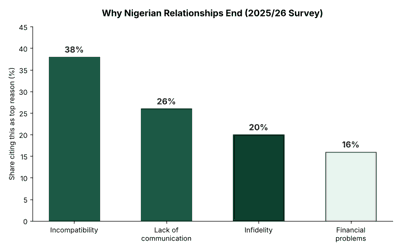
The same survey, run between October and November 2025, asked Nigerians directly why relationships end. Incompatibility topped the list at 38%, followed by lack of communication at 26%, infidelity at 20%, and financial problems at 16%. Separately, research on Nigeria’s divorce patterns lists lack of trust, infidelity, domestic violence, communication breakdowns, lack of commitment, financial problems, substance abuse, intimacy issues, constant arguing, and incompatibility as the most common cited causes. Notice how many of these are about process — how couples communicate and handle disagreement — rather than one single dramatic event.
The pressure that keeps unhappy relationships together
Understanding Nigerian relationships also means understanding the cultural weight behind marriage itself. The survey found that 64% of Nigerians see marriage as a necessary life milestone, but only 40% say they married mainly for love — suggesting that for a large share of couples, marriage is treated as an obligation to fulfill rather than purely a romantic choice. That same group reported 40% felt regret at some point and 60% said they resist divorce even when unhappy, which points to a cultural environment where staying together is often valued over whether the relationship is actually working. Financial strain compounds this: 8 in 10 respondents said the economy had affected their love life, and only 17% of couples said they split household expenses equally.

Five signs a relationship is actually healthy — not just intact
Given what the data shows about why relationships break down, the signs of a genuinely healthy relationship in Nigerian culture are really the inverse of those failure points. A relationship built on open communication, financial honesty, and mutual respect is far less likely to end up in the 38% citing incompatibility or the 26% citing poor communication.

- Open communication about money and family. With only 17% of couples splitting expenses equally and financial problems cited by 16% as a breakup reason, the ability to discuss money and in-law pressure honestly — without the conversation collapsing into conflict — is one of the clearest markers of a stable relationship.
- Shared financial honesty. This doesn’t require equal income or equal contribution. It requires both partners actually knowing where the household stands financially, rather than one partner managing money in secrecy.
- Respect that holds up under pressure. Disagreements stay focused on the actual issue rather than turning into insults or public humiliation, even in front of extended family — a common pressure point in Nigerian households.
- Room to disagree without fear. A partner who can say no, push back, or raise a concern without facing punishment, silence, or withdrawal is a strong sign the relationship isn’t running on fear or obligation.
- A shared view of what the relationship is for. Given that only 40% of married Nigerians say they married mainly for love, couples who are honest with each other — and themselves — about what they want from the relationship, whether that’s partnership, family-building, or companionship, tend to report less regret down the line.
Marriage as obligation vs. marriage as partnership
The gap between “64% see marriage as necessary” and “only 40% married mainly for love” is arguably the single most revealing statistic in the whole survey. It suggests a large number of Nigerian marriages are entered into, and maintained, primarily because of social expectation rather than because the relationship itself is thriving. That’s not automatically unhealthy — many successful long-term relationships grow into deep love over time even if they didn’t start there — but it does mean the signs covered above (communication, financial honesty, mutual respect, safety to disagree) matter even more, because they’re what determines whether an obligation-based relationship becomes a genuinely good one or simply an endured one.
The bottom line
Nigeria’s low divorce rate shouldn’t be read as proof that most relationships are healthy — the same data shows 40% of married Nigerians have felt regret and 60% stay together despite unhappiness, largely because of how strongly marriage is treated as a social necessity. The relationships that genuinely work tend to share the same five traits: honest communication, financial transparency, respect that survives conflict, safety to disagree, and a shared understanding of why the two people are together in the first place. Those traits — not the absence of a divorce filing — are the real measure of a healthy relationship.