
How to Get a Small Business Loan in Nigeria (2026): Real Options, Rates and Safe Lenders

Last updated 18 November 2026. Rates, limits and application windows change. The figures below come from the sources named, and some are from secondary reports, so confirm the terms with the lender before you apply.
Most people who search for a small business loan in Nigeria are really asking two things. Where can I get money at a rate I can survive, and how do I avoid the lender who will make my life miserable? The answer to the first has got a little easier this year. The answer to the second still needs care.
This guide covers the real options for 2026, what each lender usually asks for, how the cost adds up on a real loan, and how to check a loan app before you hand over your BVN. I am writing from the UK for readers in Nigeria and the diaspora, and I have not borrowed from any of these lenders myself. Everything below comes from published sources, which I list at the end.
Where interest rates stand this month
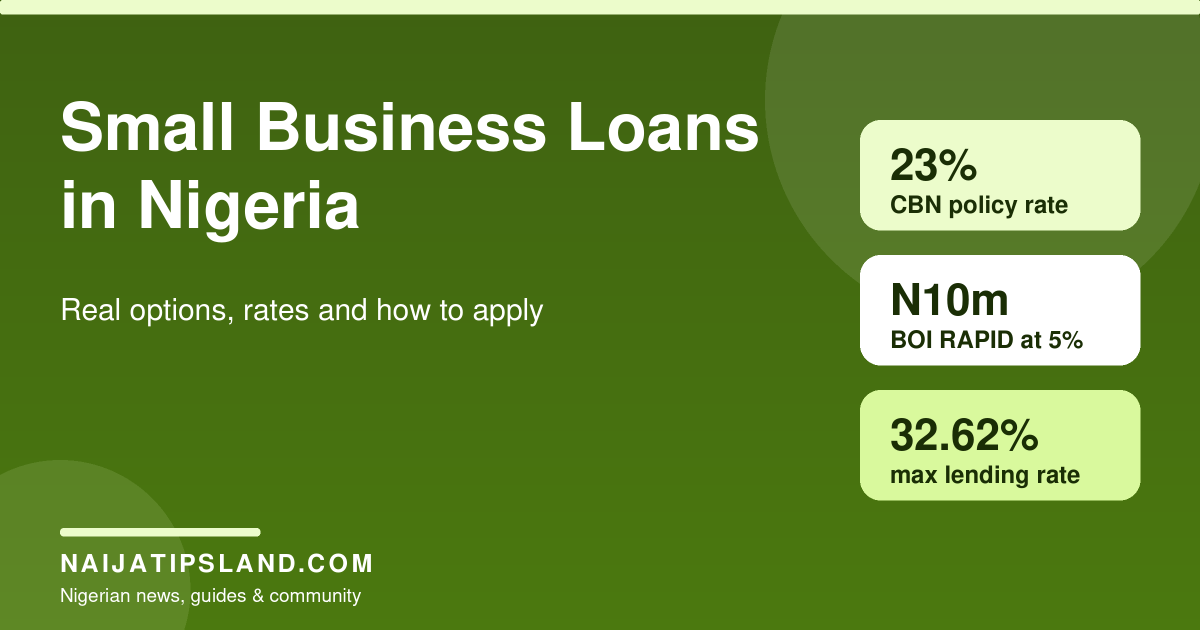
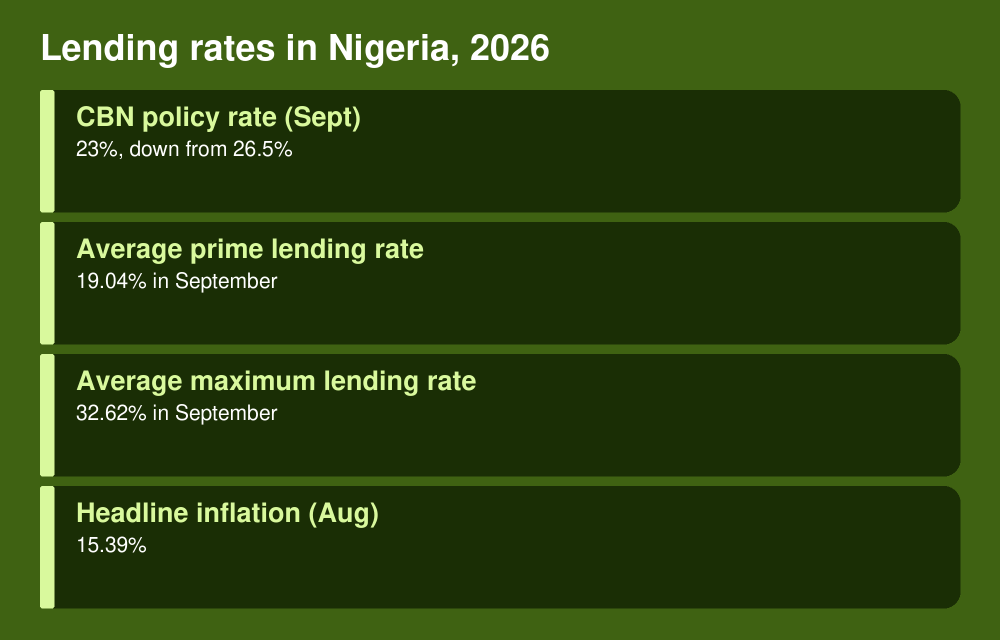
In September 2026 the Central Bank of Nigeria cut its Monetary Policy Rate by 350 basis points, from 26.5% to 23%, after the 307th Monetary Policy Committee meeting, according to Nairametrics. Headline inflation had eased to 15.39% in August, its third monthly fall in a row.
You would expect bank loans to get cheaper straight away. They did not. ThisDay reported on 26 October that the average maximum lending rate rose to 32.62% in September from 29.20% in August, and the average prime lending rate went up to 19.04% from 17.86%. Prime rates are what banks charge their best customers. A small business without a long banking history will usually pay closer to the maximum, so a commercial bank loan at around 30% a year is not unusual.
That gap is the reason the cheaper government-backed schemes matter. They are slower and more demanding on paperwork, but the rate difference is large.
Government-backed and development loans
Bank of Industry RAPID loan
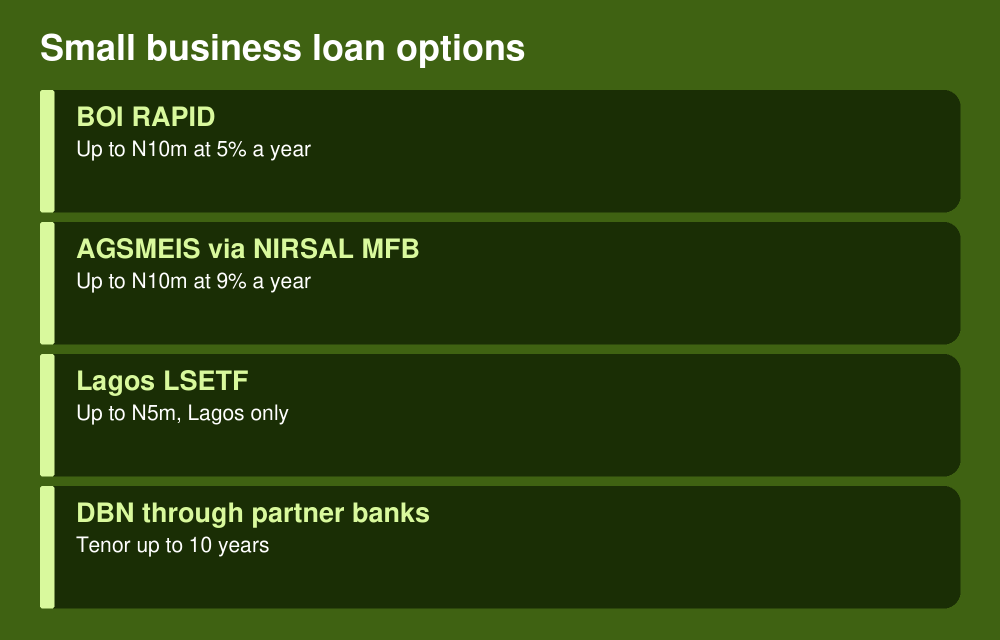
The Bank of Industry’s RAPID initiative offers up to N10 million at 5% a year for up to three years, according to a 12 November 2026 report on MSME Africa. It targets nano, micro and small enterprises, with a focus on rural and underserved areas, and it also covers cooperatives and community groups running eligible projects. Applications go through the BOI RAPID portal at rapid.boi.ng. The report lists the status as ongoing with no stated deadline, but it is a secondary source, so check the portal itself for the current terms.
AGSMEIS through NIRSAL Microfinance Bank
Techeconomy’s January 2026 roundup lists the Agri-Business, Small and Medium Enterprise Investment Scheme loan at 9% a year, up to N10 million, with a tenor of up to seven years and an 18-month moratorium. You need a registered business, a BVN, a valid ID and a viable business plan, and you must complete the mandatory entrepreneurship training. No physical collateral is required, and you cannot have an outstanding loan under a similar intervention scheme. Applications are online through the NIRSAL Microfinance Bank portal.
Lagos State Employment Trust Fund
If your business is in Lagos, the LSETF lists loans of up to N5 million at 5% to 9%. It is limited to businesses operating in the state. I could not find the current application window, so check the LSETF site before you plan around it.
Development Bank of Nigeria
The Development Bank of Nigeria does not lend to you directly. Its website says it funds and guarantees participating financial institutions, including commercial banks and microfinance banks, which then lend to businesses. Tenors can run up to 10 years with a moratorium of up to 18 months, and rates are described only as market-conforming. In practice you walk into a participating bank, ask for a DBN-funded facility, and the bank applies to DBN if it likes your case. You need to be a customer of that bank first.
One piece of advice from watching this space for a while: if a person online offers to get you a government loan for an upfront fee, walk away. Genuine schemes publish their own portals. Our guide to fake free government grant links shows how the fake ones work.
Bank and microfinance loans
Commercial banks and microfinance banks move faster, and they cost more. Techeconomy’s roundup lists several published examples. These are the lenders’ own headline figures as reported, so treat them as a guide.
- UBA’s micro business loan is listed at about 0.75% a month, roughly 9% a year, for up to N5 million. You usually need an existing UBA account.
- BOI Microfinance Bank’s working capital loan is listed at about 4% a month on a reducing balance, for up to 12 months, for businesses with at least a year of history.
- Stanbic IBTC’s short-term loans are listed at about 4% a month on some instant products, usually capped at 12 months, with at least six months of account history, CAC registration, financial statements and tax records.
- Access Bank’s SME loans vary by product. The roundup says you need CAC registration, a BVN, a TIN, steady turnover and at least a year of operating history, and personal guarantees are common.
- Baobab Microfinance Bank lends from N50,000 up to N150 million for SMEs, with tenors up to 60 months for businesses at least a year old.
Women-led businesses have extra routes. The same roundup lists Wema Bank’s SARA loan at around 9% and FCMB’s BOI-backed gender facilities, with zero-interest loans of up to N10 million on short tenors. Training is mandatory for most of these schemes.
What a loan really costs: a worked example
Monthly rates look small until you multiply them. Take a N2 million loan over 12 months with equal monthly repayments on a reducing balance. These are my own calculations for illustration, not any lender’s quote.
- At 0.75% a month, you repay about N174,900 a month, or roughly N2.10 million in total. The interest is about N98,800.
- At 4% a month, you repay about N213,100 a month, or roughly N2.56 million in total. The interest is about N557,300.
That is more than five times the interest on the same loan for the same year. A 4% monthly rate works out at about 48% a year if you simply multiply by twelve, which is far above the 32.62% average maximum bank rate. Ask every lender for the total amount you will repay, along with any processing, insurance or management fees, before you compare.
What lenders usually ask for
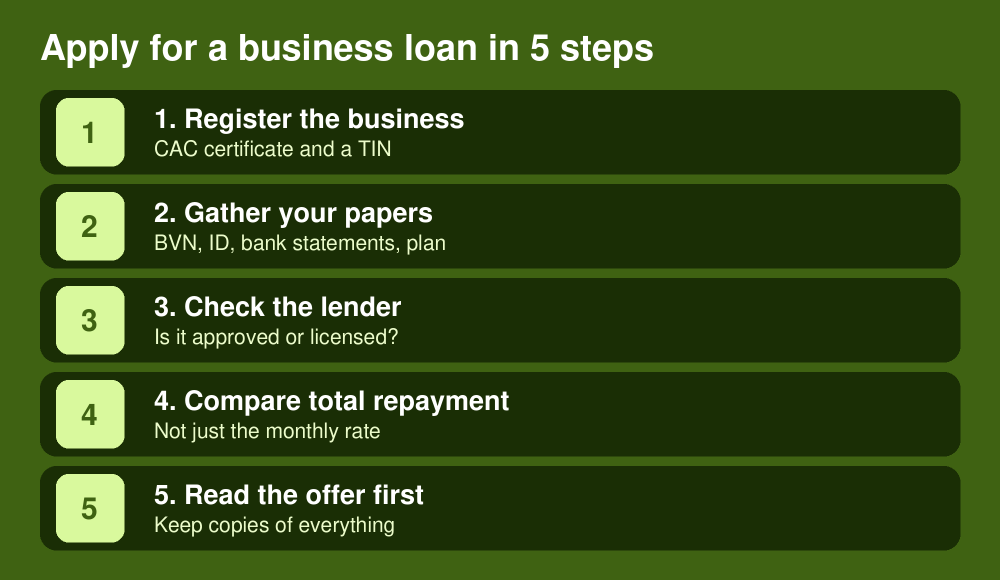
The lists differ by lender, but the same items come up again and again in the published requirements:
- CAC business registration, or a business name certificate for a sole trader.
- A BVN and valid ID for each owner.
- A TIN from the tax authority.
- Six to twelve months of bank statements showing real turnover.
- A short business plan that says what the money is for and how it will be repaid.
- Collateral or a personal guarantor with some banks. Several government schemes waive physical collateral.
If you have not registered yet, that is your first job. Our start a business in Nigeria hub links to the registration guides. A clean credit record also helps, and how to improve your credit score in Nigeria covers the basics. Cooperative members have another route, which we explain in how to start a cooperative society.
Loan apps: check before you borrow
Digital lenders are fast, but the rules changed this year. The Federal Competition and Consumer Protection Commission’s digital lending regulations took effect on 21 July 2025 and require loan apps to register. A lenders’ association challenged them in court, and an interim order paused enforcement. According to Nairametrics, the court dismissed the suit on 20 July 2026 and the commission resumed enforcement.
The same report counted 525 FCCPC-registered lenders, 33 CBN-licensed lenders with registration waivers, more than 1,000 loan apps, 112 apps on a watchlist and 54 removed from Google Play. Earlier coverage said sanctions can reach N100 million or 1% of turnover. The practical point is that lenders are pulling back from small unsecured instant loans and moving to instalment and cash-flow-based business loans, so first-time borrowers may find approval harder than last year.
Before you borrow from any app:
- Check the lender on the FCCPC’s published list of approved digital lenders. If it is missing, walk away.
- Be wary of any app that asks for access to your contacts or photos.
- Never pay an upfront fee to unlock a loan.
- Read the repayment term. Many instant loans run about 30 days.
If you also want to protect your phone and bank apps while you do all this, see how to protect your phone and bank apps from hackers.
A sensible way to choose
If you can wait a few weeks and your paperwork is in order, start with the BOI and NIRSAL routes, or a DBN-funded facility through your bank. If you need money within days, a bank or microfinance loan is realistic, and the worked example shows why you should compare the total repayment. Keep loan apps for small, short gaps you can clear within the term. Whatever you pick, borrow only what the business will earn back, and never use your rent or school fee money as the cushion. Our personal finance hub has more on budgeting and avoiding debt traps.
FAQ
Can I get a small business loan in Nigeria without collateral?
Yes, with some lenders. AGSMEIS is listed as collateral-free, and several microfinance and digital lenders lend on cash flow. Banks often want a guarantor or security, so ask what they will accept.
What is the cheapest small business loan in Nigeria?
On published rates, the Bank of Industry RAPID loan at 5% a year and the schemes at 5% to 9% are the cheapest. They have more paperwork and longer waits than bank loans.
Why are bank loans still expensive after the rate cut?
The CBN cut its policy rate, but ThisDay reported that average lending rates rose in September. Banks price risk on top of the policy rate, and small businesses are seen as higher risk.
Do I need a registered business to get a loan?
For most formal lenders, yes. Expect to need CAC registration, a TIN and a BVN. Some microfinance lenders will lend to unregistered traders on smaller amounts.
How do I know if a loan app is legitimate?
Check the FCCPC’s list of approved digital lenders and confirm the company name matches the app. Avoid apps that ask for upfront fees or demand access to your contacts.
Can Nigerians abroad get these loans?
The government schemes generally require a business operating in Nigeria and a Nigerian BVN. Diaspora readers often fund the business with their own savings or through a trusted partner. Check each scheme’s rules before applying.
This article gives general information and is not financial advice. Compare offers and read the full terms before you sign.
Sources
- Nairametrics: CBN resets MPR to 23% (22 September 2026)
- ThisDay: Despite cut in MPR, average maximum lending rate rises to 32.62% (26 October 2026)
- MSME Africa: How to apply for the Bank of Industry BOI RAPID loan (12 November 2026)
- Techeconomy: Top 10 MSME-friendly loans in Nigeria, interest rates compared (19 January 2026)
- Development Bank of Nigeria: Get a loan
- Nairametrics: Instant loans dry up as FCCPC rules force lenders toward safer borrowers (9 September 2026)
- Nairametrics: FCCPC begins enforcement on unregistered loan apps (21 January 2026)
Join the discussion
Have you tried this, or do you have a question we did not answer? 1 reader has already shared their view. Naijatipsland members help each other with real, first-hand experience.





Editor note: have you applied for a small business loan in Nigeria this year? Tell us in the comments which lender you used, how long approval took and what they asked for. Please leave out account numbers and BVN. We read every comment. – Ade