Nigeria News Today, 17 November 2026 (Evening): Senate Moves on Political Violence, Suicide Bill, Gabon Evictions

Last updated: 17 November 2026 · By Naijatipsland Editorial Team · Editorial policy
Evening roundup · Tuesday 17 November 2026 · By Ade Adeniyi, Founder and Editor
The National Assembly had a busy Tuesday. Senators spent most of the day on political violence, the President sent in a bill on attempted suicide, and the House turned its attention to Nigerian fishermen pushed out of their homes in Gabon. Away from Abuja, the campaign moved to Kebbi, INEC set out new rules of the road for the count, and the naira slipped again even with inflation at a six-year low. Here is what you need to know from today.
Today at a glance
- Senate asks INEC to disqualify candidates whose supporters are convicted of electoral violence, and wants mobile courts at rallies.
- INEC chairman warns sponsors of violence, and the commission proposes a code for anyone publishing their own result tallies.
- Tinubu campaigns in Birnin Kebbi; Atiku’s camp says the opposition is united against him.
- Tinubu sends a bill to the Senate to decriminalise attempted suicide; Akpabio welcomes it.
- Reps order a probe into the eviction of Ilaje fishermen in Gabon.
- Shettima orders over three million bags of fertiliser released for dry-season farming.
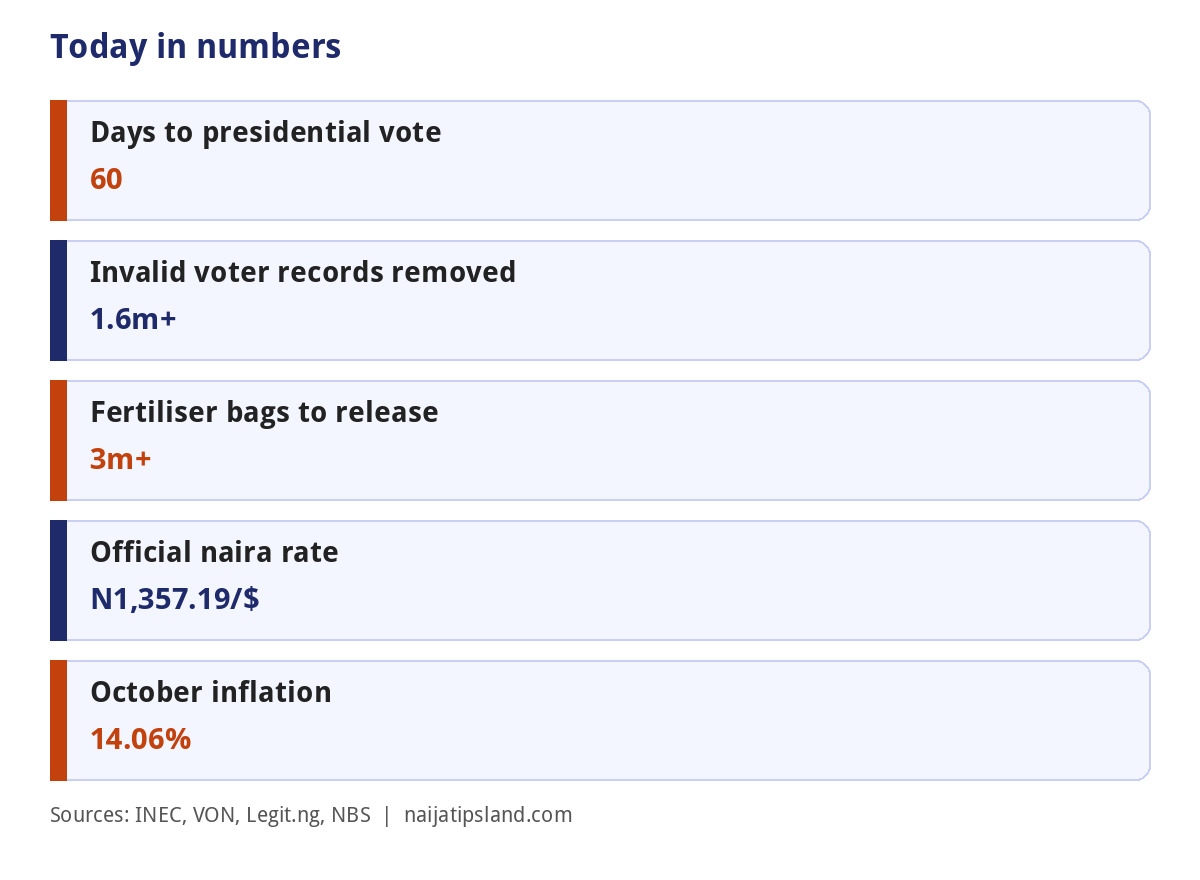
- Naira weakens to ₦1,357 at the official window as the CBN’s rate meeting nears.
1. Senate wants tougher action on political violence
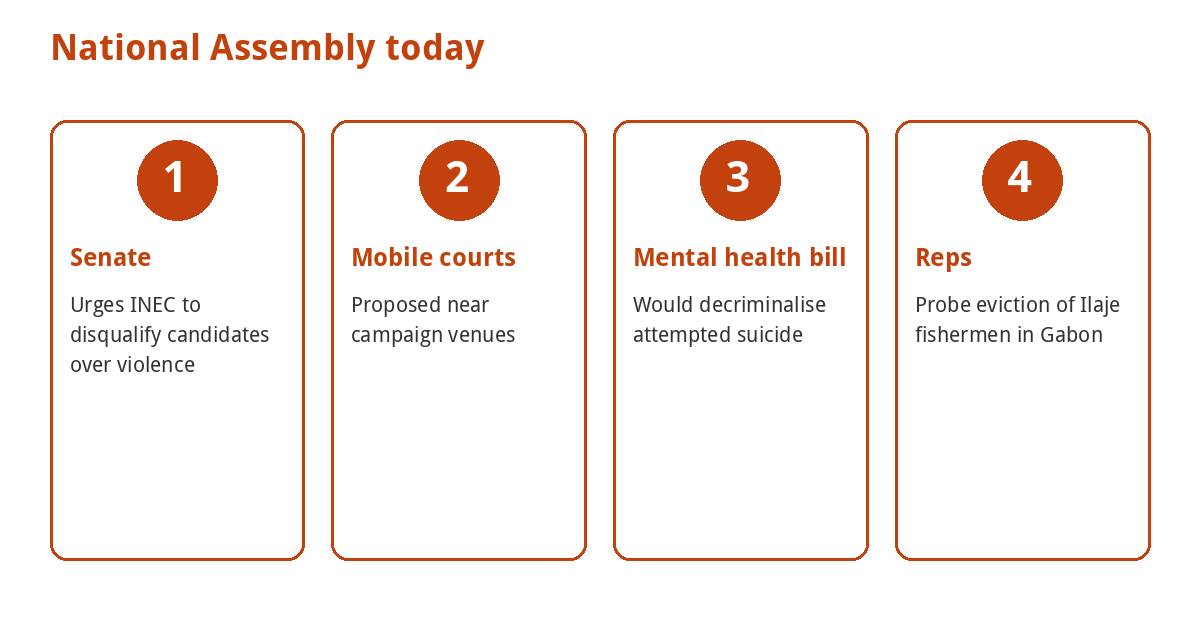
What happened: On Tuesday the Senate adopted a motion by Senator Abdul Ningi (ADC, Bauchi Central) on rising attacks on politicians and their supporters. It urged INEC to disqualify any candidate whose supporters are found by a court to have taken part in electoral violence, in line with the Electoral Act 2026. Senators named incidents in Abuja (including the stoning of President Tinubu’s convoy), Edo, Delta and Sokoto, and asked security agencies to find and prosecute both attackers and sponsors. Senator Ali Ndume (APC, Borno South) proposed mobile courts near campaign venues, and governors were told to stop denying rival parties stadiums, hotels and other public facilities. Three committees have one week to report back.
Why it matters: With 60 days to the 16 January vote, lawmakers from both the ruling party and the opposition are now on record against thuggery. If governors actually open public venues to every party, campaigns in many states could become calmer and fairer.
Source: Vanguard; Nigerian Tribune; BusinessDay.
2. INEC warns sponsors of violence and sets rules for result tallies
What happened: Speaking at the Goodluck Jonathan Foundation peace conference in Abuja, INEC chairman Joash Amupitan said security agencies working with the commission would go after those who fund violent campaigns. He said the new Electoral Act raises fines for individuals to as much as ₦5 million, that more than 1.6 million invalid records have been removed from the register, and that a nationwide mock accreditation and result transmission test is planned for 28 November. At a separate Yiaga Africa roundtable, INEC proposed a voluntary code of conduct for observers, parties and media that publish their own tallies, saying such figures must never be presented as official results. Former President Jonathan used the same conference to warn about the risk of a post-election crisis.
Why it matters: On election night many Nigerians will see numbers on social media long before INEC declares anything. The proposed code is meant to stop rival “results” from causing panic. You can follow the timetable on our 2027 Nigeria election hub.
Source: New Telegraph; Premium Times; Punch.
3. Campaign trail: Tinubu in Kebbi, Atiku’s camp responds
What happened: President Tinubu held an APC rally at Haliru Abdu Stadium in Birnin Kebbi. He thanked the state for its 2023 votes, promised cheaper food, better incomes for farmers and jobs for young people, and pointed to the Sokoto-Badagry superhighway and a proposed inland port. He asked young people to collect their PVCs. On the same day, Atiku Abubakar’s spokesman Phrank Shaibu told Channels Television that the ADC candidate is in the race to win, not to persuade others to step down, while describing Peter Obi and Seyi Makinde as strong contenders ahead of the 23 November opposition summit.
Why it matters: The North-West is one of the biggest vote banks in the country, and both the APC and the opposition are now competing hard for it. Whether the opposition settles on one candidate before ballot deadlines will shape the whole race.
Source: The Guardian; Voice of Nigeria; Politics Nigeria.
4. Bill to decriminalise attempted suicide reaches the Senate
What happened: Senate President Godswill Akpabio read a letter from President Tinubu sending the National Mental Health Amendment Bill 2026. It would amend the 2021 Mental Health Act to remove criminal penalties for attempted suicide and provide support for survivors. Akpabio, whose earlier comments on the subject drew wide criticism, welcomed the bill and said his remarks had been misreported. A separate private bill by Senator Asuquo Ekpenyong on the same issue had already passed second reading. The new bill went to the Committee on Rules and Business.
Why it matters: Doctors and mental health groups have long argued that the threat of prosecution stops people in crisis, and their families, from seeking help. If this passes, Nigeria’s law would treat a suicide attempt as a health emergency, not a crime. If you or someone close to you is struggling, please talk to a doctor or someone you trust.
Source: TheCable; BusinessDay.
5. Reps to probe eviction of Nigerian fishermen in Gabon
What happened: The House of Representatives adopted an urgent motion by Donald Ojogo (APC, Ondo) after reports that homes and businesses of Nigerians, mostly Ilaje fishermen from Ondo State, were demolished along Gabon’s coast last week. Lawmakers said some had lived there legally for decades and lost boats and equipment. The Federal Government was asked to engage Gabonese authorities, and House committees on foreign affairs, diaspora and integration in Africa must report within 14 legislative days.
Why it matters: Thousands of Nigerians earn their living in coastal communities across Central and West Africa. How Abuja handles this case will show how far it is willing to go for citizens abroad.
Source: The Nation; Independent; TVC News.
6. Three million bags of fertiliser for dry-season farmers
What happened: Vice President Kashim Shettima told fertiliser producers and agencies to speed up blending and release of more than three million bags of NPK fertiliser before dry-season planting. The plan, funded under a presidential agricultural initiative, will see government buy from local blenders and sell to farmers at lower prices. Budget minister Atiku Bagudu said about 496,000 tonnes of related stock had been identified. The NSA’s office will verify stocks, and Shettima said farmers in insecure areas must not be left out. Prices and distribution points have not yet been announced.
Why it matters: Fertiliser cost is one of the biggest drags on food production. If the bags reach farms on time, it could help keep food prices falling into 2027. Farmers weighing their options can see our guide to the best crops to grow for profit.
Source: Voice of Nigeria; Nigeria Info.
7. Naira slips even as inflation hits a six-year low
What happened: The naira lost ₦3.22 at the official market to close at ₦1,357.19 per dollar, while the parallel market rate moved to about ₦1,405. Dollar turnover fell 81% to $68.66 million. This comes a day after the NBS put October headline inflation at 14.06%, down from 14.63% in September, with food inflation at 19.13%. Month-on-month inflation, however, rose to 0.43%. The CBN’s Monetary Policy Committee meets on 23 and 24 November.
Why it matters: Lower annual inflation gives the CBN room to cut rates again, which could ease loan costs. But a weaker naira over the festive season can push up prices of imported goods. Check the latest figures on our dollar to naira rate page.
Source: Legit.ng; Moneycentral.
Security in brief
In Plateau, gunmen killed a newly graduated Operation Rainbow unit commander and another man in Tadai, Bokkos LGA, on Monday afternoon; no arrests have been reported. In Benue, the police command said it had arrested 26 suspects over kidnapping, robbery and killings and recovered nearly 500 rounds of ammunition.
Source: The Gazette (citing Premium Times); Daily Post.
What to watch next
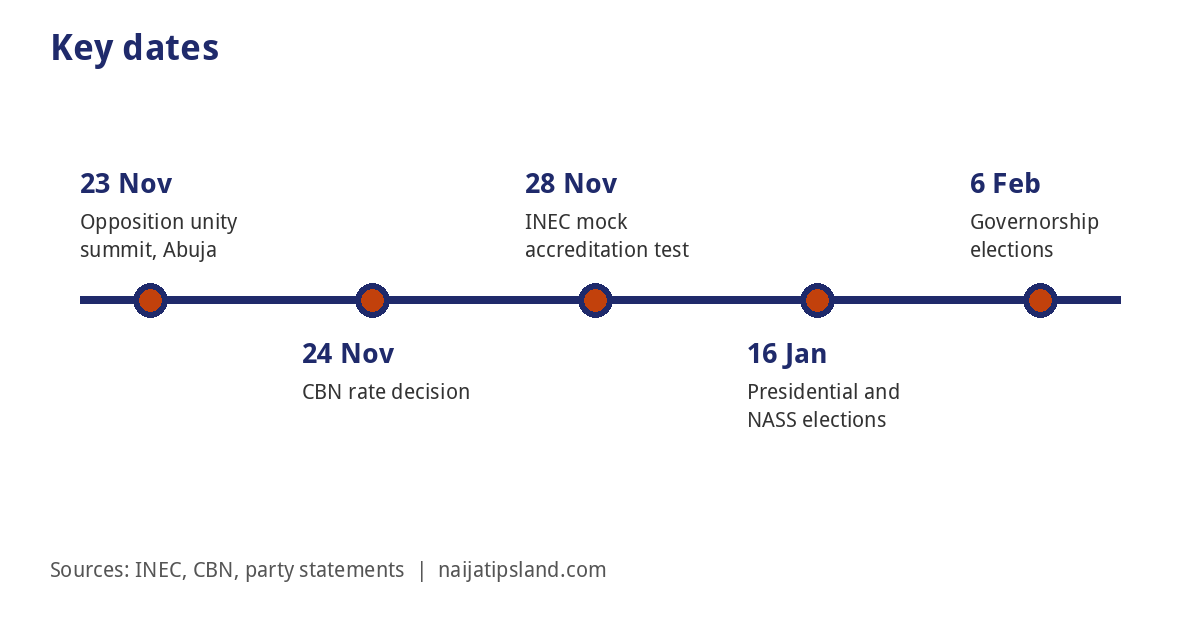
- Senate committee reports on political violence, due within a week.
- Opposition unity summit in Abuja on Monday 23 November.
- CBN rate decision on 24 November.
- INEC mock accreditation and result transmission test on 28 November.
- Presidential assent to the state police amendment.
Frequently asked questions
Can INEC really disqualify a candidate over violence by supporters?
The Senate’s resolution ties disqualification to the Electoral Act 2026 and a court conviction. It is a call on INEC, not a new law, so any action would depend on the courts and the Act’s exact wording.
Is attempted suicide still a crime in Nigeria?
Yes, for now. The Criminal Code and Penal Code still treat it as an offence. The bill sent today would change that only after it passes both chambers and is signed by the President.
When is the next election test run?
INEC says it will run a nationwide mock accreditation and result transmission exercise on 28 November 2026.
This roundup summarises reporting by the outlets credited under each story, in our own words. Follow Naijatipsland Updates on WhatsApp for the next edition. Spotted an error? Tell us and we will correct it under our editorial policy.