Global News Today, 17 November 2026: Xi-Trump-Putin Summit Set, Houthis Take Red Sea Coast, EU Rwanda Migrant Hub


Last updated: 17 November 2026 · By Naijatipsland Editorial Team · Editorial policy
Morning roundup · Tuesday 17 November 2026 · By Ade Adeniyi, Founder and Editor
Good morning. The leaders of the US, China and Russia are due to sit at one table for the first time on Thursday, while the Ukraine peace talks show fresh cracks over who gets a seat. In Yemen, the Houthis now control the Red Sea coast, oil prices are sliding despite mine blasts in the Gulf, and five European countries have picked an African country for their first deportation centre. Here is the world this morning, and what it means for Nigerians.
Today at a glance
- Xi, Trump and Putin to hold their first three-way summit in Shenzhen on 19 November.
- Ukraine talks: Moscow says Europe has not been cleared to join; Kyiv bridges hit.
- Yemen’s government pulls back from the Red Sea coast to defend Aden.
- Brent crude falls below $92 even as Iran reports tankers hitting mines.
- Five EU countries plan a migrant return centre in Rwanda from 2027.
- Experts and Ghana’s central bank warn El Niño could hit West African harvests.
1. Xi, Trump and Putin set for first-ever three-way summit
What happened
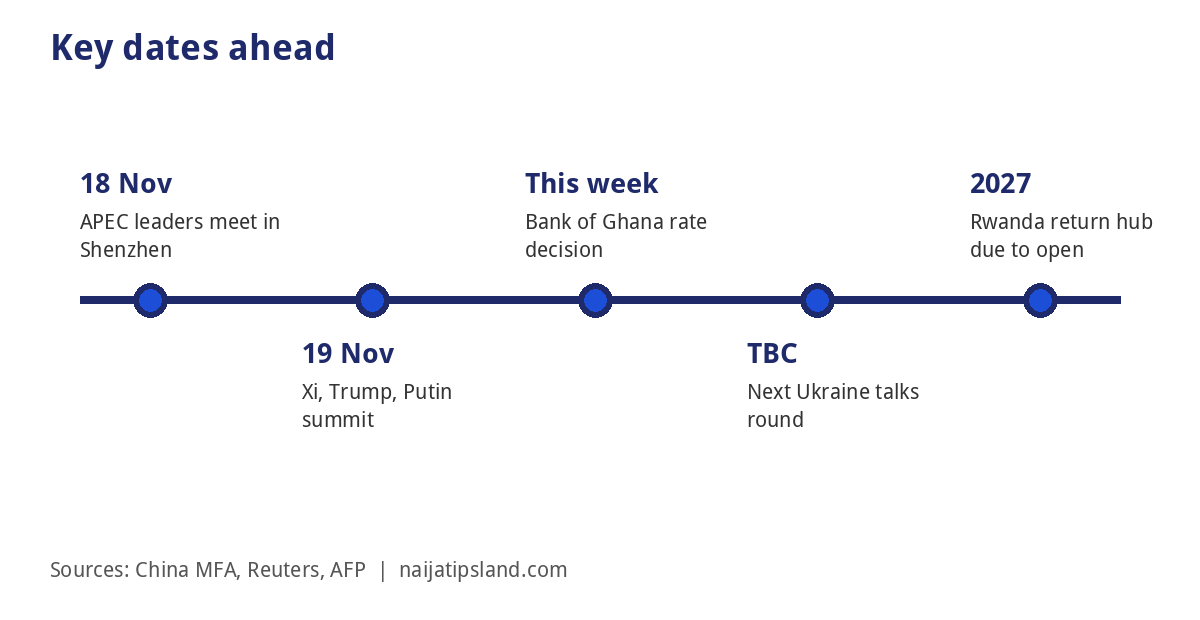
China’s Foreign Ministry said on Monday that President Xi Jinping will host Donald Trump and Vladimir Putin in Shenzhen on Thursday 19 November, on the sidelines of the APEC leaders’ meeting (18 to 19 November). Spokesperson Mao Ning called it the first face-to-face meeting of the three heads of state. Reports point to nuclear arms control, artificial intelligence and the Iran war as likely topics, since the US-Russia New START treaty expired in February. US officials had said Ukraine would not be on the agenda, but Trump told reporters on Monday he would raise it.
Why it matters
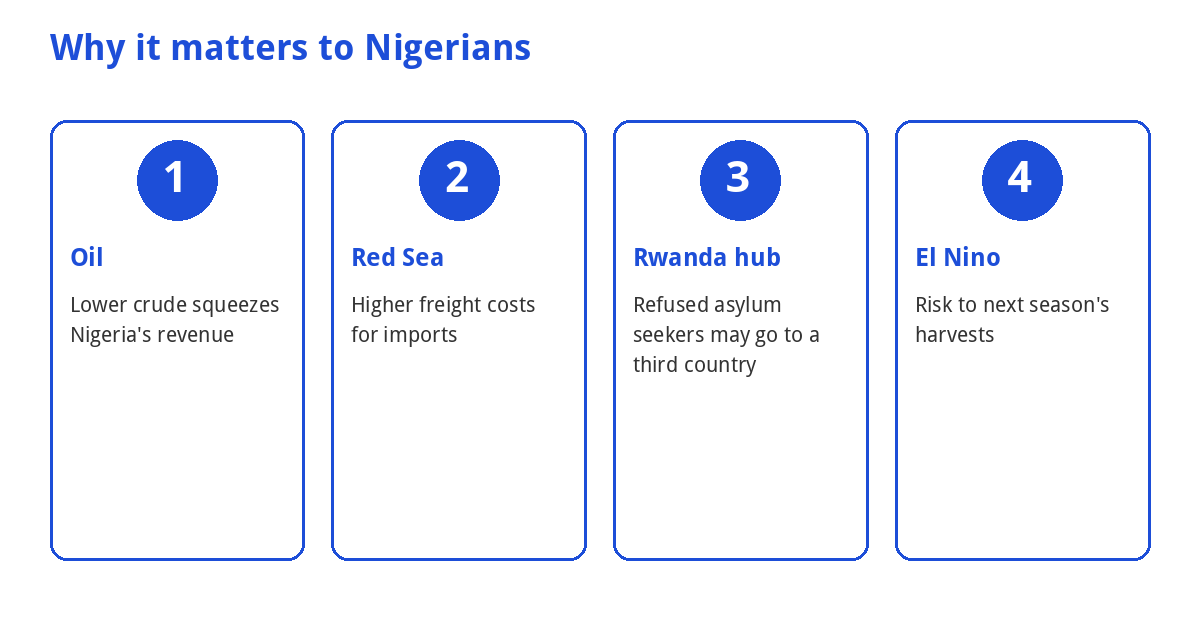
Decisions by these three powers shape oil prices, trade rules and the wars that drive them. For Nigeria, any easing of tension in the Gulf or Ukraine could feed through to crude prices, government revenue and the cost of imported food and fuel.
Source: Assam Tribune (IANS); Hindustan Times; NV.
2. Ukraine talks: Moscow and Washington disagree on Europe’s seat
What happened
Kremlin aide Yuri Ushakov said on Monday that Russia has not agreed to European representatives joining the next round of peace talks, which he said would stay in a three-way US-Russia-Ukraine format. That contradicts US envoys Steve Witkoff and Jared Kushner, who said after meeting Putin that Europe would take part. EU foreign ministers in Brussels rejected Moscow’s call for a new European security order, with EU foreign policy chief Kaja Kallas calling Russia’s demands absurd. President Zelensky said he held a “difficult” online meeting with the US envoys and a full European delegation. Overnight, Kyiv’s mayor said two major bridges in the city were hit in a Russian attack.
Why it matters
The war has kept wheat, fertiliser and fuel prices high for four years, and Nigerians feel that at the market. A peace deal would help, but the talks are now stuck on process as well as substance, so relief is unlikely to be quick.
Source: The Irish Times; BBC; Reuters.
3. Houthis take Yemen’s Red Sea coast as government falls back to Aden
What happened
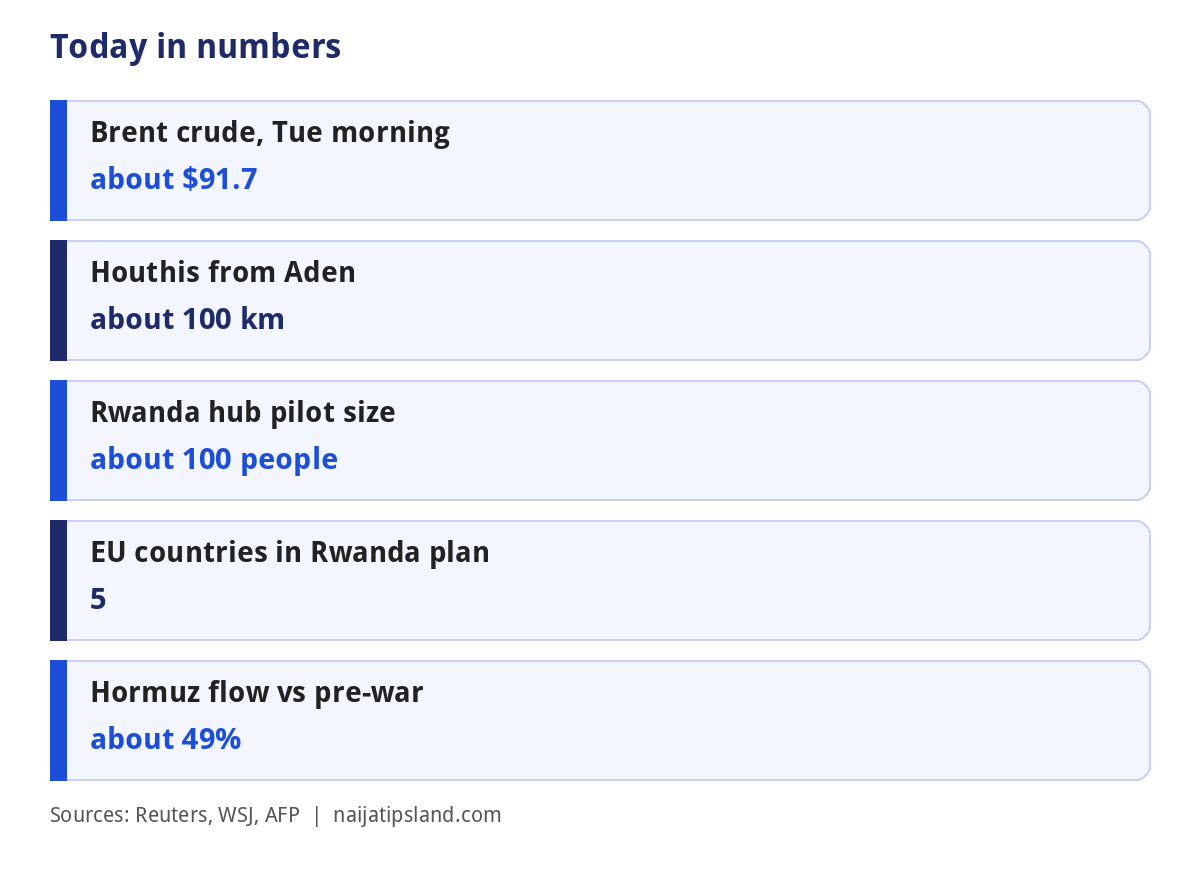
Yemen’s Saudi-backed government forces announced on Sunday that they were withdrawing from areas near the Bab el-Mandeb Strait to defend Aden, ending a six-week counter-offensive. Military sources said on Monday that Houthi fighters had reached Khor Omairah, about 100 km west of Aden, and were 25 km from government lines at Qawah. Houthi sources said they had moved into a coastal stretch of more than 150 km vacated by government troops. Saudi Arabia replaced the commander of its coalition on the same day; Western diplomats linked the change to the setback.
Why it matters
The Bab el-Mandeb is a key route for ships between Asia and Europe. When the Houthis threaten it, shipping costs and insurance rise, and that adds to the price of goods arriving at Lagos and other West African ports. Analysts warn it can also push up oil prices.
Source: Reuters; BBC; New Age (AFP).
4. Oil slides below $92 despite tanker mine blasts in Hormuz
What happened
Brent crude fell to about $91.7 a barrel early on Tuesday, after dropping 3.5% to settle at $92.44 on Monday. Traders are betting on a supply surplus because Middle East exports through the Strait of Hormuz have recovered faster than expected; the International Energy Agency said on Friday the market would return to surplus this quarter. That is despite Iran’s Revolutionary Guards saying two more tankers struck mines in the strait, and the arrival of a third US aircraft carrier, the USS Theodore Roosevelt, in the region. One bank’s analysts noted throughput in Hormuz is still only about half of pre-war levels.
Why it matters
Nigeria’s budget and foreign reserves lean heavily on crude. Lower oil prices are good news for fuel importers elsewhere but squeeze Nigerian revenue and can weigh on the naira over time. Check today’s rates on our dollar to naira exchange rate page.
Source: Express Tribune (Reuters); The Wall Street Journal; The Indian Express.
5. Five EU countries plan a migrant return centre in Rwanda
What happened
Austria, Denmark, Germany, Greece and the Netherlands announced in Vienna on Monday a plan to open a “return hub” in Rwanda in 2027, the first such facility outside the EU. It would take people whose asylum claims were rejected, whose appeals are exhausted and who refuse to go home. Diplomatic sources describe a pilot of around 100 people. Rwanda’s interior minister Vincent Biruta said arrivals could return home voluntarily, settle in Rwanda or move to a country where they have a right to live. Human Rights Watch, Amnesty International and 45 NGOs condemned the plan, and court challenges are expected. No agreement has been signed yet.
Why it matters
Nigerians are among the larger groups of asylum seekers in Europe. Under this scheme, a person with a refused claim could be sent to an African country they have never lived in rather than back to Nigeria. Anyone in the asylum system in these five countries should seek proper legal advice.
Source: RTÉ (AFP); Stuff (AP); SBS News.
6. El Niño warning for West African farms and food prices
What happened
Bank of Ghana Governor Johnson Asiama told his Monetary Policy Committee on Monday that an unusually strong El Niño could hurt farm output across West Africa into early 2027, with knock-on effects on food prices, cocoa and export earnings. At an expert forum on 13 November, a WHO official said the agency has put the event at Grade 3, its highest internal emergency level, and that no West African country is fully prepared. Climate scientist Dr Caleb Mensah warned that gaps of two to three weeks between early rains could ruin crops planted after the first showers. The UN’s FAO says more than half of the 22 countries most at risk are in Africa.
Why it matters
Nigeria shares the same weather system. Delayed or weak rains next season could cut harvests, push up food prices and undo recent falls in inflation. Farmers may need to watch NiMet forecasts closely before planting.
Source: Ghana News Agency; Adom Online; The Straits Times (AFP).
What to watch next
- The APEC summit in Shenzhen (18 to 19 November) and the Xi-Trump-Putin meeting on Thursday.
- A date for the next round of Ukraine talks, and whether Europe is in the room.
- Whether the Houthis push on towards Aden.
- Oil prices as the IEA’s predicted surplus meets continued Gulf attacks.
- The Bank of Ghana’s rate decision this week, which will mention El Niño risks.
Frequently asked questions
Will Nigerians in Europe be sent to Rwanda?
Only people in the five participating countries whose asylum claims have been fully refused, who have exhausted appeals and who refuse to leave would be in scope, and the scheme is not due to start until 2027. Minors are reportedly excluded.
Why does a war in Yemen affect prices in Nigeria?
Many ships between Asia and Europe pass the Bab el-Mandeb Strait. Threats there raise freight and insurance costs, and importers pass those costs on to buyers.
Is falling oil good or bad for Nigeria?
Mostly a mixed blessing. It reduces the government’s oil income and dollar earnings, but it can also ease global fuel and shipping costs that feed into the prices Nigerians pay.
This roundup summarises reporting by the outlets credited under each story, in our own words. Follow Naijatipsland Updates on WhatsApp for the next edition. Spotted an error? Tell us and we will correct it under our editorial policy.