
Atiku Abubakar’s 2027 Manifesto: What He Promises, What Is on Paper and How It Compares (November 2026)

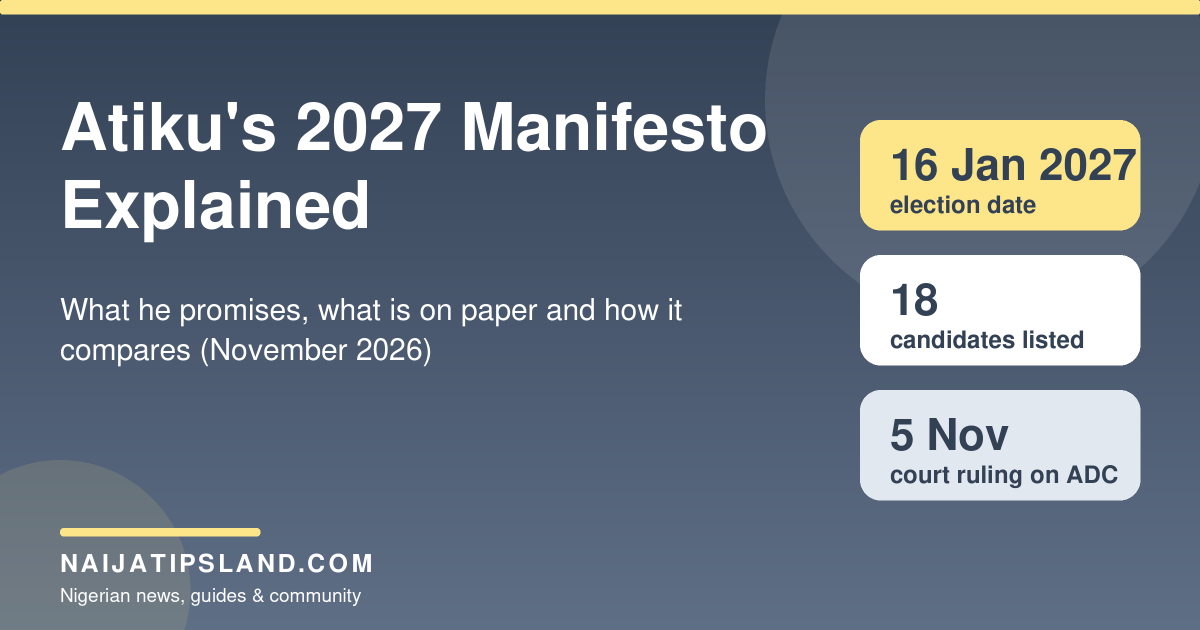
Last updated 12 November 2026. This guide is informational and neutral. It does not endorse any candidate or party, and it applies the same test to every candidate: what is in writing, what has been promised in speeches and what can be checked. Election news changes quickly, so check INEC and the courts for the latest.
If you are asking what Atiku Abubakar’s 2027 manifesto says, the honest answer has three parts. His party, the African Democratic Congress (ADC), adopted a party manifesto in April 2026. Atiku has made a set of campaign pledges since his campaign launch on 4 November. And a court ruling on 5 November has put the legal status of the ADC leadership, and reports say his nomination, in dispute. This page separates those three things so you can see which is which, and compares them with what the other two best-known platforms put on paper.
For the wider picture, including dates, candidates and voting rules, see our 2027 Nigeria Election Hub. For how the other main candidate’s promises stack up, see our guide to Tinubu’s 2027 promises and how to check them.
The basics
- Election date: INEC fixed the presidential and National Assembly elections for 16 January 2027, with governorship and state assembly elections on 6 February 2027.
- Candidate and running mate: INEC’s final list, published on 12 September 2026, named Atiku Abubakar as the ADC presidential candidate with former Rivers State governor Rotimi Amaechi as running mate. Atiku was reported as winning the ADC nomination in May 2026.
- Field: INEC listed 18 presidential candidates from 18 parties, including Bola Tinubu (APC, with Kashim Shettima), Peter Obi (NDC, with Rabiu Kwankwaso), Atiku (ADC, with Rotimi Amaechi) and Omoyele Sowore (AAC).
Is there an Atiku manifesto?
Not in the sense of a single, costed document with his name on it, as far as we could find. What exists is layered:
- The ADC manifesto and Policy Principles. The ADC’s national convention in Abuja on 14 April 2026 adopted a new manifesto alongside an amended constitution. A policy committee chaired by John Odigie-Oyegun had presented an interim report on 17 March. In May, one commentator noted that the party had not yet publicly unveiled the full manifesto and Policy Principles because of legal challenges, so check the ADC’s official channels for the current version.
- Atiku’s own policy statements. He has issued statements, including one on fuel under the heading of an economic recovery plan for 2027, and at his screening in May he presented what was described as an economic rescue blueprint and a national security reform agenda.
- Campaign pledges. These were made at the campaign flag-off in Sokoto on 4 November and at rallies since, including Kebbi on 5 November.
What Atiku has pledged since the campaign launch
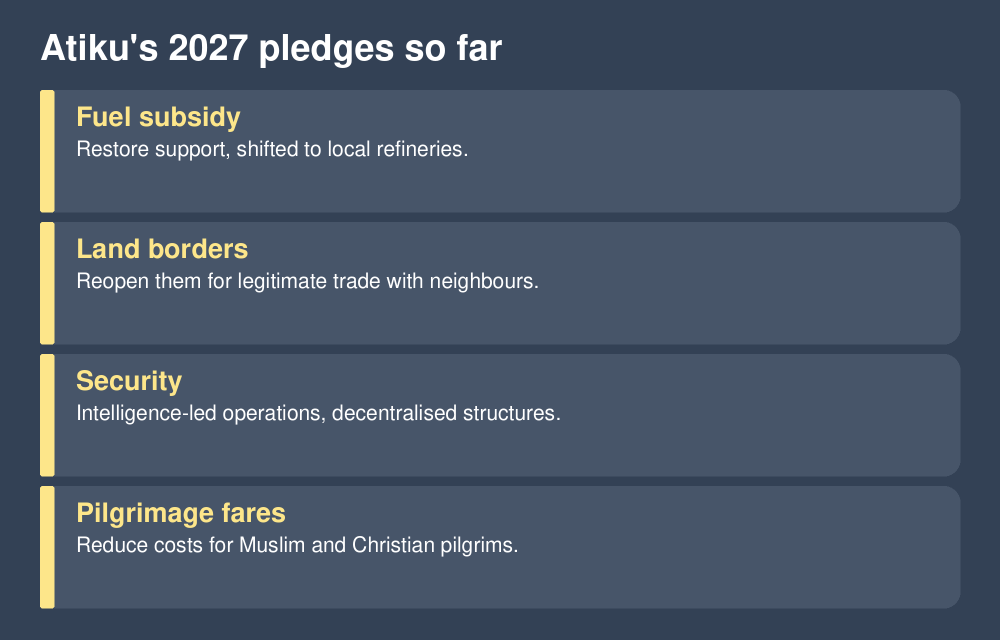
At the Sokoto flag-off on 4 November, and in Kebbi the next day, Atiku was reported by several outlets, including Premium Times, Channels Television and Daily Post, as promising to:
- Restore or reconsider the petroleum subsidy to ease fuel and transport costs.
- Reopen Nigeria’s land borders for legitimate trade with neighbouring countries.
- Tackle insecurity, including kidnapping, banditry and terrorism.
- Reduce pilgrimage fares for Muslims and Christians.
- Improve jobs and household incomes, with the slogan of making Nigeria affordable again.
In a separate message on 31 October, reported by The Sun, he said he would rebuild the North by ending the insecurity that has driven people from their farms, bringing down the cost of living and opening opportunities through education, enterprise and jobs.
The fuel proposal in detail
His most detailed written policy so far is on fuel. According to Leadership’s report on his statement, he proposes to move subsidy “from importation to production” by giving qualifying refineries preferential access to Nigerian crude. Under the plan as reported, support would be traceable and audited, must pass through to consumers under a transparent pricing formula, would not be allowed to be diverted to foreign markets, would stay within an annual ceiling set in the federal budget and approved by the National Assembly, and would be reviewed and phased down as refining capacity grows. The statement cited NNPC Limited audited figures of about ₦4.84 trillion in energy security expenses in 2023 and ₦7.13 trillion in 2024. The report gave no target pump price, no total subsidy amount and no start date.
For context on the underlying debate, see our report on the official, independent and local views on Nigeria’s fuel subsidy. Supporters of restoring support argue that it would cut transport and food costs. Critics argue that subsidies are expensive, can be diverted and crowd out other spending. Both are arguments, not settled facts.
What the ADC manifesto commits to
The ADC manifesto adopted on 14 April is described by BusinessDay, ThisDay and a party-linked commentary as built on twelve sections: agriculture, economy, energy, environment, mineral resources, foreign policy, governance and rule of law, health, human capital and social protection, productivity and industrialisation, infrastructure and transport, and security. Reported commitments include:
- Classifying kidnapping and banditry as acts of terrorism.
- Exempting survival or subsistence income from tax, with progressive taxation and tax simplification.
- A Social Protection Act to give welfare support a legal footing.
- Gradual, sequenced economic reforms with protection for vulnerable people, rather than what it calls shock therapy.
- Exchange rate stability through “managed flexibility” and a push from consumption to a production-driven economy built on regional value chains.
Note that these are party documents. Atiku’s own pledges overlap with them on security and cost of living, but some of his rally promises, such as the borders and pilgrimage fares, are not described in the sources we reviewed as part of the manifesto text, so treat them as campaign pledges until a written version is published.
The legal cloud: what happened on 5 November
On 5 November, Justice Peter Lifu of the Federal High Court in Abuja delivered a judgment in a suit brought by Nafiu Bala Gombe, a former ADC deputy national chairman. The court nullified the leadership led by David Mark and decisions taken under it, and directed INEC not to recognise or act on decisions of the party’s 99th National Executive Committee meeting. Several outlets, including Channels Television, The Sun and Africa Confidential, reported that this also affected the process that produced Atiku as the party’s presidential candidate.
The ADC rejected the judgment. It filed a notice of appeal at the Court of Appeal on 6 November and a motion seeking a stay of execution. An ADC lawyer, Kalu Kalu, said that no part of the judgment expressly voids Atiku’s candidacy. Atiku said he is “in this race” and will be on the ballot. INEC’s Mohammed Haruna said the commission would not take a position until it had the certified true copy of the judgment, and that it would obey any stay granted by the appeal court. As of reports on 11 and 12 November, no appellate reversal or stay had been confirmed, Atiku’s name was still on INEC’s published list, and the commission was expected to discuss the matter at a meeting as soon as the following week.
What that means for you: the ADC ticket remains on the INEC list for now, but its final status depends on INEC and the courts. Check INEC’s website and credible news before you rely on any statement about who will be on the ballot. Our guide on party primaries and who won each ticket explains the nominations, and our explainer on what happens if no candidate wins in the first round covers the run-off rules.
How it compares with the other two main platforms
The table lists what was publicly reported for each of the three best-known tickets as of 12 November. Each document is the party’s own claim of what it would do; none has been tested in office, other than the APC’s record of three and a half years in government.
| Candidate and party | Main document | Headline themes as reported |
|---|---|---|
| Bola Tinubu, APC | “From Reform to Prosperity” (Renewed Hope Agenda 2.0), 109 pages, launched 10 November 2026 | Four pillars: a secure nation, a more affordable life, energy, infrastructure and growth, and accountable governance. Targets for 2031 include 6% annual growth, power generation towards 10,000MW, 200,000 homes, 28,000 more military personnel, 50,000 more police and health insurance for 40% of Nigerians. |
| Atiku Abubakar, ADC | ADC manifesto adopted 14 April 2026; campaign pledges from 4 November | Security reform, restoring fuel support, reopening land borders, survival income untaxed, Social Protection Act, gradual reforms, lower pilgrimage fares. |
| Peter Obi, NDC | 2027 Governance Agenda, presented at a town hall in Jos on 10 November 2026 | National unity first, then security, moving the economy from consumption to production, more credit for small businesses, anti-corruption, education and primary healthcare, and return of displaced people to their homes. |
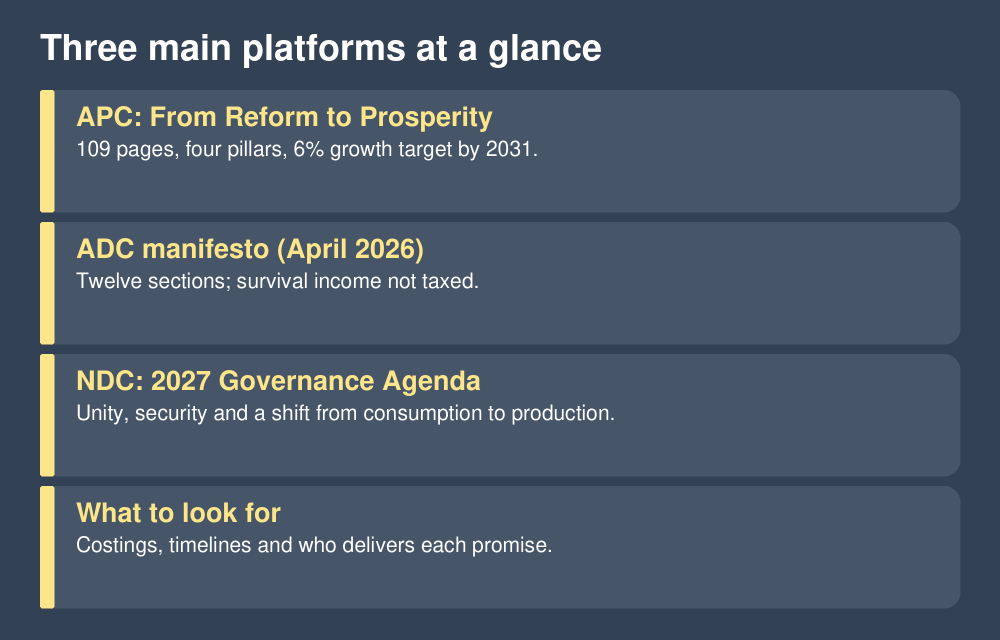
Three differences stand out. First, only the APC document, as reported, comes with a long list of dated numerical targets. Second, the ADC’s written manifesto leans on principles and sequencing rather than costed targets, while Atiku’s fuel statement is the most specific of his written proposals. Third, the NDC agenda, as reported, was presented as themes at a town hall, so look for the full written version. Each camp also attacks the others: the APC says it is delivering reforms, the ADC calls the record one of hardship and insecurity, and the NDC says the country needs unity and production. Those are political claims. Judge them against documents and data.
How to check any manifesto promise
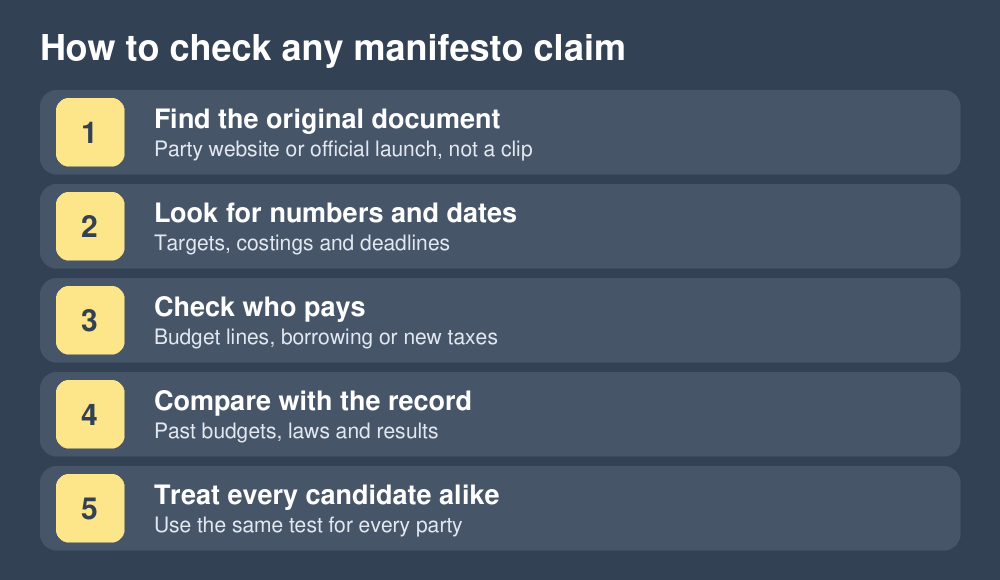
- Find the original. Use the party’s website or official launch rather than a social media clip. Our guides show how to track how votes are checked, counted and uploaded once voting begins.
- Look for numbers, dates and owners. A promise with a target, a deadline and a named office is easier to hold to account than a slogan.
- Ask who pays. Check whether the promise relies on the budget, borrowing, new taxes or savings elsewhere.
- Compare with the record. For incumbents, look at past budgets and delivery. For challengers, look at what they did in previous offices.
- Use the same test for everyone. The test should not change with the party.
If you live abroad
Nigerians in the UK and elsewhere often follow this election closely. At the time of writing, the diaspora voting rules are the subject of a separate guide; see Can Nigerians abroad vote in 2027? for what INEC has said.
Frequently asked questions
Has Atiku published a 2027 manifesto?
His party, the ADC, adopted a manifesto on 14 April 2026, and Atiku has made campaign pledges and issued policy statements, including on fuel. We did not find a separate, fully costed manifesto in his name. Check the ADC’s official channels for the latest version.
Is Atiku definitely on the ballot?
He is on INEC’s published list of 18 candidates, but a 5 November court judgment on the ADC’s leadership has raised questions about the party’s nominations. The ADC has appealed and applied for a stay. INEC has said it will study the judgment and obey any valid order. Check INEC for the latest decision.
Which party is Atiku contesting under?
The African Democratic Congress (ADC), with Rotimi Amaechi as his running mate.
What has Atiku promised on fuel?
He has pledged to restore or reconsider the petroleum subsidy. In a written proposal reported by Leadership, he suggested shifting support to domestic refining with audits, a budget ceiling and a phase-down over time. No pump price target was given.
When is the election?
The presidential and National Assembly elections are scheduled for 16 January 2027, and the governorship and state assembly elections for 6 February 2027, according to INEC’s timetable.
Sources
- Premium Times via AllAfrica: 2027 – Atiku Unveils Rescue Plan, Promises to Reopen Borders, Restore Subsidy (5 November 2026)
- Channels Television: Atiku takes presidential campaign to Kebbi (5 November 2026)
- Daily Post: 2027 – Atiku vows to tackle insecurity, reverse fuel subsidy removal
- The Sun: 2027 – I’ll rebuild the North, Atiku vows
- Leadership: Atiku unveils new plan to cut fuel prices
- Arise News: Atiku outlines economic, security blueprint at ADC screening
- BusinessDay: David Mark leads ADC opposition charge, ratifies new manifesto, constitution (April 2026)
- ThisDay: 2027 – ADC unveils blueprint, ready for power (18 March 2026)
- New Times: ADC and new framework of electoral campaign (15 May 2026)
- Channels Television: Nigeria 2027 Election Watch (11 November 2026)
- The Sun: INEC to converge over Atiku’s ADC ticket
- AllAfrica: 2027 – INEC may decide on ADC next week (12 November 2026)
- Lagos Television: ADC lawyer insists court ruling did not nullify Atiku’s candidacy
- TheCable: INEC clears 18 presidential candidates for 2027 poll (12 September 2026)
- BBC News: Nigeria’s president launches re-election manifesto (12 November 2026)
- Vanguard: 2027 – Security tops as APC-PCC unveils 4-point manifesto (11 November 2026)
- Naija News: Peter Obi unveils 2027 agenda (10 November 2026)






Editor’s note: this page is deliberately neutral. I have used the same test for every candidate: what is in writing, what has only been said at rallies, and what can be checked. If you spot a fact that has changed, tell me in the comments and I will update it. – Ade