Business News Today, 6 November 2026: NGX Loses N3.28trn, MTN and Dangote Cement Profits Soar, CBN Mops Up N3.46trn


Last updated: 6 November 2026 · By Naijatipsland Editorial Team · Editorial policy
Morning roundup · Friday 6 November 2026 · By Ade Adeniyi, Founder and Editor
Good morning. Nigerian stocks had a bad Thursday even as big companies reported strong nine-month profits. The naira held steady, the CBN drained ₦3.46 trillion from the banking system, and the oil regulator’s annual report put a number on crude theft. Here is your money briefing.
Today at a glance
- Naira: about ₦1,348.74/$ at the official window, around ₦1,400 on the street.
- NGX: All-Share Index falls 1.98%; investors lose ₦3.28 trillion in a day.
- Earnings: MTN, Dangote Cement and big banks post large nine-month profits.
- CBN mops up ₦3.46 trillion through OMO and Treasury bill sales.
- NESG: business activity slowed in October; food inflation still near 20%.
- NUPRC: thieves took 3.33 million barrels of crude in 2025.
- Fintech: banks race to store payment data locally before 1 January 2027.
1. Naira steady near ₦1,349; traders see room for gains
What happened
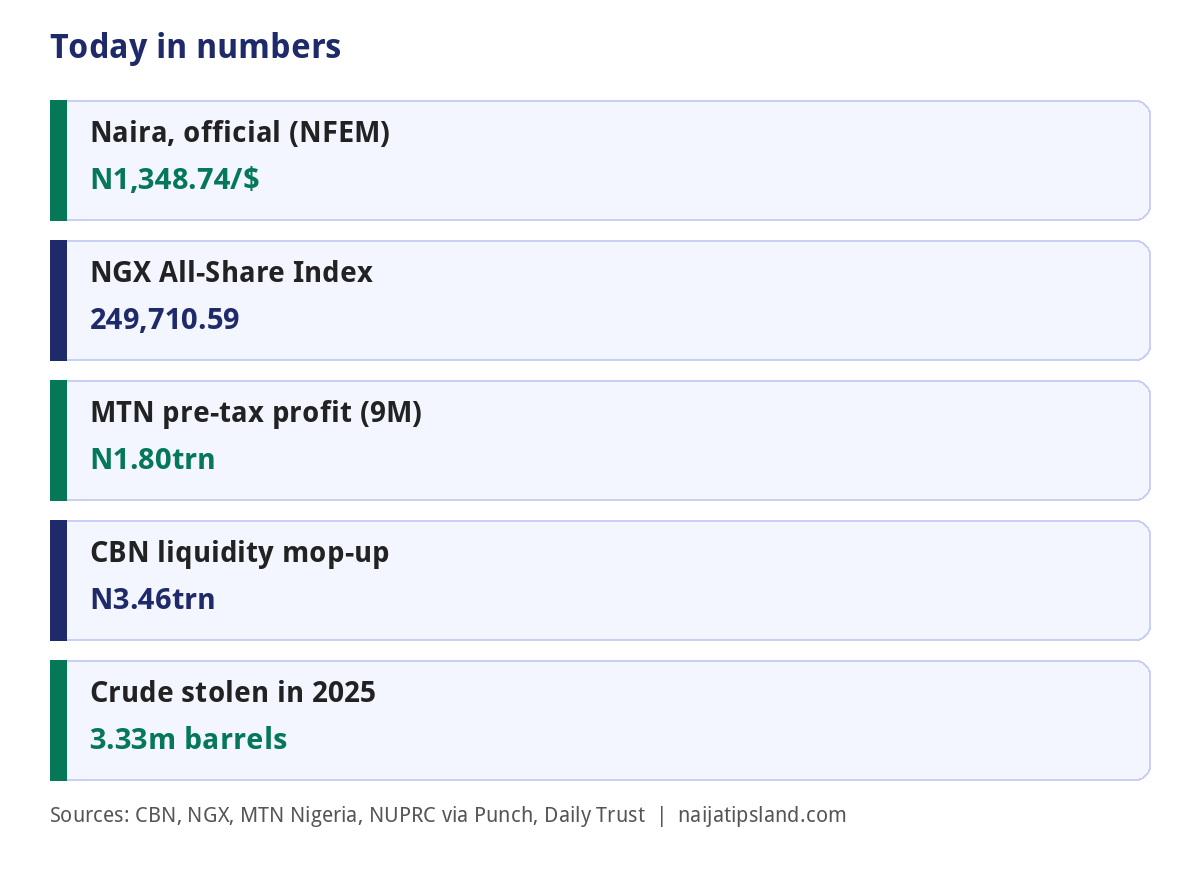
CBN data showed the naira closed Thursday at about ₦1,348.74 per dollar in the Nigerian Foreign Exchange Market (NFEM), slightly weaker than the previous session. Bureau de change dealers quoted about ₦1,390 to ₦1,400. Reuters’ weekly survey of African currency traders said the naira could strengthen next week as global risk appetite improved after the US midterm elections.
Why it matters
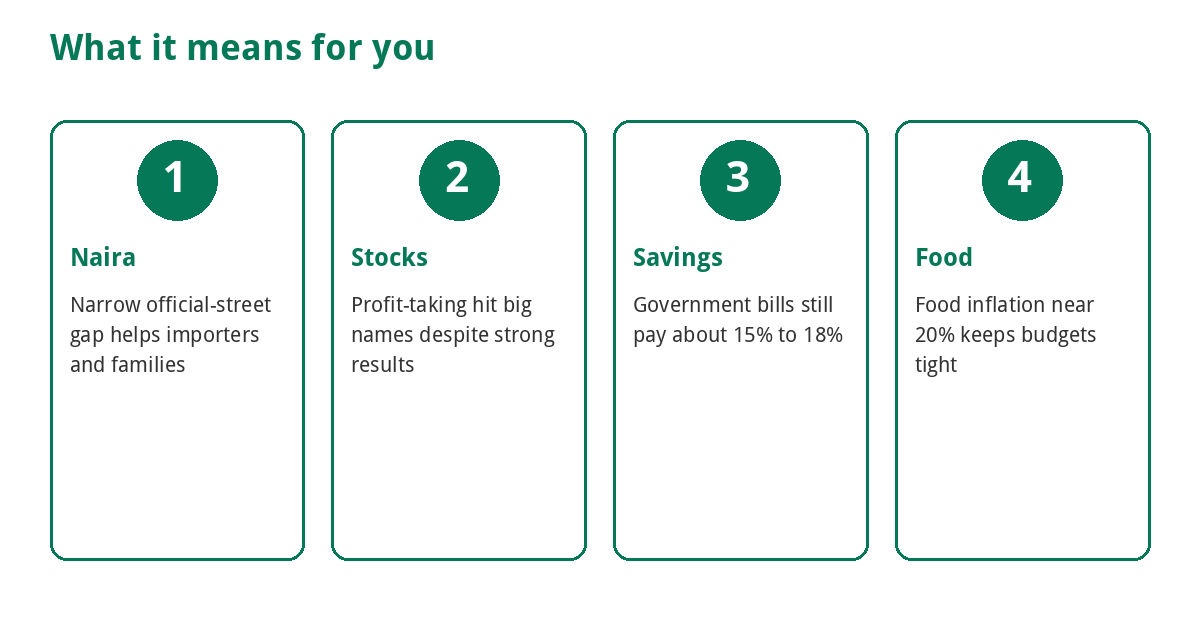
The gap between the official and street rates stays narrow, at around ₦40 to ₦50. That is good news for importers, students paying fees abroad and families receiving money from overseas. Check the latest figures on our dollar to naira rate today page.
Source: Vanguard; Reuters via CNBC Africa.
2. NGX loses ₦3.28 trillion as Dangote Cement slides
What happened
The NGX All-Share Index fell 1.98% on Thursday to 249,710.59 points, ending two days of gains. Market value dropped ₦3.28 trillion to ₦162.13 trillion. Losers outnumbered gainers 36 to 20. The industrial goods index fell 7.14% after Dangote Cement dropped about 10%, while the banking index eased 0.65%. The year-to-date return is now 60.47%.
Why it matters
Reports blamed profit-taking after a strong year. Still, it is a reminder that share prices can fall even when a company reports good results.
Source: Punch; The Guardian; Leadership.
3. Big profits from MTN, Dangote Cement and the banks
What happened
Nine-month results to 30 September showed strong earnings at Nigeria’s largest listed firms. A Daily Trust review of eight companies put their combined pre-tax profit at about ₦6.96 trillion.
Telecoms and cement
MTN Nigeria led with ₦1.80 trillion in pre-tax profit, up 59.4%. Revenue rose 23.6% to ₦4.61 trillion and subscribers rose to 94.7 million. Dangote Cement’s net profit rose 31% to ₦974.8 billion on revenue of about ₦3.8 trillion.
Banks
Zenith Bank’s pre-tax profit was almost flat at ₦928.8 billion, but its after-tax profit fell 11.6% because of a much higher tax bill. GTCO reported ₦879.9 billion before tax.
Why it matters
Data spending and cement prices are pushing these profits up, and households feel both. For shareholders, the results set up the dividend season early next year.
Source: Daily Trust; Billionaires.Africa; MarketForces.
4. CBN drains ₦3.46 trillion from the system
What happened
Across an Open Market Operations (OMO) sale on 3 November and a Treasury bill auction on 4 November, the CBN and the Debt Management Office sold about ₦3.46 trillion against bids of ₦5.57 trillion. Most of it, ₦2.95 trillion, came from the OMO sale, at stop rates of 17.67% to 17.77%. Treasury bill rates were unchanged, with the one-year bill at 15.80%, and the DMO turned away about ₦1.54 trillion of bids.
Why it matters
Taking cash out of banks helps protect the naira and slow inflation, but it keeps borrowing costs high. Savers can still earn around 15% to 18% on government bills. Our personal finance hub explains how to invest.
Source: Punch; Blueprint; bne IntelliNews.
5. Business activity slows; food prices still bite
What happened
The Nigerian Economic Summit Group’s (NESG) Business Confidence Monitor fell to 115.4 points in October from 117.8 in September. Firms blamed high costs, poor electricity, insecurity and limited access to loans. Readings above 100 still mean growth. At a national council meeting in Enugu, Agriculture Minister Abubakar Kyari said food inflation, which fell to 8.89% in January, had climbed back to 19.59% by September. He partly blamed fertiliser and transport costs linked to the Middle East war and pointed to a ₦200 billion Guaranteed Minimum Price Programme for farmers.
Why it matters
Headline inflation is 14.63%, but food prices are rising faster than wages. That squeezes household budgets and keeps pressure on small businesses.
Source: The Guardian; Vanguard.
6. Oil: 3.33 million barrels stolen in 2025; Brent back near $99
What happened
The Nigerian Upstream Petroleum Regulatory Commission’s (NUPRC) 2025 annual report, released Thursday, said 3.33 million barrels of crude were stolen last year, 2.19 million of them in the fourth quarter. Oil and gas revenue collected by the regulator fell 17% to ₦10.42 trillion, while output was 541.08 million barrels of crude and blended condensate. In global markets, Brent crude rebounded about 4% on Thursday to near $99 after new tanker attacks in the Strait of Hormuz.
Why it matters
Every stolen barrel is lost government revenue. Nigeria benefits from high prices only if it can produce and export its full quota, recently around 1.5 million barrels a day.
Source: The Sun; TheStar; BusinessDay.
7. Banks and fintechs face payment-data deadline
What happened
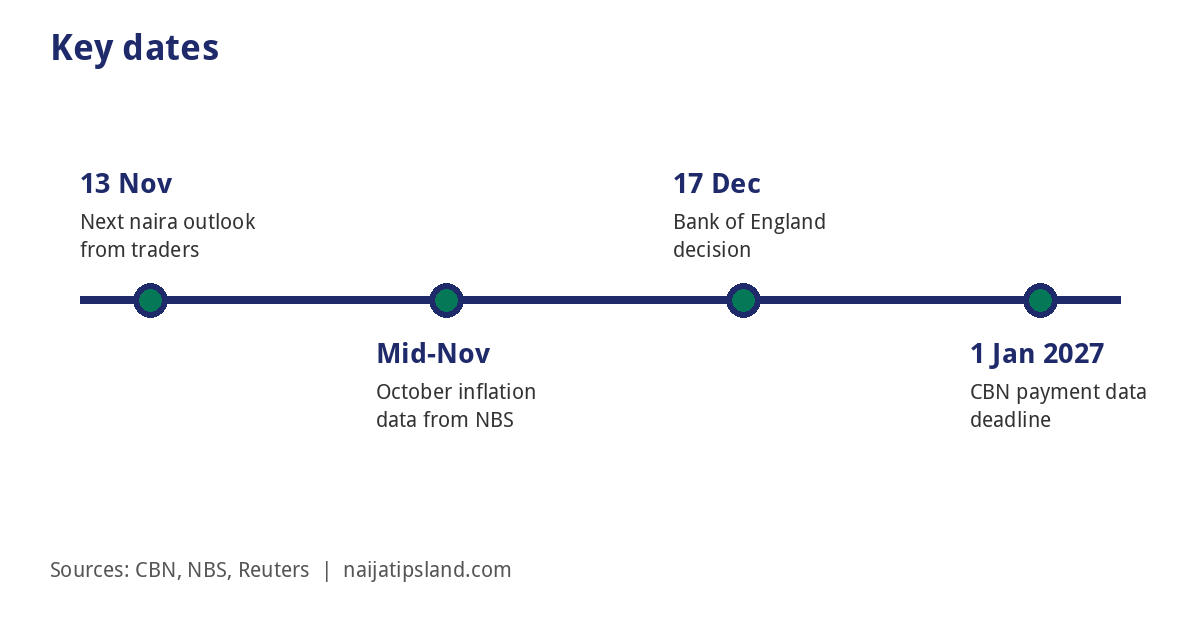
Banks, fintechs and payment firms must store payment transaction data generated in Nigeria on local servers by 1 January 2027, under a CBN directive issued in June. A NITDA and CBN survey found only 59% of institutions were ready. The CBN says the rule is about oversight and resilience. Separately, a House of Representatives bill sponsored by Lanre Okunlola proposes a new payment-data commission. It would fine non-compliant institutions at least ₦1 billion and allow up to 10 years in jail for moving payment data abroad without approval. The bill is at an early stage.
Why it matters
Switching to local data centres costs money and could disrupt services if rushed. Customers of payment apps should watch for notices about system upgrades.
Source: Nairametrics; TheNigeriaLawyer; Nigeria CommunicationsWeek.
What to watch next
- Whether the naira firms next week, as traders expect.
- More nine-month results and any interim dividend announcements on the NGX.
- October inflation figures from the National Bureau of Statistics, due mid-November.
- Oil prices if the US decides on new strikes against Iran.
Frequently asked questions
What is the official dollar to naira rate today?
The NFEM rate closed at about ₦1,348.74 per dollar on Thursday, 5 November. Street rates were about ₦1,390 to ₦1,400.
Why did Nigerian stocks fall when company profits are strong?
Investors sold to lock in gains after a year in which the index rose more than 60%. Large stocks like Dangote Cement pulled the index down.
What are Treasury bills paying now?
At this week’s auction the one-year bill cleared at 15.80%. OMO bills, open mainly to banks and institutions, cleared near 17.7%.
This roundup summarises reporting by the outlets credited under each story, in our own words. Follow Naijatipsland Updates on WhatsApp for the next edition. Spotted an error? Tell us and we will correct it under our editorial policy.