
How to Create Faceless YouTube Videos With AI in Nigeria (2026): Niches, Tools, Monetisation Rules

Last updated: 3 November 2026 · By Naijatipsland Editorial Team · Editorial policy
Checked 3 November 2026. A faceless YouTube channel is one where you never appear on camera: the video is built from narration, screen recordings, stock or AI visuals, animation and text. For Nigerians who are camera-shy, work a day job or want a global audience, it is an attractive model, and AI tools now make each step faster. But YouTube has tightened its rules on low-effort, mass-produced videos, and it is doubling the watch-hour requirement for new applicants from February 2027. This guide walks through the full workflow, the 2026 monetisation rules from YouTube’s own help pages, how Nigerians get paid through AdSense, realistic earnings, the niches that work, and the scams to avoid.
New to YouTube? Start with our guide on how to start a YouTube channel in Nigeria and get monetised, then come back here for the faceless, AI-assisted version.
Is faceless AI content allowed on YouTube?
Yes. Using AI voices, AI images or stock footage does not by itself make a video ineligible for money. What YouTube does not pay for is inauthentic content. On 15 July 2025 YouTube renamed its “repetitious content” policy to “inauthentic content” to make clear it covers mass-produced and repetitive videos. Its examples include channels that upload narrative stories with only superficial differences between them, and slideshows that all have the same narration. YouTube’s creator liaison said at the time that the update was about spam, and that the platform welcomes creators using AI tools to enhance storytelling.
Two other rules matter:
- Reused content: clips, compilations or other people’s videos without significant original commentary or editing are not monetisable.
- AI disclosure: YouTube’s help page says you must tick the “altered or synthetic content” box when content looks realistic and was made or changed with AI, for example a real person appearing to say something they did not, or a realistic scene that never happened. You do not need to disclose AI help with scripts, titles, thumbnails or captions, or cloning your own voice. Disclosing does not reduce reach or monetisation, but creators who consistently fail to disclose can face penalties, including suspension from the Partner Programme.
In practice: a faceless channel that publishes researched, original explainers with a consistent voice is fine. A channel that pumps out 30 near-identical AI story videos a week is the type YouTube is trying to demonetise.
The step-by-step workflow
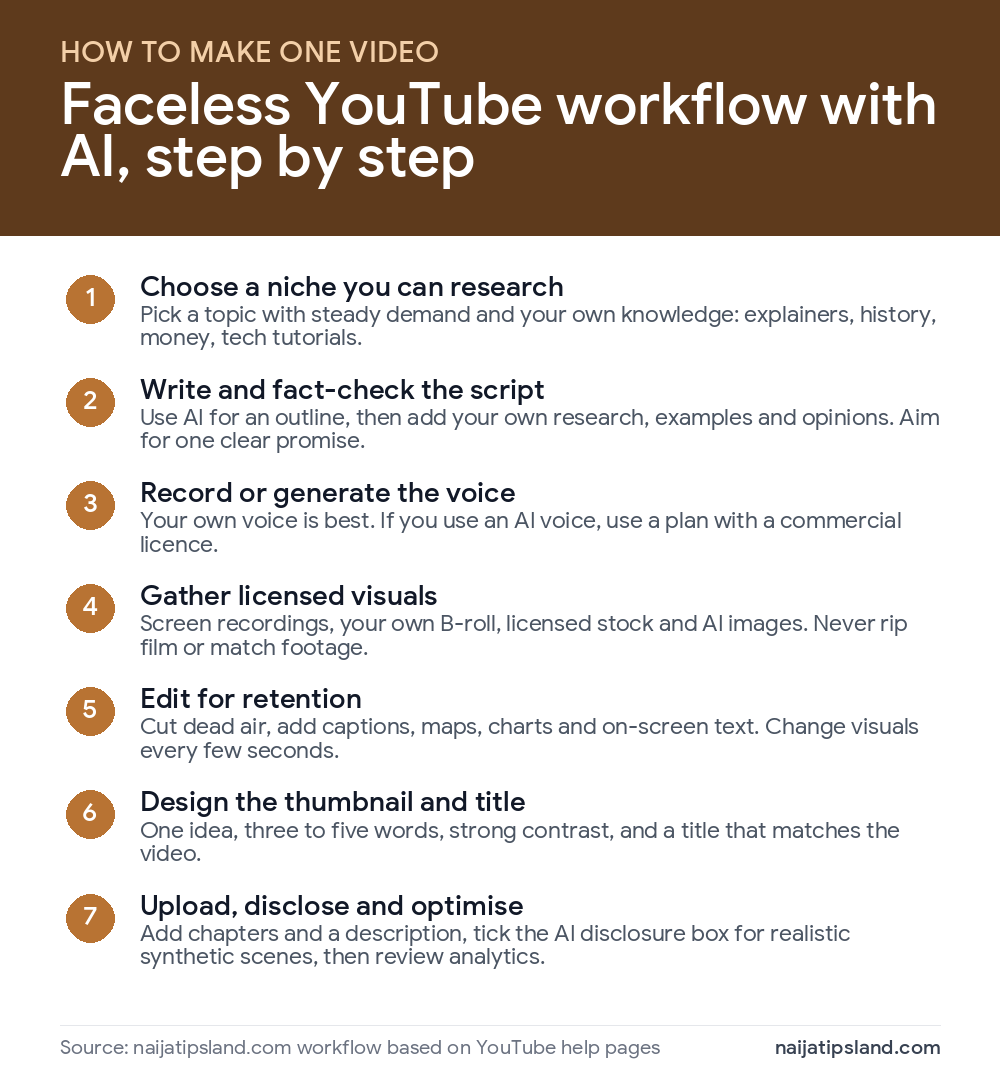
1. Choose a niche
Pick something you can research every week for a year without getting bored, that people actively search for, and where you can add knowledge others lack. Check demand by typing ideas into YouTube search and noting the autocomplete suggestions, and by looking at what smaller channels in the niche get views for.
2. Script
Use ChatGPT, Claude or Gemini to outline, suggest hooks and tighten wording, but do the research yourself and add opinions, examples and Nigerian context that a generic script would not have. A ten-minute video is roughly 1,300 to 1,500 spoken words. Read our guide to the best AI tools for Nigerian content creators for prices of each tool.
3. Voice
Your own voice, recorded on a phone in a quiet room with a cheap lavalier mic, builds trust and is safest for originality. If you use an AI voice, pick a plan with a commercial licence: ElevenLabs’ free plan does not allow commercial use, while its Starter plan ($6 a month) does. Never clone someone else’s voice.
4. Visuals
Mix screen recordings, your own B-roll (hands, streets, products), licensed stock from libraries such as Pexels or Pixabay, simple animation, maps and charts. AI image and video generators help for illustrations; see our list of free AI video generators for Nigerians for limits and watermarks. Do not use Nollywood film clips, music videos or football match footage: copyright claims and strikes will follow.
5. Editing
CapCut and Descript are popular with Nigerian creators. Cut pauses, add captions, change the visual every few seconds and put text on screen for key numbers. Retention (how long people keep watching) matters more than length.
6. Thumbnails and titles
One idea, three to five words, high contrast, and a title that matches what the video delivers. Canva works well. Misleading thumbnails get clicks once and lose the audience after.
7. Upload and SEO
Write a description that explains the video in plain words, add chapters, pick relevant tags, set the AI disclosure where needed, and add an end screen to your next video. Upload big files on Wi-Fi or a night bundle to save data.
YouTube Partner Programme thresholds in 2026 and 2027
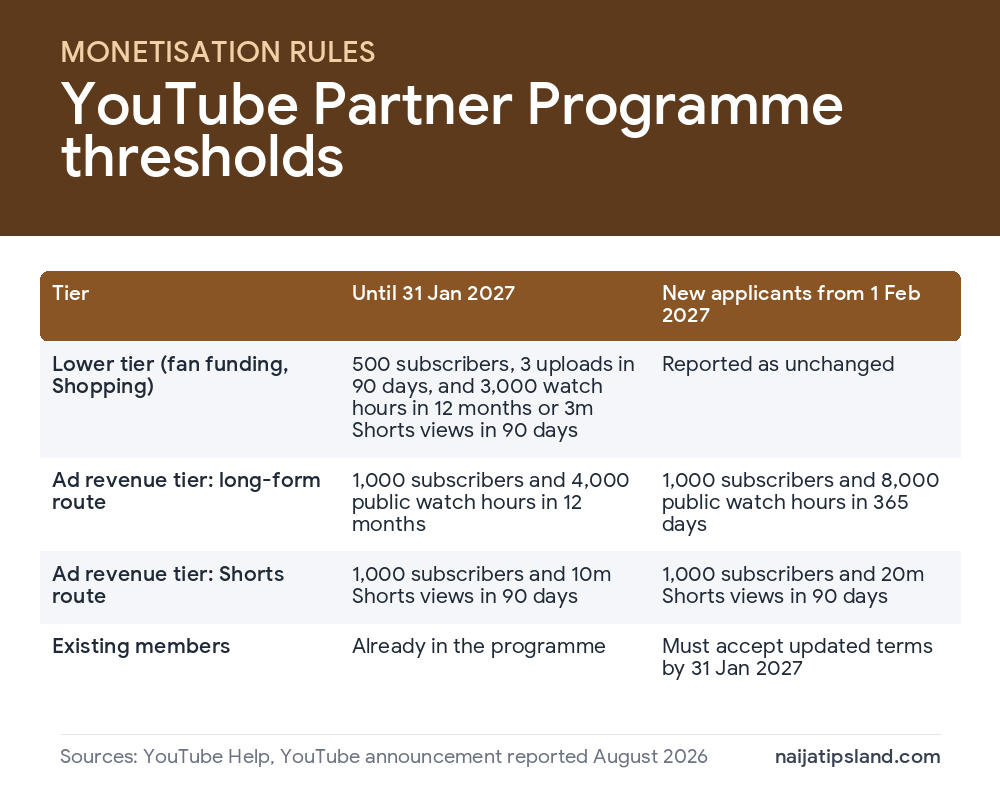
Nigeria is on YouTube’s list of countries where the expanded Partner Programme is available. According to YouTube’s help page, there are two levels:
- Lower tier (fan funding such as Super Thanks and memberships, plus Shopping): 500 subscribers and three valid public uploads in the last 90 days, plus either 3,000 public watch hours in 12 months or 3 million Shorts views in 90 days.
- Ad revenue tier: 1,000 subscribers plus either 4,000 public watch hours in 12 months or 10 million Shorts views in 90 days.
YouTube announced in August 2026 that, for new applicants from 1 February 2027, the ad revenue tier will need 8,000 public watch hours in the previous 365 days, or 20 million Shorts views in 90 days. The 1,000-subscriber requirement stays. Existing members are not affected by the new entry bar but must accept updated terms in YouTube Studio by 31 January 2027, and channels will need 10 million Shorts views in a rolling 90 days to keep earning Shorts ad revenue. If your faceless channel is close to 4,000 hours, it is worth pushing to qualify before February.
How Nigerians get paid
YouTube pays through Google AdSense, in US dollars, once your balance reaches $100. Payments are usually sent between the 21st and 26th of the month after the earnings were finalised. The steps:
- Link an AdSense account to your channel in YouTube Studio when you join the Partner Programme.
- Submit US tax information (most Nigerian individuals complete form W-8BEN) so the correct withholding applies to earnings from US viewers.
- Verify your identity and address. AdSense may post a PIN letter to your address once you reach the verification threshold, so make sure the address is exact.
- Add a payment method: a wire transfer to a Nigerian bank account (a domiciliary dollar account is best) or a USD receiving account with US routing details. Your name must match your ID and bank account.
Our guides to opening a dollar account online and receiving international payments as a Nigerian explain the options and fees.
Realistic earnings and RPM
RPM is what you earn per 1,000 views after YouTube’s share. It depends on where viewers live, the topic and the time of year. For audiences in Nigeria, ad rates are low. Analytics company Dynamoi reports an average creator RPM of about $0.15 for Nigeria on channels connected to its service (October 2025 to October 2026), against a $1.12 average across all the markets it tracks. Travel creator Tayo Aina has said he earned about $132 for a video with more than 1.1 million views in 2020, as reported by TechCabal.
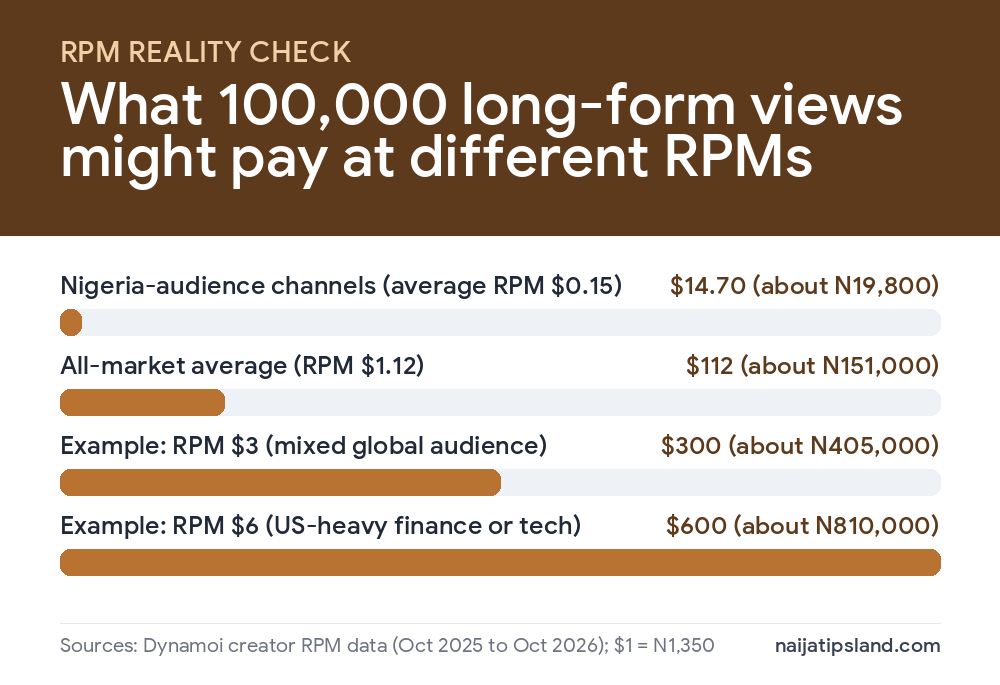
That is why many Nigerian faceless channels target viewers in the US, UK, Canada and other higher-paying markets, in English, on topics like personal finance, technology, history and education. The $3 and $6 examples in the chart are illustrations, not promises: RPMs vary widely by niche and season. Shorts pay much less per view than long videos. Expect months of zero income before you qualify, and treat ad revenue as one stream alongside affiliate links, sponsorships and your own digital products.
Faceless niches that work (and those to avoid)
| Niche | Why it works | Main risk |
|---|---|---|
| Explainers and education | Evergreen searches, good RPM abroad | Needs real research |
| African and Nigerian history | Under-served, global diaspora audience | Accuracy; avoid copyrighted archive footage |
| Personal finance and business | High advertiser demand | Never give reckless investment advice |
| Software tutorials (screen recording) | Easy to make faceless, high intent | Tools change; update videos |
| Football tactics and analysis | Huge fan base | Match footage is copyrighted; use graphics |
| Movie and Nollywood recaps | Popular | High copyright and reused-content risk |
| AI story and “facts” channels | Cheap to make | Most likely to be judged inauthentic |
What you need to start (and what it costs)
A faceless channel can start on a phone, but a laptop makes editing and research much easier. A sensible starting kit:
- Device: a laptop or a recent Android phone with enough storage for raw files.
- Microphone: a basic lavalier or USB mic. Clean audio matters more than video quality on a narration channel.
- Software: a free editor (CapCut or Descript’s free plan), Canva for thumbnails and a free chat assistant for outlines. Upgrade only when a tool clearly saves you time.
- Data and power: budget for a large monthly data bundle or home Wi-Fi, and a power bank or inverter so a power cut does not wipe an unsaved edit.
- Time: plan for six to ten hours per researched ten-minute video at first. It gets faster with templates and practice.
A realistic plan is one strong long video and two or three Shorts a week for at least six months. Consistency and quality beat volume.
Mistakes and scams to avoid
- Buying “monetised channels”. Sellers on WhatsApp, Telegram and Instagram offer ready-made monetised channels. Risks include the seller recovering the account with the original email, hidden copyright strikes, and demonetisation when the content changes. Many are outright scams.
- Watch-hour and subscriber sellers. Fake views and bought watch time break YouTube’s rules and can get a channel removed. They also wreck your analytics.
- “Automation” courses promising passive income. Be wary of anyone selling a course with screenshots of earnings and no verifiable channel. Ask which channel they run.
- Copying a viral channel’s format exactly. Templated, near-identical uploads are what the inauthentic content policy targets.
- Using free AI plans commercially. Check every tool’s licence before monetising.
- Reusing TikTok sounds and clips. Music cleared on one platform is not automatically cleared on YouTube.
If you also post short versions, our guide to making money on TikTok in Nigeria explains what pays there.
Frequently asked questions
Can a faceless YouTube channel be monetised in Nigeria?
Yes. Nigeria is eligible for the YouTube Partner Programme, and faceless channels can join if they meet the thresholds and follow the monetisation policies, including the rules on inauthentic and reused content.
Does YouTube demonetise AI voices?
No, not by themselves. YouTube says channels using AI remain eligible. It demonetises mass-produced or repetitive content, whatever tools made it.
How many watch hours do I need?
For ad revenue: 1,000 subscribers and 4,000 public watch hours in 12 months (or 10 million Shorts views in 90 days). New applicants from 1 February 2027 will need 8,000 hours or 20 million Shorts views.
How much do Nigerian YouTubers earn per 1,000 views?
It varies, but Nigerian-audience RPMs are low, around $0.15 on average in Dynamoi’s 2025-2026 data. Channels with mainly US or UK viewers usually earn several times more.
How do I receive YouTube money in Nigeria?
Through AdSense by wire transfer in dollars once you reach $100, ideally into a domiciliary or USD receiving account in your own name.
Do I need to tell viewers I used AI?
Only for realistic synthetic or altered content, using YouTube’s disclosure setting. AI help with scripts, captions or thumbnails does not need a label.
Disclaimer: this guide is general information based on YouTube’s official help pages, YouTube’s August 2026 announcement as reported by several outlets, and data from Dynamoi, TechCabal and payment providers, checked on 3 November 2026. YouTube can change its policies at any time, and earnings vary widely. Nothing here guarantees income or is financial advice.






Editor’s note: if your channel is close to 4,000 watch hours, push to qualify before 1 February 2027, when new applicants will need 8,000 hours. And set up your AdSense payment details in your own name before you hit the $100 payout threshold.