


TL;DR:
- Tracking social change ensures activists measure progress, build credibility, and avoid repeating ineffective strategies.
- Using support and support indicators, organizations can track both behavioral influence and public sentiment effectively.
- Regular reflection and combining data with community stories strengthen understanding and demonstrate genuine systemic change.
Tracking social change is the systematic process of measuring societal shifts to evaluate progress, inform decisions, and amplify impact. Activists and community builders who skip this step often repeat failed strategies, misallocate resources, and lose credibility with funders and communities alike. The field of social change measurement, sometimes called advocacy evaluation or impact tracking, gives you a structured way to understand what is working, what is not, and why. This guide covers the core benefits, key indicators, common pitfalls, and practical steps you need to start measuring your impact today.
Why track social change: the core case for measurement
Tracking social change produces real, measurable gains. A meta-analysis of 138 studies with nearly 20,000 participants found that self-monitoring improves goal adherence by 20–40% across domains including financial behavior, health, and community organizing. That finding means activists who document their progress consistently outperform those who rely on gut feeling alone.
Structured tracking also reduces wasted effort. Formal documentation cuts rework rates from 18% down to 7%, freeing up operational capacity without adding staff or budget. For grassroots movements operating on tight resources, that difference is significant.
Beyond efficiency, tracking builds trust. Funders, partner organizations, and community members all want evidence that their investment of time and money is producing results. Without documented data, you risk “impact washing,” which is the practice of claiming broad social wins without any evidence to back them up. Measurement counters that problem directly.
- Improved strategy: Data reveals which tactics move the needle and which drain energy without results.
- Accountability: Documented progress holds your organization and its partners to stated commitments.
- Resource allocation: Evidence of what works guides smarter spending and volunteer deployment.
- Credibility: Verified impact reports strengthen grant applications and community trust.
Pro Tip: Start with one clear goal and one measurable indicator before building a full tracking system. Complexity kills momentum at the beginning.
Which indicators and methods measure social change effectively?
Social change measurement uses two broad categories of support indicators: active and passive. Active support indicators include protest attendance, organizational membership growth, petition signatures, and digital engagement such as shares, comments, and campaign reach. Passive support indicators cover public opinion polls, media coverage volume and tone, and voting trends. Together, these two categories document how a movement influences both behavior and public sentiment.

Beyond support indicators, you need to distinguish between output data, outcome data, and persistence metrics.
| Indicator type | What it measures | Example |
|---|---|---|
| Output | Activities completed | Number of workshops held, posts published |
| Outcome | Changes in knowledge, attitude, or behavior | Survey showing attitude shift after campaign |
| Persistence | Whether change holds over time | Policy still in place 12 months after advocacy |
Many organizations focus too heavily on outputs without verifying whether the changes they produced actually lasted. Persistence metrics are what separate surface-level wins from genuine systemic change. If a policy you fought for gets reversed six months later, your output data looked good but your outcome was incomplete.
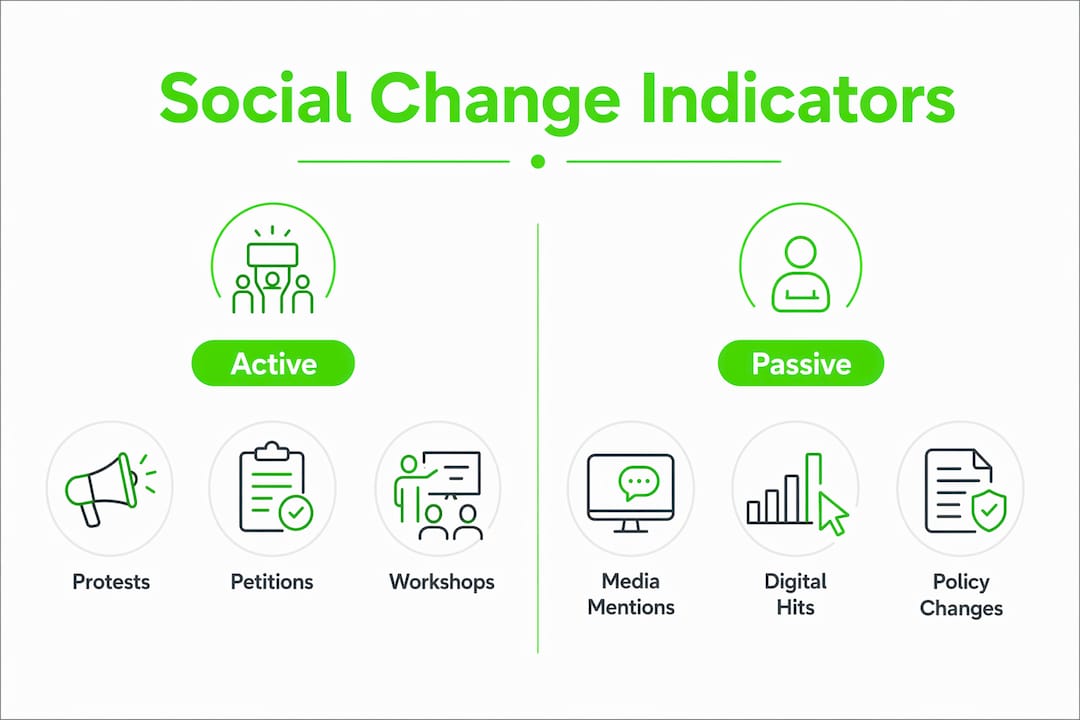
Tracking digital engagement data alongside on-the-ground indicators gives you a fuller picture. Online petition growth, hashtag reach, and community forum activity all serve as real-time signals of momentum.
Pro Tip: Build a simple change log. Document what changed, when it changed, why it changed, and what effect it had. This turns invisible work into evidence you can use in reports and funding applications.
What challenges and misconceptions exist when tracking social change?
The biggest misconception in advocacy evaluation is the idea of sole attribution. Activists rarely cause social change alone. Movements succeed because of overlapping efforts, historical timing, media attention, and community readiness. Contribution over attribution is the accepted best practice. Your job is to show how your work added value to a broader process, not to prove you were the single cause of a policy shift.
Long timeframes create another challenge. Social change rarely follows a straight line. Progress can stall for years, then accelerate suddenly. Tracking systems built for short project cycles often miss this reality. You need indicators that capture slow, nonlinear movement rather than just quarterly milestones.
Measurement bias is a third problem. Dominant measurement systems have historically made certain communities and forms of labor invisible. Standard metrics often favor quantitative data that is easy to count but miss qualitative realities like community grief, cultural shifts, or informal care networks. Decolonizing measurement means centering the community’s own definitions of progress and evidence.
“Every system of measurement reflects a philosophy of life and political power. Improving tracking requires asking whose stories and suffering are made visible, and whose are erased.”
Common pitfalls to avoid:
- Counting activities instead of measuring actual change in people’s lives
- Using metrics designed for corporate settings without adapting them to community contexts
- Ignoring negative or unintended consequences of your work
- Treating evaluation as a one-time report rather than an ongoing practice
Evaluation is not separate from social change but a learning mindset that requires humility and reflection. Activists who treat measurement as a tool for learning, rather than a performance for funders, produce better outcomes and avoid replicating harm.
How can individuals and activists apply social change tracking in practice?
Starting a tracking practice does not require expensive software or a research team. You need clear goals, a few well-chosen indicators, and a consistent habit of recording what you observe. The following steps give you a practical framework.
Define your change goal. Write one sentence describing the specific change you want to see. “Reduce police violence in our neighborhood” is too broad. “Increase civilian oversight board attendance by 30% within six months” is trackable.
Choose two to three indicators. Select at least one active support indicator (petition signatures, meeting attendance) and one outcome indicator (attitude survey results, policy language changes). Avoid tracking more than five indicators at the start.
Set a baseline. Record current conditions before your campaign begins. Without a baseline, you cannot prove that anything changed.
Collect data consistently. Use journals, Google Forms surveys, social media analytics, or community interviews. The tool matters less than the consistency. Digital communities in Nigeria have used WhatsApp group growth and Twitter engagement rates as low-cost proxies for movement momentum.
Review and adjust every 30 days. Set a monthly review date. Ask what the data shows, what surprised you, and what you will do differently. This reflection step is where most of the learning happens.
Share your findings. Publish brief updates to your community, funders, or social media audience. Transparency builds credibility and invites feedback that improves your next cycle.
Pro Tip: Combine quantitative data with short community narratives. A number tells you what happened. A story tells you why it mattered. Both together make your case far stronger.
Analyzing trending hashtags related to your cause gives you a free, real-time signal of public attention. Track weekly volume and sentiment to spot when your issue is gaining or losing traction in the broader conversation.
Social change is complex and layered, simultaneously eroding some social bonds while creating new forms of interdependence. Your tracking system needs to capture both the gains and the disruptions your work produces.
Key Takeaways
Tracking social change is the foundation of effective activism because it turns intention into evidence, guides resource decisions, and builds the credibility needed to sustain long-term impact.
| Point | Details |
|---|---|
| Tracking improves adherence | Self-monitoring boosts goal adherence by 20–40%, giving activists a measurable performance edge. |
| Use three indicator types | Combine output, outcome, and persistence metrics to prove systemic rather than surface-level change. |
| Contribution beats attribution | Focus on how your work contributed to broader change, not on claiming sole credit. |
| Decolonize your metrics | Center community definitions of progress to avoid measurement bias and invisible labor. |
| Reflect monthly | Regular review cycles turn raw data into strategic decisions that improve your next campaign. |
Measurement as power: Naijatipsland’s perspective
Measurement is not a neutral act. Every indicator you choose reflects a judgment about what counts as progress and whose experience matters. That is a political decision, whether you make it consciously or not.
What I have seen, watching Nigerian activists and community organizers work across digital and physical spaces, is that the groups who track their work with intention are the ones who survive funding cuts, leadership changes, and public setbacks. They have receipts. They know what worked and can explain why. The groups that skip measurement often find themselves starting over after every campaign cycle, unable to build on what came before.
The harder truth is that standard metrics often erase the most important work. Informal community care, cultural shifts, and the slow rebuilding of trust after harm do not show up in spreadsheets. That is why I believe tracking must always combine numbers with community narratives. Numbers without stories are incomplete. Stories without numbers are easy to dismiss.
Evaluation, done right, is a form of resistance. It says: this work happened, these people showed up, and this is what changed. That record matters, especially when powerful institutions prefer to pretend that grassroots efforts have no effect.
— Naijatipsland
Naijatipsland resources for social change tracking
Naijatipsland covers the tools, trends, and community dynamics that activists need to track social change effectively in Nigeria and across Africa.

If you are building a movement or monitoring community progress, the Naijatipsland platform offers guides on digital community identity and how online spaces shape social trends. You will also find practical guidance on respectful political discussion online, which is a skill every activist needs when engaging across difference. Developers and community builders looking to create engagement tracking tools can start with the user registration workflow guide to build the technical foundation for community platforms. Register on Naijatipsland to access the full library of social insight resources for 2026.
FAQ
Why is tracking social change important for activists?
Tracking social change gives activists evidence of what works, supports accountability, and improves resource allocation. Without measurement, campaigns repeat failed strategies and lose credibility with funders and communities.
What is the difference between output and outcome in social change measurement?
Outputs are activities completed, such as workshops held or posts published. Outcomes measure actual changes in behavior, attitudes, or policy, and persistence metrics confirm whether those changes hold over time.
How do you measure social change at the community level?
Community-level measurement tracks active support indicators like protest attendance and digital engagement, alongside passive indicators like public opinion polls and media coverage trends.
What does “contribution over attribution” mean in advocacy evaluation?
Contribution over attribution means showing how your work added value to a broader change process rather than claiming you were the sole cause of a social outcome. This approach is accepted best practice in advocacy evaluation.
How can individuals start tracking social change with limited resources?
Start with one clear goal, two to three indicators, and a simple journal or free survey tool. Consistent monthly reviews and sharing findings publicly build a credible record without requiring large budgets or technical expertise.