


TL;DR:
- Online petitions are tools that build public support and pressure decision-makers over time. They are most effective when part of a broader campaign that includes offline actions and media engagement. Treating petitions as the entire strategy often leads to limited tangible impact.
Online petitions are defined as digital tools that collect public signatures to signal widespread support for a cause and pressure decision-makers to act. The role of online petitions in advocacy has grown significantly, with 50% of American adults having signed one, and 22% doing so in the past year alone. That level of participation shows how normalized petition signing has become as a form of civic expression. For Nigerian activists, understanding what petitions can and cannot do is the difference between using them well and relying on them too heavily.
What is the role of online petitions in driving social change?
Online petitions work by creating visible, documented evidence of public concern. When thousands of people sign a petition, that number becomes a headline. It signals to journalists, lawmakers, and institutions that a significant portion of the public cares about an issue.

Petitions serve as agenda-setting tools in democratic discourse, shaping media coverage and influencing long-term public opinion rather than triggering immediate policy shifts. That distinction matters. A petition rarely forces a government to act overnight. What it does is keep an issue visible, build a record of dissent, and create pressure over time.
The mechanisms through which petitions influence change include:
- Visibility: A petition with thousands of signatures attracts media attention, which amplifies the issue beyond the original audience.
- Narrative power: Petitions frame issues in specific language, shaping how the public and press talk about a problem.
- Symbolic documentation: A signed petition creates a formal record of public opposition or support that officials cannot easily dismiss.
- Momentum building: Petitions give supporters a concrete, low-barrier action that draws them into a broader campaign.
- Decision-maker pressure: When petitions target specific reachable decision-makers, they create direct accountability.
Understanding how algorithms shape what content reaches the public is also relevant here. Platforms like Twitter and Facebook determine which petitions gain visibility, meaning the reach of your petition depends partly on how well it performs in algorithmic feeds. How algorithms shape public perception directly affects whether a petition goes viral or disappears.
Pro Tip: Frame your petition around a single, specific demand rather than a broad grievance. “Reinstate the suspended nurses at Lagos University Teaching Hospital” will outperform “Fix the healthcare system” every time.
What limits the effectiveness of online petitions?
The honest answer is that most petitions do not achieve their stated goals. Advocacy petitions on major platforms have roughly a 1% chance of achieving direct policy outcomes. That figure is not a reason to abandon petitions. It is a reason to use them correctly.
The scaling problem is equally stark. Nearly 90% of petitions are started by individuals, and over 50% of all petitions fail to collect more than 100 signatures. A petition with fewer than 100 signatures carries almost no public weight. It signals a lack of organized support rather than a groundswell of public opinion.
| Challenge | What it means for Nigerian activists |
|---|---|
| Low direct success rate (~1%) | Petitions rarely change policy alone; pair them with other tactics |
| Scaling failure (50% under 100 signatures) | Launch with a committed core group, not just a public post |
| No legal weight for online signatures | Physical signatures are still required for formal government processes in many jurisdictions |
| Slacktivism risk | Signing a petition can feel like enough, reducing deeper engagement |
| Early momentum dependency | Petitions that do not gain traction in the first hours rarely recover |
The legal limitation is particularly relevant in Nigeria. Online petition signatures generally lack formal legal effect in governmental processes. Physical, in-person signatures remain the standard for binding ballot initiatives and formal submissions. Nigerian activists must understand this distinction before treating an online petition as a legal instrument.
Overreliance on digital actions also carries a behavioral risk. Overcommitment to online-only actions can actually decrease active political participation, including voting intention. Signing a petition can create a false sense of having done enough. That psychological effect, sometimes called slacktivism, is one of the most underappreciated threats to effective advocacy.
How can Nigerian activists maximize the impact of online petitions?
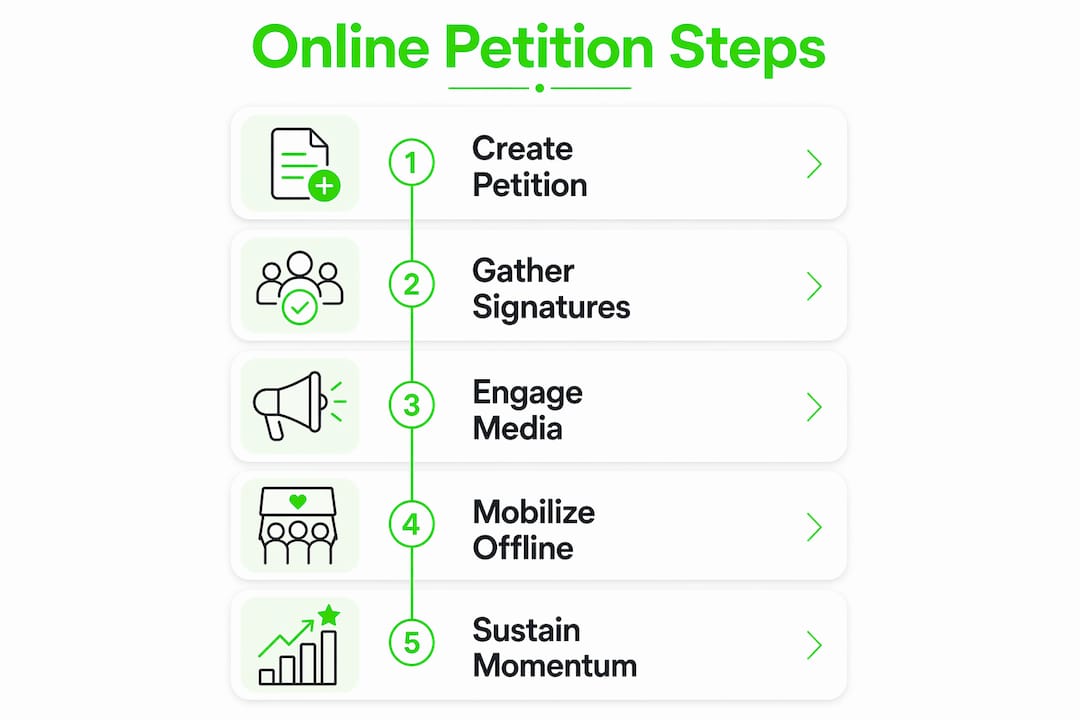
Effective petition campaigns follow a clear structure. The goal is not just signatures. The goal is to build a movement that outlasts the petition itself.
Target a specific decision-maker. Name the minister, governor, or institution responsible. “We call on the Federal Ministry of Education to…” is far more effective than a vague national appeal. Specific targets create specific accountability.
Launch with your core network first. Early momentum is critical for petition success. The first hours after launch determine whether a petition gains traction. Mobilize your most committed supporters before making the petition public.
Use the petition to build your contact list. Effective activists use petitions as a gateway to collect supporter contact information for follow-up offline organizing. Every signature is a potential volunteer, donor, or rally attendee.
Integrate the petition into a broader campaign. A petition works best as one component of a multi-channel effort that includes press releases, community meetings, social media campaigns, and direct engagement with officials.
Engage media proactively. Send your petition link to journalists covering the relevant beat. A reporter covering education policy in Abuja is far more likely to cover a petition targeting the Federal Ministry of Education than a generic national appeal.
Sustain engagement after the signature milestone. Update signatories on progress. Tell them what happened when you delivered the petition. Keep them invested in the outcome.
Pro Tip: Collect phone numbers and email addresses from signatories, not just names. That contact list is your most valuable asset when you need to mobilize people for a protest, a public hearing, or a letter-writing campaign.
Understanding how to discuss politics online respectfully is also a skill that strengthens petition campaigns. Supporters who can articulate the cause clearly in comment sections and forums extend the petition’s reach organically.
How do online petitions fit into wider digital activism in Nigeria?
Online petitions occupy a specific and limited role within the broader toolkit of digital activism. They are best understood as a starting point, not an endpoint.
The distinction between symbolic and direct action is critical. A petition is a symbolic act. It documents public sentiment and creates social pressure. Direct action, by contrast, includes protests, legal challenges, community organizing, and direct negotiation with decision-makers. Petitions support direct action by building the audience and credibility needed to sustain it.
Nigerian activists who combine petitions with complementary tactics see stronger results. Those tactics include:
- Online discussions and forums: Platforms like Naijatipsland allow activists to build community around an issue, explain its context, and recruit supporters who go beyond a single signature.
- Offline mobilization: Town halls, community meetings, and organized protests translate online support into visible, physical presence that officials cannot ignore.
- Media engagement: Press coverage multiplies the reach of any petition. A story in a major Nigerian newspaper or on a popular news platform reaches audiences who would never see a petition link.
- Coalition building: Partnering with established civil society organizations, student unions, and professional associations gives a petition institutional credibility.
Digital political participation varies widely in its real-world impact. Simple online actions like signing a petition can encourage further civic engagement when they are connected to a larger movement. When they stand alone, they rarely produce lasting change. The multi-channel approach is not optional for serious Nigerian advocates. It is the standard.
Media criticism and public accountability also play a role. Understanding why media criticism has become mainstream helps activists recognize how public narratives form and where petitions can intervene most effectively.
Key Takeaways
Online petitions are most effective when used as one part of a multi-channel advocacy strategy that combines targeted pressure, media engagement, and offline organizing.
| Point | Details |
|---|---|
| Petitions set agendas, not policies | They build public pressure and media visibility rather than directly changing laws. |
| Early momentum is decisive | Launch with your core network first; petitions that stall in the first hours rarely recover. |
| Online signatures lack legal weight | Formal government processes in Nigeria still require physical signatures for binding effect. |
| Petitions build supporter networks | Use signature collection to gather contact details for sustained offline organizing. |
| Multi-channel strategy is required | Combine petitions with protests, media outreach, and coalition building for real impact. |
The honest truth about petitions that most guides skip
Naijatipsland has watched many Nigerian activists pour energy into petition campaigns and walk away frustrated. The frustration almost always comes from the same source: the petition was treated as the campaign rather than as a tool within one.
The most effective petition campaigns I have seen in the Nigerian context share one quality. They used the petition to start a conversation, not to end one. The signatures were proof of public concern. The real work happened afterward, in the follow-up emails, the community meetings, and the direct conversations with officials.
Patience matters more than most activists want to admit. Petitions that shape media agendas do so over months, not days. The Nigerian political environment responds to sustained, visible pressure. A petition that generates 10,000 signatures and then goes silent achieves far less than one with 3,000 signatures backed by three months of consistent follow-up.
The storytelling dimension is also underused. A petition with a compelling personal story attached to it performs better than one that reads like a policy brief. Nigerian activists should lead with the human impact of the issue, not the technical details. That is what moves people to sign, share, and show up.
— Naijatipsland
Naijatipsland resources for Nigerian advocates
Nigerian activists need more than a petition link. They need a community that understands the issues, can amplify their message, and supports sustained engagement over time.
Naijatipsland is built for exactly that purpose. The platform gives Nigerian citizens a space to discuss topical issues that matter, from education and healthcare to governance and youth rights. You can also learn how to start online discussions that attract genuine engagement rather than empty reactions. Whether you are launching your first petition or building a long-term advocacy campaign, Naijatipsland connects you with a community that is already paying attention to Nigerian current affairs and ready to act.
FAQ
What is the role of online petitions in advocacy?
Online petitions document public support for a cause and apply social pressure on decision-makers. They function primarily as agenda-setting tools that influence media coverage and public discourse rather than directly changing policy.
Do online petitions actually work in Nigeria?
Petitions can work when they are part of a broader campaign that includes offline organizing, media engagement, and direct pressure on specific officials. A petition alone, with no follow-up strategy, rarely produces lasting change.
How many signatures does a petition need to be effective?
There is no universal threshold, but petitions that fail to exceed 100 signatures carry little public weight. Over 50% of petitions never reach that number, which is why launching with a committed core group is critical.
Are online petition signatures legally binding in Nigeria?
Online signatures generally do not carry formal legal weight in governmental processes. Physical signatures remain the standard for binding submissions and formal government petitions in most jurisdictions, including Nigeria.
What is the biggest mistake activists make with online petitions?
The biggest mistake is treating the petition as the entire campaign. Effective activists use petitions to collect supporter contact information and build networks for sustained offline organizing, not just to accumulate signatures.