


TL;DR:
- Nigeria’s average content engagement rate is 4.5%, with significant variation across industries and audience sizes. Marketers often focus on vanity metrics like likes and followers, but meaningful insights come from deeper engagement actions like shares and comments. Utilizing correct calculation formulas and tailoring strategies to Nigerian cultural and platform-specific contexts can significantly boost digital performance and ROI.
Nigeria’s content engagement rate averages 4.5%, yet a surprising number of businesses operating in the Nigerian digital space have no clear idea what that number means, let alone how to move it in the right direction. Most marketers track likes and follower counts, treat them as success signals, and stop there. The real story of your audience’s behavior runs much deeper. This guide breaks down engagement metrics from the ground up, explains how to calculate them correctly, and shows you exactly how to apply them to grow your online presence in Nigeria’s fast-moving digital market.
Table of Contents
- What are engagement metrics?
- Core engagement metrics in digital marketing
- How engagement is calculated: Social and analytics formulas
- What great engagement looks like in Nigeria
- Advanced tips: Going beyond the numbers
- Rethinking engagement: What most analytics miss in Nigeria
- Level up your engagement: Next steps with Naijatipsland
- Frequently asked questions
Key Takeaways
| Point | Details |
|---|---|
| Understand engagement metrics | Engagement metrics measure real user interaction quality—like comments, shares, and retention—not just vanity numbers. |
| Use local benchmarks | Nigerian engagement rates and behaviors differ from global norms, so set goals based on your industry context. |
| Calculate accurately | Use the right formulas for each platform to track engagement rate, bounce rate, and conversion effectively. |
| Focus on quality | Prioritize metrics that reflect meaningful actions, like shares or saves, for deeper audience insight. |
| Connect metrics to ROI | Align your engagement tracking with business outcomes to see true digital marketing impact. |
What are engagement metrics?
Engagement metrics are specific, measurable data points that tell you how users are actually interacting with your digital content. They go far beyond surface-level vanity numbers. A post with 10,000 impressions but only 20 comments is telling you something very different from a post with 2,000 impressions and 300 shares.
“Engagement metrics are quantifiable data points measuring user interaction quality and depth with digital content, products, or brands across platforms like websites, apps, and social media.”
This definition matters because it shifts your focus from volume to quality. You are not just counting eyeballs. You are measuring whether people care enough to act.
Here is what engagement metrics typically capture:
- Comments and replies: Active, intentional responses that signal genuine interest
- Shares and reposts: The strongest signal that your content resonates enough for someone to put their name on it
- Saves and bookmarks: A sign that users find your content valuable enough to return to
- Time on page or session duration: How long someone stays with your content before leaving
- Click-through rate (CTR): The percentage of people who saw a link and clicked it
- Scroll depth: How far down a webpage a visitor actually reads
Definitions shift slightly depending on the platform. On a website, engagement might mean pages per session or scroll depth. On an app, it could mean feature usage or daily active users. On social media, it is usually a combination of likes, comments, shares, and saves. Understanding user generated content also plays a role here, since community-driven posts often generate the highest engagement of all.
Core engagement metrics in digital marketing
With a foundation of what engagement metrics are, it is time to explore the ones that matter most for digital marketing success. Common engagement metrics include session duration, retention rate, feature usage, DAU/MAU ratio, pages per session, bounce rate, CTR, social interactions like likes, comments, and shares, and conversion rates.
Here is a breakdown of the most critical ones:
| Metric | What it measures | Why it matters |
|---|---|---|
| Session duration | Average time per visit | Shows content depth and relevance |
| Bounce rate | % of single-page visits | High bounce = poor content match |
| Pages per session | Pages viewed per visit | Indicates content exploration |
| CTR | Clicks divided by impressions | Measures headline and ad effectiveness |
| Retention rate | % of users who return | Signals loyalty and content value |
| DAU/MAU ratio | Daily vs. monthly active users | Measures habit formation |
| Conversion rate | % completing a goal action | Ties engagement directly to results |
| Social shares | Times content is redistributed | Strongest signal of content value |
Two metrics that often confuse marketers are DAU (daily active users) and MAU (monthly active users). The ratio between them tells you how sticky your platform or content is. A DAU/MAU ratio of 50% means half your monthly users come back every single day. That is exceptional. Most platforms aim for 20% or higher. If your ratio is below 10%, your content may be attracting one-time visitors without building a loyal audience.
For social media engagement, the most actionable metrics are shares, saves, and comments. These require more effort from the user than a passive like, which makes them a stronger signal of genuine interest.
Pro Tip: Do not treat bounce rate as a purely negative metric. A high bounce rate on a contact page or a single-article blog post may simply mean users got exactly what they needed and left satisfied. Context always matters.
How engagement is calculated: Social and analytics formulas
Once you know the metrics, the next step is understanding how they are actually measured and compared across channels.
There are three main formulas used for social media engagement rate:
- ER by reach: (Total engagements / Reach) x 100
- ER by impressions: (Total engagements / Impressions) x 100
- ER by followers: (Total engagements / Followers) x 100
According to Hootsuite’s engagement rate guide, each formula serves a different purpose. ER by reach is the most accurate for measuring how well your content performed among people who actually saw it. ER by followers is useful for benchmarking your account’s overall health over time. ER by impressions is best for paid content where the same user may see a post multiple times.
For web analytics, Google Analytics 4 (GA4) uses a different approach. In GA4, engagement rate equals engaged sessions divided by total sessions, multiplied by 100. An engaged session is one that lasts longer than 10 seconds, includes two or more pageviews, or includes a conversion event. This replaces the old bounce rate metric and gives a more accurate picture of meaningful visits.
Here is a comparison of the main formulas:
| Formula | What it tracks | Best use case |
|---|---|---|
| ER by reach | Engagements vs. unique viewers | Organic content performance |
| ER by impressions | Engagements vs. total views | Paid ad campaigns |
| ER by followers | Engagements vs. audience size | Account benchmarking |
| GA4 engagement rate | Engaged sessions vs. all sessions | Website and app traffic |
To calculate your own engagement rate on key platforms, follow these steps:
- Pull your total engagements for a post or time period (sum of likes, comments, shares, saves)
- Choose your denominator: reach, impressions, or followers
- Divide engagements by your chosen denominator
- Multiply the result by 100 to get a percentage
- Compare your result against Nigeria’s average or your industry benchmark
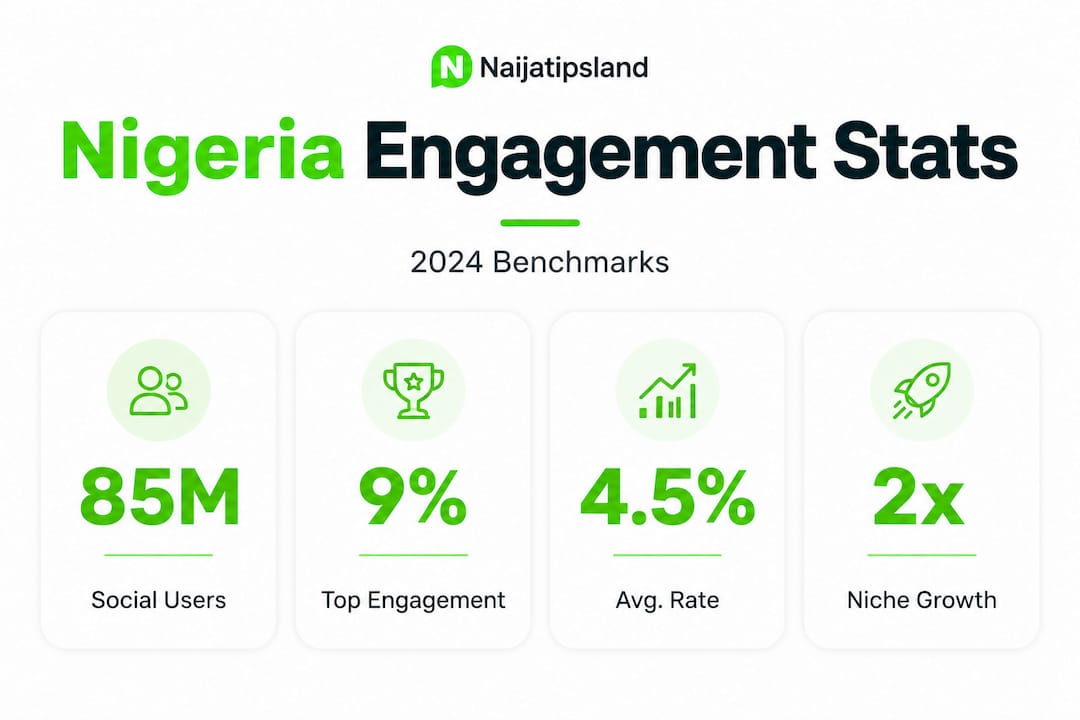
Nigeria has 85 million social media users, and small accounts in niche markets can reach engagement rates above 9%. Tracking trending topics in Nigeria and aligning your content with them is one of the fastest ways to push your engagement rate higher.
What great engagement looks like in Nigeria
Having learned how to calculate engagement, let us see what these numbers mean for marketers and business owners in Nigeria specifically.

Nigeria’s content engagement averages 4.5%, but that number hides enormous variation. Video content drives over 1.2 billion views per month across Nigerian platforms. Content marketing ROI in Nigeria has reached 320% when engagement is tracked and optimized correctly. And engagement rates vary by as much as 10 times across different industries.
What counts as “good” engagement in Nigeria depends on several factors:
- Follower count: Smaller accounts (under 10,000 followers) typically see higher engagement rates, sometimes 7 to 9%, because their audiences are more targeted and personal
- Platform: TikTok and Instagram tend to produce higher engagement rates for consumer brands; LinkedIn performs better for B2B and professional services
- Content format: Short-form video consistently outperforms static images and text posts across Nigerian platforms
- Industry: Entertainment, food, and fashion brands see the highest rates; financial services and logistics tend to see lower rates
“In Nigeria, engagement varies 10x by industry, and small follower accounts can hit 9%+ ER, making local benchmarks far more useful than global averages.”
One of the most common pitfalls is chasing impressions without watching engagement. High impressions with low engagement usually means your content is being distributed but not connecting. Your targeting may be off, or your message is not relevant to the audience seeing it.
Pro Tip: Weight your metrics by action depth. Shares and saves carry more meaning than likes. If you are reviewing a campaign, count a share as 3x the value of a like and a save as 2x. This gives you a more realistic picture of content impact.
Influencers in Nigerian culture often achieve disproportionately high engagement because they speak directly to tight-knit communities. Partnering with micro-influencers (10,000 to 100,000 followers) in your niche often delivers better engagement ROI than working with mega-influencers who have massive but passive audiences.
When you align your content with what your audience is already talking about, engagement with trending topics can spike dramatically. Nigerian audiences respond strongly to content that feels timely, local, and culturally relevant.
Advanced tips: Going beyond the numbers
Once you can recognize healthy engagement benchmarks for Nigeria, it is vital to dig deeper for even sharper insights and stronger results.
One of the clearest warning signs in any analytics dashboard is high impressions with low engagement. This pattern indicates poor content relevance. Your content is reaching people, but it is not landing. The fix is usually a combination of better audience targeting and more specific, relevant messaging.
Here are practical ways to go beyond basic metric tracking:
- Build a weighted scoring system: Assign point values to different engagement actions. Shares = 5 points, saves = 4 points, comments = 3 points, likes = 1 point. Total these scores per post to rank your content by real impact, not just raw numbers.
- Segment your audience: Break down your analytics by demographics, device type, or content category. Nigerian mobile users behave differently from desktop users, and this segmentation reveals which content formats work best for each group.
- Track return on engagement (ROE): Divide the revenue or leads generated by a campaign by the total engagement it received. This ties your engagement data directly to business outcomes.
- Calculate cost per engagement (CPE): For paid campaigns, divide total spend by total engagements. This tells you how efficiently your budget is generating audience interaction.
- Automate your reporting: Tools like Hootsuite, Brandwatch, and Google Looker Studio can pull data from multiple platforms and generate regular reports automatically, saving you hours each week.
The impact of digital ads in Nigeria is growing fast. Combining paid reach with strong organic engagement strategy gives you the best of both worlds: broad visibility and deep audience connection.
Pro Tip: Set a monthly engagement audit. Review your top five and bottom five performing posts. Look for patterns in format, topic, time of posting, and caption length. These patterns are your roadmap for the next month’s content strategy.
Rethinking engagement: What most analytics miss in Nigeria
With these advanced strategies in mind, it is worth challenging some of the most common misconceptions about what engagement metrics really mean.
Many Nigerian businesses and marketers fall into the same trap: they optimize for the metric that is easiest to see. Likes are visible. Follower counts are public. These numbers feel like progress. But a page with 50,000 followers and a 0.3% engagement rate is actually less valuable than a page with 5,000 followers and a 6% engagement rate. The smaller audience is more responsive, more loyal, and far more likely to convert.
We have seen this play out repeatedly in the Nigerian digital space. A business spends months growing its follower count through giveaways and follow-for-follow tactics. The numbers look impressive. But when they launch a product, the response is flat. The audience was never genuinely interested. It was just there.
The real value of engagement metrics is not in the numbers themselves. It is in what they tell you about the quality of your relationship with your audience. A surge in quality comments, where people are asking questions, sharing opinions, and tagging friends, tells you something a like count never can. It tells you that your content sparked a conversation. That is the kind of signal that predicts real business growth.
Understanding what makes content viral in Nigeria is closely tied to this idea. Viral content in Nigeria almost always starts with a strong emotional or cultural connection. It is not about production quality or budget. It is about relevance. When your content speaks to something your audience genuinely cares about, shares and comments follow naturally.
Nigeria’s digital scene is uniquely dynamic. Global templates and benchmarks often do not apply here. The platforms, the cultural references, the humor, the political context, all of these shape how Nigerian audiences engage. Marketers who adapt their strategy to this specific context consistently outperform those who import strategies wholesale from Western markets.
Level up your engagement: Next steps with Naijatipsland
Informed by a smarter approach to engagement, you are ready to take action with the right tools and strategies.
Naijatipsland.com is built for exactly this kind of practical, community-driven learning. You now have a clear framework for tracking, calculating, and interpreting engagement metrics in the Nigerian context. The next step is putting that knowledge to work.
Start by auditing your current metrics using the formulas and benchmarks covered in this guide. Then explore Naijatipsland’s growing library of resources, from entertainment updates that show you what resonates with Nigerian audiences, to the beginner’s engagement guide that walks you through building real audience interaction from scratch. Whether you are just starting out or looking to sharpen an existing strategy, Naijatipsland gives you the community, the insights, and the tools to grow your digital presence with confidence.
Frequently asked questions
What are the most important engagement metrics for Nigerian marketers?
Core metrics include engagement rate, session duration, retention rate, conversion rate, and social interactions like shares and comments, since these measure both audience depth and content effectiveness.
How do I know if my engagement rate is good in Nigeria?
Nigeria’s average engagement rate is 4.5%, but rates can range from 1% to 9% depending on your industry, audience size, and the type of content you publish.
What tools help automate engagement metric tracking?
Use Hootsuite or Brandwatch for social media tracking and Google Analytics 4 for website and app engagement, as these tools automate reporting and allow platform-by-platform segmentation.
Why does high reach not always mean high engagement?
High impressions with low engagement signal that your content is being seen but not connecting, which usually points to a mismatch between your message and your target audience.
How does engagement rate impact business growth?
A strong engagement rate signals an active, loyal audience, and in Nigeria, content marketing ROI has reached 320% for brands that consistently track and optimize their engagement metrics.