
History of Afrobeats Explained (2026): From Fela Kuti to the Grammys

Last updated 16 November 2026. Music history is told differently depending on who you ask, so where sources disagree on a date or a name, this article says so.
If you grew up in Nigeria, you probably did not sit down one day and decide to listen to something called Afrobeats. It was just what played at weddings, in danfo buses and on Channel O. Somewhere along the way the rest of the world caught up, gave the sound a name with an s on the end, and started putting it on stadium posters. This is how that happened, in order, and why people still argue about the name.
Afrobeat and Afrobeats are two different things
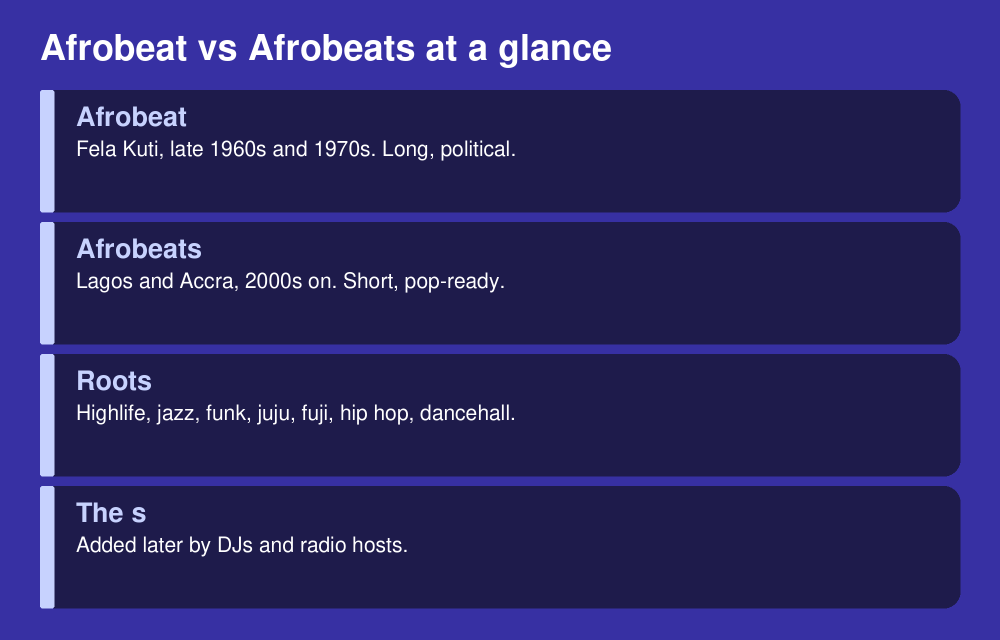
Start here, because it trips up almost everyone. Afrobeat, with no s, is the sound Fela Anikulapo Kuti built in Lagos in the late 1960s and 1970s. He mixed Yoruba music with jazz, funk and highlife, played it in long, driving pieces, and used his lyrics to attack corrupt governments and military rule. Britannica describes it as music with commentary on political and social issues.
Afrobeats, with an s, is the younger pop cousin. Britannica says it emerged in Nigeria and Ghana in the early 2000s, with a modern commercial sound and lyrics about love, identity, success and partying. The BBC describes it as a fusion of traditional West African styles with Western pop, rap and dancehall. Fela is a parent of the sound, but a song by Davido and a song by Fela are not the same thing.
The roots before the name
Highlife came first. It grew along the coast of what is now Ghana and Nigeria from the late 19th century, mixing local rhythms with brass bands and guitar music, and the BBC notes it became tied to Ghana’s national identity after independence in 1957. Fela took a lot from it. Nigeria also had its own Yoruba popular styles, including juju, made famous by King Sunny Ade, and fuji, which grew out of Muslim festival music in Lagos and southwest Nigeria.
Those sounds were the background for the generation that came next. By the 1990s, young artists in Lagos and Accra were listening to American hip hop and R&B and Jamaican dancehall as well. Ghana had hiplife, a mix of hip hop and highlife. Nigeria had a growing pop and rap scene that was starting to rap and sing in English, pidgin and Yoruba on the same record.
The 2000s: a Lagos scene finds its feet
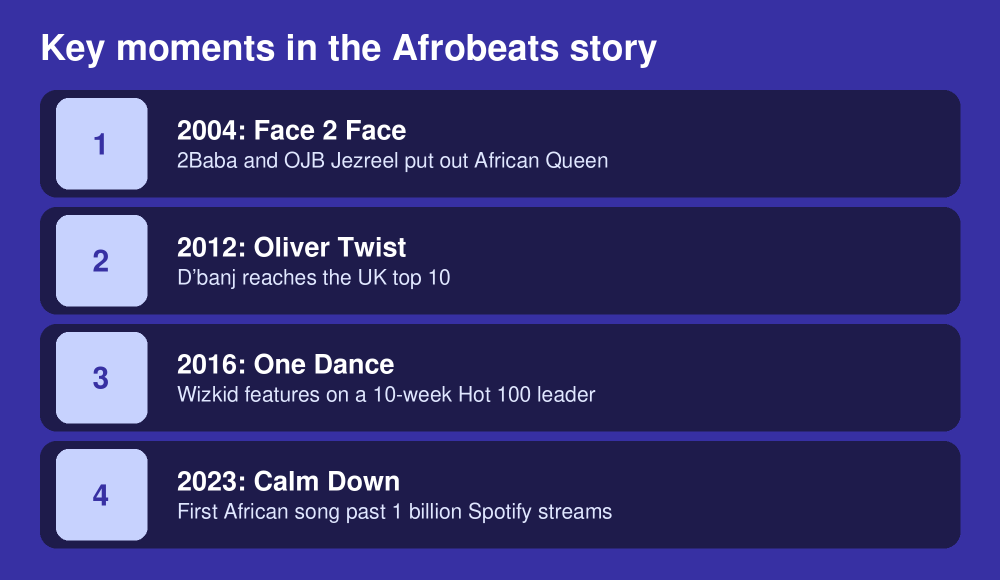
Several things came together in the first half of the decade. In 2004, 2Baba, who was still known as 2Face Idibia, released the album Face 2 Face with producer OJB Jezreel. Its single “African Queen” became one of the first big records of the new sound, and Britannica notes it was the first music video shown on MTV Base, the pan-African channel that launched in 2005 under Alex Okosi.
The same year, D’banj and Don Jazzy started Mo’ Hits Records, which pushed a polished pop sound out of Lagos. P-Square, 2Baba and D’banj soon had audiences across Africa. Daily Times Nigeria credits them with laying the commercial foundation for what followed. Radio and music television did the rest.
The UK link and the name
A lot of the early international push happened in the diaspora. London had large Nigerian and Ghanaian communities and club nights that mixed the sounds with grime, house and R&B. In April 2011, Britannica reports, the London station Choice FM launched an Afrobeats radio show that played D’banj, P-Square and 2Baba to mainstream British listeners. The DJ behind it, Abrantee Boateng, known as DJ Abrantee, is widely credited with coining the word Afrobeats for the programme.
Not every source agrees. One long-form history says DJs and radio presenters in the Nigerian and British-Nigerian community adopted the term gradually from the mid-2000s, and that no single person coined it. The safe reading is that the s was added in Britain, in the Nigerian and Ghanaian diaspora, somewhere between the mid-2000s and 2011, to give a broad mix of West African pop one handy label.
2010 to 2016: the first crossover records
In 2010, a young Wizkid put out “Holla at Your Boy”, and it changed what Nigerian pop could aim for. In 2011, Kanye West signed D’banj to his G.O.O.D. Music label. In May 2012, D’banj’s “Oliver Twist” became the first Nigerian song to chart on both the UK Singles Chart and the UK R&B Chart. The BBC says it reached the UK top 10, and calls it the moment Afrobeats really took hold in Britain.
Next came the Drake link. Drake and the British MC Skepta featured on the remix of Wizkid’s “Ojuelegba” in 2014. In 2016, “One Dance”, with Wizkid and singer Kyla, spent 10 weeks at number one on the US Billboard Hot 100, according to Britannica. In 2017 Wizkid signed to RCA Records, which Wikipedia describes as the biggest deal an African musician had received up to then.
Around the same time, the UK scene produced its own offshoot. Afroswing, which appeared around 2014 and was popularised by J Hus, combines Afrobeats with road rap, grime, dancehall, trap and R&B. People often call it Afrobeats, but the two are separate genres.
2016 to 2022: the big names and the first charts
By the middle of the decade, three artists were being called the Big 3: Wizkid, Davido and Burna Boy. Wizkid and Drake kept collaborating. Davido’s “Fall” (2017) became one of the longest-charting Nigerian songs on the US Billboard charts, and Burna Boy built a loyal worldwide audience. Tiwa Savage, Yemi Alade and Tekno kept the Nigerian side of the scene full, while Ghana’s Fuse ODG and Sarkodie did the same for Accra.
Official recognition followed. In July 2020 the UK Official Charts Company launched an Official Afrobeats Chart. In 2021, Wizkid and Tems’ “Essence” and CKay’s “Love Nwantiti” became the first Afrobeats songs to enter the Billboard Hot 100, per Spotify’s own timeline. In 2022 Fireboy DML’s “Peru” remix with Ed Sheeran reached number two in the UK, and in March 2022 Billboard launched a US Afrobeats Songs chart.
Streaming was the engine. The BBC cites Spotify data showing Afrobeats streams on the platform grew 550% between 2017 and 2022. TikTok then handled the rest, because a dance routine could carry a Nigerian song into countries that had never heard of Lagos.
2023 to 2026: stadiums, billions and the Grammys
In summer 2023, Burna Boy became the first African artist to headline a stadium in the UK, selling out London Stadium with a crowd of about 60,000, according to the BBC. That August his album I Told Them became the first album by an African artist to reach number one on the UK Albums Chart. In September 2023, Rema’s “Calm Down” passed one billion streams on Spotify, the first track by an African artist to do so, and IFPI later ranked the Selena Gomez remix the world’s second best-selling single of 2023.
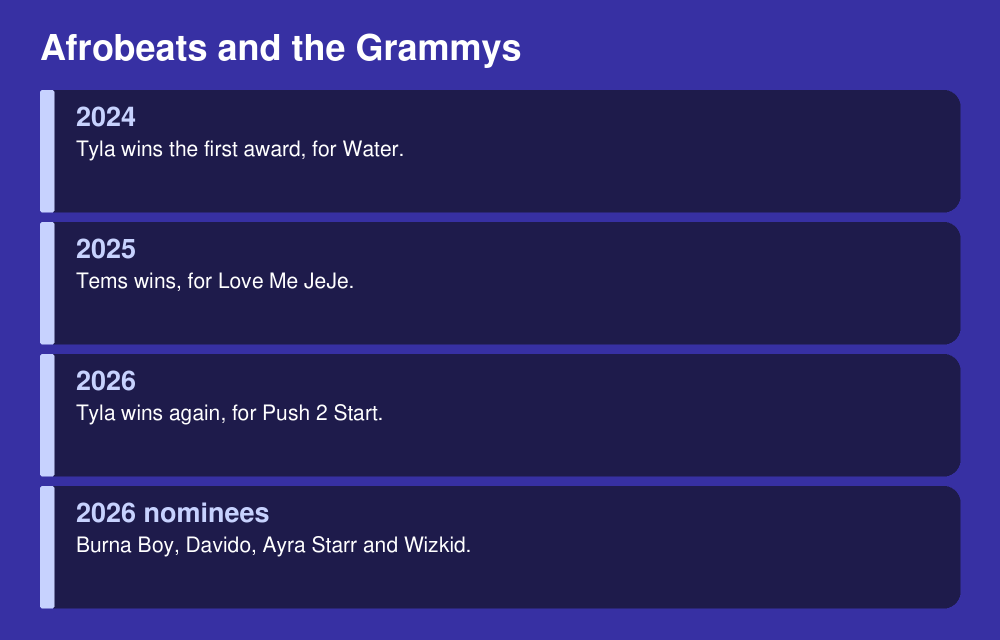
The Recording Academy then created a category for the music. The Grammy for Best African Music Performance was introduced for the 2024 ceremony. Tyla won the first one for “Water”. Tems won in 2025 for “Love Me JeJe”. In February 2026, Tyla won again for “Push 2 Start”, beating Burna Boy’s “Love”, Davido and Omah Lay’s “With You”, Ayra Starr and Wizkid’s “Gimme Dat” and Eddy Kenzo and Mehran Matin’s “Hope & Love”. If you want the current Nigerian picture for the next ceremony, our guide to the Nigerian Grammy nominees covers who has submitted.
Where it stands in November 2026
The numbers keep moving up. Spotify says Afrobeats listening in Nigeria has grown by more than 4,000% since 2021, and listening in Latin America rose by more than 180% year on year in 2025. Spotify also reports the genre’s fastest-growing subgenres include Afropop, Afro R&B and Afropiano.
The music itself is still arriving every Friday. Rema’s seven-track EP E-Mortal Boy is due on 20 November 2026, and Olamide’s album Time & Space is scheduled for 16 November. Our list of Afrobeats artists to watch tracks the newer names, and if you are heading home for the festive season, the Detty December 2026 calendar shows where the live shows are.
Why the history matters for listeners
Knowing the timeline changes how you hear a new record. When a producer slips in a highlife guitar line, or an artist sings in Yoruba over a log-drum beat, they are pulling from a century of Nigerian and Ghanaian music. Reading about the people who built it also helps you spot the difference between the genre’s real innovators and the playlist-ready copies. For more on how the wider culture is moving, see our piece on Nigerian pop culture trends.
Related guide (updated 16 November 2026)
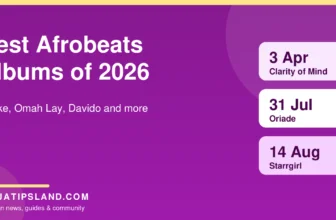
Best Afrobeats albums of 2026 ranks the year’s biggest Afrobeats albums, from Asake and Omah Lay to Davido, Ayra Starr and Victony, with release dates and streaming numbers.
Frequently asked questions
What is the difference between Afrobeat and Afrobeats?
Afrobeat is the political, jazz-and-funk-heavy sound Fela Kuti created in the late 1960s and 1970s. Afrobeats is the pop-leaning genre that emerged from Nigeria and Ghana in the 2000s and mixes highlife, hip hop, dancehall and R&B.
Who started Afrobeats?
No single person did. Fela Kuti created Afrobeat, and artists such as 2Baba, D’banj, P-Square and OJB Jezreel built the modern pop sound in the 2000s. DJ Abrantee is usually credited with popularising the word in London in 2011.
What was the first Afrobeats song to go global?
Many writers point to D’banj’s “Oliver Twist” in 2012, which charted in the UK. Wizkid’s feature on Drake’s “One Dance” in 2016 took the genre to the top of the US charts.
Is there a Grammy for Afrobeats?
There is a Best African Music Performance category, first awarded in 2024. Afrobeats songs compete in it alongside other African styles.
Who won the Grammy for Best African Music Performance in 2026?
Tyla won for “Push 2 Start” at the 68th Grammy Awards on 1 February 2026. It was her second win in the category.
Sources
- Britannica: Afrobeats
- BBC News: How Afrobeats made it to the very top of Glastonbury
- BBC News: Afrobeats
- Wikipedia: Afrobeats
- Spotify Newsroom: Afrobeats timeline
- Spotify Newsroom: Afrobeats archive
- Who Owns Africa: Afrobeats over 50 years
- I AM History: The History of Afrobeats
- BBC News: Tyla wins Best African Music Performance, 2 February 2026
- Grammy.com: Best African Music Performance
- BellaNaija: Rema announces E-Mortal Boy






Editor’s note: music history always has gaps, and fans of every era will have songs they feel we missed. Tell us which record introduced you to Afrobeats in the comments. – Ade