
How to Sell Ebooks Online in Nigeria (2026): Writing, Formatting, Platforms and Getting Paid

Last updated: 3 November 2026 · By Naijatipsland Editorial Team · Editorial policy
Checked 3 November 2026. An ebook is one of the cheapest products a Nigerian can create and sell: no printing, no stock, no delivery riders. If you know how to do something that other people struggle with, such as passing a professional exam, starting a poultry farm, relocating for study, cooking for events or using Excel at work, you can turn that knowledge into a PDF or EPUB and sell it to buyers in Nigeria and abroad. The hard parts are choosing a topic people will actually pay for, producing a book that looks professional, picking a platform that pays you without wahala, and stopping people from sharing your file for free. This guide walks through each step, with real platform fees, the ISBN and copyright process in Nigeria, pricing in naira and dollars, and simple marketing that works.
If you are still deciding between ebooks, templates, courses and other downloads, start with our wider guide to the best digital products to sell online in Nigeria. This article goes deep on ebooks only.
1. Choose a topic people will pay for
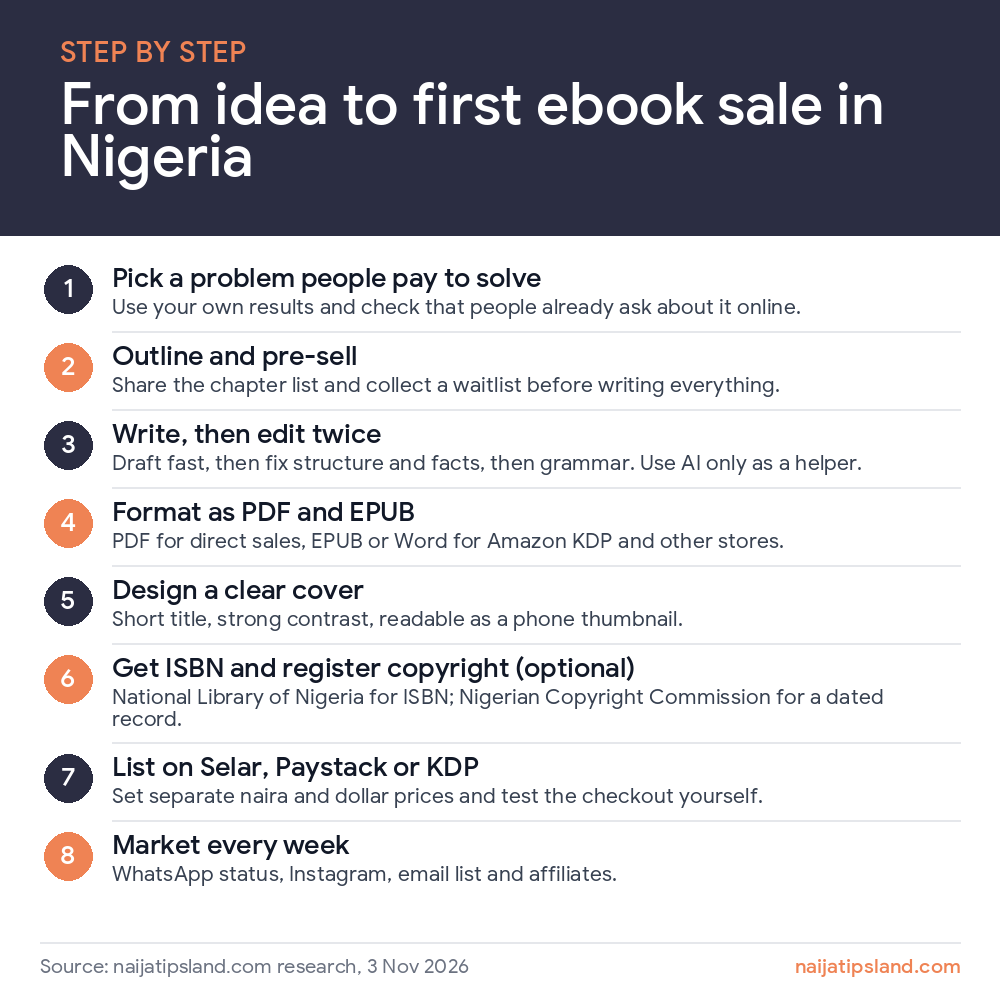
Most ebooks that sell in Nigeria solve a practical, urgent problem. Inspirational books and poetry can sell, but they are much harder to market unless you already have an audience. Before you write a single chapter, test the idea.
- Start from a result you have achieved: “How I passed ICAN in two sittings”, “Starting a 500-bird broiler farm in Ogun State”, “Your first UK student visa application, step by step”. Specific beats general.
- Check that people ask about it: search Nairaland, X, Facebook groups, TikTok comments and WhatsApp groups. Repeated questions mean demand.
- Look for competition: browse Selar, Amazon and Gumroad for similar titles. Some competition is good; it proves buyers exist. Your angle should be more current, more local or more detailed.
- Pre-sell or collect a waitlist: post the outline on your WhatsApp status or Instagram and ask people to join a list. If nobody signs up, rethink before you spend weeks writing.
Good categories for Nigerian buyers include exam preparation, agriculture and small business guides, relocation and scholarships, tech career switching, recipes, parenting, personal finance basics and faith-based devotionals. Avoid topics that promise quick riches or guaranteed results; they attract refund requests and can mislead readers.
2. Write and edit properly (including honest AI use)
A useful practical ebook is often 40 to 120 pages. Length matters less than whether each chapter moves the reader closer to the result in the title.
- Outline first: write the promise, then 8 to 12 chapter headings, then three to five points under each.
- Write a rough draft quickly: one chapter a day is realistic for many people. Use voice notes and transcribe them if typing is slow.
- Add proof: your own photos, screenshots, costings, checklists and worked examples are what make a paid book better than free blog posts.
- Edit in two passes: first for structure and accuracy, then for grammar and typos. Ask two people from your target audience to read it and tell you where they got confused.
- Get a proofreader if you can: freelance editors in Nigeria charge very different rates depending on length and experience, so ask for a per-word or per-page quote and a sample edit before you pay.
Using AI honestly: AI writing tools can help you brainstorm chapter titles, tighten clumsy sentences and spot gaps in your outline. They should not write the book for you. AI drafts are often generic, sometimes wrong about Nigerian prices and rules, and readers notice. Check every fact yourself. If you publish on Amazon KDP, its content guidelines ask you to tell it when text, images or translations were AI-generated, so read the current rules before you upload. Our guide to AI tools for Nigerian content creators covers which tools are worth paying for.
3. Format: PDF or EPUB?
The format you choose depends on where you sell.
- PDF keeps your layout fixed, works on every phone and laptop and is what most Nigerian buyers expect when they pay through Selar, Paystack or a WhatsApp link. It suits workbooks, recipe books and anything with tables or images. The downside is that small phone screens force readers to zoom.
- EPUB is a reflowable format: text resizes to fit the screen. It is the standard for ebook stores such as Apple Books, Kobo and Google Play Books. Amazon KDP accepts EPUB and Word files and converts them for Kindle.
Free tools are enough to start. You can write in Google Docs or Microsoft Word and export to PDF, design a polished layout in Canva, and create EPUB files with free tools such as Calibre or Amazon’s Kindle Create. Use headings properly so the table of contents is clickable, keep fonts readable at 11 to 12 points, and compress images so the file downloads quickly on mobile data.
4. Cover design
Most buyers see your cover as a small thumbnail on a phone. It needs a short, bold title, high contrast and one clear image. You can design one in Canva using a 1,600 x 2,560 pixel canvas, which is the ratio Amazon recommends for Kindle covers, or hire a designer on Fiverr or through Nigerian designers on Instagram. Ask for the source file and confirm that any stock photos or fonts are licensed for commercial use.
5. ISBN from the National Library of Nigeria
An ISBN (International Standard Book Number) is a 13-digit number that identifies your book. You do not need one to sell a PDF through Selar or WhatsApp, and Amazon KDP gives Kindle ebooks a free ASIN instead. But an ISBN makes your book look professional, helps libraries and bookshops list it, and is useful if you plan a print edition.
- Who issues it: the National Library of Nigeria (NLN) is the only official ISBN agency in Nigeria. Its ISBN portal warns that any other agency claiming to issue Nigerian ISBNs is fake.
- One ISBN per format: the paperback and the ebook each need their own ISBN, and an ISBN cannot be reused for another title.
- How to apply: create an account on the NLN ISBN portal (isbn.nln.gov.ng), fill in the book’s details, upload the required documents and pay through Remita. You can also apply in person at an NLN office. Self-published authors can apply as individuals; companies need their CAC certificate.
- Fees: TechCabal reported in 2024 that NLN charged ₦5,000 for one ISBN, ₦7,000 for two and ₦10,000 for blocks of three, four, five or ten, with approval in about five to seven working days. We could not find an updated official fee list for 2026, so confirm the current amount on the portal or with the NLN before paying.
- Legal deposit: Nigerian law requires publishers to deposit copies of published works with the National Library. Ask the NLN how this applies to your ebook or print edition when you apply.
6. Copyright basics
Under Nigeria’s Copyright Act 2022, your book is protected automatically once it is written down; registration is not what creates the right. However, registering with the Nigerian Copyright Commission (NCC) gives you a dated record that is very useful if someone copies your work. The NCC’s e-registration portal lists a copyright registration fee of ₦10,000, paid through Remita, and literary works such as books are eligible. Keep your drafts, dated files and emails as extra proof of authorship. Only use quotes, images and data you have the right to use, and credit sources.
7. Where to sell: platforms and real fees
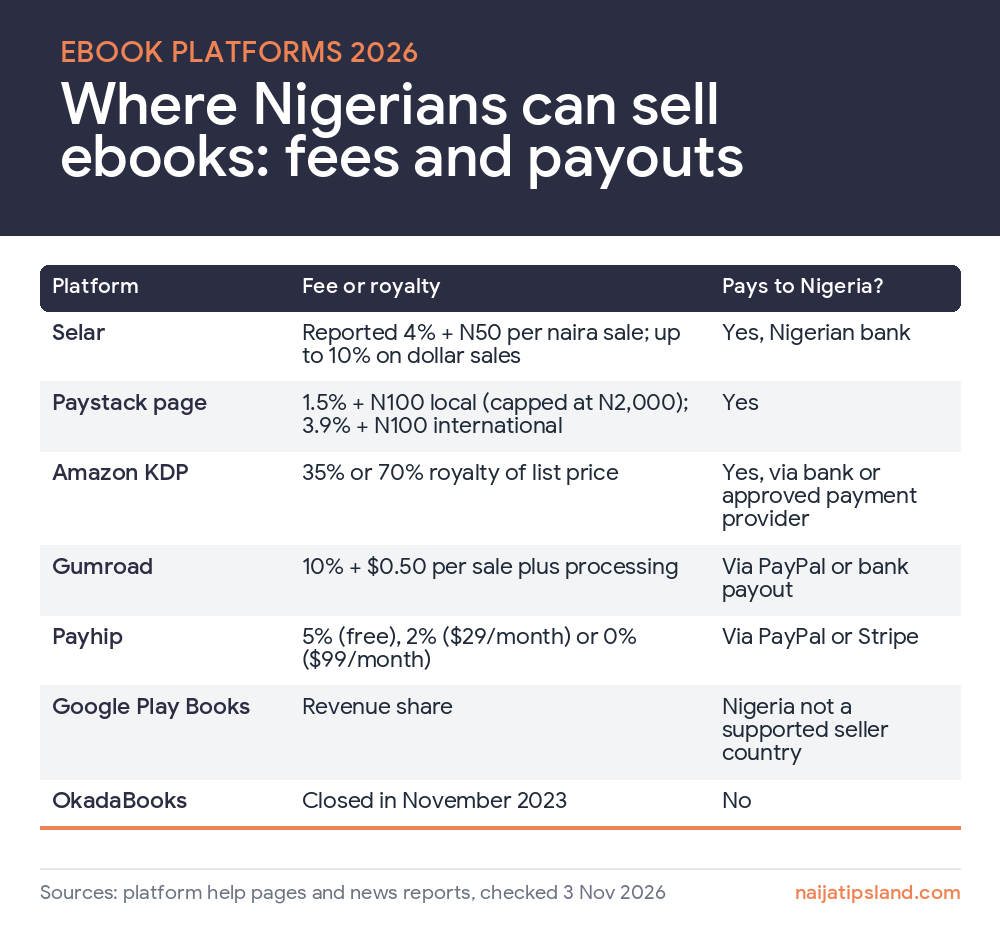
You do not need to pick just one. Many Nigerian authors sell the PDF in naira through Selar or a Paystack link, and list a Kindle edition on Amazon for international readers.
| Platform | What it charges | Pays Nigerians? | Best for |
|---|---|---|---|
| Selar | Reported 4% + ₦50 per naira sale; up to 10% on dollar sales; no monthly fee | Yes, to Nigerian bank accounts | Naira buyers, affiliates, quick setup |
| Paystack payment page or storefront | 1.5% + ₦100 per local card payment (₦100 waived under ₦2,500, capped at ₦2,000); 3.9% + ₦100 on international cards | Yes | Selling directly and emailing or WhatsApping the file yourself |
| Flutterwave Store or payment link | Standard Flutterwave transaction fees | Yes | Local and some international buyers |
| Amazon KDP (Kindle) | No upfront cost; royalty of 35% or 70% of list price (70% band has price limits and delivery costs) | Yes, via a bank or participating payment provider | Reaching global Kindle readers |
| Gumroad | 10% + $0.50 per sale plus payment processing; 30% on Gumroad Discover sales | Via PayPal or supported bank payout | Global buyers, simple checkout |
| Payhip | Free plan 5% per sale; Plus $29 a month 2%; Pro $99 a month 0%; plus PayPal or Stripe fees | Via PayPal or Stripe, where you can use them | Global buyers, EU VAT handled |
| Google Play Books | Partner Center revenue share | Nigeria is not on Google’s list of supported seller countries | Not currently an option for Nigeria-based authors |
What happened to OkadaBooks? OkadaBooks, the Lagos-based platform that many Nigerian authors used to sell ebooks in naira, shut down at the end of November 2023, citing tough economic conditions. Many older blog posts still recommend it, so ignore that advice.
Getting paid from Amazon KDP: KDP pays royalties about 60 days after the end of the month in which sales happen. Since 1 August 2026, Amazon has stopped paying KDP accounts that use a payment service provider which is not part of its Payment Service Provider Program; participating providers named by KDP include Payoneer, Wise and WorldFirst, or you can use an account at a deposit-taking bank. Check that the provider you choose accepts Nigerian residents and complete its identity checks before your first payout. Our guide on receiving international payments in Nigeria compares providers and fees.
8. Pricing in naira and dollars
There is no single right price, but a few rules help.
- Price on the outcome, not page count: a 50-page guide that helps someone pass an exam or avoid a costly mistake is worth more than a 300-page general book.
- Check ten competing titles: note their prices on Selar and Amazon and position yourself in the same range unless your book is clearly better.
- Set separate naira and dollar prices: do not just convert at the day’s exchange rate. Nigerian buyers compare prices with local alternatives; diaspora and foreign buyers compare with Amazon.
- On Kindle, mind the 70% band: Amazon’s 70% royalty applies only within a set list-price range (for the US store, $2.99 to $9.99) and in eligible marketplaces. Below or above that range you get 35%.
- Use launch discounts and bundles: an early-bird price for your waitlist, or a bundle of the ebook plus a checklist or template, often sells better than a deep permanent discount.
9. Marketing via WhatsApp, Instagram and email
Platforms will not market your book for you. The authors who sell steadily build a small audience and keep talking to it.
- WhatsApp: share short tips from the book on your status, run a free one-hour class in a WhatsApp group and sell at the end, and use WhatsApp Business catalogue and quick replies to answer buyers fast. Never add people to groups without permission.
- Instagram and TikTok: post carousels or short videos that teach one idea from each chapter, with the link in your bio. Show the inside pages, not just the cover.
- Email: offer a free chapter or checklist in exchange for an email address, then send a short sequence explaining the problem and your book. Email is the one channel no algorithm can take away.
- Affiliates: Selar lets you pay other creators a commission for each sale they refer. Bloggers can also promote your book; see our guide to making money blogging in Nigeria if you want to build your own site.
- Turn the book into a course: once the ebook sells, a video course or cohort can earn more from the same knowledge. Our guide on how to create and sell online courses in Nigeria explains how.
10. Protecting your ebook from piracy
You cannot stop every determined pirate, but you can make sharing less attractive and act quickly when it happens.
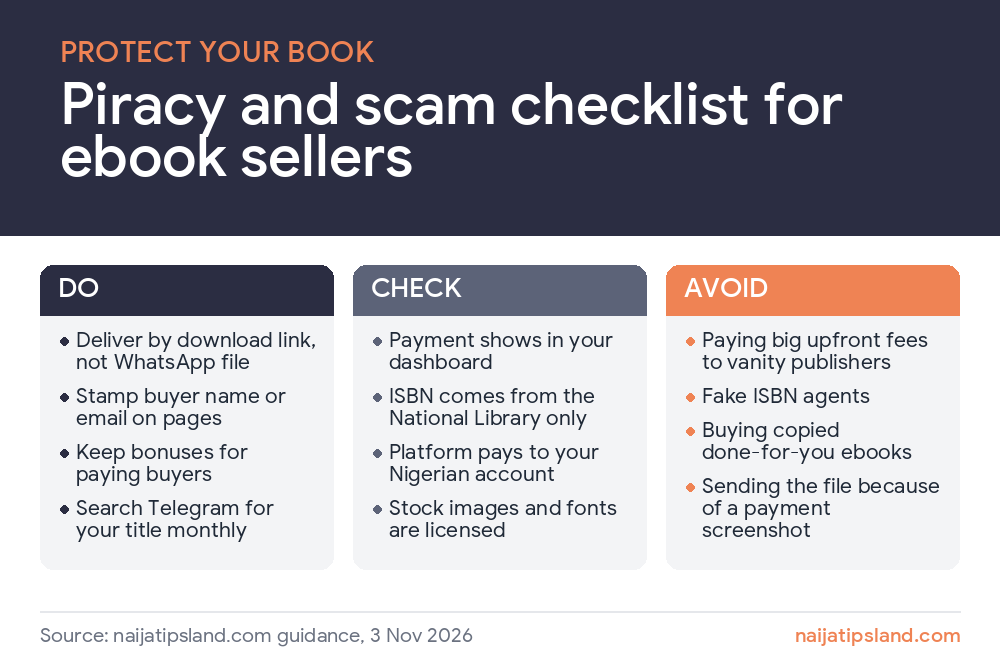
- Deliver through a platform that sends a download link rather than sending the PDF on WhatsApp yourself.
- Stamp the buyer’s name or email on each page (some platforms do this automatically) and add your copyright notice and website on every page.
- Keep updates, templates or a private community for paying buyers only, so the pirated copy is always the weaker version.
- Search your title on Telegram, Facebook and file-sharing sites every month. File takedown requests with the platform and, for serious cases, keep evidence and talk to a lawyer about the Copyright Act.
Scams to avoid
Aspiring authors are targets too. Be wary of “publishers” who charge large upfront fees and promise bestseller status, fake ISBN agents (only the National Library of Nigeria issues Nigerian ISBNs), people selling “done-for-you” ebooks that are copied from elsewhere, and buyers who claim they paid and ask you to send the file before payment shows. Confirm every payment in your dashboard, not from a screenshot. Read our guide to common WhatsApp scams in Nigeria for more red flags.
Tax and records
Ebook income is taxable income. Under the new tax rules that took effect in 2026, individuals earning up to ₦800,000 a year are exempt from personal income tax, but you should still keep records of every sale and payout. In mid-2026 Selar publicly disputed a Lagos State Internal Revenue Service demand relating to tax on creator royalties, which shows tax authorities are paying attention to the creator economy. Speak to an accountant once your sales grow.
Frequently asked questions
Can a Nigerian sell ebooks on Amazon KDP?
Yes. Nigerians can open a KDP account, upload ebooks and earn 35% or 70% royalties. The main issue is payouts: use a bank account or a payment provider that is part of Amazon’s Payment Service Provider Program and accepts Nigerian residents.
Do I need an ISBN to sell an ebook in Nigeria?
No. You can sell a PDF on Selar or through Paystack without one, and Kindle ebooks get a free ASIN. An ISBN from the National Library of Nigeria is useful for libraries, bookshops and print editions.
Is Okadabooks still working?
No. OkadaBooks shut down at the end of November 2023. Use Selar, a Paystack or Flutterwave page, or international platforms instead.
Should I sell my ebook as PDF or EPUB?
Sell a PDF for direct sales to Nigerian buyers and use EPUB, or let Amazon convert your file, for ebook stores. Many authors offer both.
Can I use AI to write my ebook?
You can use AI for brainstorming and editing, but write the substance yourself and check every fact. Amazon KDP asks publishers to disclose AI-generated content when they upload.
How do I stop people sharing my ebook for free?
Use download links instead of sending files directly, stamp buyer details on the pages, keep bonuses for paying buyers and report pirated copies quickly.
Disclaimer: fees, payout rules and government charges in this guide come from official help pages and news reports, checked on 3 November 2026. Some figures, such as Selar’s fees and the National Library’s ISBN fees, are reported rather than confirmed in a current official price list, and all fees change. Nothing here is legal, tax or financial advice; confirm current terms before you publish or pay.








Editor’s note: OkadaBooks closed in November 2023, so ignore older guides that recommend it. For naira buyers, a Selar or Paystack link plus a WhatsApp waitlist is the quickest way to get your first sales.