

TL;DR:
- Internet regulation creates rules to protect users, balance data privacy, and prevent physical infrastructure disruptions.
- However, excessive or unclear regulation risks silencing free expression and disproportionately burdening small platforms.
Internet regulation is the set of rules governing how digital data, infrastructure, and online content are managed to protect users and keep the internet safe and fair. For Nigerian internet users, understanding why regulate internet matters is not abstract. It directly shapes your privacy, your access to information, and your freedom to speak online. Global frameworks like the EU’s Digital Services Act, the United States’ Section 230, and UNESCO’s Internet for Trust initiative all influence how platforms behave in Nigeria. This article breaks down the core reasons internet governance exists, what it protects, and where it can go wrong.
Why regulate the internet at all?
Internet regulation exists because the internet, left entirely ungoverned, creates serious risks for users, businesses, and governments alike. The “lawless internet” is a misconception. The internet is already subject to national and local laws that can dynamically affect your access and privacy expectations. What regulation does is formalize those rules, set accountability standards, and create enforcement mechanisms.

The core problems regulation addresses include data theft, harmful content, network disruption, and market abuse. Without rules, platforms have no legal obligation to protect your personal data. Without oversight, governments can interfere with physical infrastructure without consequence. Without content standards, misinformation and hate speech spread unchecked. Regulation is the mechanism that assigns responsibility and creates recourse when things go wrong.
Effective internet regulation is increasingly seen as a foundation of national competitiveness, not just a policy preference. That framing matters because it shifts the conversation from “should we regulate?” to “how do we regulate well?”
How does internet regulation protect your data privacy?
Data privacy regulation protects you from having your personal information collected, sold, or exposed without your knowledge or consent. Laws like the EU’s General Data Protection Regulation (GDPR) require platforms to tell you what data they collect and give you the right to delete it. Nigeria’s own Nigeria Data Protection Regulation (NDPR) follows a similar model, placing obligations on organizations that handle Nigerian users’ data.
Section 230 of the U.S. Communications Decency Act protects online platforms from liability for user content while allowing them to moderate. This balance enables safer and more open internet experiences. Without it, platforms would either remove almost all user content out of legal fear or refuse to moderate at all. Both outcomes hurt you as a user.
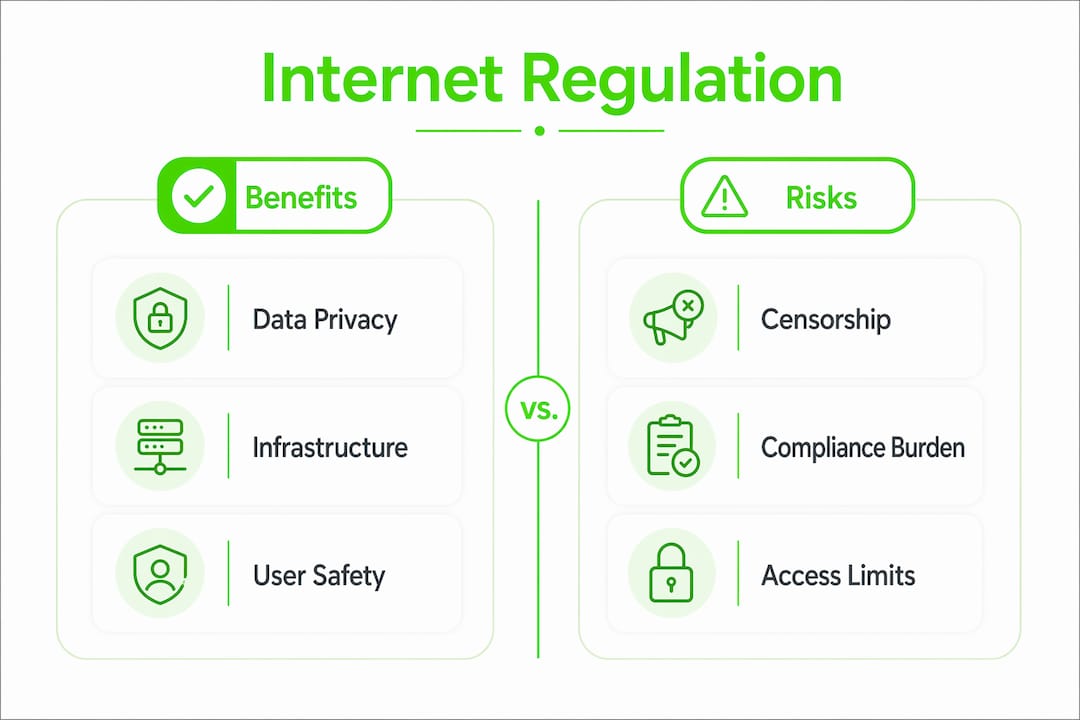
Privacy regulation also addresses identity theft. When platforms are required to store your data securely and notify you of breaches, you get early warning to protect yourself. The importance of internet laws around data privacy is especially high in Nigeria, where digital financial services are growing fast and personal data exposure carries real financial risk.
Pro Tip: Check whether any app or platform you use in Nigeria states compliance with the NDPR or GDPR. If a platform cannot name the regulation it follows, treat your data as unprotected.
Key areas where data privacy regulation helps you:
- Requires platforms to disclose what data they collect
- Gives you the right to request data deletion
- Mandates breach notifications so you can act quickly
- Holds companies legally accountable for data misuse
- Limits how long platforms can retain your personal information
Outdated legal tools alone do not address modern online harms effectively. Privacy, transparency, and design-based rules empower users better than simply removing platform liability protections. The goal is rules that make platforms safer by design, not just rules that punish them after harm occurs.
What happens when governments interfere with internet infrastructure?
Most people think of internet regulation as content rules. The physical infrastructure underneath the internet is equally regulated, and equally at risk. Approximately one-fifth of global internet connections face state-level infrastructure disruptions, including cable cutting and routing manipulation. That figure represents millions of users losing access not because of a technical fault but because of a deliberate political act.
For Nigerian users, this is not a distant concern. West Africa’s connectivity depends on undersea cables that pass through multiple jurisdictions. When a state actor tampers with routing or severs a cable, the legal framework for accountability is thin. There is currently no strong international transit law that governs how internet traffic must be treated as it crosses borders.
“The internet’s physical layer is its most vulnerable layer. Without legal protections for transit infrastructure, any government can disrupt connectivity for millions of users with minimal legal consequence.” — Yale Law Journal
| Interference type | Method | Impact on users |
|---|---|---|
| Cable cutting | Physical severance of undersea or land cables | Complete loss of connectivity in affected regions |
| Routing manipulation | Redirecting traffic through state-controlled nodes | Surveillance, data interception, and slowdowns |
| Internet shutdowns | Government orders to ISPs to block access | Loss of access to information and economic activity |
| DNS blocking | Preventing domain name resolution | Inability to reach specific websites or platforms |
The absence of international transit law creates a legal gap that states exploit. Regulation at the international level, covering how traffic must be routed and protected, is one of the strongest reasons for internet oversight. Without it, your access to information depends entirely on the goodwill of governments along the cable route.
What are the benefits and risks of regulating online content?
Content regulation aims to reduce misinformation, hate speech, and harmful material online. The benefits are real. Platforms with clear moderation rules create safer spaces for discussion, commerce, and civic participation. For Nigerian users engaging in political commentary or community organizing online, content standards protect you from coordinated harassment campaigns and deliberate disinformation.
The risks are equally real. Governments that gain regulatory authority over content can use it to silence opposition, restrict journalism, and control public narratives. Once granted, regulatory authority seldom diminishes, which creates ongoing tension between protecting users and limiting free expression. Nigeria has seen this tension directly, with social media restrictions and platform suspensions that affected millions of users.
UNESCO’s Internet for Trust initiative offers a model that addresses this tension. The initiative promotes human rights-based governance of digital platforms, shifting the focus from government control to user rights. The UNESCO Global Forum of Networks unites regulatory authorities from 80 or more countries to promote freedom of expression alongside content safety. That model is worth understanding because it represents the direction global policy is moving.
A comparison of regulatory approaches:
| Regulatory model | Primary focus | Risk to free expression |
|---|---|---|
| Government censorship model | State control of content | High. Governments define what is acceptable. |
| Liability-based model (Section 230) | Platform accountability with moderation freedom | Low. Platforms self-regulate with legal protection. |
| Human rights-based model (UNESCO) | User rights and platform transparency | Low to medium. Requires strong enforcement. |
| Design-based regulation | Platform architecture and defaults | Low. Focuses on how platforms work, not what users say. |
New regulation can disproportionately burden small platforms that lack the legal and financial resources to comply. This matters for Nigeria’s growing community of local platform builders. When compliance costs force smaller sites to shut down, the result is a less diverse internet dominated by a few large companies. That outcome reduces your choices and concentrates power in fewer hands.
You can read more about how content moderation affects Nigerian users and what platform policies mean for your rights online.
How do international regulatory efforts shape internet governance?
International regulatory efforts set the standards that national governments and platforms follow. The EU’s Digital Decade program includes over 100 laws, including the Digital Services Act and the AI Act, designed to guide innovation while protecting user rights. These laws apply to any platform operating in the EU, which includes most major platforms Nigerian users access daily.
The practical implication is that EU regulation shapes your experience on Facebook, Google, and X (formerly Twitter) even if you are in Lagos. Platforms build compliance into their global systems, and those systems affect all users. Understanding this helps you recognize that internet governance is not just a local policy issue. It is a global infrastructure question with local consequences.
Key international regulatory developments shaping the internet in 2026:
- The EU Digital Services Act requires large platforms to publish transparency reports on content moderation decisions
- The EU AI Act sets rules for how artificial intelligence can be used in content recommendation and moderation
- UNESCO’s Internet for Trust guidelines promote multi-stakeholder governance, meaning civil society, not just governments, has a voice
- The Global Forum of Networks connects regulators from 80 or more countries to share best practices
- Nigeria’s NDPR aligns with GDPR principles, giving Nigerian users a legal framework for data complaints
Regulation now shapes innovation as much as technology itself does. Countries with clear, fair regulatory frameworks attract more digital investment and build stronger digital economies. For Nigeria, engaging with these international models is not optional. It is the path to a digital economy that works for Nigerian users, not just for foreign platforms.
Key Takeaways
Internet regulation protects Nigerian users by setting enforceable rules on data privacy, infrastructure integrity, and content standards, while the greatest risks come from regulatory overreach and compliance burdens on smaller platforms.
| Point | Details |
|---|---|
| Regulation protects data privacy | Laws like NDPR and GDPR require platforms to disclose data use and notify users of breaches. |
| Infrastructure needs legal protection | One-fifth of global connections face state interference, and international transit law remains weak. |
| Content rules carry free speech risks | Government-controlled content regulation can silence opposition, as Nigeria has experienced directly. |
| International frameworks set local standards | EU laws like the Digital Services Act affect Nigerian users on global platforms every day. |
| Small platforms face disproportionate burdens | Compliance costs can force independent platforms to close, reducing diversity online. |
Naijatipsland’s take on regulation and Nigerian digital rights
Regulation is not the enemy of the open internet. Unregulated power is. The platforms and governments that operate without accountability are the real threat to your freedom online, not the rules designed to check them.
What concerns me most about the Nigerian context is the gap between the rules that exist on paper and the enforcement that actually happens. Nigeria has the NDPR. It has signed on to international frameworks. But when a platform mishandles your data or a government shuts down access, the practical path to remedy is unclear for most users. That gap is where digital rights are lost.
The international models worth watching are the ones that center users, not governments or platforms. UNESCO’s human rights-based approach and the EU’s transparency requirements both push power toward users. Nigeria’s regulators and civil society groups should be building on those models, not waiting for foreign frameworks to trickle down.
You have more power than you think. Understanding your rights under the NDPR, knowing which platforms publish transparency reports, and staying informed about policy changes are all forms of participation. Regulation works best when the people it protects are paying attention.
— Naijatipsland
Stay informed on media and internet regulation in Nigeria
Naijatipsland covers the intersection of digital policy, media influence, and civic life in Nigeria. If this article raised questions about how regulation shapes what you see, say, and share online, there is more to read.
The conversation about internet governance is moving fast. From how traditional media shapes Nigerian culture to the way global platforms respond to local laws, Naijatipsland tracks the stories that matter to Nigerian digital life. You can also follow Naijatipsland’s coverage of online censorship in 2026 to understand where the boundaries of free expression are being drawn right now. Stay engaged, stay informed, and make your voice part of the policy conversation.
FAQ
What is internet regulation?
Internet regulation is the body of laws and rules governing how digital data, online content, and internet infrastructure are managed. It covers everything from data privacy laws like GDPR to content moderation standards and physical network protections.
Why does internet regulation matter for Nigerian users?
Nigerian users are directly affected by both local rules like the NDPR and global frameworks like the EU Digital Services Act, which shape how platforms handle your data and what content you can access. Understanding these rules helps you protect your rights online.
Can internet regulation limit freedom of expression?
Yes. Government-controlled content regulation carries a real risk of censorship, and Nigeria has experienced platform restrictions that affected millions of users. Human rights-based models promoted by UNESCO aim to balance content safety with free expression protections.
Does internet regulation affect small platforms differently?
Regulatory compliance costs fall harder on small platforms that lack legal and financial resources. This can force independent sites to shut down, reducing the diversity of online spaces available to Nigerian users.
How does infrastructure regulation protect internet access?
Rules governing physical infrastructure, such as undersea cables and routing systems, protect against state-level disruptions. Without international transit law, governments can cut or manipulate connections with minimal legal consequence, threatening access for millions of users.