


TL;DR:
- Choosing the right African tech source depends on your specific needs, such as policy analysis or startup funding data.
- Combining a newsroom like Techpoint.Africa with a data platform like WeeTracker’s The BASE plus community forums offers a comprehensive view.
The strongest TechCabal.com alternatives, matched by use case, are: Techpoint.Africa (pan-African reporting), WeeTracker (startup data and investor intelligence), Technext.ng (Nigeria-focused breaking news), Disrupt Africa (startup funding coverage), Techeconomy.ng (Nigerian market analysis), and Naijatipsland (community forum and local discussion). If you want narrative journalism, go with a newsroom. If you need structured funding data, go with a database like The BASE.
Here is a quick-reference shortlist:
- Techpoint.Africa — pan-African editorial reporting with strong event coverage
- WeeTracker / The BASE — searchable database of African startups and investors
- Technext.ng — Nigeria-first breaking news and tech commentary
- Disrupt Africa — startup funding rounds and ecosystem mapping
- Techeconomy.ng — market-level Nigerian tech and business reporting
- Naijatipsland — community forum with user-submitted news and local discussion threads
TL;DR: Pick a newsroom when you need context and analysis; pick a data platform when you need deal flow, investor tracking, or structured startup records.
Table of Contents
- How these TechCabal.com alternatives compare
- How to pick the right source for your specific goal
- When should you use a journalism site vs. a data platform?
- How these sites actually differ from TechCabal
- Key Takeaways
- Why mixing sources gives you a clearer picture of African tech
- Naijatipsland: a community-driven alternative worth bookmarking
- Useful sources for deeper research
How these TechCabal.com alternatives compare
Each site below serves a distinct audience. Understanding what each one does well saves you from reading the wrong source for the wrong task.
Techpoint.Africa covers the entire continent, not just Nigeria. Its editorial team produces original reporting on policy, funding, and product launches across West, East, and Southern Africa. The site runs the Moonshot conference and a Road to Moonshot series, which makes it one of the few African tech outlets with a live events calendar that complements its editorial output. For U.S.-based readers, Techpoint.Africa is fully accessible in English with no paywall.
WeeTracker takes a different approach entirely. Beyond its editorial coverage of African business and startups, it operates The BASE, a searchable database of African startups and investors. Investors and founders use it to source deal flow and track funding activity across the continent. WeeTracker is headquartered in Nairobi, which gives its coverage a strong East African angle alongside pan-African data.
Technext.ng is the most Nigeria-centric option on this list. It publishes daily and covers Nigerian fintech, e-commerce, and consumer tech with a speed that suits readers who need to stay current on Lagos-based developments. The editorial bylines are clear, and the site does not require a subscription for standard articles.
Disrupt Africa focuses specifically on the African startup ecosystem, with particular depth on funding rounds, investor profiles, and country-by-country ecosystem reports. It publishes paid research reports alongside free editorial content, so there is a partial paywall for its deeper data products. For anyone tracking early-stage investment activity across the continent, it fills a gap that pure newsrooms leave open.
Techeconomy.ng sits between a business newspaper and a tech blog. It covers Nigerian digital economy policy, banking technology, and enterprise software with more market-level framing than most alternatives. The audience skews toward professionals in Nigerian financial services and enterprise IT.
Naijatipsland operates differently from every editorial outlet on this list. It is a community forum where users submit news, start discussions, and engage with trending topics across tech, entertainment, politics, and local current affairs. That user-generated model means you get early signals, local sentiment, and community reactions that formal newsrooms often miss or report days later. You can submit your own news tip directly, which no traditional editorial outlet allows at the same level of openness.
Pro Tip: Pair Techpoint.Africa for daily editorial reads with WeeTracker’s The BASE for weekly funding checks. Add Naijatipsland for community sentiment and early local signals that have not yet reached formal newsrooms.
| Site | Best for | Geographic focus | Type | Offerings | Access/cost | US reader relevance |
|---|---|---|---|---|---|---|
| Techpoint.Africa | Pan-African reporting | Pan-Africa | Newsroom | News, newsletters, events | Free | High — English, no paywall |
| WeeTracker / The BASE | Investor intelligence | Pan-Africa (Nairobi base) | Data + editorial | News, database, newsletters | Free editorial; database access varies | High — English, data exports |
| Technext.ng | Nigeria breaking news | Nigeria | Newsroom | News, commentary | Free | Moderate — Nigeria-specific |
| Disrupt Africa | Startup funding tracking | Pan-Africa | Newsroom + reports | News, paid research reports | Free + paid reports | High — English, funding focus |
| Techeconomy.ng | Nigerian market analysis | Nigeria | Business/tech press | News, analysis | Free | Moderate — Nigeria-specific |
| Naijatipsland | Community discussion | Nigeria + diaspora | Community forum | User news, forums, aggregation | Free, ad-supported | High — English, diaspora-friendly |
How to pick the right source for your specific goal
Not every reader needs the same thing from an African tech platform. A quick checklist keeps you from wasting time on the wrong source.
Step 1: Define your primary goal. Are you tracking investment activity, monitoring Nigerian policy, following consumer tech launches, or looking for community discussion? Your answer eliminates most of the list immediately.
Step 2: Check geographic coverage. Nigeria-only outlets like Technext.ng and Techeconomy.ng are excellent for Lagos-centric news but will miss developments in Kenya, Ghana, or South Africa. If your work spans the continent, Techpoint.Africa or WeeTracker covers you better.
Step 3: Check publication cadence. A site that publishes three times a week is not useful for breaking news. Technext.ng and Techpoint.Africa publish daily. WeeTracker’s editorial side is less frequent, but its database updates independently of the editorial calendar.
Step 4: Check newsletter and archive access. Several of these outlets offer newsletters that deliver curated coverage directly to your inbox. Techpoint.Africa’s newsletter is well-regarded. Confirm whether archives are freely searchable before committing to a source for research purposes.
Step 5: Look for data products and events. If you need structured data, only WeeTracker’s The BASE and Disrupt Africa’s paid reports give you that. For events, Techpoint.Africa’s Moonshot conference is the most established on this list.
Watch for these red flags when evaluating any alternative tech blog:
- TechCabal – Products, Competitors, Financials, Employees …
- WeeTracker – Business, Startups & Economy News From Africa
- Pluralistic: Daily links from Cory Doctorow – No trackers, no ads.
- TechCrunch
- Tech News | Today’s Latest Technology News | Reuters
- The Verge
- TechCabal – Crunchbase Company Profile & Funding
- FOSS Force – Keeping tech free
Verifying credibility quickly comes down to three checks: read three recent bylines and confirm the authors have a public professional profile, check whether the site cites primary sources or other newsrooms, and look up whether the outlet has been referenced by Reuters or TechCrunch in their own Africa coverage.
When should you use a journalism site vs. a data platform?
These two categories solve different problems. Mixing them up wastes your time.
Journalism sites (Techpoint.Africa, Technext.ng, Techeconomy.ng, Disrupt Africa’s editorial side) produce narrative reporting. They explain what happened, why it matters, and what the context is. Use them to monitor policy changes, follow product launches, understand regulatory shifts, and read analysis from reporters who cover a beat daily. The Verge is a useful global benchmark for what high-resourced product and platform journalism looks like at scale.
Data and intelligence platforms (WeeTracker’s The BASE, Disrupt Africa’s research reports) produce structured records. They tell you which startup raised how much, from which investor, in which quarter. Use them when you are sourcing leads for due diligence, building a competitive map of a sector, or tracking investor activity over time. CB Insights applies a similar model globally, profiling companies and their competitive landscapes.
There is also a third category worth knowing: independent, ad-free outlets like Pluralistic that prioritize systemic and open-source tech coverage without commercial pressure. These attract readers focused on platform regulation, infrastructure, and policy rather than VC news. For open-source and FOSS-specific depth, FOSS Force is a practical complement.
| Dimension | Journalism sites | Data/intelligence platforms |
|---|---|---|
| Timeliness | Daily to weekly | Varies; database updates on deal close |
| Depth | Narrative, contextual | Structured, queryable |
| Structured data | Rarely | Core product |
| Cost | Usually free | Often freemium or paid tiers |
| Best use case | Policy, product, community news | Due diligence, deal sourcing, investor tracking |
How these sites actually differ from TechCabal
TechCabal is a Lagos-based publication that covers African innovation and the digital economy. It monetizes through digital advertising and sponsored events and does not gate its core reporting behind a paywall. Its Crunchbase profile confirms its ownership and funding history for anyone who wants to verify the corporate structure.
Here is where the alternatives diverge:
- Editorial lens: — TechCabal balances pan-African ambition with a strong Nigerian base. Techpoint.Africa leans more explicitly pan-African. Technext.ng and Techeconomy.ng are Nigeria-first by design.
- Data products: — TechCabal does not operate a structured startup database. WeeTracker’s The BASE and Disrupt Africa’s reports fill that gap directly.
When to choose TechCabal itself: if you want a single, well-edited source for African tech narrative journalism with strong writing and consistent editorial standards, TechCabal remains a solid primary read. The alternatives above are most useful when you need something TechCabal does not offer: structured data, Nigeria-only depth, community discussion, or event-driven networking.
Key Takeaways
The most effective approach to following African tech is to combine one newsroom for daily context, one data platform for funding intelligence, and one community source for early local signals.
| Point | Details |
|---|---|
| Match source to goal | Use newsrooms for context and analysis; use data platforms like The BASE for deal flow and investor tracking. |
| Geographic coverage matters | Nigeria-only outlets miss pan-African developments; choose Techpoint.Africa or WeeTracker for continent-wide coverage. |
| Check cadence and bylines | Daily publishers suit breaking news; always verify named authors and cited sources before trusting a site. |
| Combine sources strategically | Pair a daily editorial read with a weekly database check and a community forum for early signals. |
| Naijatipsland for community | Naijatipsland offers free, ad-supported community discussion and user-submitted news that complements formal editorial outlets. |
Why mixing sources gives you a clearer picture of African tech
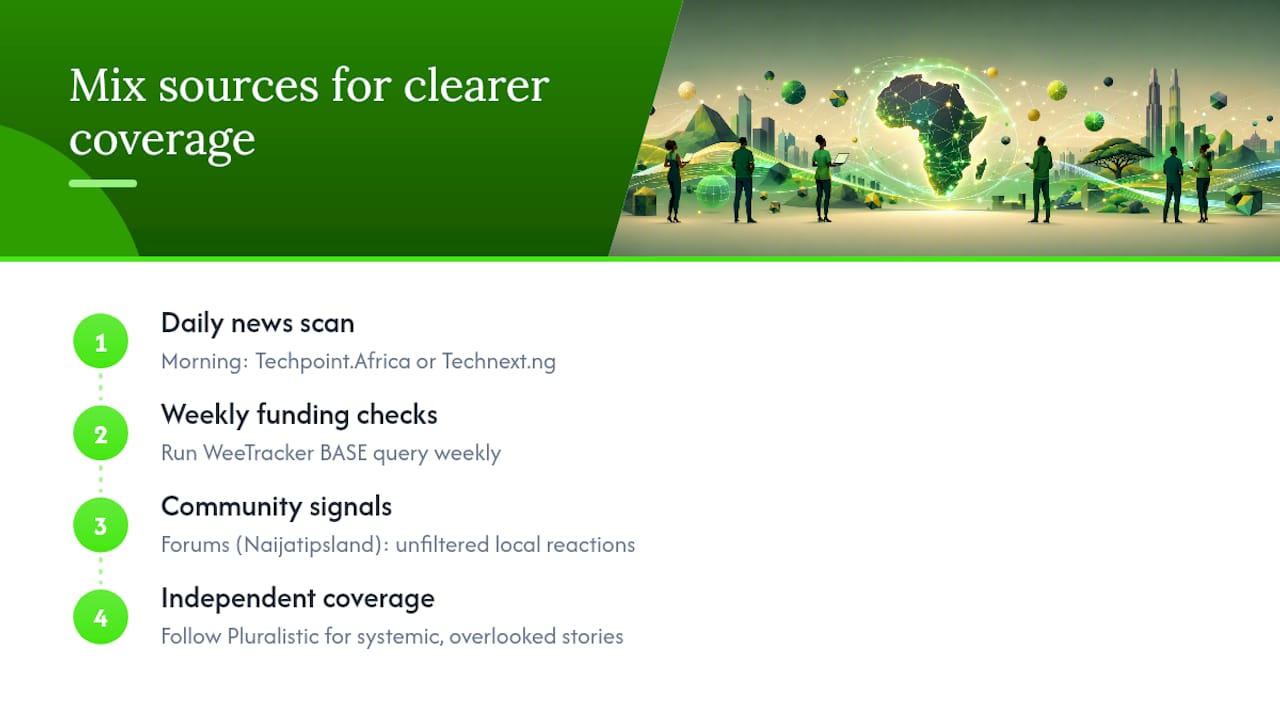
The readers who track African tech most effectively are not loyal to a single outlet. A practical weekly routine looks like this: scan Techpoint.Africa or Technext.ng each morning for breaking news and policy updates, run a WeeTracker BASE query once a week to catch funding rounds that did not make the editorial cycle, and check community forums like Naijatipsland for the local reactions and early signals that formal newsrooms pick up later, if at all.
That last part is underappreciated. Formal reporting is filtered through editorial judgment, which is valuable but also slow. Community platforms surface the unfiltered version: what founders are actually saying, what consumers are complaining about, what rumors are circulating before they become stories. For anyone trying to stay genuinely current on Nigerian and African tech, ignoring that layer means missing a real part of the picture. Independent outlets like Pluralistic make a similar argument for systemic coverage: the stories that do not fit a commercial editorial model still matter, and they require a different kind of source.
Naijatipsland: a community-driven alternative worth bookmarking
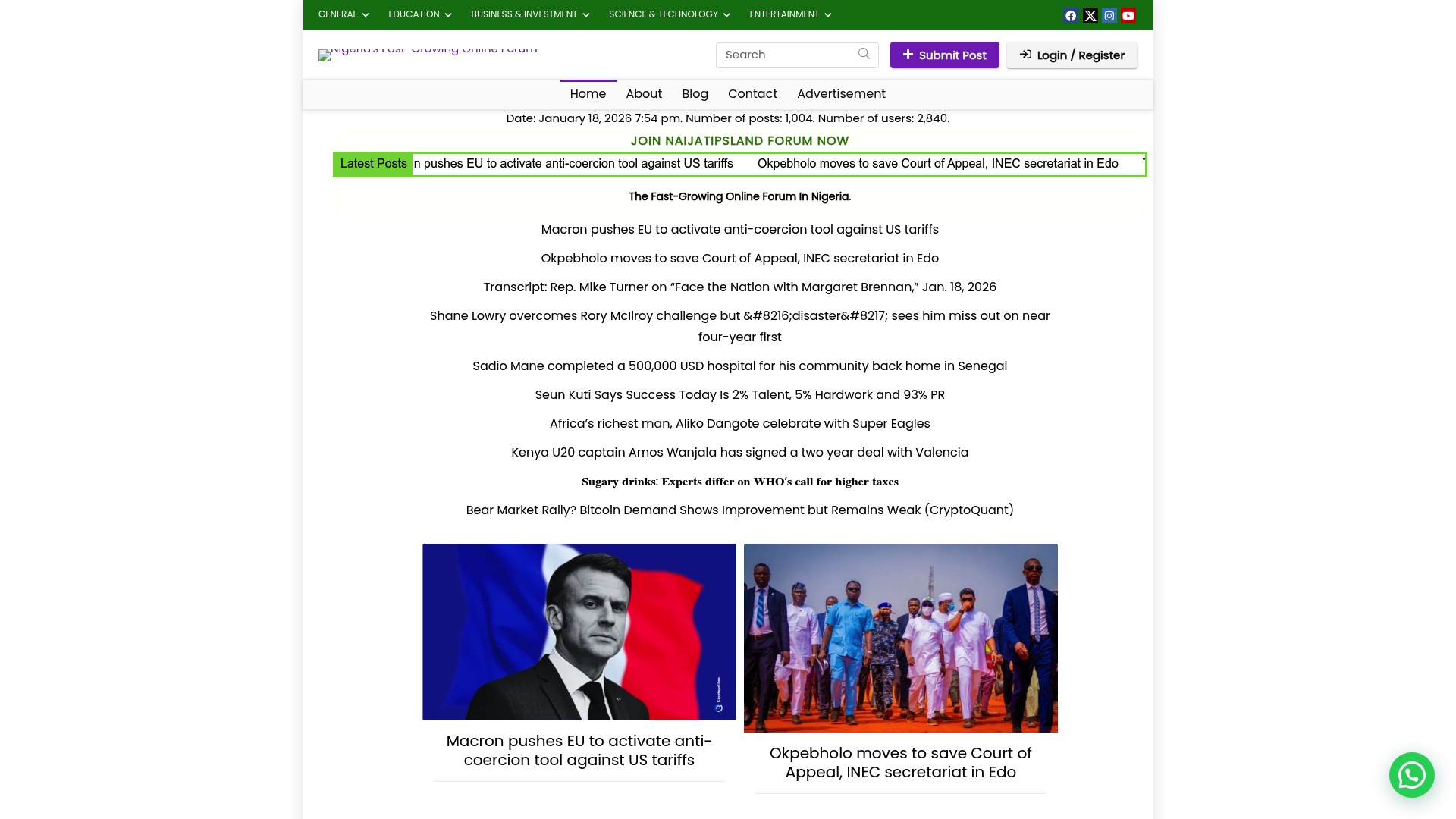
While the editorial outlets above focus on professional journalism, Naijatipsland gives you something different: a live, user-driven forum where Nigerians and diaspora readers discuss tech, entertainment, politics, and current affairs in real time. The platform is entirely free and ad-supported, so there is no subscription barrier between you and the content.
What you get on Naijatipsland:
- Community forums — covering tech, entertainment, sports, business, and local current affairs
- Open submission workflow so you can contribute your own articles and join the conversation
For U.S.-based diaspora readers, Naijatipsland is one of the most accessible ways to stay connected to what Nigerians are actually talking about, not just what editors have decided is worth covering. Visit Naijatipsland to start reading and join the community today.
Useful sources for deeper research
For readers who want to go further, here are the primary sources worth bookmarking:
- WeeTracker — editorial coverage plus The BASE database for African startup and investor data
- CB Insights / TechCabal profile — company intelligence and competitive landscape for TechCabal and its alternatives
- TechCabal on Crunchbase — ownership, funding history, and organizational facts
- TechCrunch — global startup and VC context that complements Africa-focused reporting
- Reuters Technology — wire-style, policy-relevant reporting for cross-border and institutional context
- The Verge — product and platform journalism at global scale, useful as a benchmark for editorial depth
- Pluralistic — ad-free, privacy-respecting coverage of systemic tech issues and platform regulation
- FOSS Force — open-source and free software coverage for readers who need technical depth on infrastructure topics
For internal Naijatipsland resources, the Nigeria Online Forum page explains how community discussion drives local reporting, and the digital banking in Nigeria article is a good example of the site’s fintech coverage depth.