Last updated: 22 October 2026 · By Naijatipsland Editorial Team · Editorial policy
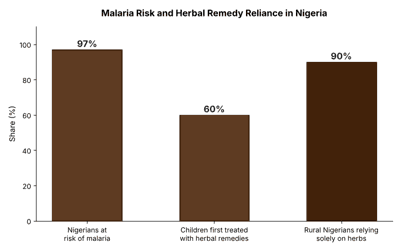
Long before pharmacies became common on every street corner, Nigerian households relied on roots, leaves and bark passed down through generations to treat everyday illnesses — and that reliance hasn’t disappeared. Today, an estimated 90% of rural Nigerians depend solely on herbal remedies for their healthcare needs, and roughly 60% of Nigerian children with malaria-related fevers are first treated with herbal remedies before anything else is tried. The question worth asking isn’t whether these remedies are used — it’s which ones actually hold up when researchers look closely.
Why herbal medicine still matters so much in Nigeria
Nigeria carries the heaviest malaria burden in the world. The country alone accounts for more than 51 million cases and roughly 207,000 deaths every year — about 25.9% of all global malaria cases and nearly 31% of Africa’s malaria deaths. An estimated 97% of Nigeria’s population, around 173 million people, live in areas at risk, with prevalence climbing to 34% in the northwest compared to about 16% in the south and southeast. Children from the poorest households are hit hardest, facing malaria rates roughly seven times higher than children from wealthier homes.
Against that backdrop, it’s easier to understand why traditional remedies remain so deeply embedded in everyday health decisions. The World Health Organization estimated in 1985 that about 65% of the world’s population relied on herbal or traditional treatment in some form; by 2022, that estimate had climbed to roughly 88%. In Nigeria specifically, herbal medicine isn’t a fallback — for many families, especially in rural areas, it’s the primary and sometimes only form of care available.
Five remedies — and what the research actually says
Not every traditional remedy has been studied, and not every one that’s been studied holds up. But several commonly used Nigerian remedies have real evidence behind them, even if they work best as a complement to proper medical care rather than a replacement for it.
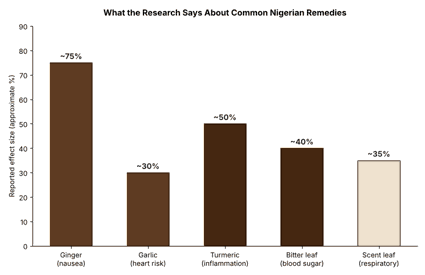
- Ginger for nausea. Research published in journals including the Journal of Nutrition has found ginger can reduce nausea by up to 75% in some studies, making it one of the better-evidenced home remedies for motion sickness, morning sickness, and general stomach upset.
- Garlic for heart health. Regular garlic consumption has been linked to around a 30% reduction in heart disease risk in some research reviewed by ScienceDirect, alongside modest benefits for blood pressure and cholesterol.
- Turmeric for inflammation and joint pain. Curcumin, the active compound in turmeric, has anti-inflammatory effects that Johns Hopkins researchers note can rival some over-the-counter anti-inflammatory medications for joint pain — though dosing and consistency matter.
- Bitter leaf for blood sugar. Several Nigerian studies point to bitter leaf improving insulin sensitivity and helping with blood sugar control, which is part of why it remains a staple in managing diet-related conditions in many households.
- Scent leaf (nchanwu) for coughs and colds. Nigerian medical journals have documented antimicrobial and expectorant properties in scent leaf, supporting its traditional use for coughs, colds, and other respiratory complaints.
A quick-reference guide to using them
Knowing a remedy works in a lab study is different from knowing how to actually use it at home. Here’s the practical version of what each remedy is traditionally used for and how it’s typically prepared.

Where herbal remedies fall short — and why that matters most with malaria
A systematic review of 43 plant species traditionally used against malaria found that only about 37% showed meaningful antimalarial effectiveness in testing. That’s an important number, because malaria is precisely the illness where delay is most dangerous. Treating a child’s fever with herbs first, as roughly 60% of Nigerian families do, can mean losing hours or days before the parasite causing the illness is actually addressed — time that matters enormously with a disease responsible for over 200,000 deaths a year in Nigeria alone, 97% of them caused by the most dangerous malaria species, Plasmodium falciparum.
This is the honest tension at the heart of Nigerian herbal medicine: remedies like ginger, garlic, turmeric, bitter leaf, and scent leaf have real, research-backed value for the everyday complaints they’re traditionally used for — nausea, mild inflammation, blood sugar support, coughs and colds. But for a fever that could be malaria, especially in a child, a rapid test and proper antimalarial treatment from a clinic or pharmacy should never be delayed in favor of home remedies alone.
The bottom line
Nigeria’s natural remedies aren’t folklore to be dismissed, nor are they a substitute for modern medicine when the stakes are high. Ginger, garlic, turmeric, bitter leaf, and scent leaf each have genuine evidence behind their traditional uses for everyday ailments, and there’s nothing wrong with reaching for them first for a mild stomach upset or a seasonal cold. The line to hold firmly is this: for anything that could be malaria, especially with a feverish child, herbal treatment should run alongside — never instead of — a proper diagnosis and medical care.