


Many Nigerian business owners believe VAT registration is optional until they receive penalties from the Federal Inland Revenue Service. The reality is stark: businesses exceeding ₦25 million in annual turnover must register, and failure to comply triggers automatic surcharges. This guide clarifies VAT definitions, legal frameworks, compliance processes, and practical business impacts to help you navigate Nigeria’s 7.5% value-added tax system confidently.
Table of Contents
- Introduction To VAT In Nigeria
- Legal And Regulatory Framework
- VAT Registration And Compliance Requirements
- Calculation, Payment, And Reporting Of VAT
- Exemptions, Zero-Rated Items, And Implications
- Common Misconceptions About VAT In Nigeria
- Practical Impact Of VAT On Nigerian Businesses
- Consequences Of Non-Compliance And Penalties
- Explore More On Nigerian Business And Tax Topics
- Frequently Asked Questions About VAT In Nigeria
Key takeaways
| Point | Details |
|---|---|
| VAT rate | Nigeria charges a flat 7.5% VAT on most goods and services nationwide. |
| Registration threshold | Businesses with annual turnover above ₦25 million must register for VAT with FIRS. |
| Exemptions | Basic food items, medical supplies, and educational materials are exempt from VAT. |
| Penalties | Late payments attract a 10% surcharge plus Central Bank of Nigeria interest rates. |
| Tax nature | VAT is an indirect consumption tax collected by businesses but paid by final consumers. |
Introduction to VAT in Nigeria
Value-added tax represents a consumption tax collected at every stage of production and distribution. Introduced in Nigeria in 1993, VAT replaced the old sales tax system to create a more efficient revenue collection mechanism for federal and state governments.
Nigeria’s VAT operates at a flat 7.5% rate on taxable goods and services. The 2019 VAT Act increased the rate from 5% to 7.5%, affecting businesses nationwide. This rate applies uniformly across all states, though recent court rulings have sparked debates about state collection rights.
What makes VAT an indirect tax is its collection mechanism. Businesses charge customers VAT on sales, then remit collected amounts to FIRS after deducting input tax credits. The final consumer bears the actual tax burden, while businesses act as collection agents.
VAT applies to most goods and services sold in Nigeria, including:
- Retail products and wholesale goods
- Professional services like consulting and legal advice
- Hospitality services including hotels and restaurants
- Telecommunications and technology services
- Construction and real estate transactions
The primary purpose of VAT is generating government revenue while formalizing business taxation. Nigeria collected over ₦2.5 trillion in VAT revenue during 2025, making it a crucial funding source for infrastructure, education, and healthcare.
“VAT is collected at every sale point but ultimately borne by the consumer, making it an indirect tax that businesses must manage carefully to maintain compliance and cash flow.”
Understanding VAT’s foundational principles helps Nigerian entrepreneurs recognize their obligations and plan accordingly. The tax system requires active participation from registered businesses, creating administrative responsibilities alongside financial obligations.
Legal and regulatory framework
The VAT Act 2019 establishes the current legal foundation for VAT collection and enforcement in Nigeria. This legislation replaced earlier VAT laws, modernizing compliance requirements and expanding the tax base to capture digital economy transactions.
Federal Inland Revenue Service serves as Nigeria’s primary VAT authority. FIRS responsibilities include:
- Processing VAT registrations for eligible businesses
- Collecting VAT returns and payments from registered entities
- Conducting audits and investigations into VAT compliance
- Enforcing penalties for non-compliance and late filings
- Providing guidance and clarifications on VAT regulations
The legal framework establishes mandatory registration thresholds, filing schedules, and penalty structures. Businesses operating above specified turnover levels cannot choose whether to participate in VAT collection.
FIRS enforces strict penalties for VAT non-compliance, including financial surcharges and potential criminal charges. Late payment surcharges equal 10% of the outstanding VAT amount plus interest calculated at the Central Bank of Nigeria’s prevailing rate.
Serious violations can trigger additional consequences:
- Business closure orders for persistent non-compliance
- Criminal prosecution for deliberate tax evasion
- Asset seizures to recover unpaid VAT liabilities
- Restrictions on government contract eligibility
The regulatory framework also mandates proper invoicing practices. Registered businesses must issue VAT invoices showing the tax amount separately from base prices. This transparency ensures customers understand the tax component of their purchases.
FIRS has modernized compliance through digital platforms, requiring electronic filing and payment for most VAT obligations. This shift improves efficiency but demands technological adaptation from traditional businesses.
Nigeria’s VAT regulations align with international best practices while addressing local economic realities. The framework balances revenue generation needs with business operational capabilities, though enforcement remains challenging in informal sectors.
VAT registration and compliance requirements
Businesses with annual turnover above ₦25 million must register for VAT under Nigerian law. This threshold applies to total revenue from taxable supplies, not net profit. Voluntary registration is available for businesses below this threshold if they anticipate crossing it soon.

Registration occurs through FIRS’s online portal, requiring specific documentation and information. The process typically takes 7 to 14 business days once all requirements are submitted correctly.
Follow these steps to register for VAT:
- Create an account on the FIRS TaxPro Max platform using your business email and contact information.
- Complete the VAT registration form with accurate business details including incorporation documents and bank information.
- Upload required documents such as Certificate of Incorporation, memorandum and articles of association, and proof of business address.
- Submit the application and await FIRS review and verification of submitted information.
- Receive your VAT registration number via email upon approval, typically within two weeks of submission.
- Begin charging VAT on taxable supplies immediately after receiving your registration number.
Once registered, businesses must comply with ongoing obligations. These include issuing proper VAT invoices, maintaining detailed transaction records, and filing periodic returns with FIRS.
VAT invoices must contain specific information: supplier name and VAT number, customer details, transaction date, description of goods or services, base amount before VAT, VAT amount at 7.5%, and total amount including VAT.
Pro Tip: Set up a separate bank account for VAT collections to avoid mixing tax money with operational funds. This practice simplifies reconciliation and ensures sufficient funds for timely VAT payments to FIRS.
Filing schedules depend on business size and turnover. Large businesses typically file monthly returns, while smaller entities may qualify for quarterly filing. Missing deadlines triggers automatic penalties regardless of payment status.
Maintaining compliance requires robust accounting systems that track input VAT, output VAT, and eligible credits. Many Nigerian businesses use accounting software to automate VAT calculations and generate compliant reports for FIRS submission.
Calculation, payment, and reporting of VAT
VAT calculation in Nigeria uses a 7.5% rate applied to the sale price of taxable goods and services. The formula is simple: Sale Price × 0.075 = VAT Amount. For example, a ₦100,000 sale generates ₦7,500 in VAT, making the total customer payment ₦107,500.
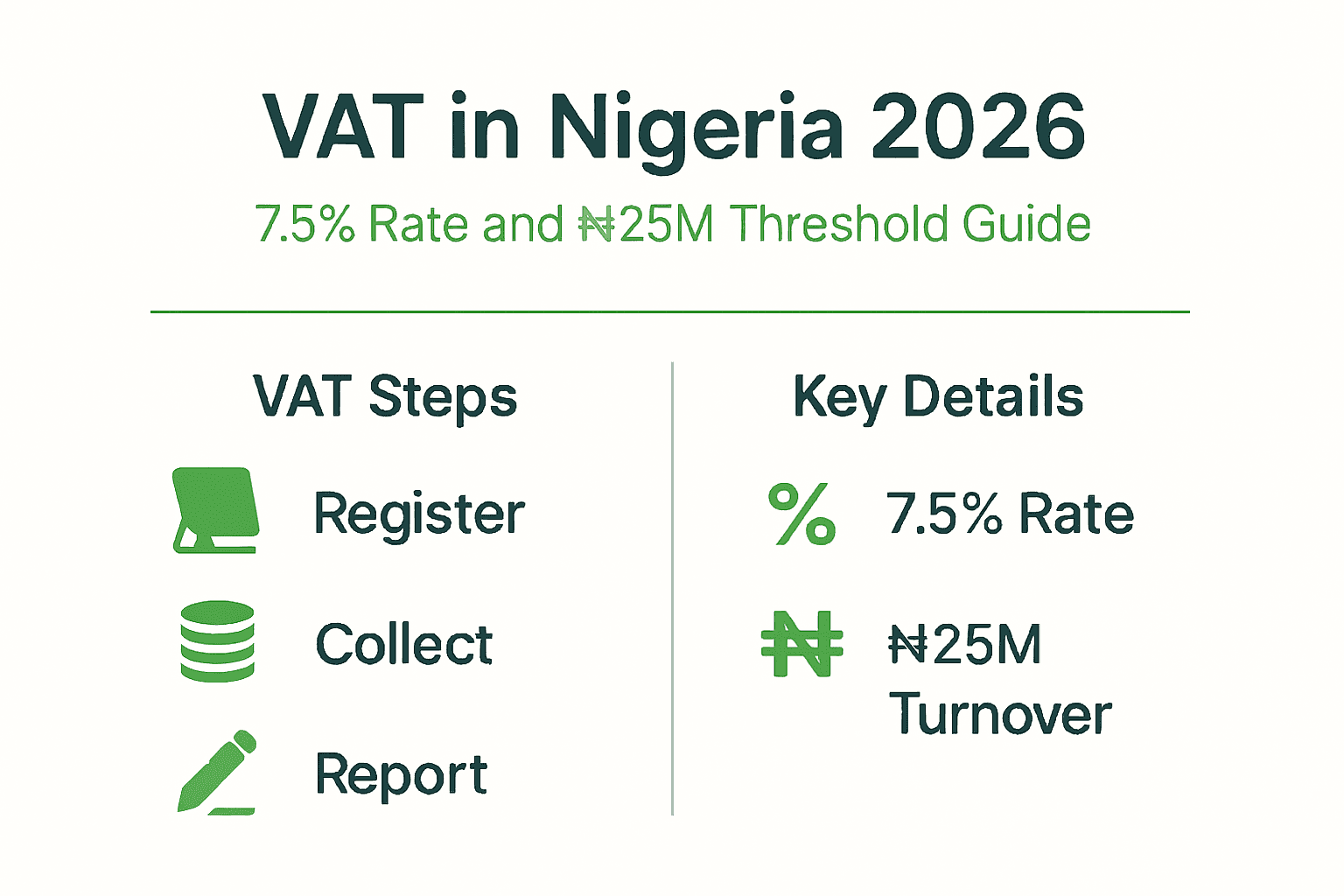
Input tax credits reduce the VAT businesses owe to FIRS. When you purchase business inputs, you pay VAT to suppliers. This input VAT can offset the output VAT you collect from customers.
The net VAT calculation works as follows:
- Total output VAT collected from customers: ₦500,000
- Total input VAT paid to suppliers: ₦300,000
- Net VAT payable to FIRS: ₦200,000
Businesses remit only the difference between output and input VAT, not the full amount collected. This mechanism prevents double taxation and ensures VAT applies only to value added at each stage.
| Transaction Type | Base Amount | VAT (7.5%) | Total Amount |
|---|---|---|---|
| Sale to customer | ₦200,000 | ₦15,000 | ₦215,000 |
| Purchase from supplier | ₦120,000 | ₦9,000 | ₦129,000 |
| Net VAT payable | ₦80,000 | ₦6,000 | – |
Filing schedules vary by business size. Large corporations with significant turnover file monthly returns by the 21st day following each month. Smaller businesses may qualify for quarterly filing, submitting returns within 21 days after each quarter ends.
Late filing or payment attracts immediate penalties. FIRS charges a 10% surcharge on unpaid VAT amounts plus interest calculated using Central Bank of Nigeria rates. These penalties compound monthly, making delays increasingly expensive.
Pro Tip: Schedule VAT payments at least three business days before deadlines to account for banking delays. Electronic transfers sometimes experience processing lags that could cause unintended late payments and automatic penalty assessments.
Accurate record keeping is essential for VAT reporting. Maintain detailed sales and purchase registers showing all transactions, VAT amounts, and supplier or customer information. FIRS may request these records during audits, and missing documentation can result in disallowed input tax credits.
Electronic filing through FIRS platforms has become mandatory for most businesses. The TaxPro Max system allows online return submission, payment processing, and compliance tracking. Paper filing is now limited to exceptional circumstances requiring prior FIRS approval.
Exemptions, zero-rated items, and implications
Nigerian VAT law distinguishes between exempt supplies and zero-rated supplies, creating different tax and credit implications for businesses. Understanding these categories prevents costly compliance errors.
Exempt goods and services are not subject to VAT, and businesses cannot claim input tax credits on purchases used to produce them. Exemptions include:
- Basic food items like bread, cereals, and unprocessed agricultural products
- Medical and pharmaceutical products for human consumption
- Books, newspapers, and educational materials
- Baby products including diapers and formula
- Commercial vehicle transport services
Zero-rated supplies carry a 0% VAT rate but remain within the VAT system. Businesses supplying zero-rated items can claim input tax credits on related purchases, creating potential refund situations.
Common zero-rated items include:
- Exported goods and services sold to customers outside Nigeria
- Plant, machinery, and equipment purchased for use in export processing zones
- Goods and services for humanitarian donor-funded projects
- Selected agricultural equipment and inputs
| Category | VAT Rate | Input Tax Credits | Common Examples |
|---|---|---|---|
| Taxable | 7.5% | Allowed | Electronics, clothing, professional services |
| Exempt | Not applicable | Not allowed | Basic foods, medicines, educational books |
| Zero-rated | 0% | Allowed | Exports, EPZ machinery, donor projects |
The distinction matters significantly for business planning. A company selling exempt goods cannot recover VAT paid on inputs, making those costs a permanent expense. Conversely, exporters benefit from zero-rating by recovering all input VAT.
Mixed supply businesses face complexity when dealing with both taxable and exempt supplies. Proper apportionment of input VAT becomes necessary, requiring detailed tracking of which inputs relate to which supply categories.
Pro Tip: Document the basis for claiming exemptions or zero-rating meticulously. FIRS frequently challenges these classifications during audits, and insufficient evidence can result in retrospective VAT assessments plus penalties.
Correct classification affects pricing strategies and competitiveness. Businesses selling exempt items absorb input VAT as a cost, potentially requiring higher base prices compared to zero-rated competitors who recover these amounts.
Common misconceptions about VAT in Nigeria
Many Nigerian entrepreneurs misunderstand fundamental VAT principles, leading to compliance failures and unnecessary penalties. Addressing these misconceptions prevents costly mistakes.
Myth: VAT registration is optional if your business is small. Reality: Registration becomes mandatory once annual turnover exceeds ₦25 million. FIRS actively monitors business revenues and issues penalties for unregistered entities operating above the threshold.
Myth: You can include VAT in your advertised prices without separate disclosure. Reality: Nigerian regulations require transparent VAT disclosure. Invoices must show the base price and VAT amount separately, ensuring customers understand the tax component.
Myth: VAT doesn’t affect business cash flow since customers pay it. Reality: Timing mismatches create significant cash flow challenges. You remit VAT to FIRS monthly or quarterly, but customers might delay payments, leaving you to cover VAT obligations from working capital.
Myth: Missing one VAT filing deadline isn’t serious. Reality: Every late filing triggers automatic penalties regardless of whether you eventually pay. FIRS systems generate surcharges immediately, and accumulating multiple violations can lead to business closure orders.
Myth: Small businesses can ignore VAT if they operate informally. Reality: Informal operations don’t exempt you from tax obligations. FIRS increasingly targets informal businesses through third-party data and banking transaction monitoring.
Key realities to understand:
- VAT registration thresholds apply to gross revenue, not profit margins
- Input tax credits require proper documentation and compliant supplier invoices
- Export zero-rating needs supporting evidence like shipping documents and foreign payment proof
- Voluntarily registering below the threshold creates immediate compliance obligations
Pro Tip: Conduct a VAT health check annually with a qualified tax consultant. Professional review identifies compliance gaps before FIRS audits discover them, giving you time to correct issues and avoid penalties.
Many businesses mistakenly believe cash flow challenges justify delaying VAT payments. This thinking backfires spectacularly when penalties accumulate. Proper VAT planning treats collected tax as FIRS money held temporarily, never as available working capital.
Practical impact of VAT on Nigerian businesses
VAT creates significant operational and financial effects for Nigerian businesses, particularly small and medium enterprises operating with tight cash flow margins.
Small businesses often struggle with timing gaps between collecting VAT from customers and remitting it to FIRS. When customers delay payments, businesses must still meet monthly filing deadlines, potentially requiring bank loans or depleting operational reserves.
The 7.5% VAT rate directly affects pricing strategies and competitiveness. Businesses must decide whether to absorb VAT in advertised prices or add it on top. Consumer sensitivity to price increases can impact sales volumes, especially in price-competitive markets.
Cash flow implications include:
- Advancing VAT payments while awaiting customer settlements
- Maintaining adequate liquidity reserves for monthly FIRS remittances
- Managing working capital constraints when input VAT exceeds output VAT
- Dealing with non-recoverable VAT on exempt supplies
VAT compliance demands robust accounting infrastructure. Manual systems struggle to track input credits, apportion mixed supplies, and generate accurate FIRS reports. Most growing businesses eventually invest in accounting software, creating additional operational costs.
Compliance improves business credibility with multiple stakeholders. Banks view VAT registration and regular filing as positive indicators when evaluating loan applications. Government contracts often require proof of VAT compliance. Large corporate customers prefer suppliers with proper VAT registration.
Strategic VAT planning helps balance compliance and cash flow. Setting payment terms that align with FIRS deadlines reduces financing pressure. Negotiating faster customer payments specifically for VAT components improves liquidity. Building VAT contingency reserves prevents last-minute scrambling.
Export-oriented businesses benefit from zero-rating provisions but face refund processing delays. FIRS can take months to process input tax credit refunds, creating working capital needs that smaller businesses struggle to finance.
The administrative burden is substantial for businesses without dedicated accounting staff. Processing invoices, reconciling records, calculating credits, and filing returns consume time that entrepreneurs could spend on business development.
Consequences of non-compliance and penalties
Failing VAT obligations triggers escalating penalties that can devastate Nigerian businesses financially and operationally. Understanding these consequences emphasizes compliance importance.
Late VAT payments incur a 10% surcharge plus interest calculated at Central Bank of Nigeria rates. For a ₦1 million VAT liability, one month’s delay costs ₦100,000 in surcharge plus approximately ₦25,000 in interest, totaling ₦125,000 in avoidable penalties.
Repeated non-compliance escalates FIRS enforcement actions. The authority follows a progressive approach:
- Automated penalty assessments issued immediately upon filing deadline passage.
- Demand notices requiring payment within specified timeframes, typically 30 days.
- Tax audits investigating underlying compliance issues and potentially identifying additional liabilities.
- Asset liens and bank account restrictions to secure unpaid tax debts.
- Business closure orders for persistent offenders refusing to comply.
- Criminal prosecution for deliberate tax evasion involving false returns or fraudulent claims.
Tax fraud in VAT matters constitutes a criminal offense under Nigerian law. Deliberately understating output VAT, claiming fictitious input credits, or operating above registration thresholds without registering can result in imprisonment and substantial fines.
“Maintaining timely VAT filing and payments protects business continuity and prevents costly penalty accumulation that diverts resources from growth investments.”
Non-compliance damages business reputation beyond financial penalties. Public tax records show defaulters, affecting relationships with customers, suppliers, and financial institutions. Government agencies exclude non-compliant businesses from procurement opportunities.
FIRS increasingly uses data analytics and third-party information to identify non-compliant businesses. Banking transaction monitoring, import data analysis, and industry benchmarking help authorities detect unregistered entities and under-reported revenues.
Voluntary disclosure before FIRS detection offers some relief. Businesses discovering past compliance errors can approach FIRS proactively, potentially negotiating reduced penalties compared to amounts assessed during enforcement actions.
The cost of compliance is always lower than penalties for non-compliance. Investing in proper accounting systems, professional tax advice, and timely filing prevents expensive problems while building business credibility and sustainability.
Explore more on Nigerian business and tax topics
Navigating VAT compliance represents just one aspect of running a successful business in Nigeria. Naijatipsland offers extensive resources covering business registration, financial management strategies, and regulatory updates affecting Nigerian entrepreneurs.
Our platform connects you with a vibrant community of Nigerian business owners sharing practical insights, discussing regulatory changes, and supporting each other through compliance challenges. Beyond VAT, explore topics ranging from online business opportunities to understanding how news forums shape business information access across Nigeria. Join thousands of entrepreneurs staying informed about tax policy changes, business strategy innovations, and market opportunities through active community discussions and expert-contributed articles.
Frequently asked questions about VAT in Nigeria
What is the current VAT rate in Nigeria?
Nigeria charges a flat 7.5% VAT rate on taxable goods and services nationwide. This rate increased from 5% following the 2019 VAT Act amendments and applies uniformly across all states, though implementation debates continue regarding state versus federal collection authority.
Who must register for VAT in Nigeria?
Businesses with annual turnover exceeding ₦25 million must register for VAT with FIRS. This threshold applies to gross revenue from taxable supplies, not net profit. Voluntary registration is available for businesses below this amount anticipating future growth past the mandatory threshold.
What is the difference between exempt and zero-rated goods?
Exempt goods are not subject to VAT and businesses cannot claim input tax credits on purchases used to produce them. Zero-rated goods carry 0% VAT but remain in the VAT system, allowing businesses to claim input tax credits and potentially receive refunds when input VAT exceeds output VAT.
What penalties apply for late VAT payment in Nigeria?
Late VAT payments attract a 10% surcharge on the outstanding amount plus interest calculated at Central Bank of Nigeria rates. These penalties apply automatically from the deadline date and compound monthly. Persistent non-compliance can lead to business closure, asset liens, and criminal prosecution for deliberate evasion.
How does VAT affect small business cash flow?
VAT creates timing mismatches between collecting tax from customers and remitting it to FIRS. When customers delay payments, businesses must still meet monthly filing deadlines using working capital. This cash flow pressure intensifies for businesses with thin profit margins or seasonal revenue patterns requiring careful liquidity planning.
Can I claim VAT refunds if my input tax exceeds output tax?
Yes, businesses can claim VAT refunds when input tax credits exceed output VAT collected, typically occurring with export-focused companies enjoying zero-rating benefits. However, FIRS refund processing can take several months and requires comprehensive documentation proving the legitimacy of claimed input credits and export transactions.