Last updated: 22 October 2026 · By Naijatipsland Editorial Team · Editorial policy
Working from home in Nigeria comes with a very different set of stresses than the global conversation about WFH burnout usually covers. It’s not just about Zoom fatigue or blurred boundaries – it’s about whether your power will hold, whether your data will last till the end of a client call, and whether a single bad network day could cost you a job opportunity. Only 14% of Nigerian businesses operate fully remotely, and the infrastructure gap means remote work here carries a layer of stress that workers in more reliable markets rarely have to think about. Here’s what’s actually driving that stress, and what genuinely helps.
How Nigerians Actually Work
According to Zoho’s 2024 State of Productivity and Collaboration in Nigeria report, which surveyed over 500 organisations, most Nigerian businesses still operate on-site, with remote work remaining a minority arrangement.
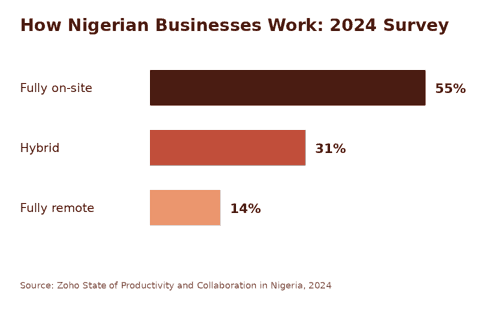
- 55% of businesses are fully on-site.
- 31% use a hybrid setup.
- 14% are fully remote – typically roles held by individual contributors who need little day-to-day collaboration.
That last point matters: the people working fully remote in Nigeria are disproportionately freelancers, consultants, and contractors serving clients abroad – exactly the group most exposed to the infrastructure problems below, often with no employer IT department to fall back on.
What’s Actually Driving the Stress
The pain points aren’t the ones you’d expect from Western remote-work advice. Nigerian remote workers are fighting infrastructure, not just workplace culture.
Power and connectivity failures
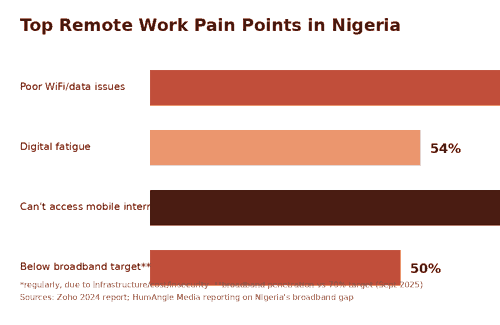
80% of respondents in Zoho’s survey reported poor WiFi or data problems that hinder collaboration – and that’s before factoring in Nigeria’s well-known power supply challenges. Independent reporting backs this up starkly: Nigeria ranks 131st of 156 countries for fixed broadband download speed, broadband penetration was still below 50% as of September 2025 (short of a 70% national target), and up to 71% of Nigerians cannot regularly access mobile internet due to infrastructure, cost, or insecurity in their area. For remote workers, this isn’t an inconvenience – it’s a livelihood risk. One Lagos-based freelancer lost a job opportunity paying in dollars after her connection failed mid-interview; another was rejected after a required speed test failed because of unreliable service.
Digital fatigue
54% of respondents reported digital fatigue – the exhaustion of being constantly reachable across multiple apps and platforms, with 35% of workers juggling 6 to 10 apps daily and senior staff often managing more than 10.
The cost of staying online
Nigerians pay more for internet access than people in 148 other countries, including the US and China. For many remote workers, a backup data plan or a more reliable connection like Starlink or fibre is simply unaffordable, which means a single network failure during an important call can’t always be worked around.
Coping With Work-From-Home Stress
None of this means remote work in Nigeria is unworkable – it means the coping strategies have to account for infrastructure realities most WFH advice ignores.
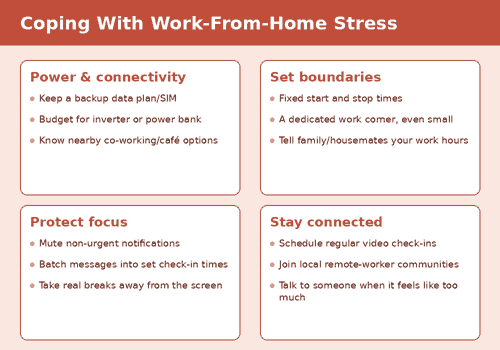
Power and connectivity
- Keep a backup data plan or a second SIM from a different network as insurance against one provider’s outages
- Budget for an inverter, power bank, or generator fuel as a real line item, not an afterthought – treat it as part of the cost of working remotely
- Know your nearest reliable co-working space or café in advance, so a power or network failure on an important day doesn’t catch you scrambling
Set boundaries
- Decide on fixed start and stop times for work, even if your schedule is flexible
- Set up a dedicated work corner, even a small one, to create a mental separation between work and home space
- Tell family or housemates your working hours clearly, so interruptions are the exception rather than the norm
Protect your focus
- Mute non-urgent notifications and batch messages into set check-in times instead of responding to everything instantly
- Take real breaks away from the screen, not just a scroll through a different app
Stay connected
- Schedule regular video check-ins with colleagues or clients so isolation doesn’t compound the stress of unreliable infrastructure
- Join local remote-worker or freelancer communities – they’re often the fastest way to learn which providers, backup options, or co-working spaces actually work in your area
- Talk to someone when it feels like too much – the stress of unreliable infrastructure is real and worth acknowledging, not just pushing through
The Bottom Line
Working from home in Nigeria means managing two layers of stress at once: the universal challenge of boundaries and focus, and a uniquely local layer of power and connectivity risk that can directly threaten income. Budgeting for backup power and data as seriously as you’d budget for any other business cost, building boundaries that protect your time, and staying connected to people who understand exactly what you’re dealing with all make a real difference – even when the infrastructure itself is out of your hands.
This article is for general informational purposes. Infrastructure conditions, data costs, and availability of backup options vary significantly by location within Nigeria and can change over time.