
Affordable Tech Courses for Beginners in Nigeria (2026): Free and Paid Options


Last updated: 2 November 2026 · By Naijatipsland Editorial Team · Editorial policy
Checked 2 November 2026. Learning a tech skill no longer has to start with a ₦1 million bootcamp. Nigerians can now begin with government-funded training, sponsored programmes, free online curricula and low-cost certificates, then pay for more structured teaching only when they know which direction suits them. The hard part is sorting the genuine options from the noise, and budgeting for the costs nobody advertises, such as data, a usable laptop and power.
This guide lists named free and paid options you can check yourself, with the prices published on the providers’ own pages or in dated comparisons, how long each takes, what kind of certificate you get, which skill to start with and how to avoid bootcamp scams. If you want the bigger picture first, read our guide to the skills in demand in 2026.
Free tech courses for beginners
3MTT (Three Million Technical Talent)
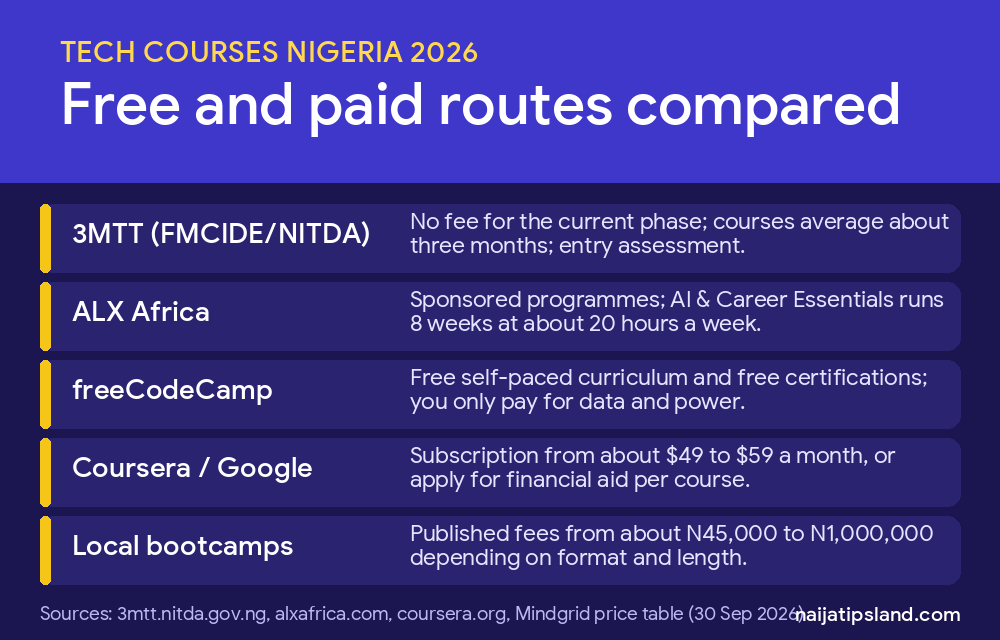
3MTT is run by the Federal Ministry of Communications, Innovation and Digital Economy with NITDA. Its official site says there is no fee for the current phase, although participants cover their own transport, meals and similar costs. Tracks listed include software development, data analysis and visualisation, data science, AI and machine learning, UI/UX design, cloud computing, DevOps, cybersecurity, product management, quality assurance, animation and game development. Courses average about three months, and applicants take an entry assessment that places them on a suitable course. Applications go through the official 3MTT portal linked from 3mtt.nitda.gov.ng. Intakes open and close in phases, so check the official site rather than WhatsApp forwards for dates. Related schemes such as the DeepTech programme and the Airtel x 3MTT NextGen Fellowship are more selective.
ALX Africa
ALX runs sponsored programmes for young Africans, many backed by the Mastercard Foundation. Its AI & Career Essentials programme is listed at 8 weeks at about 20 hours a week and needs no coding background; it covers prompting, responsible AI use, content creation with AI and data-driven decisions. ALX also lists data, virtual assistant and other tracks. Independent comparisons in 2026 describe ALX programmes as free or sponsored with competitive intake; confirm the terms on alxafrica.com before you apply.
freeCodeCamp
freeCodeCamp is a non-profit with a free, self-paced curriculum in web design, JavaScript, Python, data analysis and more. Its certifications are free; you only pay for your own data and power. It suits disciplined self-learners who want proof of skills through projects rather than classroom time.
HNG Internship
HNG runs a free, fast-paced online internship with an elimination format. It is better for people who already know the basics and want pressure, teamwork and real tasks than for complete beginners.
Low-cost paid options
Google Career Certificates and Coursera
Google’s professional certificates in data analytics, IT support, UX design, cybersecurity and project management are taught on Coursera. Coursera’s own page quotes $49 a month in the US and Canada after a 7-day free trial, and Coursera Plus is listed at $59 a month. Local pricing differs by country; a September 2026 Nigerian comparison put Coursera Plus at roughly ₦39,000 to ₦45,000 a month. If you cannot afford it, use the Financial aid available link on the course page. Coursera says you fill in an application about your education, goals and finances and wait up to 16 days for review; starting a free trial cancels the application, and aid only covers the course it was approved for.
Udemy
Udemy sells single courses with lifetime access. List prices run from $19.99 to $199.99, but courses are frequently discounted to around $9.99 to $18.99. Pay with a naira card that allows international payments or a dollar virtual card. Udemy certificates show completion, not assessed skill, so build projects alongside.
Local bootcamps
Nigerian bootcamps add live teaching, mentors and deadlines. Published fees vary widely, as the table shows.
| Provider / course | Published cost | Duration | Certificate |
|---|---|---|---|
| 3MTT | Free (current phase) | About 3 months | Programme completion; check current terms |
| ALX AI & Career Essentials | Sponsored | 8 weeks, about 20 hrs/week | ALX completion |
| freeCodeCamp | Free | Self-paced | Free project-based certifications |
| Google certificates on Coursera | $49/month (US price) or financial aid | Self-paced, often 3 to 6 months | Google professional certificate |
| Udemy single course | $19.99 to $199.99 list, often on sale | Self-paced | Certificate of completion |
| AltSchool Africa nano-diplomas | From about ₦45,000 | Short programmes | AltSchool certificate |
| AltSchool Africa diplomas | $290 upfront or $30/month | Multi-month | AltSchool diploma |
| GOMYCODE Intro to Cybersecurity | ₦189,000 | 12 weeks | GOMYCODE certificate |
| Utiva bootcamps | $300 to $500 | Online cohort | Utiva certificate |
| Tech365 frontend | ₦1,000,000 | 3 months | Tech365 certificate |
Bootcamp figures are from providers’ public pages as compiled in Mindgrid Academy’s dated comparison of 30 September 2026; Coursera and Udemy figures are from their own pages and payment guides. Prices change, so confirm before paying.
Which skill should you start with?
Pick a skill that matches how you like to work, not the one with the loudest adverts. A good test is to spend two free weeks on the basics before paying for anything.
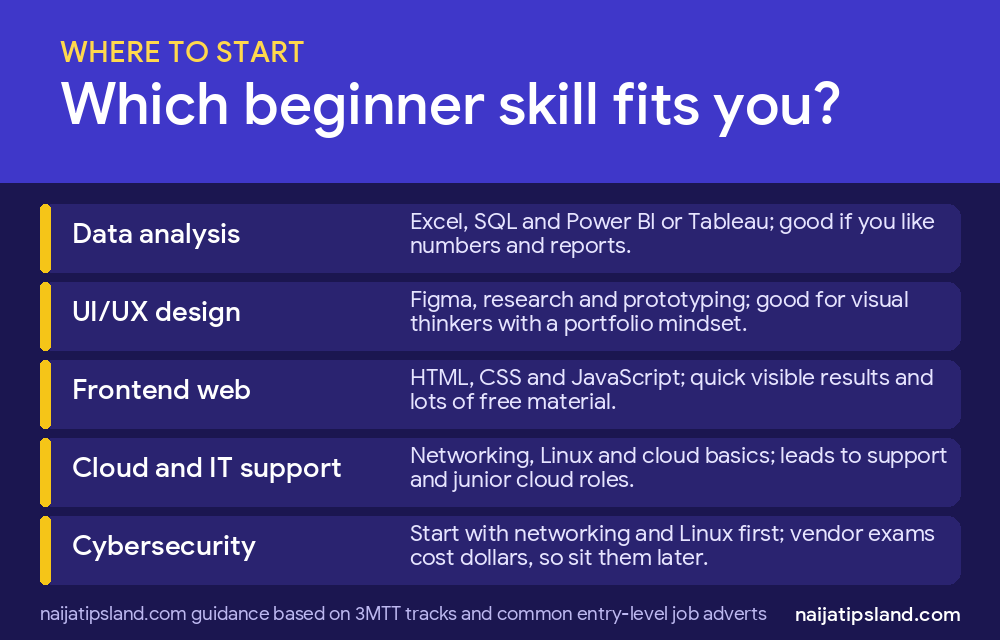
- Data analysis: Excel, SQL and a dashboard tool such as Power BI. It fits accountants, administrators and anyone who already works with reports, and many local employers hire for it.
- UI/UX design: Figma, user research and prototypes. You need a portfolio of case studies, not just a certificate.
- Frontend web development: HTML, CSS and JavaScript. Free material is plentiful and results are visible quickly, which keeps motivation up.
- IT support and cloud: networking, Linux and cloud basics. Google’s IT Support certificate is a common entry point.
- Cybersecurity: start with networking and Linux; vendor exams are priced in dollars, so sit them once you are earning.
If you are unsure about online learning itself, our article on the advantages of e-learning explains what self-paced study demands, and our guide to digital literacy covers the basics to master first.
The hidden costs: data, laptop and power
The course fee is rarely the whole bill. Plan for these before you start:
- Data: video lessons eat data. MTN’s own price list on 2 November 2026 showed 10GB plus 10 minutes for ₦4,500 and 20GB for ₦7,500, both valid for 30 days. Download lessons on Wi-Fi where you can and watch at lower resolution.
- Laptop: a used machine with 8GB of RAM and an SSD is the practical minimum for coding and data tools; 4GB laptops struggle. Buy from a seller who lets you test it.
- Power: a power bank that can charge a laptop or a small inverter avoids missed live classes during outages.
- Time: most beginner tracks need 8 to 20 hours a week for two to three months, plus portfolio work after.
- Exam fees: AWS, CompTIA and similar exams are charged in dollars and are optional at the start.
How to judge a bootcamp before you pay
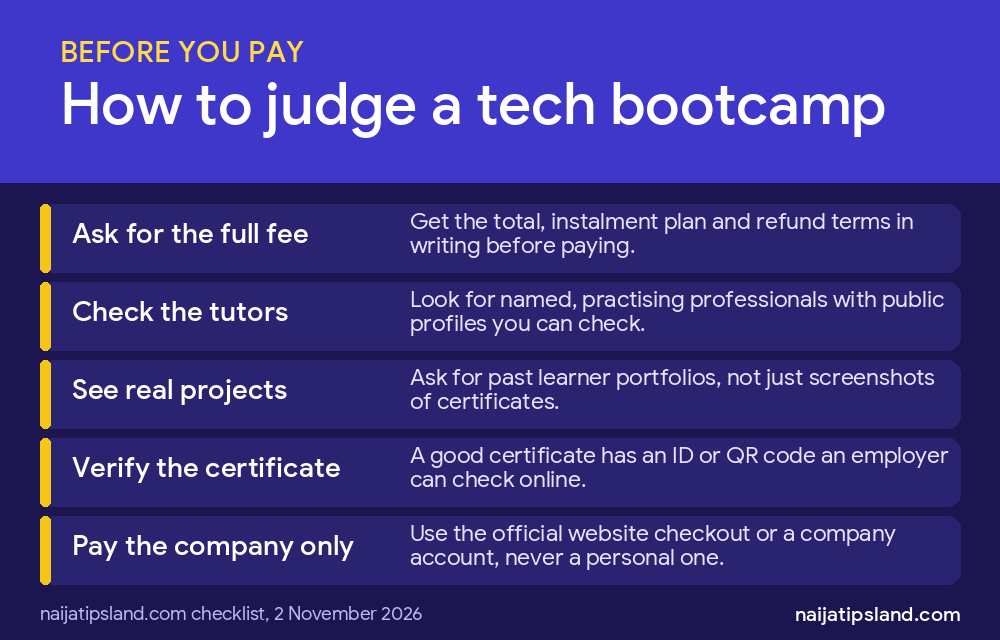
- Ask for the full fee, instalment plan and refund policy in writing.
- Check that tutors are named, practising professionals with public profiles.
- Ask to see real past learner projects and where graduates now work.
- Find out whether classes are live, recorded or both, and the class size.
- Check whether the certificate has an ID or QR code that employers can verify online.
- Confirm the company is registered; you can search its name on the CAC portal. Our guide to business name registration explains what registration means.
How to avoid tech course scams
Free government and sponsored programmes attract fraudsters. Watch for these warning signs:
- “Registration fee” for a free programme: 3MTT says there is no fee for its current phase. Anyone asking you to pay to “secure a slot” is not the official programme.
- Look-alike links: apply only through links on official sites such as 3mtt.nitda.gov.ng, alxafrica.com and coursera.org, not shortened links in WhatsApp groups.
- Guaranteed jobs or dollar salaries: no honest course can promise a job. Treat “pay ₦50,000 and earn $2,000 a month” as a red flag, just as with fake job adverts.
- Payment to personal accounts: pay through the provider’s website checkout or a company account in its registered name, and keep the receipt.
- Pressure to pay today: genuine early-bird discounts have published end dates; a caller demanding payment within the hour is a warning.
A simple plan by budget
- ₦0: apply to 3MTT or ALX, and study freeCodeCamp or free Coursera audits in the meantime.
- Under ₦50,000: a month or two of Coursera (or a financial aid application), a discounted Udemy course, and a data plan.
- ₦150,000 and above: a local live bootcamp, once you have tested the skill for free and checked the provider carefully.
Once you have skills and a portfolio, see our guides to remote jobs for Nigerians paid in dollars and the best freelance websites for Nigerians.
Frequently asked questions
Is 3MTT really free?
Yes. The official 3MTT site says there is no fee for the current phase, though you pay for your own transport, meals and data. Ignore anyone charging to register you.
What is the cheapest way to get a Google certificate in Nigeria?
Apply for Coursera financial aid on the course page and wait up to 16 days for a decision. Do not start a free trial while you wait, as that cancels the application.
Which tech skill is easiest for a complete beginner?
Many beginners find data analysis with Excel and SQL, or frontend web basics, the easiest to start because results are visible quickly and free material is plentiful.
Do I need a laptop to learn tech?
You can start some lessons on a phone, but serious practice needs a laptop. A used machine with 8GB of RAM and an SSD is a sensible minimum.
Are free certificates respected by employers?
Employers care more about what you can show. A free certificate plus two or three solid portfolio projects usually beats an expensive certificate with nothing to show.
How long does it take to become job-ready?
Most beginners need three to six months of steady study, then a further two to four months of projects and applications.
Disclaimer: this guide is general information based on providers’ official pages, Coursera’s help centre, MTN’s price list and dated published comparisons available on 2 November 2026. Programmes, intakes and prices change often, and dollar prices move with the exchange rate, so confirm details with each provider before applying or paying. Providers named are examples, not endorsements.









Quick tip: if you apply for Coursera financial aid, do not start the free trial while you wait, because that cancels your application. Which free or paid course helped you most when you started in tech? Share your experience below.