Last updated: 28 October 2026 · By Naijatipsland Editorial Team · Editorial policy
When Nigerians ask for the “easiest work visa”, they usually mean one of two things: a visa they can get without already holding a job offer, or a visa that employers actually sponsor. Both exist, and neither is truly effortless. This guide separates the routes, explains the real requirements from official government sources, and flags where the money and the risk sit. Checked 28 October 2026. Rules change, so confirm each point on the official page before you pay a fee.
What “easy” should mean
An easy visa is not the one with the shortest advert. It is the one where the requirements are published, objective and within your reach: a degree or training you already have, a language test you can pass, savings you can show. Be suspicious of any agent who calls a route easy without asking about your qualifications.
Routes that need no job offer
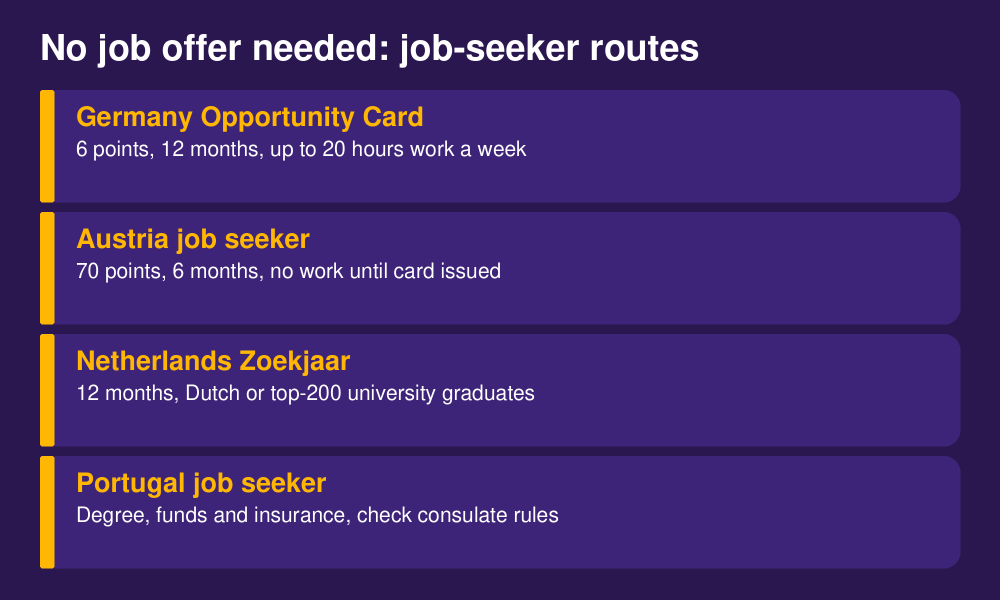
Germany: Opportunity Card (Chancenkarte)
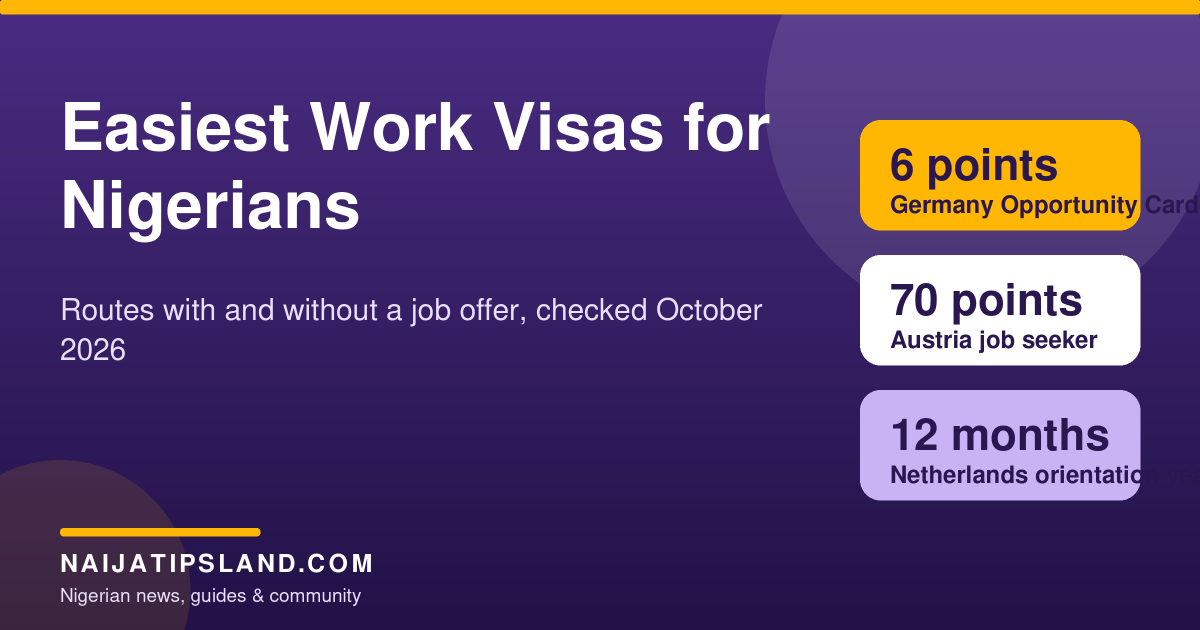
This is the most talked-about option, and for good reason. The Opportunity Card lets non-EU citizens come to Germany to look for work without a job contract. Under the points route you need at least six points, plus a completed degree or at least two years of vocational training that is recognised in the country where you earned it, and basic language proof: German at A1 or English at B2. The German embassy’s checklist notes that native English speakers are usually exempt from proving English, depending on the individual case. Points are awarded for language, work experience, age and any previous stay in Germany, and one point can come from applying jointly with a partner. If your qualification is already recognised in Germany, you qualify as a skilled worker without the points test.
The card is issued for up to one year. During that time you may take part-time work of up to 20 hours a week and do job trials of up to two weeks per employer. You must show you can support yourself; the German mission’s guidance gives a monthly figure of at least €1,091 as a general benchmark. Once you find qualified work, you switch to the proper residence permit at the local foreigners’ office.
Austria: job-seeker visa (Red-White-Red Card route)
Austria offers a six-month job-seeker visa to highly qualified people who reach at least 70 points across education, experience, language and age. It is hard to score that high, and you cannot work until you personally receive the Red-White-Red Card after finding an employer. It suits strong profiles, not beginners.
Netherlands: orientation year (Zoekjaar)
The Dutch orientation-year permit gives recent graduates twelve months to look for work, freelance or start a business, with no separate work permit needed. The catch is the eligibility test: you must have graduated from a Dutch university or one in the global top 200, and apply within three years of graduating. The fee quoted by recent guides is about €210. If you studied at a ranked university, it can be one of the most flexible routes in Europe.
Portugal and others
Portugal has a job-seeker visa that asks for a degree or equivalent qualification, proof of funds and health insurance, but consulate practice varies, so confirm the current requirements with the Portuguese embassy that covers Nigeria before you rely on it.
Routes where an employer does the heavy lifting
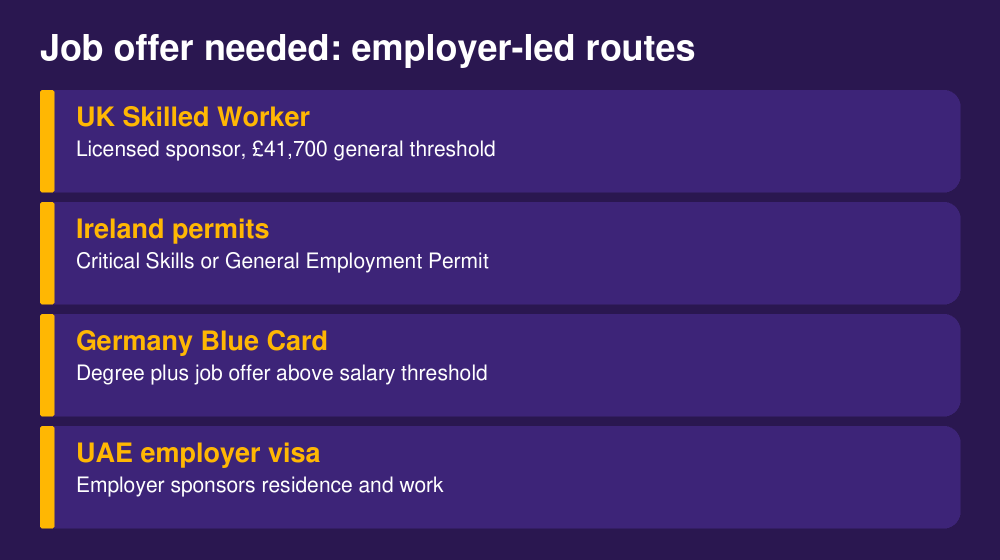
If you can get a job offer, the employer’s sponsorship often makes the visa itself straightforward. The UK Skilled Worker visa needs a licensed sponsor, a role at the required skill level and a salary that clears the general threshold of £41,700 or the occupation’s going rate. Our UK Skilled Worker Visa guide covers the steps. Ireland runs employment permits for critical-skills and general roles, Germany issues the EU Blue Card to graduates earning above a set salary, and the UAE ties residence to your employer. For a country-by-country comparison, read our guide to the best countries to move to for work.
A five-step plan
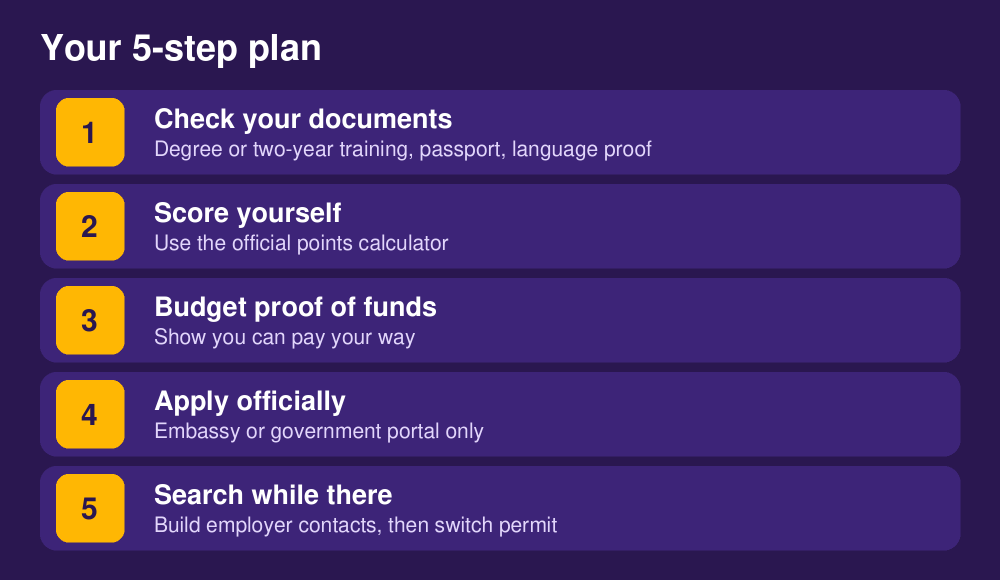
- Gather your documents. Degree or vocational certificate, passport, transcripts and language results.
- Score yourself honestly. Use the official points calculator, not an agent’s estimate.
- Plan the money. Proof of funds, visa fee, flights and the first months’ rent.
- Apply through official channels only. Embassy or government portals; ignore anyone who offers a “fast track”.
- Search while you are there. Use trial jobs, networking and LinkedIn, then change to a work permit.
Mistakes that cost Nigerians money
- Paying for a job offer. A genuine sponsor never charges you for it. Read our guide to job and recruitment scams.
- Applying to the wrong route. A Zoekjaar needs a qualifying university; the Opportunity Card needs recognised training.
- Underestimating funds. Refusals often follow thin proof of money.
- Ignoring recognition. Regulated professions such as medicine, nursing and engineering need formal recognition first.
For wider planning, see types of visas, visa-free countries for Nigerians and remote jobs that can build a record before you move.
Frequently asked questions
Can I get a work visa without a job offer?
Yes, on job-seeker routes such as Germany’s Opportunity Card, Austria’s job-seeker visa and the Dutch orientation year, but each has strict qualification tests.
Do I need a degree?
Not always. The German card accepts two years of recognised vocational training, but most routes favour degrees.
Is the UK the easiest?
Only if you already have a sponsored job offer. Without one, the UK has no general job-seeker work visa.
Bottom line
The easiest visa is the one whose published rules you already meet. For most Nigerian graduates that means checking the German Opportunity Card first, then employer-led routes if you can land an offer. Verify everything on official pages and never pay for a promise.
Which route fits which profile
- Recent graduate from a ranked university: the Dutch orientation year is worth checking first, because it lets you work freely for twelve months.
- Graduate or trained tradesperson with solid English: Germany’s Opportunity Card is the most open points-based route, with a low points bar of six.
- Highly qualified, long experience, strong language scores: Austria’s 70-point route can work, but only if you can document every point.
- Already interviewing with foreign employers: skip the job-seeker visas and ask the employer about sponsorship under the UK, Irish or German skilled routes.
The real cost of a “no job offer” visa
Job-seeker visas look cheap because the visa fee is small, but the true cost is your runway. You need proof of funds, a flight, housing deposits and several months of living costs while you search, and part-time work may only cover a fraction of that. A common mistake is arriving with just enough to pass the visa check and nothing to survive a slow job market. Plan for at least the full period of the permit, and keep an emergency return fund.
How to improve your chances before you apply
- Raise your language level. Extra points for German or stronger English can be the difference between rejection and approval.
- Get your degree verified early. Request any assessment or recognition your target country needs before you book anything else.
- Build a foreign-facing CV. Tailor it to the local format and show measurable results; see our LinkedIn guide.
- Contact employers while still in Nigeria. Video interviews often come before the move, and a conditional offer lets you switch to a sponsored permit.
- Keep every document. Contracts, payslips, certificates and references are checked closely.