


TL;DR:
- Citizen feedback in Nigeria helps bridge the information gap between government reports and community experiences. It improves public trust and accountability when feedback leads to visible and verifiable changes. Combining digital tools with face-to-face engagement creates more inclusive and effective communication channels.
Citizen feedback is the direct input from individuals that enables governments to identify service gaps, correct failures, and strengthen democratic accountability. In Nigeria, where public trust in government institutions remains fragile, the role of citizen feedback is not a theoretical concept. It is a practical tool that determines whether roads get fixed, schools get staffed, and hospitals stay stocked. When citizens speak and officials listen, governance improves. When that loop breaks, communities suffer the consequences in silence.
How does citizen feedback improve public service delivery?
Citizen feedback in governance works by closing the information gap between what officials report and what residents actually experience. Digital feedback loops improve credibility and constrain opportunistic official reporting. That matters in Nigeria, where inflated project completion reports and ghost worker payrolls have long distorted public sector performance data.

The mechanism is straightforward. When citizens report broken water pipes, delayed salary payments, or absent teachers, they generate real-time data that official audits often miss. That data forces a response. Digital citizen vigilance shifts accountability by incentivizing officials to manage their reputations through public responses to feedback. A local government chairman who ignores 500 documented complaints on a public platform faces a different kind of pressure than one who receives a private memo.
Public trust grows when feedback produces visible results. A study of 4,124 participants linked trust directly to verifiable outcomes and continuous engagement. That finding has a clear implication: one-off town halls do not build trust. Sustained, two-way communication does.
The benefits of community feedback extend beyond individual complaints:
- Improved decision-making: Officials gain ground-level data that budget reports cannot capture.
- Reduced corruption: Public feedback creates external oversight that internal audits miss.
- Better resource allocation: Communities that report needs consistently receive more targeted interventions.
- Stronger legitimacy: Governments that respond to feedback are perceived as more credible and worth engaging.
Pro Tip: Document your feedback with dates, photos, and specific locations. Vague complaints get filed away. Specific, evidence-backed reports demand a response.
What are the main challenges to meaningful feedback in Nigeria?
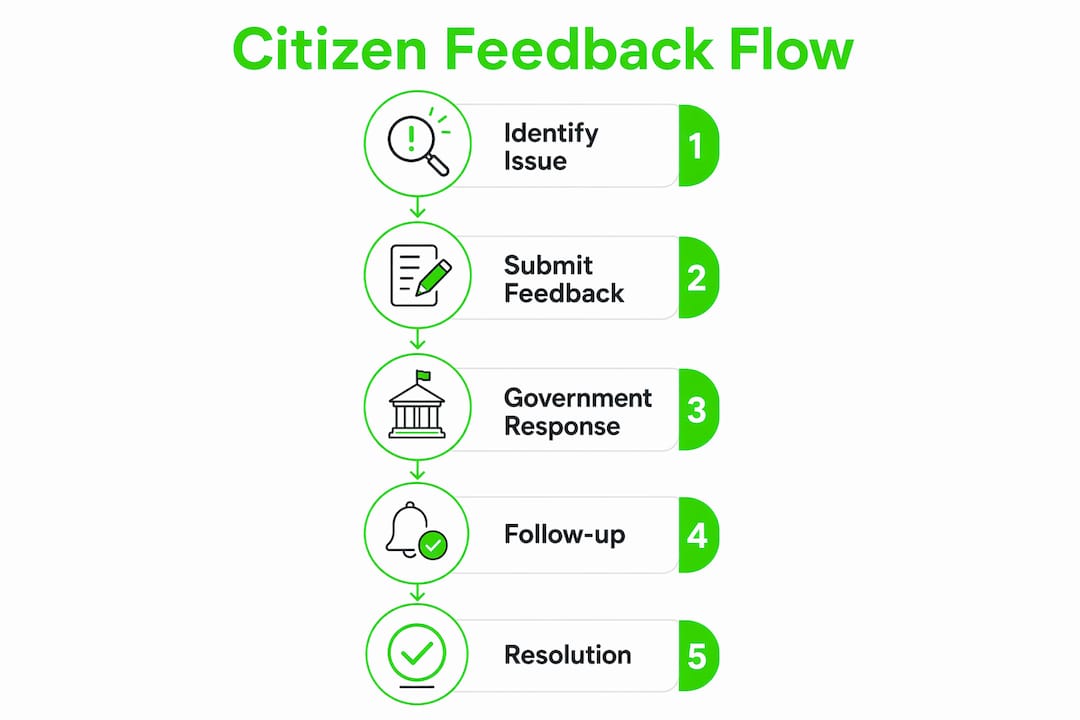
The barriers to effective citizen feedback in Nigeria are real and well-documented. Over 50% of surveyed urban residents had never engaged with complaint redress systems, citing low awareness and doubts about whether the system works. That statistic reflects a trust deficit, not a lack of opinion.
Several specific barriers limit the impact of public input in Nigerian communities:
- Limited access to information: Many citizens do not know which agency handles which complaint, or how to submit one formally.
- Technological exclusion: Digital feedback portals assume smartphone access and internet literacy that millions of Nigerians do not have.
- Symbolic participation: Citizen participation efforts often fail because government follow-up is weak, leaving citizens feeling their input was decorative rather than consequential.
- Participatory fatigue: When feedback produces no visible change, citizens stop providing it. This creates a cycle where disengagement validates official inaction.
The exclusion problem runs deeper than internet access. Over half the urban poor rely on offline and intermediary-based complaint mechanisms because technology-enabled systems do not reach them. In Lagos slums, Kano markets, and rural Benue communities, the most affected citizens are often the least able to use the platforms designed to help them.
Evaluating citizen feedback systems in Nigeria requires honest acknowledgment of these gaps. A platform that collects 10,000 complaints and resolves 50 does not represent success. It represents a broken feedback loop that will eventually collapse under the weight of its own irrelevance.
Pro Tip: If digital platforms are inaccessible to you, community-based organizations and ward-level civic groups often serve as intermediaries who can escalate your complaint through formal channels.
Which citizen feedback methods work best for Nigerian communities?
No single method works for every Nigerian community. The most effective approach combines digital tools with face-to-face engagement, because hybrid feedback systems combining digital and offline methods improve both inclusiveness and sustained engagement.
The table below compares the main feedback methods available to Nigerian citizens:
| Method | Accessibility | Effectiveness | Inclusiveness |
|---|---|---|---|
| Digital portals and apps | Medium (requires internet) | High when monitored | Low for rural and low-income users |
| Traditional complaint desks | High (walk-in) | Medium | High |
| Community town halls | High | Medium to high | High |
| Social media reporting | Medium | High (public pressure) | Medium |
| Citizen monitoring groups | Medium | High (collective voice) | High when well-organized |
Digital platforms like social media have proven effective at generating public pressure in Nigeria. The #EndSARS movement in 2020 demonstrated how aggregated citizen voices on Twitter and WhatsApp could force a national policy response. That example also shows the limits of digital-only approaches: the movement produced immediate policy announcements but inconsistent follow-through, partly because the feedback loop lacked formal institutional channels.
Traditional complaint desks at local government offices remain the most accessible option for citizens without reliable internet. Their weakness is response time and documentation. Complaints submitted verbally often disappear without a reference number or follow-up mechanism.
Community town halls, when structured properly, offer the best combination of accessibility and accountability. They allow citizens to speak directly to officials, create public records of commitments, and build the kind of face-to-face relationships that sustain civic engagement over time. The role of digital journalism in amplifying what happens at these town halls has grown significantly, extending their reach beyond the room.
Pro Tip: When attending a town hall or submitting a complaint, bring written documentation and request a reference number. An untracked complaint is an invisible complaint.
How can Nigerian citizens ensure feedback leads to real change?
Feedback that produces change follows a specific pattern. It is specific, evidence-backed, persistent, and delivered through channels that create accountability. Citizen feedback framed as data-backed evidence rather than vague complaints is taken more seriously and demands official response.
Follow these steps to make your feedback count:
- Be specific. Name the location, the date, the agency responsible, and the exact problem. “The Agege-Ogba road has had an unfilled pothole at the Iyana-Ipaja junction since january 2026” is actionable. “The roads are bad” is not.
- Gather evidence. Photos, videos, and written records transform personal complaints into verifiable data. Officials cannot dismiss what they cannot deny.
- Use multiple channels. Submit the same complaint to the relevant agency, your ward councillor, and a public platform. Parallel submissions increase the chance of a response.
- Follow up consistently. One complaint rarely produces change. Repeated, documented follow-ups create a paper trail that is harder to ignore.
- Collaborate with others. Collective feedback from a community group carries more weight than individual submissions. Digital communities have shown how organized citizen voices can shift government priorities.
On the government side, emotional intelligence and active listening by officials are critical for turning feedback into governance improvements. Civil servants who treat citizen critique as an attack rather than information will always underperform those who treat it as data. The “Listening State” model requires officials to accept, process, and act on what citizens report.
Meaningful participation involves two-way communication, verifiable results, and continuity. Without those three elements, citizen engagement becomes a performance rather than a process.
Pro Tip: Track your submissions in a personal log with dates and reference numbers. If an agency fails to respond within its stated timeframe, that record becomes your evidence for escalation.
Key Takeaways
Citizen feedback is most effective when it is specific, evidence-backed, submitted through multiple channels, and followed up consistently by both citizens and accountable officials.
| Point | Details |
|---|---|
| Feedback closes information gaps | Citizens report ground-level realities that official audits and budget reports routinely miss. |
| Trust requires visible results | Public trust grows only when feedback produces verifiable outcomes, not just acknowledgment. |
| Hybrid methods reach more people | Combining digital platforms with offline town halls and complaint desks improves inclusiveness. |
| Vague complaints get ignored | Specific, evidence-backed feedback with dates and locations demands a formal response. |
| Collective voices carry more weight | Organized community groups produce stronger accountability pressure than individual submissions. |
Naijatipsland’s take on citizen feedback and Nigerian governance
The most honest observation about citizen feedback in Nigeria is this: the problem is rarely that citizens have nothing to say. The problem is that the systems designed to receive their voices were never built to act on them.
Naijatipsland has watched this pattern repeat across local government areas, federal agencies, and state ministries. Citizens show up to town halls, fill out forms, and post complaints online. Officials acknowledge receipt. Nothing changes. Citizens disengage. Officials interpret the silence as satisfaction. The cycle continues.
What breaks that cycle is not a better app or a new feedback portal. It is a culture shift on both sides. Citizens need to treat feedback as a civic responsibility, not a one-time act of frustration. Officials need to treat citizen input as performance data, not a political threat. The traditional media and digital platforms that amplify these exchanges play a real role in keeping both sides honest.
The communities in Nigeria that have seen genuine governance improvements share one trait: they did not stop after the first ignored complaint. They documented, organized, escalated, and made their feedback impossible to dismiss. That persistence is not a workaround. It is the actual mechanism of democratic accountability.
— Naijatipsland
Stay informed and engaged with Naijatipsland
Naijatipsland is built for Nigerian citizens who want more than headlines. The platform gives you a space to discuss governance issues, share community experiences, and stay connected to the civic conversations shaping your city and state.
Naijatipsland recently covered the DevReporting urban journalism project, which selected eight journalists to report on urban governance challenges in Lagos. That project is exactly the kind of citizen-centered reporting that turns community feedback into public record. Explore the platform, submit your perspective, and add your voice to the conversation. Your input matters more than you think.
FAQ
What is citizen feedback in governance?
Citizen feedback in governance is the direct input from residents about public services, policies, and government performance. It gives officials real-time data to improve decision-making and service delivery.
Why is citizen feedback important in Nigeria?
Citizen feedback reduces information gaps between what officials report and what communities experience. It also builds public trust when governments respond with visible, verifiable improvements.
What stops Nigerians from giving feedback to the government?
Low awareness of complaint systems, doubts about effectiveness, and limited internet access are the main barriers. Over 50% of urban residents have never used a formal complaint redress system.
Which feedback method works best for Nigerian communities?
Hybrid methods combining digital platforms with offline community dialogues work best. They reach more citizens, including those without reliable internet access, and produce more sustained engagement.
How do citizens make sure their feedback gets a response?
Frame feedback as specific, evidence-backed data with dates, locations, and documentation. Collective, measurable complaints are significantly harder for officials to ignore than vague individual grievances.