


TL;DR:
- Monitoring key macroeconomic indicators helps Nigerians anticipate changes that impact their finances and business plans. Tracking domestic and global signals regularly enables timely adjustments, reducing financial shocks and enhancing resilience. Using a tiered system of daily, weekly, and monthly reviews keeps decisions informed and proactive without overload.
Economic trend monitoring is the practice of tracking key macroeconomic indicators, including GDP, inflation, unemployment, and central bank signals, to understand how the economy is performing and where it is headed. For Nigerians managing household budgets, running small businesses, or making investment decisions, knowing why monitor economic trends matters is the difference between reacting to financial shocks and preparing for them. The World Economic Forum and PIMCO both frame this practice as fundamental to sound financial planning. In Nigeria’s volatile economic environment, where inflation and foreign exchange pressures shift rapidly, monitoring these trends gives you a measurable edge.
Why monitor economic trends: the core case
Monitoring economic trends helps you make personal finance decisions because key macroeconomic indicators directly change expectations for growth, inflation, and interest rates that affect your purchasing power, savings returns, and borrowing costs. This is not abstract analysis reserved for economists. It is the data that determines whether your salary keeps pace with prices, whether your loan repayment becomes unaffordable, and whether your business revenue holds up.

The importance of economic trends becomes clearest when you connect each indicator to a real financial outcome. When the Central Bank of Nigeria raises its Monetary Policy Rate (MPR), commercial bank lending rates follow. That means your mortgage, business loan, or personal credit line gets more expensive. When GDP growth slows, employment contracts, and consumer spending falls. Each of these shifts is measurable before it hits your wallet, if you know what to watch.
Nigeria’s economic context amplifies this need. The naira’s sensitivity to oil revenues, the country’s dependence on food imports, and the Central Bank of Nigeria’s frequent policy adjustments all create a financial environment where economic data moves fast and the consequences of ignoring it are severe. Tracking these signals is not optional for anyone serious about financial resilience.
What economic indicators matter most and how to read them
Economic indicators fall into two categories: leading indicators, which signal future economic direction, and lagging indicators, which confirm what has already happened. Leading indicators like consumer sentiment and inflation expectations move ahead of broader economic activity, providing early warnings. Lagging indicators like unemployment and realized inflation confirm past conditions. Understanding this distinction is the foundation of useful economic analysis.
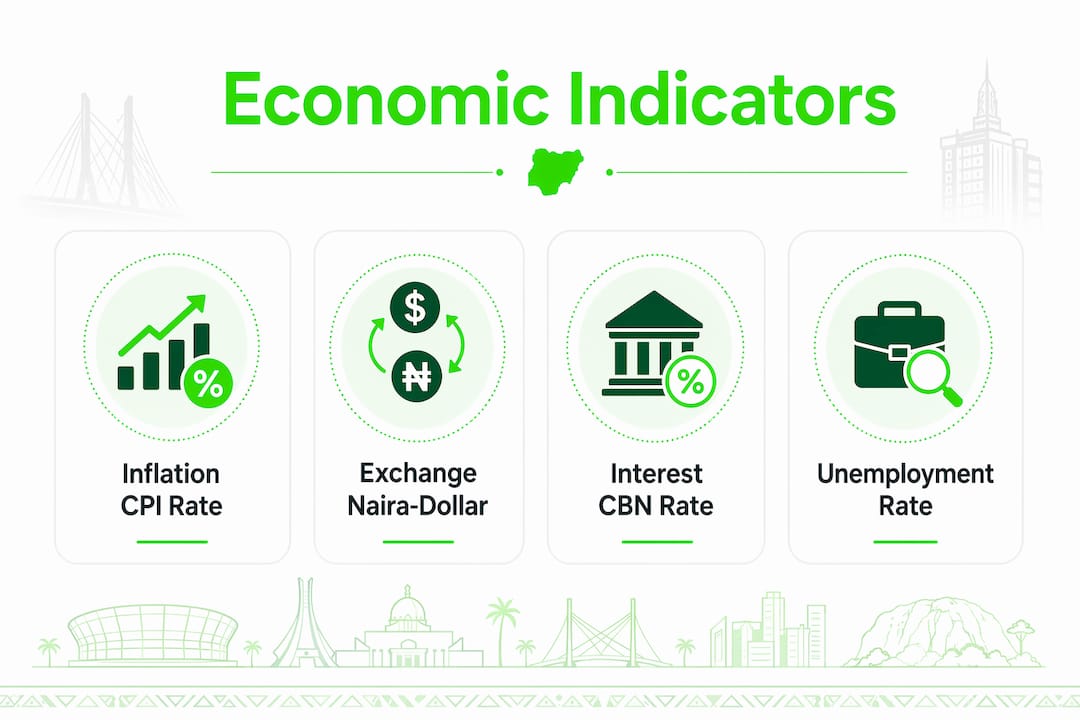
Here are the core indicators every Nigerian should track:
- GDP growth rate: Measures total economic output. Rising GDP signals expanding employment and business activity. Falling GDP warns of contraction and reduced consumer spending power.
- Inflation rate (CPI): Tracks the price of a basket of goods and services. Nigeria’s inflation trends directly erode the real value of your savings and raise the cost of everyday purchases.
- Unemployment rate: A lagging indicator that confirms economic health after the fact. Rising unemployment signals reduced household income and weaker consumer demand across sectors.
- Central Bank of Nigeria MPR: The benchmark interest rate that sets the floor for borrowing costs. When the MPR rises, credit becomes more expensive for individuals and businesses alike.
- Foreign exchange rate: The naira’s value against the dollar determines import costs, which feed directly into domestic inflation for food, fuel, and manufactured goods.
Pro Tip: Do not track these indicators in isolation. The real signal comes from how they move together. Rising inflation alongside a weakening naira and a rising MPR tells a very specific story about tightening financial conditions that should prompt you to review your debt exposure immediately.
Why leading indicators are critical for timing your decisions
Leading indicators are the most useful tools for anticipating economic shifts before they affect your finances. Separating leading from lagging indicators improves strategic foresight and timely decision-making, especially in volatile markets like Nigeria. The practical value is this: if you wait for lagging indicators to confirm a downturn, you have already lost the window to adjust.
Consider how this works in sequence:
- Consumer sentiment falls. Households report lower confidence in their financial outlook. This is a leading signal that spending will contract.
- Inflation expectations rise. Businesses and consumers anticipate higher prices and begin adjusting behavior, which itself accelerates inflation.
- Central bank tightens policy. The MPR increases in response to rising inflation expectations, making borrowing more expensive.
- Unemployment rises. Businesses cut costs in response to lower demand and higher financing costs. This is the lagging confirmation that a downturn has arrived.
“Tracking leading indicators is less about precise prediction and more about continuously updating your risk expectations in a dynamic environment.” — World Economic Forum Chief Economists Outlook, May 2026
For Nigerians, the most relevant leading indicators include the naira’s forward exchange rate, fuel pump price movements, and the Central Bank of Nigeria’s policy statements. These signals routinely precede broader economic shifts by weeks or months, giving you time to act.
How global shocks hit Nigeria’s economy and your finances
Global inflation is expected to rise in 2026, driven by energy and food price volatility, with 94% of surveyed chief economists agreeing on this direction. For Nigeria, that consensus translates directly into higher import costs, naira depreciation pressure, and domestic price increases across food, fuel, and manufactured goods. The impact is not distant or theoretical. It lands in your grocery bill and your business’s input costs.
| Global shock | Transmission channel | Nigeria impact |
|---|---|---|
| Energy price spike | Higher fuel import costs | Fuel subsidy pressure, transport inflation |
| Food price volatility | Higher import costs for wheat, rice | Consumer price increases, food insecurity |
| Geopolitical conflict | Supply chain disruption | Input cost rises for manufacturers and SMEs |
| Dollar strengthening | Naira depreciation | Higher cost of imported goods and services |
Supply shocks from Middle East conflict are expected to approach COVID-19 levels if tensions persist, creating inflation and growth uncertainty that Nigeria’s import-dependent economy absorbs directly. This is why monitoring global economic trends is as important as watching domestic data. Nigeria’s economy does not operate in isolation, and neither should your financial planning.
Pro Tip: Set a Google Alert for “Nigeria inflation” and “CBN policy rate” to receive real-time updates without having to check multiple sources daily. Pair this with a monthly review of the World Economic Forum’s chief economists outlook for the global picture.
How to track economic trends and build your own dashboard
Building a macroeconomic dashboard that combines GDP, inflation, employment, central bank signals, and currency moves, updated across daily, weekly, and monthly timeframes, is the most effective method for staying ahead of economic shifts in Nigeria. The goal is not to become an economist. The goal is to have a structured system that tells you when conditions are changing and what that means for your specific financial situation.
Here is how to build a practical monitoring system:
- Daily: Check the naira to dollar exchange rate on the FMDQ platform or your bank’s rate board. Note any Central Bank of Nigeria announcements or policy statements.
- Weekly: Review fuel pump prices, food market prices in your area, and any major government fiscal announcements. Check trading indicator guides for context on how global markets are reading Nigerian and emerging market signals.
- Monthly: Pull the National Bureau of Statistics (NBS) CPI report, the CBN’s latest MPR decision, and Nigeria’s GDP growth figures when available. Compare these to your previous month’s data to identify direction.
- Quarterly: Review the World Economic Forum’s chief economists outlook and the IMF’s World Economic Outlook for the global context that shapes Nigeria’s external environment.
A two-horizon monitoring habit that separates short-term weekly signals from long-term monthly trends helps you avoid both overreacting to daily noise and missing structural shifts that build over months. The NBS, CBN, and World Bank Nigeria pages are free, reliable, and updated regularly. You do not need a Bloomberg terminal to stay informed.
How economic monitoring shapes personal finance, investments, and business strategy
Pairing macro data with customer and demand data helps businesses avoid relying solely on optimism or past sales figures, which is the most common planning mistake Nigerian SMEs make. The same principle applies to personal finance. Macro data tells you the direction of the environment you are operating in. Your personal data tells you how exposed you are.
Here is how to apply economic trend analysis directly to your decisions:
- Inflation rising: Accelerate debt repayment on variable-rate loans before interest rates increase further. Reduce cash holdings in naira and consider inflation-linked assets or dollar-denominated savings.
- MPR increasing: Delay taking new loans if possible. Review existing variable-rate debt and calculate the cost of refinancing at a fixed rate.
- Naira depreciating: If your business imports inputs, lock in forward contracts or build up dollar reserves. If you are a consumer, reduce exposure to imported goods in your budget.
- GDP growth slowing: Businesses should tighten inventory, reduce discretionary spending, and focus on customer retention over acquisition. Individuals should build emergency savings before conditions worsen.
- Employment data weakening: For business owners, this signals reduced consumer spending ahead. Adjust revenue forecasts downward and review your cost structure before the demand drop arrives.
Fidelity Investments research confirms that watching multiple economic signals, including earnings, labor stability, and investment flows, reduces decision mistakes that come from reacting to headline anxiety alone. Nigeria’s economic resilience strategies require exactly this kind of multi-signal discipline.
Key takeaways
Monitoring economic trends is the single most practical financial habit Nigerians can build to protect purchasing power, time investments, and adapt business strategies before conditions deteriorate.
| Point | Details |
|---|---|
| Lead with leading indicators | Track consumer sentiment and inflation expectations before they become realized economic pain. |
| Map global shocks to local impact | Energy and food price volatility abroad translates directly into naira pressure and domestic inflation. |
| Build a tiered dashboard | Use daily, weekly, and monthly data reviews to separate immediate signals from structural trends. |
| Connect data to decisions | Link each indicator to a specific financial action: inflation to debt repayment, MPR to loan timing. |
| Use free Nigerian data sources | NBS, CBN, and World Bank Nigeria pages provide reliable, regularly updated macroeconomic data at no cost. |
Naijatipsland’s perspective on economic monitoring in Nigeria
Most Nigerians I speak with know that the economy is difficult. Fewer have a system for tracking exactly how difficult it is getting and what to do about it. The most common mistake is waiting for the news to tell you that inflation has risen or the naira has fallen before adjusting your financial behavior. By that point, the adjustment window has already closed.
What I have found genuinely useful is treating economic data the way you treat weather forecasts. You do not need to understand atmospheric physics to decide whether to carry an umbrella. You need a reliable source, a regular check-in habit, and a clear link between the forecast and your behavior. The same applies here. You do not need a finance degree to act on a rising MPR or a falling naira. You need to know what those signals mean for your specific situation and have a plan ready.
The other mistake worth naming is data paralysis. Some people start tracking economic indicators and become so focused on the complexity that they stop making decisions at all. The discipline is not about certainty. It is about reducing the range of surprises. Nigeria’s economic environment in 2026 rewards those who update their expectations regularly and act on the direction of change, not those who wait for perfect information.
— Naijatipsland
Stay informed with Naijatipsland
Naijatipsland covers Nigerian economic news, current affairs analysis, and market developments in a format built for everyday readers, not financial professionals.
Whether you are tracking Nigeria’s latest inflation figures, following CBN policy decisions, or trying to understand how global energy prices affect your household budget, Naijatipsland brings you timely, relevant updates. Explore our current affairs coverage to build the habit of staying informed, and check our trending news explainer to understand why following economic and current affairs stories is one of the most practical things you can do for your financial future.
FAQ
Why should Nigerians monitor economic trends?
Monitoring economic trends gives you advance warning of changes in inflation, borrowing costs, and exchange rates that directly affect your budget, savings, and business revenue. Acting on early signals protects you from financial shocks that reactive decision-making cannot prevent.
What are the most important economic indicators to track in Nigeria?
The most critical indicators are the CPI inflation rate, the CBN Monetary Policy Rate, the naira to dollar exchange rate, GDP growth, and unemployment data from the National Bureau of Statistics. Together, these five metrics give a complete picture of economic direction.
What is the difference between leading and lagging economic indicators?
Leading indicators like consumer sentiment and inflation expectations move before the broader economy shifts, providing early warnings. Lagging indicators like unemployment and realized inflation confirm what has already happened.
How do global economic shocks affect Nigeria specifically?
Global energy and food price volatility transmits into Nigeria through higher import costs, naira depreciation, and domestic inflation. Nigeria’s dependence on fuel imports and food commodities makes it especially sensitive to international supply disruptions.
How often should you review economic data?
A tiered monitoring schedule works best: check exchange rates and CBN announcements daily, review CPI and fuel prices weekly, and analyze GDP and employment data monthly. This cadence keeps you informed without creating information overload.